Housing

Assembly votes down new ‘safety zone’ around Juneau’s homeless shelter — for now

Assembly member Wade Bryson speaks during a committee meeting on Monday, Aug. 4, 2025. (Photo by Clarise Larson/KTOO)

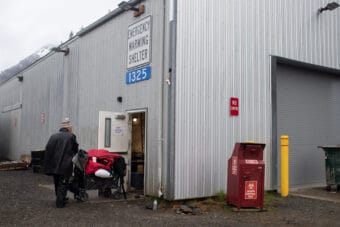
Juneau Assembly members have rejected a plan to create a shelter safety zone with tightened restrictions on camping in the area around the Glory Hall homeless shelter in the Mendenhall Valley.

The narrow vote came during a committee meeting on Monday night, but members may reconsider the proposal in September. 

The city outlined a loose plan for the zone after staff, patrons and neighbors of the shelter asked the Assembly to take action to protect the Teal Street area. They say it has become unsafe because of threats from some unhoused people camping in the vicinity

The topic generated a lot of tension at the meeting. That was between Assembly members who supported what they saw as a public safety measure and those who saw it as a stopgap solution for the larger issue of homelessness in Juneau. 

Assembly member Wade Bryson voted in favor of the plan. He argued the Assembly’s inaction is putting people’s safety at risk. 

“We haven’t protected the patrons. We haven’t protected the staff. And we’re not talking about allowing people to camp near this property. That’s not really what the issue is,” he said. “We’re talking about protecting those very vulnerable, the most vulnerable of us, from the predators of our community.”

City leaders say the shelter safety zone is intended to increase protection for staff and people using the shelter’s services. It would likely make the rules for camping or loitering in public spaces stricter in the zone than they are citywide.

The City of Bellingham, Washington, created a protection zone surrounding a shelter last year following similar safety concerns. It added harsher restrictions on camping or loitering in the zone.

Some Assembly members who voted against the zone said they worried it would unlawfully target unhoused people and could open the door for possible lawsuits. Assembly member Neil Steininger argued it wouldn’t solve any issues, but merely move them somewhere else. 

“I just can’t see how it takes us forward as a community on this issue, more than just whack-a-mole on the next piece of the problem, without actually trying to address anything beyond one symptom of a much broader, much more difficult issue,” he said. 

Assembly members asked the city to look into other potential safety measures, like hiring private security to patrol the area or establishing a city-sanctioned summer shelter.

Juneau opens up application for $2.5M in affordable housing funding

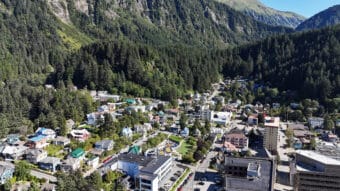
Downtown Juneau on Wednesday, March 26, 2025. (Photo by Clarise Larson/KTOO)

Juneau is inviting developers, nonprofits and tribal governments to apply for grants or loans from its affordable housing fund.

The city created the fund five years ago to address the city’s lack of housing — specifically, low and middle-income rentals. There is $2.5 million available in the fund this year. The application period opened last week and runs through Aug. 22. 

“Things are getting more challenging with the landscape for housing on the federal level,” said Joseph Meyers, the city’s housing and land use specialist. “I’m really hopeful that we get a lot of people applying for these funds, and get more units on the grounds.”

The city then uses criteria like proximity to public transportation and long-term affordability to decide which projects get funding and how much.  

The city has awarded nearly $13 million in grants or loans from the fund since its establishment. But not all projects funded in the past have been required to offer affordable units. In 2022, the Juneau Assembly approved a $1.2 million loan from the fund for a development called Ridgeview. 

The Assembly initially approved the loan for the project with an affordability requirement, but later stripped those requirements after input from city leadership. The developer listed the units as condos available for purchase at market price to the dismay of many Juneau residents. Some testified at public meetings and others posted hundreds of comments on social media. 

Meyers said since then, the Assembly has required affordability for projects approved to receive funding. 

“If the application doesn’t meet that requirement, they’d have to go back to the drawing board,” he said. “We really do want to focus on providing some affordability, at least with all these projects.”

The application period closes on Aug. 22. Then, a committee will review them and make recommendations to the Assembly for final approval. 

Klukwan wants to build more housing. Intensifying landslide risk is getting in the way.

Chilkat Indian Village environmental staff and outside researchers stand on the 23 mile slide area during a site visit in June.
Chilkat Indian Village environmental staff and outside researchers stand on the 23 mile slide area during a site visit in June. (Avery Ellfeldt/KHNS)

Decades ago in the Chilkat Valley, heavy rains would spark mudflows that tumbled down the Takshanuk Mountains, over an international highway and into the Native village of Klukwan.

Dan Hotch remembers it well. The slides in the late twentieth century that flooded and damaged buildings would routinely deposit a slurry of rocks and mud under his family’s home.

“Growing up as a kid, we hated August and September weather because we knew the rains were coming, and we knew the water was coming down. And there was no way to really stop it,” said Hotch, who is now an environmental specialist with the Chilkat Indian Village.

Then, about 25 years ago, a community member built a berm high in the foothills to divert the debris down another slide path and away from the village.

For decades, it worked. But now that’s starting to change. As the slide path evolves and sediment builds up, rocks and mud have started surging out of that channel – and heading in a concerning direction.

“That migration has caused it to start to point debris flows more towards the village again,” said Josh Roering, an Oregon-based geologist researching geohazards across Southeast Alaska.

The situation has major implications for the village’s safety – and long-term future.

The tribe wants to build more housing not only for current residents, which the 2020 census put at 87 people, but also to make it possible for tribal members who don’t live in the village to move there.

But that’s complicated by the fact that Klukwan is sandwiched between two geohazards that are intensifying with climate change: to the east, landslides from the Takshanuks, and to the west, erosion and flooding from the Chilkat and Tsirku Rivers.

Dan Hotch swaps the SD card out of a infrasound sensor that’s monitoring wind, rain, rockfall and more as part of a regional geohazard research initiative. (Avery Ellfeldt/KHNS)

“With these extreme high temps in the summers, and then the atmospheric rivers in the fall and winters, a lot more flooding is happening here,” said Jess Kayser Forster, who has consulted for the Chilkat Indian Village on environmental issues for more than a decade.

That means the village has two options for development: further north, up the valley, or east, across the highway and into the foothills — which would mean building in areas with intensifying landslide risk.

In response, the tribe has joined a region-wide research project to better understand the threat and develop accordingly.

“It’s kind of hard to expand this way if we wanted to, knowing the fact that (mudflows) could come and take out everything that you’re trying to do,” Hotch said.

Studying the risk 

It’s an issue playing out across the region, state, country and world. Communities are expanding into wilderness at the same time as rising temperatures are fueling less predictable and more severe wildfires, floods and landslides.

That has triggered a global reckoning over how to model extreme weather, protect communities and develop new ones without putting more people in harm’s way. 

“You can see it all over Southeast Alaska, my home included,” Kayser Forster said. “We’re all built in these areas where these hazards are.”

That reality is top of mind in Klukwan. In 2018, the tribal council kicked off a climate resilience planning process. Then, in 2020, an atmospheric river triggered a devastating landslide that killed two community members in Haines.

The 2020 Beach Road landslide, pictured above in June 2025. (Avery Ellfeldt/KHNS)

“We realized that we were underprepared if an event like that were to happen in Klukwan. It highlighted a lot of our needs, and a lot of our risks. But it also highlighted the community’s desire to build those capacities,” said Shawna Hotch, who serves as the tribal liaison for Klukwan’s Tribal Emergency Operations Center.

By 2022, the village had joined a regional research project that aims to help tribal governments to do just that.

The effort is called the Ḵutí Project, which means “weather” in Tlingit. The project, which is run out of the Sitka Sound Science Center using a five-year federal grant, is fueling research in Klukwan, Skagway, Hoonah, Yakutat, Craig and Kasaan.

The main goal is to ensure communities have the data and tools they need to grapple with – and prepare for – weather events that are typically sparked by heavy rains. Roering, the University of Oregon-based researcher, emphasized that the geography, geology and risk are unique in each community. That means on-the-ground research is, too.

Planning for the future in a changing landscape

Klukwan, for its part, sits in the shadow of fractured cliffs further weakened by rain, frost and snow that are crumbling into a catchment below. During heavy rains, water and gravity carry the material downhill.

“When the debris flows get too big to stay in the current channel, they’ll do what’s called an avulsion,” Roering said. “That means they basically jump out of the banks, go over the banks, and follow a new path.”

The village of Klukwan sits alongside the Takshanuk Mountains, north of Haines. (Avery Ellfeldt/KHNS)

Particularly interesting is that state geologists have recently discovered permafrosthigh up on those mountains. Roering said it’s too soon to say whether melting permafrost – another climate impact – could be contributing to instability. But research in other parts of the world suggests it’s possible.

Studying and addressing those processes has taken several forms. First, the project is funding the installation of a brand-new weather station, to ensure more accurate local forecasting.

The project has also funded lidar collection and analysis, which provides insight into existing slidepaths and how they’re changing. Finally, it made possible the installation of cameras and sensors high up in the mountains.

On a recent field visit to Klukwan, Roering walked through a dense patch of forest, and pointed them out.

“These are called infrasound sensors,” he said. “They’re recording things that we are not hearing but are happening in the environment.

Think: wind, rain and rockfall. That data, combined with camera footage, provides crucial context about what triggers rockfalls and mudflows, and when those flows are more likely to avulse out of the main channel – and potentially surge toward the village.

For now, Roering said the goal is to develop a baseline of what exactly is happening on the hillside, and why. But even that is complicated.

“This is going to be a long term project,” Roering said. “That channel is going to keep changing, regardless of a berm that gets built next summer, or the summer after.”

Even so, the tribe will ideally be able to use the information for a few purposes. First, planning new berms to divert the slides away from the village, and supporting grant applications to fund the work.

And second is safe community development. Hotch, of the tribe’s environmental staff, said that could encourage tribal members to move home. He himself moved back to Klukwan about a decade ago after spending years in Oregon, first for boarding school and later for work.

“It’s great to be home,” he said. “We need more people back at home.”

City proposes code change to make it easier to arrest people without housing in Juneau

Tents line the sidewalks along Teal Street in Mendenhall Valley on Tuesday, May 27, 2025. (Photo by Clarise Larson/KTOO)

The Juneau Assembly is considering changing city code to make it easier for police officers to arrest people without housing who are camping in public spaces. 

At a committee of the whole meeting on Monday night, Assembly members advanced a proposed plan to change the city’s disorderly conduct code.

The discussion on the proposed policy changes comes as city leaders say they’ve received a growing number of complaints from residents and businesses about the problems that people without housing are causing for surrounding neighborhoods where they camp. 

“This would give our officers a tool that they could quickly deploy when they’re seeking to address camping impacts on public paths, sidewalks, rights of way, garages, bus stops, those sorts of areas,” said Deputy City Manager Robert Barr at the meeting. 

That tool is arresting people. 

The changes would make it easier for Juneau Police Department officers to arrest people who are obstructing public spaces by camping. 

The proposed disorderly conduct code change would add standing, walking or camping to the list of actions that could prompt an arrest if someone is blocking public areas. It also adds public paths, parking lots and garages and stairwells to the list of locations it applies to.

Barr said that right now, arresting people without housing in these specific situations is complicated. Most of the time, officers arrest people for trespassing instead of disorderly conduct. But that requires additional steps.

“It is simply more challenging, takes more time, is more burdensome,” he said. 

Barr said the amendments would essentially get rid of some of those hurdles to arrest people.

Assembly Members also moved forward with a plan to draft an ordinance to establish a “shelter safety zone” surrounding the Teal Street neighborhood and Juneau’s Glory Hall homeless shelter after repeated reports of staff being threatened on the site.

But the proposed ordinance is still very preliminary. Details like the potential boundary of the area and what protections would be in place have not yet been decided. 

Assembly member Ella Adkison reluctantly agreed to move forward with the changes, but said they’re merely a stopgap for a larger issue.

“It’s not going to make the core of the issue any better.  I do not think it will in any way help our unhoused population,” she said. “What I see the use for this is to make it a little easier for our police department to do something they’re already doing.”

Last year, the U.S. Supreme Court ruled that cities can ban people from sleeping and camping in public places. Right now, Juneau city policy allows for dispersed camping but prohibits it on places like sidewalks or roads. In general, the city allows people to camp on unimproved public land as long as they keep their impact low on the surrounding community. 

However, Assembly member Wade Bryson said he thinks the city’s current status quo is not working and it’s putting people at risk. He said the Assembly needs to take action.  

“The sooner we get tough on this situation, the sooner we crack down or the sooner we say this is how you have to behave in our community, the sooner we will have less of these problems,” he said. 

Assembly members also briefly discussed reestablishing a summer campground designated for people without housing, like the one the city closed last year, but that idea didn’t move forward. The city closed the campground after an increase in reported illegal activities and complaints from the surrounding neighborhoods. 

Assembly members will take public testimony and vote on the proposed code changes at a regular meeting later this summer.

Homeowners along Mendenhall River may pay less in property taxes following annual flooding

Home in the Mendenhall Valley on Wednesday, April 2, 2025. (Photo by Clarise Larson/KTOO)

Property tax bills are starting to arrive in Juneau residents’ mailboxes this week.

Last month, the Juneau Assembly passed a municipal budget that increased the property tax rate. Property tax bills for most Juneau residents are expected to go up – but not for everyone. 

The average residential property value rose by less than 1% this year. But many homes in  Mendenhall Valley near the river saw a decline in their assessed values after last August’s glacial outburst flood. 

City Finance Director Angie Flick said assessed homes near the Mendenhall River saw a roughly 20% drop in value. 

“We would anticipate that those homes in those areas would sell for a lesser value because of the risk of flooding, just because they experienced it last year,” she said.  

Property tax bills are calculated by multiplying the mill rate by a property’s value. The Assembly voted to increase the property tax rate, but it’s not enough to pay for city spending next year. That means the city will dip into savings to fill the gap.

Flick said bills can vary from property owner to property owner for a variety of reasons, like the location. 

“There’s always pockets of communities that have more drastic changes — it’s the beauty of the law of averages,” she said. “But in general, they should be pretty close to last year, probably slightly higher.”

Although the average property assessment went up only slightly this year, high housing costs continue to be a barrier to homeownership in Juneau.

According to a study by the Alaska Department of Labor and Workforce Development, Juneau has had the highest average sale price for a single-family home in the state for the past two years. 

The deadline to petition an assessment passed earlier this spring. Property tax bills must be received or postmarked to the city on or before Sept. 30.

Police clear homeless encampment in Juneau amid safety concerns

Tents line the sidewalks along Teal Street in the Mendenhall Valley on Monday, June 16, 2025. (Photo by Clarise Larson/KTOO)

The Juneau Police Department cleared a homeless encampment on the side of a Mendenhall Valley road Tuesday morning. That’s after the department gave people living there a notice to vacate the area last week. 

On Monday, a row of tents sat across the street from Juneau’s Glory Hall homeless shelter. People living there were packing up their belongings and waiting for police to arrive and tell them to leave. 

Monika Jay Escajeda was about to pitch her tent when she heard police would dismantle the camp. She said she thinks there needs to be a place for her and others to go. 

“If they don’t have a place, I don’t feel like they should be like, ‘Well, you guys can’t pitch a tent,’” she said. 

City officials decided to clear the encampment in response to safety concerns. But police and city officials say they’re looking for better solutions as camp residents seek a new place to stay. 

Escajeda is from Juneau, but she said she’s run out of places to go next. She’s considering going back to Seattle, where she used to live. She heard many of her friends don’t know what they will do, either. She said she wished she could bring them with her.

“It’s sad to be honest,” she said. “If I was able or capable, I think I would want to snatch and take everybody that I could. But I’m trying to figure it out.”

Juneau Police Chief Derek Bos issued people at the encampment a 48-hour notice to vacate with approval from the city manager’s office on Friday. The move was prompted by increased public outcry from nearby homes and businesses. For months, residents have testified at Assembly meetings that the area — near the shelter and the airport — has become dangerous.

Glory Hall homeless shelter director Kaia Quinto said that her staff have been threatened and assaulted by people camping nearby. Many of them are people who have been banned from the shelter for behavioral problems. 

“With a large encampment comes lots of issues,” she said. “While some people are being very respectful and camping, I think there are some that are causing issues for sure.”

Per city code, Juneau police are allowed to clear encampments outside of official campsites after 48 hours or if the encampments are more than three tents large. But Deputy City Manager Robert Barr said the city does not always enforce that code because people need to sleep somewhere.

“As long as the impacts are low on the rest of the public, on the surrounding neighborhood area, our enforcement action is going to be low or non-existent,” he said. 

On Tuesday morning, four days after Juneau police posted notices, officers came to clear the encampment, accompanied by heavy machinery. 

Police clear a homeless encampment on Teal Street on Tuesday, June 17, 2025. (Photo by Yvonne Krumrey/KTOO)

Juneau police officer Jeremy Weske directed the effort. He said police can’t direct people where to go next, but they can give a general outline of what’s allowed — public property is OK as long as tents are not on a right of way or impeding others from using the land.

“We’re really trying to allow people to find a space to be and be left alone,” he said. “There are just times where the sites get a little bit beyond that, and we have to come in and clean them up.”

Weske said he doesn’t enjoy enforcing the policies even when safety concerns are raised.

“I hate it, but we have to keep the area clean, and hopefully we can continue to work together for a good end,” he said. 

Tyler Johnson lives at the Glory Hall. He came out to help people pack up as the excavator scooped up the things people left behind. He said that without assigned campgrounds like the one the city closed last year, people will end up in this situation again and again. 

“I mean, there’s no real alternative,” he said. 

Barr said the Assembly plans to discuss homelessness in Juneau in general at an upcoming committee meeting. But he said he’s not expecting a solution anytime soon.

Site notifications
Update notification options
Subscribe to notifications