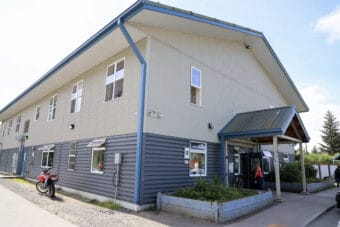
St. Vincent de Paul’s transitional shelter has 26 rooms. (Photo by Lisa Phu/KTOO)
The Juneau chapter of St. Vincent de Paul, a global Catholic organization that provides housing support and many other services, will have a new executive director in July.
Dave Ringle, who has led the organization for the last five years, is stepping down as director. He plans to remain with the organization to help with strategic planning and major projects.
Jennifer Skinner will take over. She has a background in social work and spent two years as deputy director at St. Vincent de Paul.
In Juneau, the nonprofit runs a thrift store, a warming shelter for unhoused people in winter and provides more than 100 units of affordable housing to low-income residents and families.
Ringle joined the organization after he retired from a teaching career. He said teaching prepared him for the creativity and fast-thinking required for the work he has done, but he said Skinner has a different set of skills to bring to the table.
“I had to learn human resources. I had to learn finance. I had to learn housing,” Ringle said. “Jennifer comes in already knowing that, and she’s going to help with providing some stability and some structure.”
Ringle was hired as an interim director, with a timeline of about six months. He stayed on for five years. But now amid health issues, he says it’s time to let Skinner take over.
He said he joined the organization at a time of chaos and he’s spent the last two years working with Skinner to provide St. Vincent de Paul with a smooth and stable transition.
Ringle said he doesn’t want the organization’s mission to be waylaid by the search for a new director. He said St. Vincent de Paul will keep working to provide both immediate shelter needs and long term housing for Juneau’s unhoused community.
“Our goal is to continue that, to look at ways we can both care for the people who can’t find a place to live, but with a long term goal of fixing what is broken,” Ringle said. “And it’s not an either or.”
Skinner will start her role as executive director on July 1. Ringle said he plans to take a long bike ride before he comes back to help out.
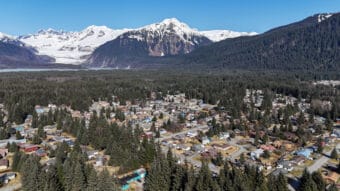
Trees outline the Telephone Hill neighborhood in downtown Juneau on Monday, June 9, 2025. (Photo by Clarise Larson/KTOO)
The City and Borough of Juneau plans to evict all residents of the historic downtown Telephone Hill neighborhood by Oct. 1.
It’s part of a plan that will demolish existing homes and clear the area for newer, denser housing in response to the city’s housing crunch this fall. But no developer has signed onto the project.
Tenants living there now have about four months to move out and find new housing before demolition begins.
The Assembly’s approval of the redevelopment project on Monday was a decision years in the making. The only Assembly member to vote against the plan was Paul Kelly.
Assembly member Christine Woll said she recognizes the decision was a difficult one.
“I wish we could sign an agreement with a contractor today that said we aren’t kicking out these families until we have a plan to get 10 times more people in that place — that’s not possible,” she said. “I’m excited to move forward on investing resources that we’re going to need to build that high-density, affordable housing in this place.”
The Assembly approved spending roughly $5.5 million in city dollars — pulled from a few different sources — to fund the first phase of demolition and site preparation for the area. The total project cost is estimated at $9 million.
But the city has not yet secured a developer to construct new housing there.
This is a preliminary concept drawing of what the Telephone Hill neighborhood redevelopment could look like. (Courtesy/City and Borough of Juneau)
Some residents, like Tony Tengs, who lives downtown, said the Assembly had already made its decision long before the vote even occurred.
“This will be a very visible $9 million scar in the heart of downtown and the subject of much ridicule,” he said. “You may go down as the most notorious Assembly in the history of Juneau, if your big gamble doesn’t pay off.”
The city plans to get the land ready for a developer to then come in and start building housing next summer. But, as Douglas resident Mark Whitman points out, no developer has signed onto the project yet.
“You are waiving a $9 million carrot, hoping someone will buy into this — and no clear takers,” he said. “A bad gamble with our money. This is not fiscal responsibility.”
The neighborhood gets its name because it was home to Alaska’s first commercial telephone service. The hill and many of its houses were a part of the original Juneau townsite in the late 1800s.
All the people living on Telephone Hill are renters, and have been since the state took ownership of the neighborhood in the 1980s. It was originally intended to be redeveloped back then to build a new Capitol complex there — but that didn’t happen.
Assembly member Wade Bryson said the Assembly’s decision shouldn’t be a surprise.
“People who are living on Telephone Hill, how much time would be enough? Because this action, this night was talked about five years ago, four years ago, three years ago, two years ago, a year ago,” he said. “This was not a surprise, or it certainly should not have been a surprise to anybody that eventually it would come to this.”
Demolition is slated to begin between October and December, and city officials say they hope that a developer could begin construction as soon as next summer.
Jonathan Swinton and Stephanie Carter with Gastineau Human Services walk past the location where a Juneau affordable housing project was scheduled to begin construction last month. Wednesday, May 29, 2025. (Photo by Clarise Larson/KTOO)
Rain drizzled down as Jonathan Swinton walked down a muddy road in Lemon Creek. He pointed to an open area filled with bright green foliage and spruce trees where a construction site should be.
“There are 51 units that we were hoping to have under construction right now that are missing,” he said. “That’s 51 people that this community isn’t able to house that it could.”
Swinton is the executive director of Gastineau Human Services, a nonprofit that helps people affected by homelessness or addiction.
The nonprofit was expected to break ground here in April for a three-story building with 51 long-term housing units. The housing is designed and designated for people in recovery from substance misuse, reentering society after incarceration, or facing housing instability.
A conceptual design for Gastineau Human Service’s proposed 51-unit permanent supportive housing project in the Lemon Creek area. (Image courtesy of the City and Borough of Juneau)
Housing advocates say the units are sorely needed to address increased homelessness in Juneau. But the Trump administration pulled a key grant and Congress nixed earmarked funds. Swinton said that set the project back.
“By now, they would have had the foundations poured,” he said. “I will be very surprised if we can break ground before April of next year.
The nonprofit was relying on the congressional earmark and grant from the U.S. Department of Housing and Urban Development to cover roughly $8.1 million of the project’s $11.6 million cost. It hadn’t been awarded either of them yet, but Swinton said the organization was confident enough to set a construction date.
Swinton said nonprofits like Gastineau Human Services depend on federal funding to provide services to housing-insecure and unhoused people in the community.
“The tragic part of the whole thing is that people don’t have the support that they need to get into a place where they can keep themselves from slipping up again,” he said. “That’s what this housing is trying to do.”
The news comes as some Juneau residents are calling for police to crack down on homeless encampments in town. City officials and police say there isn’t an easy fix to growing rates of homelessness and its impacts — but creating more housing is a start.
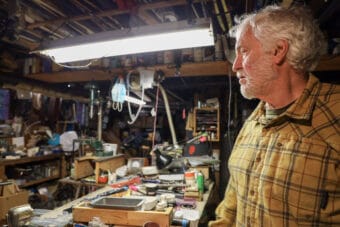
Dave Ringle runs Juneau’s St. Vincent de Paul chapter, a nonprofit that provides various types of housing assistance and has operated the city-run emergency warming shelter for the past two winter seasons.
“Housing is the key to keeping people from that homeless cycle,” he said. “Not having enough supported housing and enough low-income rental housing in this community is probably the driving force behind our homelessness problem.”
Ringle said the resources of service providers in Juneau are already stretched thin.
Data on the number of unhoused people living in Juneau is very limited, but information collected by the Homeless Management Information System indicates that over the last three years, the number of people in Juneau who receive housing assistance is roughly 350 to 400.
“Every time we get a vacancy, we have three to four people who could fill the vacancy within our transitional housing,” he said. “Our rental units are 100% leased. We could probably provide double the number of units that we currently have.”
He and Swinton say the urgency to build this type of housing is only growing. Gastineau Human Services is already reapplying for another version of the federal grant and looking for other funding options. Last summer, the Assembly unanimously approved a local grant of $2 million for the project.
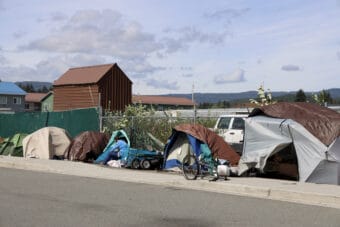
Tents line the sidewalks along Teal Street in the Mendenhall Valley on Tuesday, May 27, 2025. (Photo by Clarise Larson/KTOO)
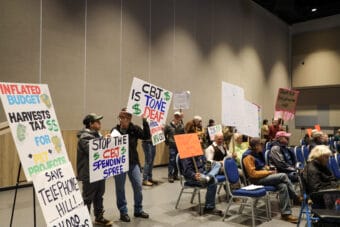
At a recent Juneau Assembly meeting, Juneau property and business owners testified that interactions with unhoused people camping near the airport have been escalating.
“We get attacked,” said Tiffany Koeneman, an employee at Alaska Glacier Seafoods. She told Assembly members that she and her coworkers were recently threatened by a man with a knife.
“So we had to call JPD,” she said. “We have people out there loading vans, but that’s not the worst of it. I mean, the safety part of it, somebody’s going to get hurt.”
Scott Jenkins owns property near Teal Street Center, which is home to many services for Juneau’s vulnerable communities. He told the Assembly he worries about safety and public health and listed some hazards.
“Blocking the sideways leaving trash everywhere, shooting up drugs outside people’s windows, needles in the ditches and in our vehicles, piles of human crap in and around the creek area on our property,” he said.
He said the encampments have begun to affect the way he views the neighborhood.
“People camping is one thing, but should they be able to claim ground anywhere they wish, as long as it’s not private property?” Jenkins said.
The answer to his question is “not really.” Juneau city policy allows for dispersed camping only on unimproved public land. A 2024 Supreme Court decision gave cities even more latitude to suppress homeless encampments when it said cities may ban people from camping in public places.
Now some Juneau residents are asking that the city crack down on encampments. But city officials say increased policing won’t necessarily help.
Instead, the city has given guidelines to the police for how and when law enforcement should intervene — like after an encampment has caused problems for the surrounding community.
“The police isn’t going to solve homelessness,” said Juneau Police Deputy Chief Krag Campbell. “But if we can help them, you know, do some basic needs that might help out other members in the community.”
Campbell said JPD offers help with disposing of trash at the encampments—but he said it’s hard for police to respond to calls where a resident reports illegal activity at an encampment. Often the only evidence is what that caller said.
“Those are really hard ones to handle as police because by the time you get there, they’re probably still not engaged in that behavior,” he said.
And he said that when people call in, they have to testify and sometimes press charges in order for a case to be prosecuted. He said sometimes, callers don’t want to get involved beyond the initial call.
“They want that person gone,” Campbell said. “They want that person arrested, but they don’t want to be the mechanism to make it happen”
Deputy City Manager Robert Barr said the Supreme Court case means Juneau police can enforce city limitations on camping that have been in CBJ code for years.
“We utilize that carefully, and I would say both compassionately and firmly, when we need to utilize it,” he said.
Barr said JPD generally begins to get involved when an encampment continually creates problems, whether that be trash build up or open drug use. He said the city focuses on individual people or camps that repeatedly impact other people using the area, instead of widespread clearing of encampments.
“The code says what it says,” Barr said. “And at the same time, people have to be somewhere.”
Juneau used to have a city-run campground near downtown that unhoused people could live in in the summer months. Last spring, after considering moving the campground, the city closed it, and instructed people to dispersed camp — to sleep on public land.
Barr said data on the number of unhoused people living in Juneau is very limited, but it shows there are more people living outside now than in the past. And he said that’s true nationwide, as affordable housing becomes more scarce.
“Which is unfortunate,” he said. “And of course, something we don’t control at the local level, but that is a reality that we have to deal with at the local level.”
Kaia Quinto directs the Glory Hall homeless shelter in Juneau. City officials say encampments tend to cluster around the shelter because it offers services and Quinto agrees.
“I think the Glory Hall staff as a whole, you know, we’re feeling very uncomfortable,” she said.
Quinto said just last week, two staff members were assaulted. She said JPD has been stepping in to help police the area around the shelter, and it’s helped her and her staff feel safer. But she said the calls for increased policing of the area don’t really make sense to her.
“JPD is doing all they can, so I think, like, I really don’t know what else they could do,” Quinto said. “It’s very clear to me, at least, that they’re doing everything they can.”
Quinto said some unhoused people using the Glory Hall’s services have told her that they feel like they have nowhere to go. They’ve been asked to move over and over again.
“It’s very obvious that we have more people who are unhoused than we have shelter beds,” she said.
And until that changes, she said she doesn’t know of any realistic solutions to the increased encampments and threats her staff face.
A preliminary concept drawing of what the Telephone Hill neighborhood redevelopment could look like. (Courtesy of the City and Borough of Juneau)
The Juneau Assembly chose a preliminary redevelopment plan on Monday night for the downtown Telephone Hill neighborhood that — if approved — would evict residents by Oct. 1.
The move marks a major step toward breaking ground after years of planning. But, the city would be asking for evictions before a developer has signed onto the project.
The plan would demolish all of the existing houses and structures on Telephone Hill this fall. City officials want to lay the groundwork for a developer to build newer, denser housing where the historic neighborhood once stood next summer. The city has not yet put out a formal request for proposals from potential developers.
“You might need to invest in demolition and site preparation just to be able to attract developers,” City Manager Katie Koester told Assembly members at Monday’s Committee of the Whole meeting.
Members decided to move forward with a plan that would spend $5.5 million to fund the first phase of demolition and site preparation of the downtown neighborhood.
Assembly member Alicia Hughes-Skandijs called investing in developing new housing a priority amid Juneau’s housing crunch.
“I think if we want affordability, I think if we want them to densify in this site, it is going to require a big commitment of capital funds from the city,” Hughes-Skandijs said.
The Telephone Hill neighborhood in downtown Juneau on Thursday, April 3, 2025. (Photo by Clarise Larson/KTOO)
The Assembly will take public comment and hold a final vote on the ordinance before any work can begin. That’s expected to happen on June 9. But, if approved, it would give the tenants living there about four months to move out of their units and find new housing.
Assembly member Wade Bryson said he thinks the city has given residents more than enough notice already to find a new place.
“We’re asking these people to vacate during the easiest time of the year to find housing,” he said. “We are not being haphazard or careless, this has been talked about and has methodically gotten to this point.”
The neighborhood sits on roughly four acres of land on a hill that straddles the State Office Building downtown. It was state-owned from the 1980s until 2023 when the city took it over. The state originally intended to build a new Capitol complex there, but that never panned out. All people living there are renters.
Last year, the Assembly voted to redevelop the neighborhood to build denser housing in response to Juneau’s ongoing housing crunch. The new plan would be an official start to the process.
But not everyone thought it was the best idea. Assembly member Paul Kelly was the only member to vote against the plan. He said he wants a more defined plan before asking tenants to leave.
“I don’t feel good about moving forward when we don’t have a guarantee for more housing, we’re going to be asking people to leave,” he said. “I would like us to be able to guarantee that we’re not going to have something that’s going to potentially sit idle.”
The $5.5 million slotted to fund the demolition and site preparation would be pulled from a few city funding sources. Some Assembly members were concerned that costs could skyrocket if they wait. Koester said that’s always a risk, but especially now amid the Trump Administration’s tariff policies.
The ordinance will be introduced at an Assembly meeting on May 19. Koester said the city will send eviction notices to tenants sometime that week.
Demolition would begin between October and December, so a developer could begin construction next summer. Developers would be on the hook for any road construction costs related to the project.
Benjamin Stepetin walks out of Juneau’s emergency warming shelter on its last morning open for the season on Wednesday, April 16, 2025. (Photo by Clarise Larson/KTOO)
The steel door slammed behind Benjamin Stepetin as he stepped outside Juneau’s city-run emergency warming center early Wednesday morning. He slung a garbage bag with an extra pair of jeans and a few blankets over his shoulder.
The warming center, meant to be a last resort for unhoused people to survive the cold winter nights when temperatures drop below freezing, closed for the season Wednesday morning.
For the next five months, Stepetin doesn’t know where he will sleep every night.
“I have nowhere to go, and so I’ll be camping out somewhere tonight,” he said. “Because I can’t come back here, so I’m gonna have to sleep outside somewhere.”
Stepetin is one of 36 people who stayed at the shelter on Tuesday night. It’s the second year it’s been located in an industrial warehouse in Thane, about a mile from downtown. Staff from St. Vincent de Paul, a local nonprofit that works to help people affected by homelessness, operate it.
Like many of their clients, Stepetin stayed at the shelter almost every night since it opened in October. While some patrons secured temporary housing at Juneauʼs year-round shelters ahead of the closure, staff say most patrons did not.
The shelter saw an average of 45 people a night throughout the season.
Though spring has technically come, it’s still cold out. The shelter only had some blankets and a bit of extra clothing to give to patrons before they headed out. Last year, some patrons were given camping gear. But this time, staff didn’t have tents to offer.
“The best I can do right now is get some cardboard and I can put that down and lay on that,” Stepetin said. “That just helps a little bit.”
Another patron, Marvin Holmes, sipped coffee this morning, worrying about his next move. He’s new to Juneau and it’s his first time experiencing homelessness without access to a shelter.
“This place is not going to be here, at which point I don’t know what I’m going to do,” he said. “All these guys were built for this. They know how to get a tent to go somewhere, get out of the elements. I’m going to be finished tonight — and I’m really scared.”
Whitney Gannon knows what that’s like. She said she became homeless in Juneau after she escaped a domestic violence situation two years ago. Now, she’s the shelter’s manager and it’s her mission to help people like herself get into housing and feel safe.
“There are so many different reasons why these people come here, but this is literally their last stop before it’s actually the street,” she said.
When she lost access to housing, she was able to stay at the nearby Mill Campground, a city-run campground that used to be available for people experiencing homelessness. However, the Juneau Assembly decided to close it down last summer after an increase in illegal activity.
Instead, Juneau Assembly members opted for what’s called dispersed camping, essentially allowing people to sleep on public land that isn’t technically a campground.
Last June, the U.S. Supreme Court ruled that cities can ban people from sleeping and camping in public places. Deputy City Manager Robert Bar said that has affected Juneau’s enforcement of homeless encampments.
“If a group of folks are camping … on public land, we are unlikely to take much enforcement action if we’re not seeing uncontrolled garbage, the presence of drugs, illegal drugs, if we’re not getting a lot of public complaints,” he said. “We’re probably not going to do much right?”
But it’s up to the discretion of the city and police to decide when a campground crosses the threshold to require enforcement or dismantling. Barr said that’s the hard part.
“I think it’s something that we’re going to have … to continue to struggle through as a community for years,” he said.
Back at the shelter Wednesday morning, patrons funneled into a city bus to be dropped off downtown or in the Mendenhall Valley.
Where they end up tonight is up to them.
Close
Update notification options
Subscribe to notifications
Subscribe
Get notifications about news related to the topics you care about. You can unsubscribe anytime.