Housing

Juneau Assembly approves rezoning over 200 acres of city land for denser housing

North Douglas Highway near Grant Creek on Thursday, Oct. 24, 2024. (Photo by Clarise Larson/KTOO)

Cars zoomed past the wooded land that surrounds Grant Creek off North Douglas Highway on Tuesday morning. It’s located just a few minutes beyond the bridge from downtown Juneau. 

The area was quiet — nothing but a few single-family homes sat nearby and only a handful of people walked past on the shoulder of the highway. But soon — that could all change. 

On Monday, the Juneau Assembly approved rezoning more than 200 acres of city-owned property to increase the housing density in those areas. It includes land north and south of Grant Creek and west of the Bonnie Brae and Blacktail Subdivisions on North Douglas. They also approved rezoning some land in the Auke Bay area.

“These resolutions today are actionable steps that will help address the housing shortage in Juneau and allow the community to grow into the cultural and economic hub that’s needed to create lifelong residents in Juneau,” said Michael Riederer, a North Douglas resident.

Riederer lives adjacent to one of the rezoned lots and testified in favor of all the rezoning approved by the Assembly at the Monday night meeting.

“As a member of a long-time North Douglas family, I have no concerns about the possible additional traffic burden and look forward to seeing new families in the neighborhood,” he said. 

Rezoning the land to have a higher density means more units can be built there than what was authorized before, so more people can live there. 

It’s just one way the Assembly and city are trying to incentivize developers to build more housing in the borough. That’s especially needed as a U.S. Coast Guard Icebreaker is slated to be homeported in Juneau, bringing more residents to town in the coming years, and as annual glacial flooding of the Mendenhall River threatens homes in the Mendenhall Valley. 

“The market is stuck,” said Dan Bleidorn, the city’s lands and resources manager, at a previous meeting on the topic. “Part of this like a multiple-zone-change scenario is to try to get multiple types of city property ready for development or disposal at a future time when plans can be worked on.”

Not everyone is on board with the idea. 

Auke Bay resident Heather Marlow said she was concerned about landslides and whether people in the rezoned lots could get insurance for their homes if they happened. 

“As many of you are aware, the area in Southeast Alaska has seen landslides yearly for several years,” she said. “If this area is rezoned and developed, are we setting up an area that’s not considered for landslide coverage?”

During previous meetings on the topic, other residents expressed concerns about the increased traffic more housing could bring to the North Douglas area and the lack of access it has to emergency services. 

“I understand the need to increase housing, but if we do it and put people in harm’s way, that’s not a service to the community,” said North Douglas resident Gary Gillette during a Planning Commission meeting in October. 

He asked the rezones on North Douglas be stalled until a second crossing from Douglas Island to Juneau is built. That plan is likely years away from even breaking ground.

Though the Assembly approved the rezones, it doesn’t necessarily guarantee developers will want — or be able to afford — to build there. High interest rates and the cost of materials continue to be barriers for many developers from breaking ground on new projects.

Juneau Assembly OKs $3M loan for 60-unit apartment complex in Mendenhall Valley

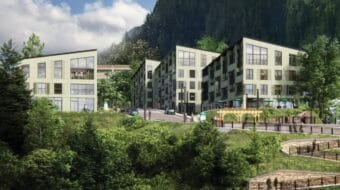
This is a drawing of one of the proposed Creekside Apartment complex buildings in the Mendenhall Valley. (City and Borough of Juneau)

The Juneau Assembly approved a $3 million loan Monday night to help a local developer construct a 60-unit apartment complex in the Mendenhall Valley.

The money comes from the city’s Affordable Housing Fund. The two three-story buildings, called the Creekside Apartments, are slated to be built across the street from the Mendenhall Mall near Pucker Wilson’s food truck. The developer is Tower Legacy II LLC. 

According to its loan application, the developer says the location’s proximity to grocery stores, health care centers and public transportation will help reduce some of the barriers people with lower income face when trying to find housing in Juneau. 

The City and Borough of Juneau created the Affordable Housing Fund to address the shortage of low and middle-income housing and uses the money to help developers create more rentals and single-family homes. 

The city typically uses 80% AMI to determine eligibility for affordable housing programs. It refers to a household or individual income that is at or below 80% of the Area Median Income, which is categorized as “low-income.” In Juneau in 2024, 80% AMI for a single person is $67,700 and $120,800 for a household.

Last year, the fund had $4 million available for projects. The Assembly already approved $1 million of that to help renovate the downtown Gross-Alaska Theatre building into an apartment complex. The remaining $3 million in the fund will go toward this new development, which is expected to cost about $8 million in total. 

By accepting the city’s low-interest loan, Tower Legacy II agrees to make roughly a third of its units meet certain affordability requirements laid out by the city. 

At least 18 of the studio apartments must be available for $1,150 per month and three of the two-bedroom apartments must go for $1,600 per month. During the term of the loan, the apartments can’t be used as short-term rentals. 

The developer’s application outlines a timeline to have all 60 units completed by May or June of this year, but a representative for the company said Tuesday that next year is more likely. 

This story has been updated with more information about how the city determines affordable housing prices and the expected timeline for the project. 

Juneau Assembly OKs $1M loan to revive downtown Gross-Alaska Theatre for housing

The Gross-Alaska Theatre in downtown Juneau on Tuesday, Dec. 17, 2024. (Clarise Larson/KTOO)

The shuttered Gross-Alaska Theatre building in downtown Juneau is poised to get a new life as home to 22 new apartments, including 20 that are considered affordable units. 

On Monday night, the Juneau Assembly unanimously approved a $1 million loan to help renovate the former movie theater on Front Street into an apartment complex. The money comes from the city’s Affordable Housing Fund.

The city created the fund to address the lack of affordable housing in Juneau and uses the money to promote more rental housing and single-family homes. 

Zachary Kohan is a co-partner of BroKo Holdings LLC, the developer. In an interview Tuesday, he said he grew up going to the theater as a kid. 

“It’s a fixture of downtown, and to have the ability to potentially bring that back is exciting, and to have the city behind us is very exciting,” he said. 

Reviving the theater building into new housing has been an idea circulating for at least a decade. But it hasn’t come together until now.

The building used to have two retail storefronts, the theater and apartments, but the apartments have been out of commission since the ‘90s. The theater itself closed during the pandemic. 

Kenny Solomon-Gross, the vice president and general manager at Gross-Alaska Theaters, said the cost to revive the apartments was always too much for his family’s business to take on. The company owns another theater in the Mendenhall Valley and is in the process of selling the downtown building to BroKo Holdings. 

View the full BroKo Holdings funding application here.

“Speaking for my family, we are really excited that the Gross building is going to come back to life again,” he said in an interview Tuesday. “For them to be able to get that loan to be able to make those apartments again, come back to life, we are super excited about that.”

Loans from the Affordable Housing Fund are just one way the Assembly is incentivizing developers to construct more affordable housing. Kohan said the funds are crucial to the project. 

“We’re in a high interest rate environment, and to be able to secure rehabilitation funds, it just brings the cost down,” he said. “That’s been the biggest constraint and the prohibitor, I think, for providing new housing supply in Juneau.”

The plan is to offer 16 one-bedroom and six two-bedroom apartments at the site. Twenty of the apartments will be rented to people who make 80% or less than the Juneau Area Median Income, at a monthly rent of about $1,900 for a one-bedroom, and $2,200 for a two-bedroom, per the loan requirements. 

Kohan said the company is still finalizing the building purchase, so it is unclear when construction will start. According to its application with the city, the company plans to have the units ready within three years.

The company originally requested $1.1 million, but the Assembly approved only $1 million at the meeting on Monday. After the vote, Assembly member Christine Woll requested the Assembly add the remaining $100,000 to the loan as well. The Assembly will vote on that at a later meeting.

Report: Southeast Alaska is projected to lose nearly a fifth of its population by 2050

Downtown Juneau on Wednesday, Dec. 4, 2024. (Clarise Larson/KTOO)

Millions of visitors flock to Southeast Alaska tourism hubs like Juneau, Ketchikan and Sitka every summer. But, when the cruise ship season comes to a close, it gets pretty quiet. 

Each town has a relatively small year-round population compared to the number of people who visit them. But, soon those populations are projected to get much smaller. 

According to a recent report by the Alaska Department of Labor and Workforce Development, Southeast Alaska’s overall population is projected to drop by about 17% by 2050 — or roughly 12,000 people. That’s about the populations of Sitka and Wrangell combined.

Compare that to Alaska’s overall population, which is projected to drop by 2%.

Brian Holst, the executive director of the Juneau Economic Development Council, said without more people moving to the region, Southeast Alaska can’t sustain its population. And, it could have adverse impacts on the region’s workforce and economy. 

“People are choosing to live elsewhere, we think in large part, because for all the attractiveness of Juneau, for too many families the price of a home and the cost of being here is just too much of a challenge,” he said.

The total population of Southeast Alaska is roughly 71,000, with close to half living in the capital city. Southeast Alaska relies on its year-round residents for a lot of things — like the tourism industry, fisheries and state jobs. 

According to the study, the loss in population comes from a mixture of increased outmigration and deaths outnumbering births in the region.

Because while Southeast Alaska’s population grows smaller, it’s also growing older. It’s actually older than most of the state. According to a 2024 report by the Juneau Economic Development Council, the over-60 population in Juneau outnumbers the under-20 population.

Fewer people in the region equals a smaller workforce, less young people going to schools and fewer people to care for the aging population. 

The Juneau School District has already been grappling with declining enrollment for decades. There are just simply fewer students to fill the schools than there were a few decades ago.

“When you have inadequate transportation in Southeast Alaska and inadequate school funding, you really eliminate two of the biggest incentives for young people to stay in Alaska,” said Juneau School Board member Emil Mackey.

At the start of the school year, Juneau’s high schools and middle schools consolidated. It was a decision made by the board in part to address the dwindling number of students. Mackey said if the younger population continues to decline, elementary school closures could be next. 

“No matter how many kids we have, we have the same infrastructure costs  — it costs the same to paint a building if there’s one student or 300 students in it,” he said. “I would believe, yes, future closures would have to be necessary.”

More people simply need to move here, Holst said. That’s hard to do as Juneau isn’t building housing fast enough to meet its changing demographics, and the cost of living and rent continues to rise. 

“It comes down to the cost of living,” he said. “While you can have a job, does it pay enough to be able to afford Juneau’s high cost of living, and more specifically, housing, or housing costs? Our housing costs continue to be very high. For young people in particular, it’s really hard to make ends meet here in Juneau.”

But, Holst said these are just projections and there’s still time to reverse course. The projections are based on the last several years of population trends. 

“I see the glass half full here. I think we have challenges ahead of us, but there are things that we can do to make our community a little bit more affordable,” he said. 

Holst said that includes things like building more affordable housing and supporting child care, which the City and Borough of Juneau has been prioritizing. On a positive note, according to the state’s study, Southeast Alaska’s communities’ wages rose the most in the state in 2023. 

Juneau group home for women in reentry and recovery reopens after demolition

Christina Lee is the operations manager for Tlingit and Haida’s Reentry and Recovery program. She stands at the new T’áa Shuyee Hit Haven House building on Nov. 5, 2024. (Photo by Yvonne Krumrey/KTOO)

A group home in Juneau for women experiencing addiction or leaving incarceration has just reopened after being rebuilt following flood damage. T’áa Shuyee Hit Haven House is now accepting applicants. 

Haven House is run by the Central Council of the Tlingit and Haida Indian Tribes of Alaska. Christina Lee is the operations manager for Tlingit and Haida’s Reentry and Recovery program. She says Haven House is a place for new beginnings. 

“The women in our community, and everywhere, need to know that there’s a safe place to come,” Lee said. “Need to know that there’s an opportunity to start over.”

Up to nine women can live there and it costs $600 a month. Each resident gets their own room and must participate in programs that support mental health and recovery. 

The group home in the Mendenhall Valley originally opened as a nonprofit in 2015. Tlingit and Haida had just taken it over in 2020 when, months later, the entire house flooded and was shut down. 

After rebuilding from the ground up, Tlingit and Haida began accepting applications for residents last month. 

The program doesn’t allow children to live in the house with their parents, but kids can visit. The same goes for romantic partners. 

The program is voluntary and requires participation in programming, so Lee said their applicants tend to be more self-selecting. They’re women committed to their healing and recovery. 

“They have to be able to do chores and be responsible, as long as they can live in a community with other women and be able to hash out any differences that there is,” she said. “That’s kind of what we’re wanting.”

Lee says the program lasts two years, but if life circumstances change, it can be shorter. 

Tlingit and Haida President Chalyee Éesh Richard Peterson says programs like Haven House mean that women can take steps away from old, harmful patterns. 

“We’re excited that it’s a place that’s going to create a supportive environment, hopefully to reduce relapse, reduce recidivism,” Peterson said. “And help our folks break those cycles that have kept them trapped in difficult situations.”

The application process is ongoing. More information can be found on the Tlingit and Haida website, or by calling 907-463-7266. 

Juneau’s latest attempt to allow for more housing? Changing zoning rules on city land.

North Douglas Highway near Grant Creek on Thursday, Oct. 24, 2024. (Clarise Larson/KTOO)

Juneau is facing a housing crisis — there are simply not enough homes to keep up with demand. To increase the supply, the city wants to open up more public land for development.

This week, the Juneau Planning Commission approved a series of land rezones that span from North Douglas to Auke Bay. All of them would increase housing density in those areas. But not everybody is thrilled about it.

The Juneau Assembly has long tried to tackle Juneau’s housing crunch. Members have tried all sorts of things to encourage more development. Their latest attempt is to entice more developers by rezoning city-owned land to allow for denser housing.

Last year, the Assembly directed city Lands and Resources staff to look at what city land could be rezoned.

“The market is stuck,” said Dan Bleidorn, the city’s lands and resources manager, at Tuesday’s Planning Commission meeting. “Part of this like multiple-zone-change scenario is to try to get multiple types of city property ready for development or disposal at a future time when plans can be worked on.”

The commission approved rezones for land north and south of Grant Creek, and west of the Bonnie Brae and Blacktail Subdivisions on North Douglas. They also approved land in the Auke Bay area and private land in Lemon Creek near the prison. All would increase the housing density allowed. 

At the meeting, a few residents were not keen on the idea of allowing more housing to be developed, specifically on North Douglas. 

“I understand the need to increase housing, but if we do it and put people in harm’s way, that’s not a service to the community,” said North Douglas resident Gary Gillette.

He said he was concerned about increased traffic more housing could bring to the area, and the lack of access it has to emergency services. He asked the commission to hold off on approving the rezones until a second crossing from Douglas Island to Juneau is built. That’s still years away – the city and the state are still determining where a new bridge should be built.

Another resident, Kathy Coghill, also spoke against rezonings. She argued that North Douglas simply isn’t ready yet for that kind of growth. 

“That’s enough from Douglas. You build the Bench road, you get us reasonable infrastructure, then come back and propose more housing out there. I’m all for it. But right now it’s really getting the cart ahead of the horse,” she said.

Big changes could be on the horizon for North Douglas in the coming years, with or without rezoning. Last week, a cruise line and Goldbelt Inc. announced plans to develop a new cruise ship port on West Douglas. 

The commission denied a proposal to rezone an area near Fish Creek. They shot it down because of its distance from city utilities and concerns about impacts to Fish Creek.

Commissioner David Epstein said there are still a lot of steps to go through before any housing can actually be built on the land. 

“All we’re doing here tonight is setting the table. That doesn’t mean tomorrow you know, there’s going to be housing built,” he said. “There are significant hoops and hurdles to jump over and through.”

The rezones still need to go to the Assembly for a public hearing and final approval. And, approval doesn’t necessarily guarantee developers will jump on it. High interest rates and the cost of materials continue to be stumbling blocks for developers.

Site notifications
Update notification options
Subscribe to notifications