Houses line the streets of Douglas in late May. (Photo by Clarise Larson/Juneau Empire)
Alaska Gov. Mike Dunleavy signed a bipartisan bill into law last week that puts more guardrails on how local governments assess the value of real estate. Assessments are what provide the basis for property taxes.
The newly signed bill, SB 179, requires tax assessors to be accredited by the state, prevents municipalities from raising the assessed value of properties during an appeal process and changes the default for who hears appeals.
Juneau Democratic Sen. Jesse Kiehl said the aim is to make the property assessment process in the state more fair and transparent for property owners.
“I was very pleased to see the governor sign that bill. It has a lot of provisions in it, almost all of which I like and are good,” he said.
The tax assessment portion of the bill was originally introduced in a separate measure by Kiehl and in the Alaska House by Anchorage Republican Rep. Julie Coulombe. It was later folded into another bill as the legislative session neared its end.
That bill was sponsored by Kenai Republican Sen. Jesse Bjorkman. It also allows local governments to exempt farm structures from property taxes and outlaw taxes on real estate sales.
When Kiehl’s bill was first introduced in the Alaska Senate, it received a lot of support, particularly from residents in Juneau and Haines, who said they had seen steep jumps in their property assessments. That led them to question if their assessors were being transparent and fair.
“This is another one of those pieces of legislation that was brought in by citizens who saw something they didn’t think was always working right,” he said. “So, working with them, I’m really proud of where we ended up.”
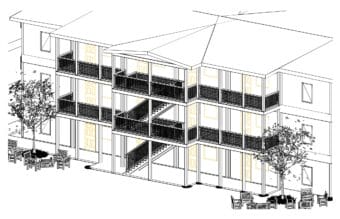
A conceptual design for Gastineau Human Service’s proposed 51-unit permanent supportive housing project in the Lemon Creek area. (Clarise Larson/KTOO)
Juneau needs more housing for its most vulnerable populations — and a newly permitted affordable housing project hopes to help fill in the gaps.
On Tuesday, the city planning commission unanimously granted a conditional use permit to local nonprofit Gastineau Human Services for a three-story apartment building with 51 long-term housing units in the Lemon Creek area.
Jonathan Swinton is the executive director of Gastineau Human Services. The nonprofit helps people affected by homelessness or addiction.
“It’s just so important,” Swinton said. “Anybody who has experienced an addiction, or has been through incarceration, or has ever experienced homelessness, knows how difficult it is to be in that kind of environment and believe in and hope for yourself, and hope for your future.”
The housing project was designed specifically for people in recovery from substance misuse, reentering society after incarceration, or facing housing instability.
Swinton said residents will be surrounded by other people going through a similar journey to recovery. They will have access to case managers, treatment groups, AA and NA meetings and individual counseling.
He said those resources are key to helping people maintain sobriety, feel confident to successfully re-enter society post-incarceration and find a network of support.
“We think by having both this environment of support from those in similar circumstances and the additional resources that our nonprofit can offer, that we’re setting them up for a much better chance of long-term success,” he said.
The nonprofit’s goal is to have construction begin next year and open the facility in 2026.
In May, the Juneau Assembly gave the project a $2 million grant. But, the nonprofit still needs to gather another $9.5 million from other sources to be able to fully fund construction. And, Swinton said this building is hopefully just the first phase of a larger development project.
Correction: A previous version of this story misidentified the type of permit issued by the Planning Commission on Tuesday.
Lisa Puananimōhalaʼikalani Denny plays ukulele at a memorial show for Steven Kissack on Aug. 10, 2024. (Photo by Yvonne Krumrey/KTOO).
A Juneau stage was packed with artists on Saturday night. They were there to pay tribute to Steven Kissack, a local man who was shot and killed by law enforcement during a standoff last month.
Many on stage and in the crowd knew Kissack — he’d lived on the streets downtown for years with his malamute, Juno — and they were there to mourn him and to call for change.
On stage in the Crystal Saloon Saturday night, Lisa Puananimōhalaʼikalani Denny played “Nearer my God to Thee” on her ukulele. She said she sang it at her father’s funeral.
“We all experience loss. And Juneau is a family, and we feel our losses together,” she said.
Denny saw Kissack often until he died last month. She was working downtown when she heard the shooting. And she isn’t the only one. The audience and lineup on Saturday were full of people who knew and interacted with Kissack regularly or were nearby when he was shot.
The event took place only a few feet from where the standoff happened. The Juneau Police Department said Kissack threatened officers with a knife. The incident is still under investigation by the Alaska Bureau of Investigation.
David Elrod works at the Crystal Saloon and organized the event.
“I don’t think anybody anywhere wants to see anything like this happen,” he said. “And you can debate the merits of how it happened, but nobody wants to see it happen.”
Elrod said the responses from local artists to Kissack’s death made him want to gather people together to try to make something positive out of the tragedy.
Elrod said a lot of people made the event happen — bartenders donated their tips, the artists that performed donated their time, and a portion of the bar profits that night were donated too. Artist Natalie Weinberg auctioned a live painting and local chef Amara Enciso auctioned a private dinner — the money from each went into the donation pool.
Between ticket sales, donations and bar sales, the event brought in $5,200 for Gastineau Human Services. The local nonprofit provides housing for formerly incarcerated people and others struggling with housing instability, and provides mental health care and addiction treatment services.
Advocates for change also took the stage on Saturday.
Salomé Starbuck started Juneau Justice for Steve. She experienced housing instability herself as a teenager, and knew Kissack as a member of the downtown community in Juneau.
“We will work to see this city house the unhoused in a considerate and inclusive way allocate funding to comprehensive medical health care, mental health care services for the vulnerable, and where an armed police presence is escalatory rather than de-escalatory, implement new systems for how contact is initiated with our at-risk communities,” she said.
About a dozen people have been activate in Starbuck’s organization to advocate for local mental health response teams, made up of people trained to address mental health crises and intervene before the police get involved.
Because the shooting took place in the middle of the day on a busy street, dozens of people in town witnessed it. Josh Fortenbery, a local folk musician, wrote a song about Kissack’s death.
“We’re gonna grieve together a little bit,” he said before the opening chords.
Clarification: This story previously stated that donations and ticket sales from the event totaled $4,600, but the portion of the Crystal Saloon’s bar tab added to that means $5,200 was raised for Gastineau Human Services.
This story has also been corrected to more accurately reflect Starbuck’s personal history.
That’s according to a preliminary damage assessment completed by the City and Borough of Juneau and the American Red Cross of Alaska this past weekend.
Many homeowners are still cleaning out their homes.
“We’re collecting all different types of garbage right now – that’s your general trash, construction and demolition debris, large appliances, hazardous waste,” said Deputy City Manager Robert Barr. “Impacted residents can place those things at the edge of their property line close to the right-of-way.”
The Alaska Department of Transportation hauled away more than 100 truckloads of trash over the weekend, and Barr said crews will continue trash pick-up through this week, and likely beyond.
The Central Council of the Tlingit & Haida Indian Tribes of Alaska is also providing free debris removal for tribal citizens. Tribal Transportation Manager RJ Hill estimates crews took 15 tons of trash to the dump in just the first day and a half of clean up last week.
The city will also set up a junk vehicle pick-up for the many cars that were totaled by flood water. It already operates a year-round junk vehicle program that takes in vehicles for free, but the sheer number of damaged cars and trucks will overwhelm that system. The city is looking for a short-term solution to store vehicles while they’re waiting to be junked.
Volunteers are helping with the clean-up too. More than 100 people showed up to help at the Melvin Park volunteer center over the weekend, but United Way volunteer coordinator Ryan O’Shaughnessy said more help is needed.
“We need folks who are willing to get into a crawl space, get dirty, and help us haul out insulation as well as sheetrock and insulation that’s behind it,” he said.
O’Shaughnessy added that people who can’t do the heavy duty work can still help out with things like cooking and delivering meals. United Way is also asking for donations or loans of dehumidifiers, respirators and elbow length gloves.
The volunteer center will be open at Melvin Park at least through Wednesday, from 10 a.m. to 6 p.m. Free hot meals will be available there each day from noon to 2 p.m. and from 5 p.m. to 7 p.m.
Information about volunteer opportunities later in the week will be posted on the city’s website.
Insulation piled outside of a home on Meander Way, which took on water during the record-breaking glacial outburst flood on Aug. 6, 2024. (Photo by Anna Canny/KTOO)
From Wednesday through Friday, the Alaska Division of Homeland Security and Emergency Management will open two disaster assistance centers to help homeowners and renters affected by flooding navigate applications for individual state disaster relief money.
People can show up to the Mendenhall Valley Library or Generations Southeast Community Learning anytime between 10 a.m. and 6 p.m. Be sure to bring documentation of damages, a valid ID, proof of occupancy and insurance information. The deadline to apply for State Individual Assistance is Oct. 9, 2024 and applications can be submitted online.
The American Red Cross of Alaska has also announced that it will be offering financial assistance for people whose primary residence was damaged in the flood. The Red Cross will be operating it’s own assistance center this week at the Open Red Cross Enrollment Center on Glacier Highway, Monday through Wednesday.
Correction: A photo previously misidentified the location of a home on Meander Way.
Telephone Hill in downtown Juneau on Monday, Aug. 5, 2024. (Clarise Larson/KTOO)
Tommy Jimmie Jr. and Joe Johnson sat in the bright afternoon sun on the steps leading up to the Telephone Hill neighborhood in downtown Juneau on Thursday.
The pair came to relax near the tall green trees and thimbleberry bushes. Jimmie said he’s there almost every day.
“This has always been a part of my walk going through this neighborhood. I do the flume, and oftentimes I’ll meet him here, and I’ll come down this way,” he said.
Jimmie is Lingít and grew up in Juneau. He said he didn’t know that there were plans underway by the City and Borough of Juneau to redevelop the area to make way for more housing.
“I think those houses are just as old as some of those that are down here in the village,” he said. “I would think they would be renovating some of those houses up there rather than trying to get rid of them — they’re historical monuments, as far as I’m concerned.”
The neighborhood sits on roughly four acres of land on a hill in the center of downtown Juneau. There are seven houses and one five-unit apartment building there. Most residents there have openly opposed the city’s redevelopment plan.
But in February, after a handful of community meetings on the topic, the Juneau Assembly asked city staff to move forward with a redevelopment plan that would demolish the neighborhood’s historic homes and add more than 100 new housing units.
But when that will happen is still up in the air. At Monday’s Assembly committee meeting, City Manager Katie Koester said it all depends on the developer.
“I think the earliest we can do anything would be next summer — which I find that to be very unlikely — but I hope it doesn’t take up to three years which is the other end of the spectrum on that,” she said,
At the meeting, the Assembly approved a plan to seek interested developers who might want to take on the project. Once the city chooses one of them, that will determine how quickly the project moves along.
All the people who live on Telephone Hill right now are renters, but some have lived there for decades. The land is owned by the city, which acquired it from the state in recent years. Before that, the state had owned it since 1984.
Koester said the city is not actively maintaining the houses up there anymore but will continue to let the renters live there for the time being. But if any health or safety issues arise in the buildings, they may need to vacate the residents.
“We are encouraging people to move out and find alternative housing as soon as possible,” she said.
Affordability is also a key point for the Assembly in its decisions about how the project should move forward. For years the Assembly has been trying to find different avenues to tuck affordability requirements or incentives into development projects amid Juneau’s housing crisis.
On Monday, the Assembly approved a goal for the Telephone Hill project to have 20% of its units to be below-market rent at 80% of the area median income.
But, Koester warned that requiring developers to sell some of their units below-market will likely come with a cost to the city.
“Tax abatement, site development, land transfer — we don’t really know what strategies might be needed. But, if the Assembly wants to mandate something as part of the development, we can expect to have to pay for part of that one way or another,” she said.
Mayor Beth Weldon made the motion to add the affordability aspect to the redevelopment plan. But she worried some developers would be discouraged by it.
“Part of me wants to just let the free market reign on this particular piece of property,” she said. “It’s a prime piece of property — this is my struggle.”
Koester said the city will put out the request for interested developers in the coming months.
Flowers lay in the street at a memorial for Steven Kissack in downtown Juneau on July 19, 2024. (Photo by Yvonne Krumrey/KTOO)
People who witnessed Monday’s deadly police shooting in downtown Juneau are carrying a lot of emotions — anger, confusion and grief, to name a few. A local mental health care provider has compiled resources to help residents deal with the trauma.
William Sanders said he’s been struggling with his anger since Steven Kissack was shot and killed during a standoff with police officers.
“I’m trying to keep my mind occupied,” he said. “Sometimes that’s the only way I can sleep. I keep busy till I collapse.”
Sanders said he and Kissack were friends. He said Kissack was someone who helped people navigate being on the streets and always shared his food.
Sanders doesn’t have stable housing, and he said witnessing a violent death like this makes living on the streets even harder. In the chaos of the shooting, he said he and another witness feared for their own safety.
“We all checked ourselves. We didn’t know if we were hit,” he said.
Matthew Mulhern was working at Devil’s Club Brewery when police confronted Kissack. He was standing in a window that looks out on Front St. when the shooting started.
“I didn’t ever expect it to turn into what it did,” he said. “That was not a possibility in my mind, that I was going to watch someone be shot.”
He said he’s also been feeling a lot of anger. And it wasn’t until the next day that he realized how close he was to being hurt himself. He found a bullet hole in the wall where he had been standing, right before the gunfire.
“The thing that is terrifying to me is that I cannot be safe at work, that I cannot be safe inside my building,” Mulhern said. “In what realm is that okay?”
Mulhern was able to get an appointment with his therapist only a few hours after the shooting. And, he said, the community of people who witnessed the shooting while working downtown have been supporting each other through the fallout.
“I am really lucky that I have a bit of a support network, and I still don’t feel like it’s enough to be perfectly honest,” he said.
Meryl Connelly-Chew is a program coordinator for the local chapter of the National Alliance on Mental Illness, or NAMI.
They said anger like Sander’s and Mulhern’s is normal when people witness traumatic events. And so are feelings of sadness, guilt and fear.
“Really just by witnessing — even for many of us, watching the videos — or everyone in town is kind of talking about this right now. Talking about something so traumatic and violent can have an effect on us,” Connelly-Chew said.
Connelly-Chew said NAMI has put together resources on their website for people who have witnessed a traumatic event. People can also use support hotlines like 9-8-8 or reach out to NAMI to seek therapists who specialize in trauma.
They said spaces like the vigil for Kissack earlier this week, or memorials that have been set up downtown, are important for people to be able to grieve together.
A downtown Juneau memorial for Steven Kissack. July 19, 2024. (Photo by Yvonne Krumrey/KTOO).
“I think it’s really important to know that there is not one person in my personal or professional life in the past week that hasn’t been affected by this in some way,” they said. “I think the entire community is experiencing the effects of this.”
Connelly-Chew said people should give each other as much compassion and kindness in the wake of Kissack’s death as they can. And that’s especially true when people interact with people who are living outside in Juneau.
“These are folks who are grieving someone they loved very much, someone who felt like their family. They are wanting to share stories, they are wanting to take care of each other, share food, do all of the things that any of us do when we’re experiencing loss,” they said.
And people living outside have a harder time accessing mental health care. But community support goes a long way.
“Stop in, say hello to people at the memorial site,” Connelly-Chew said. “Share a hug or a story and just show up in that grief the way that you would for someone in your neighborhood.”
Close
Update notification options
Subscribe to notifications
Subscribe
Get notifications about news related to the topics you care about. You can unsubscribe anytime.