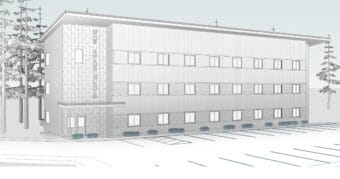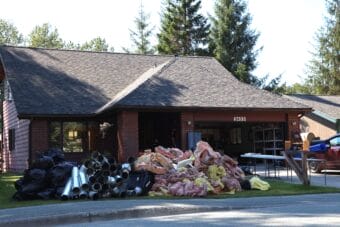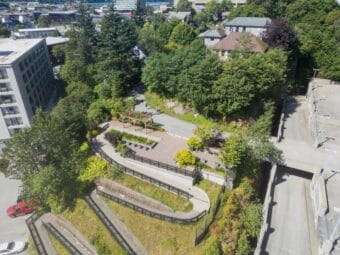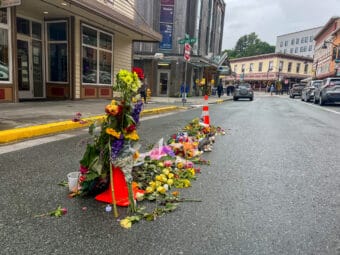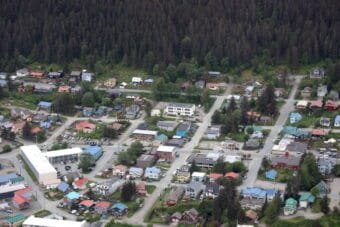
This is a conceptual design for Gastineau Human Service’s proposed 51-unit permanent supportive housing project in the Lemon Creek area. (City and Borough of Juneau)
An affordable housing project built specifically for people in recovery from substance misuse received funding support from the Juneau Assembly this week.
On Monday, the Assembly unanimously approved a grant of $2 million to Gastineau Human Services, a local nonprofit that works to help people affected by homelessness or addiction. The funding will help the nonprofit construct a three-story building with 51 long-term housing units in the Lemon Creek area.

Dave Ringle, the executive director of Juneau’s St. Vincent de Paul chapter, was one of the multiple people at the meeting who testified in support of the grant. He said the project is critical to getting people out of homelessness and into stable situations.
“This is a long-term, cost-effective way to work with the root causes of homelessness and provide a home and support so people can work their way out of the terrible conditions,” he said.
Usually, affordable housing projects like this one have to apply for money through the city’s Affordable Housing Fund, competing against other projects for funding.
But Gastineau Human Services was facing a tight deadline to submit its application for other grants it was pursuing to fund the project. So the Assembly agreed to fund it anyway.
The nonprofit will still need to puzzle together another $9.5 million from other sources.
Lauren Connolly is a nurse at the Southeast Alaska Regional Health Consortium’s Front Street Clinic. It’s geared toward assisting homeless and low-income patients in Juneau. During testimony, she said there is an urgent need for housing units like this in Juneau.
“In my job — even before I knew anything about this project — you can definitely recognize the need for more supportive, sober living here in Juneau,” she said.
The nonprofit’s goal is to have construction begin in 2025 with housing available in 2026.
Downtown Juneau in January, 2024. (Clarise Larson/KTOO)
Picture a downtown Juneau where housing isn’t as cutthroat to find, businesses don’t close down after cruise ships leave and the pressures of tourism don’t feel so heavy.
That sounds ambitious, but those are the priorities of a plan called Blueprint Downtown. Over the past six years, a commission of Juneau residents has examined every aspect of downtown and created a plan to lay the foundation for the next 20 years.
Betsy Brenneman, a member of the Blueprint committee, explained the concept at a city planning commission meeting last week.
“The intent was to nurture the preservation, restoration and revitalization of downtown,” she said.
Brenneman described it as a vision that could guide everyone from the city government to local businesses in their decision-making.
The plan addresses priorities like housing growth, year-round business vitality and tourism management. It recommends things like revising zoning regulations, increasing public safety measures and completing the Seawalk along the downtown waterfront.
Some planning commissioners had questions. Member Mandy Cole said she wonders how much “teeth” the plan would have to move the needle on issues like the housing shortage.
“We’ve done many things to sweeten the pot and still haven’t gotten where we needed to get,” she said. “In my view, this plan is exactly that vehicle for the next three to five years to try and increase housing downtown by various methods.”
Others said they wanted more language in the plan to address short-term rental regulations.
The commission voted unanimously at the meeting to recommend the Assembly adopt the plan. Ultimately, the Assembly will decide what aspects of the plan go into place and when.
Rep. Julie Coulombe, R-Anchorage, speaks on the floor of the Alaska House of Representatives on Feb. 28, 2024. (Eric Stone/Alaska Public Media)
The Alaska House of Representatives passed a bill on Wednesday that would put more guardrails around the state’s property assessment process.
Last year, many residents in Juneau and Haines said they saw steep jumps in their property assessments — large enough that some questioned whether their assessors were being transparent and fair. Rep. Julie Coulombe, an Anchorage Republican who sponsored the bill, said the bill would tackle some of their concerns.
“HB 347 puts some baseline requirements in place to protect the taxpayer, while preserving the important principle of local control,” she said.
The bill would stop assessors from raising a property’s value during an appeal, establish new certification standards for assessors, and require a response from the government if a property owner presented an appraisal that didn’t match theirs.
It also changes the default for who hears tax appeals to an appointed Board of Equalization, instead of the municipality’s locally elected officials.
Some residents have also urged the Legislature to cap how much the assessed value of a property can go up, but neither this bill nor a companion bill in the Senate does that.
Rep, Sara Hannan, a Juneau Democrat, called it a “fairly clean-cut bill” and said it only aims to standardize the appeal process in municipalities across the state — not expand the state’s tax authority.
“It simply sets up standards to make sure that citizens are treated fairly and have a recourse,” she said. “And if someone says they’re an assessor and establishing the tax for you, that you know that they’ve met a professional standard of governance.”
The bill did see some pushback. Rep. Jesse Sumner, a Wasilla Republican, argued that putting limits on raising values after appeals could incentivize more people to file them. And he fears big landowners could find new ways to game the system.
“I think that we may inadvertently be causing a lot of headaches for our local governments in relation to those very large property taxpayers. So, I would just question if this is really the best thing to do,” he said.
But the bill sailed through the House on Wednesday with a wide bipartisan majority — and with Juneau’s delegation speaking strongly in favor. The House reconsidered the bill on Friday afternoon but passed it again.
The bill now heads to the Senate. Sen. Jesse Kiehl, a Juneau Democrat, introduced a nearly identical bill in the Senate earlier this year. He said he’s optimistic the bill will have support there.
Downtown Juneau on Saturday, March 23, 2024. (Clarise Larson/KTOO)
In a bid to figure out what role short-term rental properties will play in Juneau’s future, the City and Borough of Juneau is creating a task force to tackle if — and how — those rentals should be regulated.
On April 15, the Juneau Assembly agreed to allow the mayor to begin selecting residents who are interested in joining the task force, which will recommend regulations for the Assembly to consider.
At the meeting, most Assembly members, like Michelle Hale, said they favor future regulations. Hale says she’s concerned about how short-term rentals affect the long-term housing in Juneau.
“We have a lot of houses and apartments that have been converted to short-term rentals, and that means people can’t live in those that actually live and work here,” she said.
Last fall, the Assembly approved a program that requires people to register their short-term rentals with the city. At the time, city leaders said the free program would help ensure operators are paying sales tax and provide data on the growing short-term rental market — data that could eventually shape restrictions on them.
A little over 330 properties have been registered so far, but city officials believe there are still some operators that have not registered. And that’s likely the case. A recent point-in-time study reported nearly 600 active and intermittent short-term rental listings in Juneau.
At the meeting, Assembly member Ella Adkison said introducing regulations now is a way to get ahead of any future growth in the industry. But she said she doesn’t think the city needs to rush to put them in place.
“Even if we decide that we’re not interested in tamping down on this industry and that the numbers aren’t concerning yet, there’s no reason to leave an industry unregulated when we can get ahead of it and make sure that it’s growing in a way that we want to see it grow,” she said.
Assembly member Alicia Hughes-Skandijs disagreed. She said she thinks the city is moving far too slowly.
“We’re not ahead of this — it’s too late to get ahead of this,” she said. “So you can throw that out the window.”
Assembly member Wade Bryson said he’s hesitant to regulate short-term rentals. He said that could harm independent travelers who want to come to Juneau.
“While not everyone is in favor of short-term rentals, they do serve a purpose in the community and they do provide economic activity,” he said.
City officials said the task force likely will be created in the next month or so and will start meeting soon after.
On Monday, April 15, the last night before Juneau’s warming shelter closed, a man who gave the name Mikey said he and his partner did not know where they would go next. (Yvonne Krumrey/KTOO)
On Monday night, about 20 people slept on cots in the warehouse that served as Juneau’s warming shelter this winter. At its peak, the Thane shelter housed 63 people.
A man who gave the name Mikey said that he and his partner had been staying in the shelter since losing their housing earlier in the winter. But he said it’s been hard for the two of them to keep uprooting their lives every day.
“I carry close to 50 pounds of stuff in my backpack. He’s walking with his walker with three hip surgeries,” he said.
Now, those day-to-day problems are likely to get even harder. The warming shelter closed for the season on Tuesday morning. But unlike previous years, the people staying there could not move to a city-run campground.
Earlier on Monday night, at City Hall, the Juneau Assembly tabled a plan that would have relocated the city-run campground for people experiencing homelessness to a new location further away from downtown.
“We really don’t see any good options — any, frankly — for the campground at this point,” Deputy City Manager Robert Barr said.
He said the cost estimate for preparing the new location came in much higher than expected, and a nearby construction project made it unsuitable. But he said there aren’t any other better locations.
The Assembly’s decision means there is no plan in place for a city-run campground, unless they can find a suitable location. That could still happen this summer, but it’s not clear where or when.
Assemblymember Alicia Hughes-Skandijs said she will be pushing for the city to find a solution that isn’t dispersed camping.
“I don’t think dispersed camping is any kind of solution,” she said. “So I will be pushing still for us to find something and try to overcome those obstacles.”
Dave Ringle is the executive director of St. Vincent de Paulʼs Juneau chapter, which ran the shelter this winter. He said some shelter patrons have found temporary housing at Juneauʼs year-round shelters, like the Glory Hall. But others would have to find a place to sleep in their cars or camp for the summer.
“We donʼt have a good campground option,” he said. “And so we’re going to ‘camp where you can,ʼ which most cities have. And we’re going to monitor it.”
Ringle said that even if the Assembly does find a suitable location for a new campground, it’s still just a stopgap. He said what Juneau really needs is more affordable housing.
“Long term, we’ve been taking some steps in that direction, but in the short term we have to keep people alive,” he said.
Before going to sleep for his last night at the shelter, Mikey said he and his partner — and many others in the shelter — did not know where they would go next. He said he felt abandoned by the city.
“Take a look at what you’re doing to us right now,” he said. “Where are we gonna lay our heads for tomorrow night? We don’t know.”
Some baby boomers would like to downsize from their large homes, but say it doesn’t make financial sense. Single-family homes in Dumfries, Va., are seen here last year. (Amanda Andrade-Rhoades/The Washington Post via Getty Images)
Among the many hard truths for those trying to enter America’s brutal housing market, here’s one: Baby boomers continue to own many of the country’s large houses, even after their households have shrunk to one or two people.
Baby boomer empty nesters own twice as many of the country’s three-bedroom-or-larger homes, compared with millennials with kids, according to a recent analysis from Redfin. That means those larger homes aren’t hitting the market, one factor limiting the supply for the younger generations who could use those extra bedrooms.
Some baby boomers, the generation now between the ages of 60 and 78, are happy in their large homes, using the extra bedrooms for hobbies and visiting family. Others say they want to downsize, but it just doesn’t make sense financially.
Some want to downsize, but the numbers don’t add up
Sherry Murray, 73, and her husband, 80, bought their house in the North Hills of Pittsburgh in 1991, for $240,000. It’s got four bedrooms, including some they don’t use anymore. Many of her friends are in the same boat.
“What a lot of us have done is not walled off the extra bedrooms, but closed the doors, and you try not to have to maintain them,” she says. “It’s just too much house at this point.”
The house is paid off, and Murray has wanted to downsize for a while, but she says homes that fit what she’s looking for – 2,000 square feet, all on one level, in the same suburban area – sell quickly and for a lot of money.
So they’ve stayed put.
“You don’t want to be economically stupid. If my house is worth even $650,000, I don’t want to spend $1.1 million to downsize substantially, knowing that on top of that, I’m probably going to have to pay some [homeowner association] fees,” she says.
Smaller homes can cost more if they’re newer, or are part of a community that provides extra services. Some metro areas have few one-story homes, making them hot commodities.
Multifamily buildings can provide single-level living, but some baby boomers are wary of paying condo fees. A mixed-use apartment development is seen under construction in St. Petersburg, Fla., in February. Octavio (Jones/Bloomberg via Getty Images)
Some homeowners are also affected by what’s known as the mortgage lock-in effect. While 54% of baby boomer homeowners own their homes free and clear, according to Redfin, most of those with mortgages have low rates. So it doesn’t make much sense to take out a new mortgage, with rates now around 7%.
“It just is a dumb economic decision to spend that much extra money for getting so much less,” Murray says.
Across the country, many baby boomers are facing their own version of this calculus: It can be cheaper — and more appealing — to stay in their current, large house, than to sell it and move to something smaller.
This doesn’t only affect younger buyers.
“You’ve got a pure housing mismatch for older homeowners. They are mismatched physically or functionally with the house that they’re in,” says Gary Engelhardt, an economist at Syracuse University who studies aging and housing markets. “That’s because it’s multifloor living. It’s stairs. It’s also other upkeep.”
Engelhardt says that’s a serious concern because it can can lead to things like falls. “And falls can be very devastating, could have very devastating health consequences, especially for the oldest old,” he says. “In general, we would like to have older homeowners … matched with their housing in a much better way than we currently have.”
So what could be done?
Engelhardt says there are basically two policy approaches to deal with what’s happening.
First, he says, is to provide subsidies or tax credits for home modifications that allow older adults to age in the homes they have. While that could make seniors’ current housing safer, it doesn’t put those houses back into the market.
Second, encourage building housing that’s well suited to older Americans, Engelhardt says: “You promote the construction of new residential units that are going to be ADA compliant, that are going to have universal design and all the types of features that lend themselves to a better match of functionality at older ages.”
For instance, the government could create a tax credit to encourage developers to build accessible housing, akin to the Low Income Housing Tax Credit that incentivizes building affordable housing.
Jenny Schuetz, a housing policy expert at the Brookings Institution, says in trying to incentivize older adults to move out of homes that are now too large for them, different tools are needed depending on their geography and financial resources. For instance, a lower-income homeowner of a deteriorating row house might be willing to a swap for a newer, smaller apartment in an elevator building, if there was a program for that.
But longtime California homeowners who’ve seen their property values skyrocket would likely require a different approach, Schuetz says. There, Proposition 13 strictly limits increases in property taxes – so that many longtime homeowners pay taxes on a small fraction of their home’s value. That created its own lock-in effect, though a recent rule change allows those over age 55 to keep their lower tax rate if they buy and move into a home of equal or lesser value.
Building more housing that’s attractive to seniors
There are other policy changes that could make it easier to build housing for different life stages and thereby entice boomers to downsize.
“I think one of the things that we know to be true is that older adults want to be able to age in their communities,” says Danielle Arigoni, managing director for Policy and Solutions at National Housing Trust. That’s where they already have friends and neighbors, doctors and bus routes they know — familiarity that makes aging in their community possible.
Some baby boomers find that when they want to downsize, there are no smaller options in their neighborhoods. Single-family homes are seen in a neighborhood in San Marcos, Texas, last month. (Jordan Vonderhaar/Bloomberg via Getty Images)
But many areas, including neighborhoods where a lot of baby boomers live, have zoning that only allows single-family homes. That means when older adults decide their current homes are too big, they basically have to move out of their neighborhoods.
“People want to be able to age in their communities, but there are very few options available for people who do want to do that but want to downsize,” Arigoni says.
So if cities and states want to encourage more right-sizing, they could change their zoning rules to allow more types of housing in all neighborhoods. (Cities across the country are already working to change their zoning rules, for reasons including boosting supply and lowering housing costs.)
Municipalities can also allow and encourage accessory dwelling units (ADUs), secondary dwellings like backyard cottages or basement apartments. Arigoni says these offer lots of advantages for older adults.
For instance, ADUs can be built all one level, with no steps at all. The homeowners can move into the new, smaller ADU on their property, and make money renting the larger house — allowing them to stay in the neighborhood they love, while adding a home to the rental market. The extra space can also provide housing for caregivers or family members.
Another way to unlock supply in lower-density neighborhoods is to allow homeowners with large lots to split them, generating cash for the homeowner while creating space for a new house to be built.
More housing is coming: 1.6 million homes and apartments are currently under construction in the U.S. That supply should make it easier for buyers to find homes that suit them.
In the meantime, many baby boomers are sympathetic to what the younger generations are up against.
“I really feel sorry for them,” says Guarang Patel, 67, a Maryland homeowner who’s hoping to downsize and move closer to his adult children. “They should also get the equal opportunity.”
Copyright 2024 NPR. To see more, visit https://www.npr.org.
Close
Update notification options
Subscribe to notifications
Subscribe
Get notifications about news related to the topics you care about. You can unsubscribe anytime.