Housing

Lawmakers weigh whether to reduce or acknowledge rights of growing Alaska homeless population

TJ Beers holds a sign to advocate for the rights of people experiencing homelessness outside the state Capitol on April 9, 2024. Beers was homeless for four years and in three states. “I don’t know how I survived,” he said. (Claire Stremple/Alaska Beacon)

TJ Beers stood across the street from the Capitol in a navy suit and held a sign that caught the late afternoon sun on Tuesday. It was printed on a large piece of cardboard, reminiscent of what an unhoused person may sleep on, and said: “A record 51+ homeless residents died on Anchorage streets in the 2023-24 year.” On its reverse was printed: “Please support a homeless bill of rights.”

Beers traveled from Anchorage to Juneau to ask lawmakers to join three other states in codifying the civil and human rights of people experiencing homelessness. He said a bill of rights would keep homeless people safe and be a first step to helping them become housed.

“I want to help the homeless people, I want to push for a homeless bill of rights. Because we need one, the homeless situation in this country is bad and it’s getting worse,” Beers said.

His push comes as those rights are being decided in Alaska and nationally.

Three states — Rhode Island, Connecticut and Illinois — have passed bills that affirm that homeless people have equal rights to housing, medical care, freedom of movement and private property. Lawmakers in California, Hawaii, Oregon, Vermont, Missouri, and Massachusetts have proposed them.

Yet as Alaska grapples with housing its growing homeless population, new measures could move in the opposite direction for people who sleep on the street.

Alaska lawmakers are considering a proposal from Gov. Mike Dunleavy that would further criminalize homelessness. In addition, the U.S. Supreme Court will hear a case at the end of the month that could determine if homeless people may be penalized for sleeping outside when adequate shelter is unavailable.

Beers’ sign is accurate — Anchorage authorities counted 52 people who died outside this last winter. There is no low-barrier shelter in Fairbanks, where hundreds of people are estimated to be homeless and the temperature can drop to minus-40 degrees Fahrenheit. Juneau’s assembly will consider allowing “dispersed camping” this week in the absence of enough shelter. All of Alaska’s major cities have struggled to house or shelter homeless populations that often end up on the street.

More than 3,200 people are estimated to be homeless in Anchorage, a number that far exceeds the city’s ability to house or shelter them. Beers has been homeless there, and slept in Sullivan Arena.

“That was a big nightmare,” he said. “The drugs, the fights, the overdoses. It was a nightmare. You talk about gnashing of teeth! Boy, that was there.”

Beers is now housed through a voucher program in Anchorage. By his count, he was homeless for four years after he was unable to find affordable housing in Maine.

Homeless people are not allowed to sleep where they may block streets, sidewalks or trails. But a new proposal aimed at deterring protests would also further criminalize homelessness. Rather than a simple violation, sleeping outside could be a crime.

If Senate Bill 255 or its companion, House Bill 386, becomes law homeless people will be further limited in where they can stay, Attorney General Treg Taylor said on Wednesday.

“I think that would keep them from putting their tents across sidewalks, roadways, alleyways,” he said. “I think they’d be more limited to parks, those types of places where people aren’t trying to go from point A to point B.”

Taylor explained that the increased penalty would come if a homeless person were asked to move and did not do so.

Senate Judiciary Committee members expressed concern over the bill’s other potential effects this week, suggesting it may have an uphill route to becoming law before the end of the legislative session.

Alaska is not the only state that has restrictions on where homeless people may sleep or sit.

At the end of April, the U.S. Supreme Court is poised to hear arguments in a case from Oregon that will determine if it is cruel and unusual punishment to arrest or ticket people for sleeping outside if they have no other safe place to go. An Alaska civil rights nonprofit joined a brief supporting the plaintiff last week. The outcome could affect whether the proposed law is constitutional.

A safe place to go

Alaska lawmakers are considering upstream methods for addressing homelessness as well. The Senate’s proposed capital budget includes a $6 million appropriation for Housing Alaskans, a public-private partnership.

Sens. Forrest Dunbar and Elvi Gray-Jackson, both Anchorage Democrats, sponsored a resolution that would acknowledge the lack of affordable housing in Alaska and call it “one of the most urgent needs of our state.” Housing advocates and people who manage shelters have said increased affordable housing is the best way to combat homelessness.

Most homeless people don’t get the opportunity for an introduction on the Senate floor, like Beers did this week, when he was a guest of Sen. Löki Tobin, D-Anchorage. It makes Beers a representative of their humanity and dignity on the marbled floors and lushly carpeted halls of the Capitol.

After speaking with lawmakers, he held his signs in the cooling evening in front of the state courthouse across the street. As he told his story, he paused at the moment that he learned that a homeless companion in Maine had died from exposure after Beers left the state. His eyes brimmed with tears.

“If I hadn’t left, maybe he wouldn’t have died,” he said.

He unfolded another cardboard sign. “A warm bed not a cold grave,” it said.

This story originally appeared in the Alaska Beacon and is republished here with permission.

Sitka’s housing crunch hits tribal citizens hardest, study says

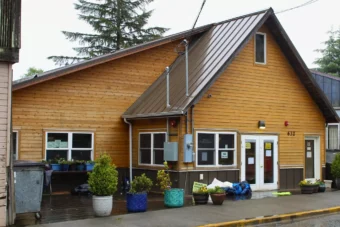
Baranof Island Housing Authority, which constructed this four-plex in the Kaasda He’en Shanaa’x, is hoping to solicit ideas and input from community members on how to expand affordable housing in Sitka. (Robert Woolsey/KCAW)

Tribal citizens in Sitka are being squeezed out of Sitka’s housing market, and some are leaving town, according to a new study commissioned by Baranof Island Housing Authority, with support from Sitka Tribe of Alaska. Now, they are hoping the data – and community input –  will guide them towards solutions.

Cliff Richter is the Executive Director of the housing authority. He said the last tribal housing needs assessment was conducted about five years ago.

“Our data was getting a little stale,” Richter said.

Sitka Tribe and the housing authority collected responses from over 300 Alaska Native or Indigenous households in Sitka and nearly 200 households of Sitka Tribe of Alaska tribal citizens outside of Sitka. The survey found that Native residents in Sitka are more likely to rent instead of own, live in older housing such as mobile homes, and rely on friends or family for shelter. The survey also found that tribal citizens are leaving Sitka at a higher rate than other residents.

Robin Sherman is the Communications Director for Sitka Tribe of Alaska.

“An astounding number of the people who responded said that they were really interested in living in Sitka, but lack of housing, you know, or affordable housing was a big barrier,” Sherman said.

Richter said the survey data has already influenced decision-making at the housing authority, which is now prioritizing higher-density housing and smaller lots in planning a new subdivision on Herb Didrickson Drive. They have other ideas on strategies to expand affordable housing, like weatherization and replacing mobile homes, but Richter said the next step is to involve the community in establishing priorities and solutions. While the survey focused on tribal housing needs, Richter said the issue – and the solutions – are community-wide.

“We’re seeing this as information that’s going to benefit the entire community,” he said.

Baranof Island Housing Authority, Sitka Tribe of Alaska, and the City and Borough of Sitka will co-host a community meeting tonight (4-11-24) to share potential strategies for expanding affordable housing in Sitka and solicit ideas from community members. The event takes place at 6 p.m. at the Sheet’ká  Kwáan Naa Kahídi and is open to the entire Sitka community. You can read the full tribal housing needs assessment here.

You’ll need more than $100,000 in income to afford a typical home, studies show

A sold sign stands outside a home in Wyndmoor, Pa., on June 22, 2022. Two recent studies suggest that prospective homeowners will have to earn more than $100,000 annually to afford a typical home in much of the U.S. (Matt Rourke/AP)

You’ve heard that it’s a tough time to buy a house, but exactly how tough is it?

A pair of recent studies predicts that you’d need to earn more than $100,000 per year to comfortably afford a typical home in much of the U.S. right now.

That’s a major jump from just four years ago, and it comes at a time when fewer homes are on the market and mortgage rates and housing prices have been high. House hunters, meanwhile, haven’t seen their wages increase at the same pace.

“Housing costs have soared over the past four years as drastic hikes in home prices, mortgage rates and rent growth far outpaced wage gains,” Zillow senior economist Orphe Divounguy said in a statement.

The six-figure threshold

A Zillow analysis released in February found that prospective homeowners would have to earn more than $106,000 annually to be able to buy a typical home in the U.S.

That’s an 80% increase from the $59,000 yearly income the website predicted a household would need to comfortably afford a home in 2020.

In a separate study released Monday, the financial website Bankrate suggested Americans would have to rake in $110,871 per year to afford a median-priced home, which the outlet says costs $402,343. That income level surged nearly 50% from its 2020 estimate.

“Home values are near record highs, and if you want a house, you have little choice but to pay a high price,” Bankrate housing market analyst Jeff Ostrowski said.

The national median household income, according to data from the U.S. Census Bureau, is around $74,500.

Location, location, location

Of course, those figures are based on national data, and home prices vary depending on where you want to live.

Bankrate found that aspiring homeowners in 22 states and Washington, D.C., should earn at least $100,000 per year to afford a typical home. Buyers in the South and Midwest require less to pay for new digs than those in the West and Northeast.

Still, the 22 states requiring a six-figure income is an increase from the only six states (and D.C.) where that much money would have been necessary to buy a typical house in 2020.

The states that saw the largest increase in the annual income necessary to buy a typical home were Montana, Utah, Tennessee, South Carolina and Arizona.

In Seattle, New York City, Boston and four major metro areas in California — San Jose, San Francisco, Los Angeles and San Diego — prospective households would have to earn more than $200,000 per year to afford a typical home, according to Zillow.

Memphis, Cleveland, New Orleans and Birmingham were among the most affordable cities.

But Zillow found only three major metro areas in the U.S. where homebuyers making the median income could afford a typically priced home: Pittsburgh, St. Louis and Detroit.

Copyright 2024 NPR. To see more, visit https://www.npr.org.

Juneau Assembly sticks with plan to relocate city-run homeless camp, despite pushback from business owners

A Goldbelt Tram car rises up Mount Roberts above the Mill Campground in August, 2023. (Clarise Larson for the Juneau Empire)

The City and Borough of Juneau is moving forward with a plan to relocate its seasonal campground to a different site further from downtown, despite nearby business owners’ concerns. 

According to Mayor Beth Weldon, the Assembly is tasked with finding an option that is “the best of the very, very worst.” 

City officials proposed the plan to move the city-run campground for people experiencing homelessness last month, citing an increase in illegal activities there last summer. 

The new location is next to the city’s indoor cold weather shelter, in an area mostly populated by commercial businesses by the port. City officials say moving there would make it easier to provide maintenance and emergency services to campers and would ease the campground’s impact on nearby neighborhoods.

But last week, a group of business owners nearby wrote a joint letter in opposition of the plan. 

Kyle McDonnell with Alaska Coach Tours testified at Monday’s Juneau Assembly meeting. He said the city’s proposed location would put commercial businesses at risk of vandalism, break-ins and other criminal activities he said were associated with the indoor cold weather shelter.

“I recognize the difficult position the Assembly is in right now, and I recognize there are no easy solutions. We’ve seen it all winter long with break-ins in the buses, destruction of equipment and garbage scattered all around our property including used needles,” he said. “Putting this camp right in the middle of an industrial-zoned area, full of local businesses, is not ideal for anyone.” 

He and the group proposed a different location even further down Thane Road called the Little Rock Dump, which is owned by Docks and Harbor. The group said moving the campground further down Thane would be safer for both businesses and campers. 

But resident Kiernan Riley opposes the move. They’re concerned that the Little Rock Dump is too far away for campground users to walk to.

“Pushing the Mill campground to Thane, with no way to access it, will make it just that — inaccessible,” Riley said. “Without a shuttle, there’s not a lot of incentivization to walk all the way out the road to a tent when you can put that tent somewhere else that’s more accessible to Foodland or to other resources to get food.”

City officials said the city just does not have enough staff to shuttle people to and from the campground. 

The Assembly voted to move forward with the plan to move the campground next to the cold weather shelter for now. But multiple members said they have concerns. A final decision will likely come at the April 29 Assembly meeting. 

In the meantime, the cold weather shelter is set to close on April 15.

Correction: A previous version of this story misidentified the pronouns of Kiernan Riley. 

If you recently sold your home, you might get part of your realtor fee back

A ‘For Sale’ sign is posted on the lawn in front of a home on March 15, 2024, in Miami, Fla. The National Association of Realtors announced that it had reached a nationwide $418 settlement of claims that the industry had conspired to keep agent commissions high. (Joe Raedle/Getty Images)

Big changes are coming to the way people buy and sell houses in the United States. The National Association of Realtors settled a lawsuit last week that could up-end the way real estate agents are paid, doing away with the traditional agent’s commission of 5-6%. That’s prompting a reckoning for buyers, sellers and real estate agents. Here are six things to know.

What if you already sold a house?

As part of the settlement, the National Association of Realtors agreed to pay $418 million over the next four years. That’s in addition to $210 million that various brokerage firms had already agreed to pay. Lawyers will get a chunk of that money, but the rest will go to people who sold their homes in recent years and paid what critics argue were inflated real estate commissions. Eligibility depends on where you live, but in some parts of the country, the settlement covers people who sold homes as much as a decade ago.

“We don’t know the exact number, but we estimate it to be in the neighborhood of 40 or 50 million” people, says Benjamin Brown, co-chair of the anti-trust practice at Cohen Milstein, one of the law firms involved in the class-action case.

To find out if they’re entitled to compensation, sellers can check the lawyers’ website: www.realestatecommissionlitigation.com.

How will this change real estate commissions ?

For decades, the norm in this country has been for the person selling a home to pay both her own agent and the buyer’s agent. What’s more, the buyer’s share of that commission had to be spelled out in order to advertise the home on the big regional listing sites. Realtors insist they never fixed those commissions, but as a practical matter, the public notice worked to set a standard — often in the neighborhood of 5 or 6%, split between the seller’s agent and the buyer’s agent.

For a home priced at $400,000 — which is close to the national average — that works out to $20,000 to $24,000 in commissions — much higher than people in other countries typically pay. In Germany, commissions average 4.5%. In the UK, they’re under 2%.

Starting in July, sellers will no longer have to spell out a commission for the buyer’s agent. Advocates say that should lead to more negotiation, more competition and ultimately lower costs.

What increased negotiations mean for buyers and sellers?

There’s going to be more opportunity to shop around, and likely a wider array of services, from deluxe agents who charge a premium price to discount agents with more limited services — similar to what exists in other markets like stock brokers and travel agents.

Sellers may be able to negotiate a flat fee to market their house, not connected to the selling price. Buyers may be able to purchase a la carte services — paying less if they do their own house-hunting on the Internet and more if they want to be chauffeured around to open houses.

Many sellers may decide not to pay the buyer’s agent, leaving buyers to shoulder that cost on their own, or go without an agent altogether.

Overall expenses are expected to be significantly lower, however. Economists at the Federal Reserve Bank of Richmond estimate the changes could save homebuyers $30 billion a year, with most of those savings coming out of the pockets of real estate agents.

Prospective home buyers leave a property for sale during an Open House in a neighborhood in Clarksburg, Md. on September 3, 2023. The new real estate commission structure could mean buyers have to pay more out-of-pocket fees starting in July. (Roberto Schmidt/AFP via Getty Images)

What does this mean for agents?

Agents are still sorting out what this might mean for their business. When fees are more negotiable, agents will have to make the case for what they’re worth. But the best agents feel like they do that already.

“Do I think that realtors have to learn to do business in a different way? Absolutely,” says Kevin Wilson, president of the Greater Nashville Realtors. “But I also think this is a wrinkle in the landscape. Not a landmine.”

A drop in commissions might drive some agents into other lines of work, but that’s not necessarily a bad thing. The U.S. has 2.5 to 3 million real estate agents — which is far more than any other country, relative to the size of its housing market. For example, the U.S. has about six times more home sales each year than the U.K. does, but 26 times more agents.

“Do we see agents that work with buyers start to phase out of the business because they’re just not getting as many clients?” asks Jovani Ortiz, an agent on Long Island. “These are sort of the unknowns that most agents are looking at right now.”

While the commission pie is likely to shrink, it may be cut into fewer slices, so the remaining agents might end up making the same amount of money.

With home prices and mortgage rates already high, how will homebuyers pay for their own agents?

While sellers have traditionally paid buyers’ agents in the U.S. (and built that expense into the sales price of their home), many sellers may opt not to pay buyers’ agents in the future. In that case, buyers will have to pay their own agent out of pocket, on top of a down payment and other closing costs. Finding thousands of dollars to pay an agent could be a challenge, especially for first-time buyers, who typically have limited funds and also the greatest need for an agent’s guidance. First-time buyers accounted for just 26% of existing home sales in February — tying a record low.

“Many first time buyers are already at the absolute max of what they’re able to borrow,” says Vanessa Perry, a professor at George Washington University School of Business and a fellow at the Urban Institute’s Housing Policy Finance Center. “They’re not going to be able to come up with any additional cash to pay their own agent.”

Home sellers could still agree through negotiation to pay the buyer’s agent. But in a hot housing market, sellers may have little incentive to do so. Eventually, buyers may be able to fold the cost of their agent’s commission into their mortgage, stretching the payments out over the life of the loan. But that will require a change in mortgage underwriting rules. Over time, lower real estate commissions should lead to somewhat lower housing prices.

What should people who are thinking of buying or selling in the next six months do?

The settlement’s changes in commission rules take effect in July, just as many people will be shopping for homes ahead of a new school year. But it’s not clear how quickly the landscape will change. Buyers and sellers may want to talk with their agent about the costs and benefits of moving before the deadline or waiting until the new rules are in place. Remember, commissions account for $20,000 to $24,000 on a typical home. Still, that’s just one factor to consider when deciding when to buy or sell — along with interest rates, the supply of homes on the market and life circumstances like a new job or family member.

Copyright 2024 NPR. To see more, visit https://www.npr.org.

Juneau’s Forget-Me-Not Manor gets $2M to build more housing for vulnerable residents

Phase two of Juneau’s Housing First project in Lemon Creek doubled the size of the existing Forget-Me-Not Manor. (Photo by Adelyn Baxter/KTOO)

A facility in Juneau that offers permanent housing for people who are experiencing homelessness is slated to receive $2 million in federal funding to expand its reach.   

Mariya Lovishchuk is the executive director of the Glory Hall, which runs the facility in Lemon Creek. She said the money was the final piece in the puzzle they needed to pay for a new phase of construction that will add 28 new units at Forget-Me-Not Manor, bringing the total number of units to 92. 

“This was the missing piece. And now we can start construction and so yeah, we are rolling along full speed ahead,” she said. “We’re just so grateful. And I’m so happy that this is moving forward.”

The money was included in a $459 billion pending bill approved by Congress and signed by the president earlier this month. 

Among its pages are hundreds of projects for Alaska that U.S. Sen. Lisa Murkowski requested, through a process that used to be known as earmarking. It’s now called “congressionally directed spending.” 

Forget-Me-Not-Manor serves people experiencing homelessness who also live with a disability or chronic health issues condition. Along with offering permanent supportive housing, it has physical, behavioral and addiction treatment services on-site.

Lovishchuk said creating low-barrier housing options that are tied to onsite medical services is a crucial step in addressing the root causes of homelessness.

“Juneau is in the middle of a housing crisis. And so what this will mean is that there’ll be 28 more homes for people who really need them the most,” she said. 

Research from the University of Alaska Anchorage School of Social Work found that people who moved into Forget-Me-Not Manor had fewer emergency room visits and police encounters. They also reported better physical and mental health. 

Now with the funding secured, Lovishchuk said they plan to begin construction as soon as late April. 

Other projects in Juneau will receive funds as well, including nearly $100,000 to AWARE — Juneau’s domestic violence support organization — for facility and safety improvements at the shelter. The City and Borough Juneau will get $2 million to upgrade its first responder radio system.

In a statement, Murkowski said the funding is much needed.

“Juneau is getting critical investments that will improve public safety in our state’s capital,” she said. 

Projects in other Southeast Alaska communities — like Gustavus, Pelican and Angoon — also received millions of dollars that Murkowski requested. 

Many of the projects were on Rep. Mary Peltola’s request list, too. Sen. Dan Sullivan doesn’t make requests for congressionally directed spending.

Site notifications
Update notification options
Subscribe to notifications