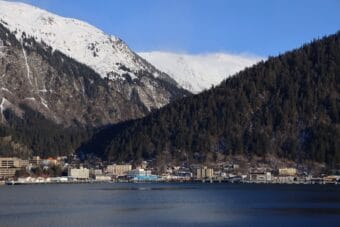
A Goldbelt Tram car rises up Mount Roberts above the Mill Campground in August, 2023. (Clarise Larson for the Juneau Empire)
Juneau is considering moving its city-owned campground primarily used by people experiencing homelessness following an escalation of reported illegal activities there last summer.
Deputy City Manager Robert Barr said moving the campground next to the city’s indoor cold weather shelter would make it easier to provide maintenance and emergency services to campers and ease the campground’s impact on nearby neighborhoods.
“The overall tenor at the campground has really been challenging – last year in particular – but it has been deteriorating over the past couple of years,” he said.
At a committee meeting on Monday, the Assembly unanimously agreed to move forward with the plan and take public comment on it next month. If approved, the new location would open to campers in mid to late April.
For many years the city has run the Mill Campground, a place where people can camp free of charge between April and October. It’s located south of downtown underneath the Goldbelt Tram’s path.
The new location would move campers further south on Thane Road and further away from residential neighborhoods downtown. But, they would still be near many commercial businesses.
Barr cited issues like drug use, vandalism and break-ins and transactional sex as some of the reported criminal activities to be happening at the campground.
“The public impact on this one — I don’t really want to sugarcoat this — I think that the public impact is going to be significant in a geographic vicinity wherever the campground is,” he said.
Assembly member Michelle Bonnet Hale said Juneau is not alone in its struggle to meet the needs of people experiencing homelessness in the community. This winter, the cold-weather emergency center has seen between 40-50 patrons each night.
“This problem is happening across the country in all kinds of places in the country,” she said. “So I think it’s just a very difficult situation and I don’t think we have any good or easy answers right now.”
Currently, it costs the city about $70,000 each year to operate the campground during the summer. Most of the cost comes from clean-up and garbage removal at the site.
Barr said it would cost about $110,000 to move the campground to the new location. He said the city does not plan to provide transportation between the new location and downtown if it is approved.
The new site would have 19 platforms for campers to pitch tents.
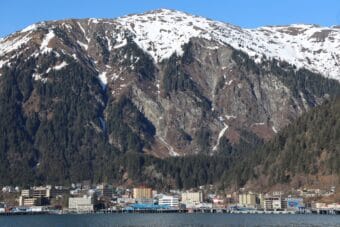
Downtown Juneau in January 2024. (Clarise Larson/KTOO)
Most property assessments in Juneau did not change much from this year to last, according to preliminary data recently shared by the city.
Both residential and commercial property assessments rose by less than 2% on average. Residential property assessments saw an average rise of just about 1.66% overall and commercial assessments rose 1.24% compared to the year before. The value of vacant land rose by less than 1%.
City Finance Director Angie Flick said that reflects a cooling housing market.
“Homes are staying on the market longer,” she said. “We still have a housing crisis in Juneau — that’s not to say that’s no longer an issue — but the market seems to have cooled substantially compared to last year, a couple of years before that.”
Last year, the residential assessed property value increased by an average of about 16% — and some residents reported a more than 40% rise. Commercial property assessments rose by about 6%.
City assessors rely on retail sales data to make their assessments, but that data has become harder to get. Alaska is one of only several states that doesnʼt require disclosure of real estate sale prices. In 2020, the Juneau Assembly mandated disclosure, but that was repealed by voters in the 2022 local election.
Flick said that change has made it more difficult for Juneau’s assessors to do their job.
“Our assessor’s office is working to an end without full data. So, they use the data that they have and they use tools and processes in the trade, and they follow all of the standards. Certainly having full information would create better results,” she said.
Though property assessment notices were recently shared with residents, property tax bills won’t be released until June.
Property taxes are calculated by multiplying a property’s assessed value by the city’s mill rate. The Assembly will decide on a mill rate this spring.
The deadline to file a petition for an assessment to the city is April 1. More information can be found on the city’s website.
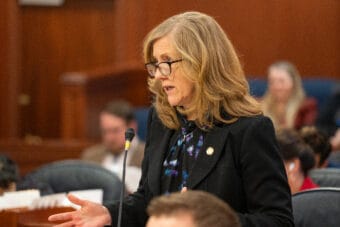
Sen. Jesse Kiehl, D-Juneau, speaks during a joint session of the Alaska Legislature on Feb. 26, 2024. (Clarise Larson/KTOO)
Many residents in both Juneau and Haines saw a jump in their property assessments last year. Now, an Alaska Senate bill would require state accreditation for tax assessors and prevent municipalities from raising the assessed value of properties during an appeal process.
Sen. Jesse Kiehl, a Juneau Democrat, sponsored SB242. He said the bill aims to make the property assessment process in the state more fair and transparent for residents.
“This is a bill that maintains the important principle of local control in local government, but sets some basic rules of the road and a little bit of balance for property owners who disagree with the tax assessor on what their property is worth,” he said.
The bill puts into place new standards for assessors in Alaska by requiring a level 3 certification from the Alaska Association of Assessing Officers or requiring that they work under the supervision of someone who does. But it would also allow municipalities to adopt their own standards instead if they prefer.
The bill would also prevent assessors from raising the value of a property during an appeal process. And, it changes the default for who hears tax appeals to an appointed Board of Equalization, instead of the municipality’s locally elected officials.
Residents from Juneau and Haines gave public testimony on the bill on Thursday. Brenda Josephson, a Haines resident, said she applauds the bill and the guardrails it puts in place following what she said was a “trainwreck” of an assessment process last year.
“We had an uncertified contract assessor that was hired and he enacted a new exotic hybrid mass appraisal valuation system,” she said. “The result was assessments where some properties were assessed in excess of their full and true market value.”
The Haines Borough faced a summer of intense public criticism following a dramatic rise in some property assessments and resulting tax bills. Many residents blamed the borough’s contract assessor who they say did not have proper credentials for the position. However, the borough says the rise in property values is the result of a hot residential real estate market and corrections for out-of-date assessments.
Though nearly all testifiers on Thursday spoke in favor of the bill, some Juneau residents, like Howard Beary, requested Kiehl include an assessment limit in the bill to cap how much the assessed value of a property can increase from one year to the next.
“What I noticed in this bill is there’s no limits, and my property tax went up over 40%,” he said. “This bill has some positive things, but there’s nothing in there that says that they can’t raise it 40%.”
In an interview, Kiehl said that doesn’t fit with the goal of that bill, and he doesn’t want it to disrupt different municipalities’ revenue structures across the state.
Following public testimony, the bill was held in committee for further consideration. Kiehl said he feels good about the chances of the bill moving forward this session.
Houses line the streets of South Douglas in late May. (Photo by Clarise Larson/Juneau Empire)
The Juneau Assembly has offered grants to residents looking to build accessory dwelling units, often called mother-in-law apartments, since 2015. The goal was to promote housing construction in Juneau, especially for long-term rentals.
Last summer, they boosted the funding for that grant program.Now, it’s been six months since the Juneau Assembly approved 16 grants amounting to $13,500 each for residents who want to build accessory dwelling units on their properties.
Members hoped the grants would incentivize people to construct more housing. But the city’s housing and land use specialist, Joseph Meyers, said only one person has applied since the size of the grant more than doubled.
“You know, we are advertising it, and we’re putting it out there. I’ve had a couple of inquiries,” he said. “So there’s some interest, it might just be that there’s not a ton of knowledge of the program.”
The previous version of the grant only offered $6,000. So far, 44 residents have used the grant funding since it began in 2015. In total, it’s estimated there are more than 800 accessory dwelling units in Juneau.
In August, the city boosted the program to adjust for inflation and the rise in construction costs.
Meyers said the cost of building additions like accessory dwelling units can be spendy — upwards of $100,000 in some cases. He says the city grant won’t cover the entire cost of adding a unit — but he says it’s a start.
“The price of putting in an accessory dwelling unit has always been a little bit expensive. We really wanted to try to be able to cover more of the cost or to try to provide more for people to develop more units,” he said.
Assembly member Michelle Bonnet Hale supported increasing the grants back in August. Now, she said she is not sure why people aren’t biting at the opportunity, but one reason could be the high cost of construction.
“It’s just a drop in the bucket. Right? I mean, it depends if you’re just like converting a room or converting something above a garage or something — that’s one thing. But if you’re actually building something, that’s just a drop in the bucket,” she said.
Hale said restrictions may also dissuade people from building more housing. Accessory dwelling unit grant recipients can’t use the unit as a short-term rental for at least five years.
According to the 2023 economic indicator report from the Juneau Economic Development Council, renters in Juneau pay an average of about $1,400 per month.
On the flip side, the average rate for a short-term rental in Juneau is about $5,600 per month. That’s according to data from airDNA, a company that tracks short-term rentals in cities around the world.
The city has sent out press releases and social media posts about the program. But Hale said they’ll need to do more to promote it if they want more people to apply.
City leaders said there are 15 grants now available. More information is available on the city’s website.
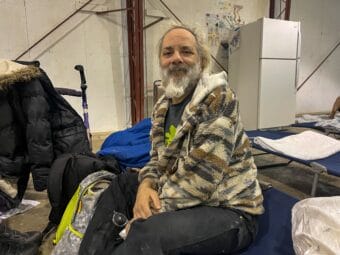
A man named Frank sits in his tent with a river view in Portland, Ore., in 2021. A lawsuit originally filed in 2018 on behalf of homeless people in the Oregon city of Grants Pass is set to go before the U.S. Supreme Court in April. (Paula Bronstein/AP)
In April, the U.S. Supreme Court will hear a major case that could reshape how cities manage homelessness. The legal issue is whether they can fine or arrest people for sleeping outside if there’s no shelter available. The 9th U.S. Circuit Court of Appeals has deemed this cruel and unusual punishment, and this case is a pivotal challenge to that ruling.
The high court declined to take up a similar case in 2019. But since then, homelessness rates have climbed relentlessly. Street encampments have grown larger and have expanded to new places, igniting intense backlash from residents and businesses. Homelessness and the lack of affordable housing that’s helping to drive it have become key issues for many voters.
The case, Grants Pass v. Johnson, could have dramatic implications for the record number of people living in tents and cars across the United States.
An Oregon town banned camping and the use of sleeping bags and stoves on public property
In the small city of Grants Pass, Oregon, homeless people say the city broke the law when it aggressively tried to push them out over the past decade. To discourage people from sleeping in public spaces, the city banned the use of stoves and sleeping bags or other bedding. But during several years when she had lost housing, Helen Cruz says she needed to live in city parks because they’re close to the jobs she had cleaning houses.
“We’re not out there because we want to be,” she says. “We don’t have a choice. There’s no place to go.”
Grants Pass has no homeless shelter that’s open to everyone. A religious mission takes in a few who agree to attend services. That left Cruz racking up thousands of dollars in fines, which she remains unable to pay.
“And I keep getting mail from Josephine County court saying, ‘You owe this. If you don’t pay this, it’s going to collections,'” she says, “which has destroyed my credit.”
A lawsuit originally filed in 2018 on behalf of homeless people in Grants Pass said the situation there was part of a larger crisis, as homelessness rates around the U.S. were high and growing. It accused the city of trying to “punish people based on their status of being involuntarily homeless.” The 9th Circuit agreed, saying the city could not ban people from sleeping outside with “rudimentary protection from the elements” when there was nowhere else for them to go.
The same appeals court also sided with homeless people in a landmark 2018 case out of Boise, Idaho, which the Supreme Court later declined to take up.
Critics say the Grants Pass ruling is a major expansion over the Boise one, since it forbids not just criminal penalties but civil ones. Advocates for homeless people don’t see much difference, since some in Grants Pass who couldn’t pay their fines were eventually jailed.
Grants Pass petitioned the Supreme Court. And its appeal has drawn support from dozens of local and state officials across the West and elsewhere who urged the justices to take this case. Among those filing such friend-of-the-court briefs are Republican-led states like Idaho, Montana and Nebraska and Democratic-led cities like Los Angeles and San Francisco, plus a separate brief from California Gov. Gavin Newsom.
Officials say the law has paralyzed their efforts to manage a public safety crisis
States and cities contend these rulings have contributed to the growth of tent encampments.
“These decisions are legally wrong and have tied the hands of local governments as they work to address the urgent homelessness crisis,” Theane Evangelis, the attorney representing Grants Pass, said in a statement. “The tragedy is that these decisions are actually harming the very people they purport to protect.”
Evangelis and others say sprawling tent camps pose a threat to public health and safety. Those living in them often face theft or assault and are at risk of being hit by passing vehicles. And they note that encampments have led to fires, disease, environmental hazards and high numbers of people overdosing on drugs and dying on public streets.
“It’s just gone too far,” California Gov. Gavin Newsom said last year at a Politico event in Sacramento. “People’s lives are at risk. It’s unacceptable what’s happening on the streets and sidewalks. Compassion is not stepping over people on the streets.”
Critics also say the 9th Circuit’s rulings are ambiguous and have been interpreted too broadly, making them unworkable in practice.
“We need to have clarity,” says Seattle City Attorney Ann Davison, who wrote a legal brief on behalf of more than a dozen other cities plus the National League of Cities.
For example, what exactly constitutes adequate shelter? And what about when a bed is open, but someone refuses to go? Local officials say that this happens a lot, and some acknowledge that people might have good reasons to not want to go to a shelter. Yet Davison says court rulings essentially require cities to build enough shelter for every person without housing, something many places can’t possibly afford.
They also argue that homelessness is a complex problem that requires balancing competing interests, something local officials are better equipped to do than the courts.
“We are trying to show there’s respect for the public areas that we all need to have,” Davison says. “And we care for people, and we’re engaging and being involved in the long-term solution for them.”
Advocates say punishing homeless people won’t solve the problem
Attorneys and advocates for the homeless plaintiffs argue that the 9th Circuit rulings are far narrower and less restrictive than cities claim.
“It’s interesting to me that the people in power have thrown up their hands and said, ‘There’s nothing we can do, and the only solution we can think of is to arrest people,'” says Jesse Rabinowitz of the National Homelessness Law Center. “That’s simply not true.”
He and others say the rulings do allow cities to regulate encampments. They can limit the time and place for them, ban the use of tents, even clear them out. And plenty of cities do that, though they often face lawsuits over the details of what’s allowed.
Grants Pass did what’s not allowed, which is ban camps everywhere all the time, says Ed Johnson of the Oregon Law Center, which represents those suing the city. He says that would basically make it illegal for people to exist.
“It’s sort of the bare minimum in what a just society should expect, is that you’re not going to punish someone for something they have no ability to control,” he says.
The reason they can’t control being homeless, Johnson says, is because Grants Pass — like so many cities around the U.S. — has a severe housing shortage and unaffordable rents. He says that cities are blaming the courts for decades of failed housing policies and that fining and jailing people only makes the problem worse.
“When we criminalize people, we know it impacts their ability to get a job,” says Ann Oliva, CEO of the National Alliance to End Homelessness. “It impacts their ability to get housing in the long run if they have a criminal record.”
Some cities that side with Grants Pass say they have invested heavily to create more affordable housing, even as homelessness rates keep going up. That’s a long-term challenge they’ll still face, whatever the Supreme Court decides.
Copyright 2024 NPR. To see more, visit https://www.npr.org.
Assembly member Paul Kelly, center, asks a question during an Assembly committee meeting on Monday, Feb. 12, 2024. (Clarise Larson/KTOO)
The Juneau Assembly has asked city staff to move forward with a Telephone Hill redevelopment plan that would demolish the neighborhood’s historic homes and add more than 100 new housing units.
Designers shared four redevelopment models with Juneau residents in the fall. Option C added the most new housing — 100 to 200 apartments in mid-rise buildings. Option D was the only plan that preserved some of the existing houses while adding apartments among them.
In an online survey, Juneau residents gave Option C just 13 more votes than D. But at an Assembly Committee of the Whole meeting Monday night, member Christine Woll said their decision was a response to Juneau’s housing crisis, not the survey.
“Option C barely quote-unquote won the survey,” she said. “I think that’s a useful piece of information, but I think our decision should be based on what we think is best for the community based on what we know.”
“The level of housing people are asking for, I think we can achieve that and allow people who are living in the area to remain in their homes if we proceed with, instead, Option D,” he said.
First Forty Feet’s Options C and D were the most popular Telephone Hill redevelopment models in a recent city survey. (Screenshot from City and Borough of Juneau document.)
But Mayor Beth Weldon said tenants may have had to leave even if the city left the houses standing.
“We have to remember that if we leave the houses there, the people that are in them currently may not stay in them because they’ll go up to fair market value,” she said. “And after my tour there — there’s a house there that has some land. It’s a big house with a view. That house is going to go for $900,000.”
Assembly member Wade Bryson said they had a responsibility to serve all of Juneau’s residents.
“I would hate for this Assembly to take an action that would stop economic growth for a small group of individuals, a small group of Juneauites,” he said. “That doesn’t seem like the common good or good for the community.”
The Assembly voted to direct staff to refine Option C, with Kelly voting no.
The Assembly also agreed that the historic review process had been sufficient, and that a more extensive review wasn’t necessary. Kelly cast the only no vote.
Architects had reported on the historic significance of Telephone Hill and its houses, most of which were built in the early 1900s. The state had owned the buildings from 1984 until last March, when it transferred ownership of the land to the City and Borough of Juneau.
An assessment of the buildings’ condition found water damage, roof leaks and rotten window sills and door frames in many of the houses. In the assessment, engineers wrote that it is “likely not economically feasible for CBJ to own or rent” the houses.
Close
Update notification options
Subscribe to notifications
Subscribe
Get notifications about news related to the topics you care about. You can unsubscribe anytime.