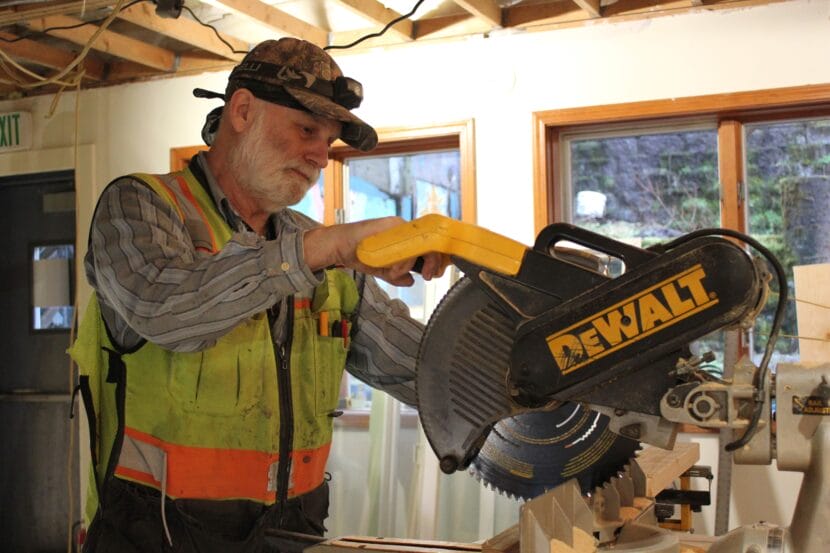
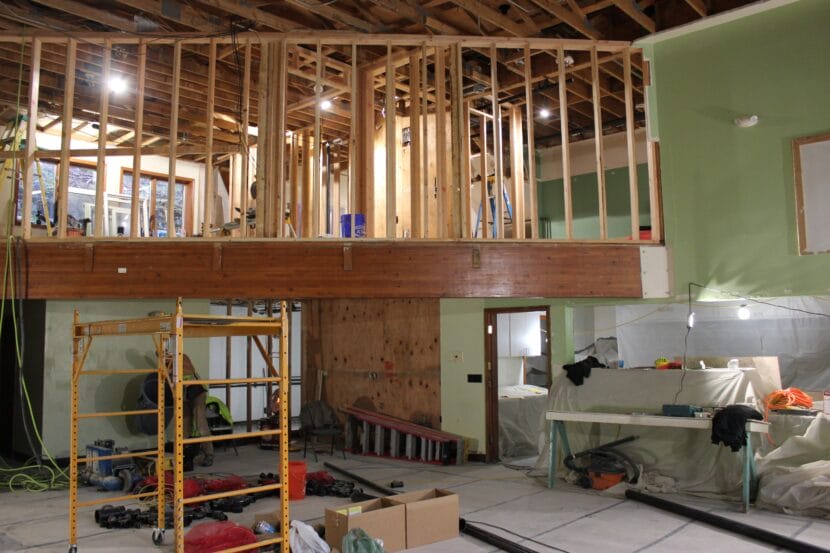
Carver Construction carpenter Tom LeBlanc is overseeing construction work at the Glory Hall’s downtown building. (Katie Anastas/KTOO)
The Glory Hall is seeking a commercial tenant for the ground floor of its downtown Juneau space.
Work to convert the building, which previously housed the Glory Hall’s emergency shelter before it moved to the Mendenhall Valley in 2021, began in November. Once construction is complete, the building will have seven affordable housing units upstairs and a 2,000-square-foot commercial space downstairs.
Tom LeBlanc, with Carver Construction, is overseeing the project. Standing on the third floor Thursday morning, he said work is moving along well.
“All the framings are done up here,” he said. “Now the subs will be coming in – the electricians, the plumbers – so we still have a little ways to go. But so far, so good.”
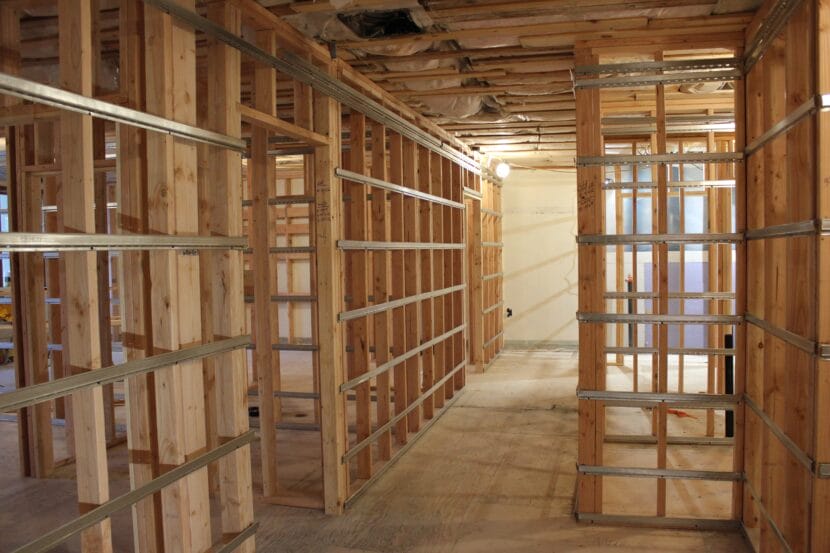
Framing was underway on the second floor of the Glory Hall’s downtown building on Jan. 4, 2024. The second floor will have two apartments. (Katie Anastas/KTOO)
Mariya Lovishchuk, executive director of the Glory Hall, said the building will have a one-bedroom apartment and six efficiency units. While the Glory Hall’s Forget-Me-Not Manor in Lemon Creek provides addiction treatment and behavioral health services on site, the downtown units are meant for tenants who don’t need that kind of support.
“These apartments are going to be for people who are below median area income, and people will have to be able to live independently and successfully in these units without on-site staff,” Lovishchuk said.
Lovishchuk hopes to have tenants move into the apartments in June. Rent will be below the fair market rent – in Juneau, fair market rent is $1,138 for an efficiency unit and $1,307 for a one-bedroom. They’ll also accept housing vouchers.
“There are so many people in Juneau looking for housing, with or without vouchers, and just cannot find the actual units,” Lovishchuk said. “We are really hoping to solve even a small portion of this.”
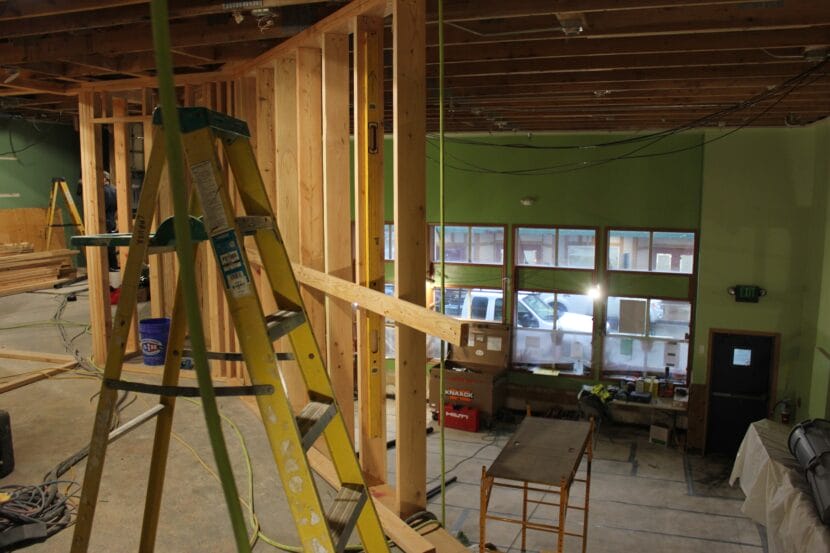
The third floor of the building will have five affordable apartments. Carver Construction has completed framing work there. (Katie Anastas/KTOO)
The downstairs space will have a full commercial kitchen, but Lovishchuk said they’re open to all kinds of businesses interested in supporting the Glory Hall’s mission to provide housing. The commercial lease will subsidize rent for the upstairs tenants.
“We’re really hoping to have somebody in there before the tourist season really, really picks up,” she said.
Lovishchuk said tenant applications will likely be available in April. She said people interested in the commercial space can contact her by email at info@feedjuneau.org. A committee of board members will review proposals and negotiate a lease.
The Glory Hall’s downtown building includes a 2,000-square-foot commercial space on the ground floor. (Katie Anastas/KTOO)
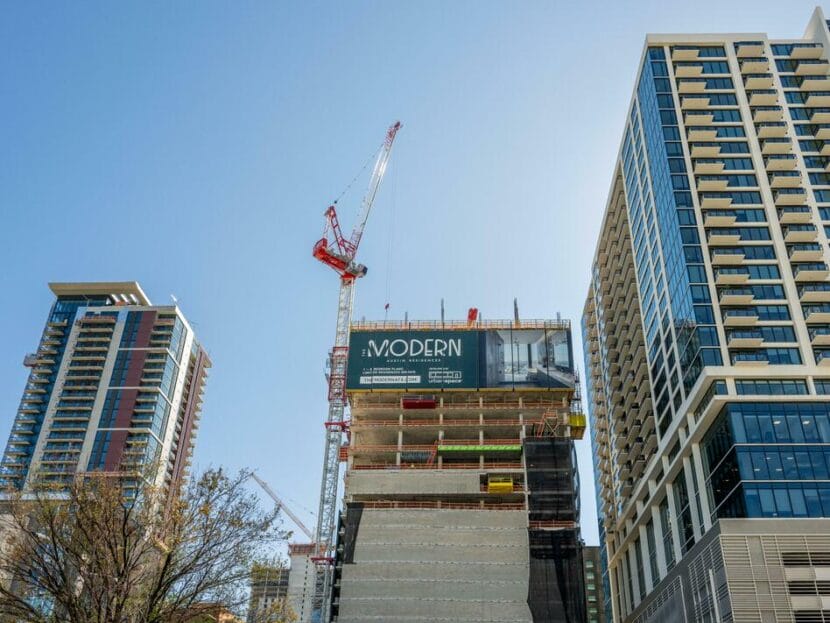
Austin, Texas, is the country’s largest city to toss out its requirements for off-street car parking. The city hopes removing the mandates will encourage other modes of transportation and help housing affordability. (Brandon Bell/Getty Images)
The city council in Austin, Texas recently proposed something that could seem like political Kryptonite: getting rid of parking minimums.
Those are the rules that dictate how much off-street parking developers must provide — as in, a certain number of spaces for every apartment and business.
Around the country, cities are throwing out their own parking requirements – hoping to end up with less parking, more affordable housing, better transit, and walkable neighborhoods.
Some Austinites were against tossing the rules.
“Austin has developed as a low density city without adequate mass transportation system,” said resident Malcolm Yeatts. “Austin citizens cannot give up their cars. Eliminating adequate parking for residents will only increase the flight of the middle class and businesses to the suburbs.”
But much more numerous were voices in support of eliminating the minimums and the impact they’ve had on housing costs, congestion, and walkability.
“I think our country has used its land wastefully, like a drunk lottery winner that’s squandered their newfound wealth,” said resident Tai Hovanky. “We literally paved paradise and put up a parking lot.”
The amendment sailed through the council — making Austin the biggest city in the country to eliminate its parking mandates citywide.
“They’re all just dead weight,” says Tony Jordan, the president of the Parking Reform Network, of parking minimums. One issue is just how arbitrary they can be.
Take bowling alleys. Jordan says the number of required parking spots per bowling lane could vary anywhere from two to five, in cities right next to each other.
“What’s the difference between a bowler in city A and city B? Nothing. It’s just these codes were put in … very arbitrarily back 30 or 40 years ago and they’re very hard to change because anytime the city wants to change them, there’s a whole big hoopla,” he says.
San Francisco is one of many U.S. cities that has thrown out its parking minimums in recent years. (Justin Sullivan/Getty Images)
Random as these rules can be, they have major consequences: Parking creates sprawl and makes neighborhoods less walkable. Asphalt traps heat and creates runoff. And parking minimums can add major costs to building new housing: a single space in a parking structure can cost $50,000 or more.
One 2017 study found that including garage parking increased the rent of a housing unit by about 17 percent.
The real problem, says Jordan, is what doesn’t get built: “The housing that could have gone in that space or the housing that wasn’t built because the developer couldn’t put enough parking. … So we just lose housing in exchange for having convenient places to store cars.”
A move to let the market decide
Austin City Council member Zo Qadri was the lead sponsor on the resolution to remove parking mandates there. He emphasizes that getting rid of parking mandates isn’t the same thing as getting rid of parking: “It simply lets the market and individual property owners decide what levels of parking are appropriate or needed.”
Austin removed parking requirements for its downtown area a decade ago, “and the market has still provided plenty of parking in the vast majority of the projects since then,” says Qadri.
A new survey from Pew Charitable Trusts found that 62% of Americans support property owners and builders to make decisions about the number of off-street parking spaces, instead of local governments.
Angela Greco, a 36-year-old musician and copywriter in Austin, is one of them. She drives, but prefers to walk or take transit. She’s not worried that doing away with the old rules will make it too hard to find a place to park.
“I’ve lived in like cities where it’s way more difficult, like New York and L.A.,” Greco says. “Parking just isn’t that difficult in Austin to me to begin with, even in really dense areas.”
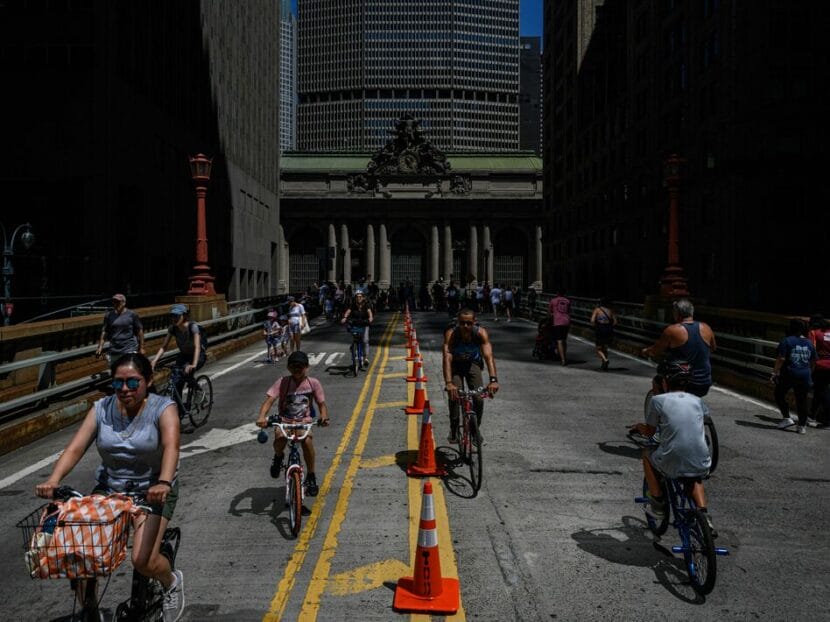
Many cities hope that ditching their parking requirements will make their neighborhoods more amenable to biking and walking. People are seen biking and walking along Park Avenue near Grand Central Station during the Summer Streets initiative in New York City in August 2022. (Ed Jones/AFP via Getty Images)
She says the question of whether the city invests in transit and walkability, or doubles down on cars, is decisive in whether she’ll live in Austin long-term.
“Like if it doesn’t seem like the public transit’s going to get better, and if it seems like the highway expansion is going to happen, then I’m probably going to start looking for where else I can live. … It’s a major factor in my life and my happiness. Like sometimes I’m driving on the road and I’ll be in traffic or something or even just on the highway, and it’s such an ugly landscape,” Greco says. “And then I’ll think: this isn’t really how I want to spend my adult life.”
Too much parking can hinder effective transit
What about the idea that cities without good transit can’t cut back on parking?
Jonathan Levine, a professor of urban and regional planning at the University of Michigan who studies transportation policy reform, says cities’ parking minimums can make good transit nearly impossible to develop.
“An area that has a lot of parking is transit-hostile territory,” he says.
He explains why: When people take transit, they complete their journey by walking to their destination. A sea of parking at the destination makes that walk longer, and it makes the physical environment less appealing to those on foot.
“Who wants to walk by a bunch of parking lots to get to your destination?” Levine notes.
And having tons of parking encourages driving. “If you have parking everywhere that you’re going, that parking essentially is calling to the drivers, drive here! Park here! … So if you keep on designing those areas by governmental mandate, you’re creating areas that transit can’t serve effectively,” says Levine.
Many more U.S. cities – including New York City, Milwaukee, and Dallas — are exploring getting rid of their parking minimums too. Duluth, Minn., lifted its parking mandates in December.
Levine says getting rid of these rules is good news for cities.
“It’s a huge drag on housing affordability. And it’s a huge impediment for cities fulfilling their destiny, which is enabling human interaction. Because what parking does is it separates land uses, separates people. It makes cities have a much more sprawling physical profile than they otherwise would have.”
Copyright 2024 NPR. To see more, visit https://www.npr.org.
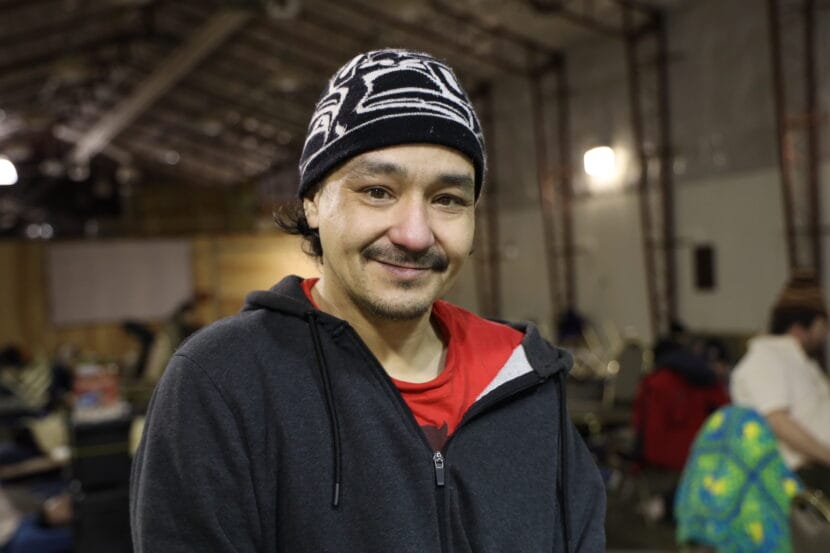
Julien Piccard poses for a photo at the new emergency warming shelter location in Juneau on Thursday, Dec. 21, 2023. (Clarise Larson/KTOO)
In a warehouse about a mile south of downtown Juneau, Julien Piccard sat at a table near his cot with a late-night dinner of ramen and a plastic-wrapped sandwich.
Piccard has been without stable housing since 2007. For the last few years, he’s relied on Juneau’s winter emergency shelter, a city-funded space that’s meant to be a last resort for unhoused people to survive the night when temperatures drop below freezing.
“If it wasn’t for this place, I don’t know what I would do honestly. It would be bad,” he said.
Piccard said it isn’t where he wants to be – surrounded by strangers in an industrial warehouse meant for storage, not housing. But if he wants to make it through this winter, it’s where he has to be.
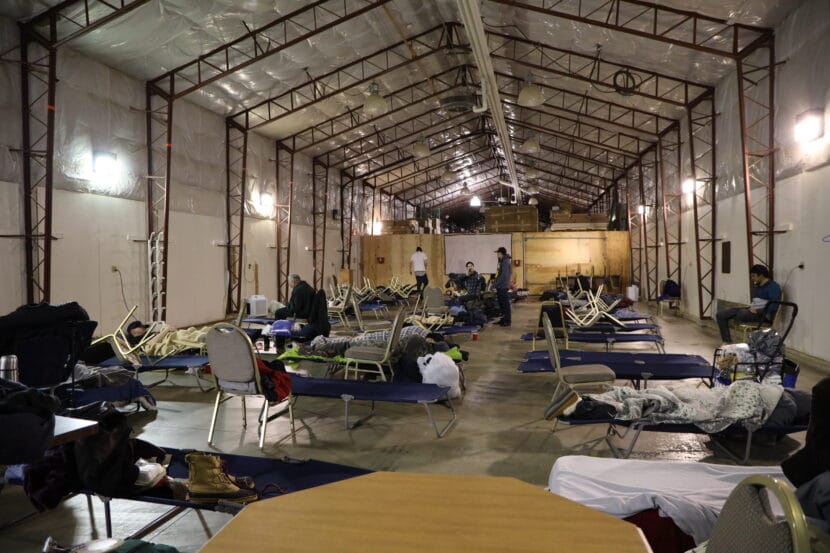
Patrons at the new emergency warming shelter location in Juneau settle in for the night on Thursday, Dec. 21, 2023. (Clarise Larson/KTOO)
“I haven’t always been in this position, you know?” he said. “I used to work, have a family… When you’re in Juneau and you get down to the bottom, no matter how hard you fight and claw, and try and get your way back up, you can’t.”
For two years, the city’s emergency shelter was located downtown at Resurrection Lutheran Church in the Flats neighborhood. But this summer, the church’s congregation was split on whether to run the shelter again, citing rising costs and wear and tear to the church. No other providers offered to fill in because they didn’t have a suitable space.
As winter approached with no plan in place, city leaders decided in October to relocate the shelter to the city-owned warehouse in Thane and work with St. Vincent de Paul to operate it. The organization previously ran the shelter from 2019 to 2021.
The warehouse was warm inside Thursday night. A temporary plywood wall separates the shelter from half of the building that’s used as the city’s ballot processing center. The cold air outside quickly dissipated to the smells of soup, and the sounds of low chatter.
The warehouse has heating, insulation and electricity, though its bathrooms are port-a-potties that sit just outside. There’s no running water. It’s open from 9 p.m. to 7 a.m. and St. Vincent de Paul provides meals at night and in the morning.
Shelter manager Jackie Bryant said this winter on its busiest nights, nearly 50 people have stayed there, and 163 individuals have used the shelter since it opened in late October. Despite the snowier and colder winter expected ahead, Bryant said after her first visit to the warehouse, she was sure the new shelter could provide the basics for people to get through the night.
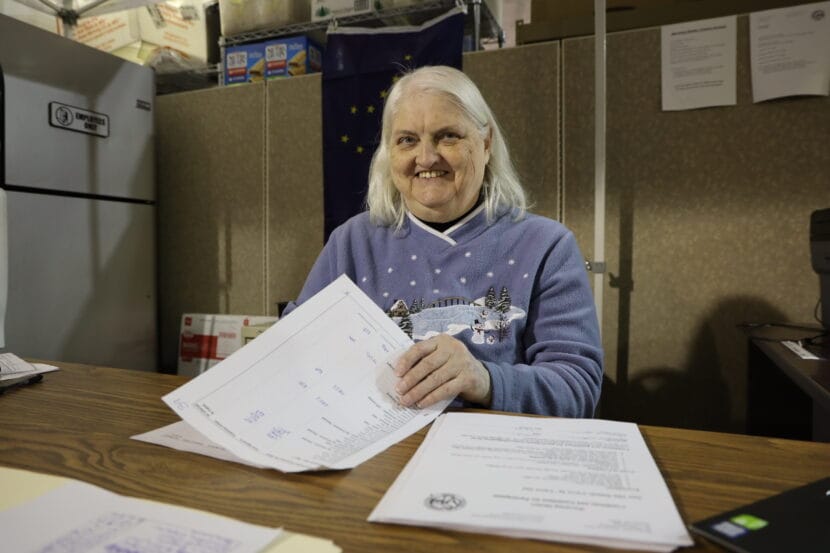
Jackie Bryant, the manager at Juneau’s new emergency warming shelter location, smiles for a photo at the shelter on Thursday, Dec. 21, 2023. (Clarise Larson/KTOO)
“That was my first reaction: it was warm in here,” she said. “That’s what they need.”
Bryant said the warehouse has been running better than she expected, but it’s still just an emergency stopgap to Juneau’s greater housing crisis.
“A warming shelter is not a solution,” Bryant said. “It just keeps people alive, which is what it’s designed for, to keep them alive during the winter. It does not replace housing by any means. But there’s a real need for it.”
Ogla Askoak, one of the shelter’s staff, knows that need well. On Thursday she stood at a table near the shelter’s entrance and helped new patrons sign in as they came in for the night.
“I really enjoy working with these people. I look forward to coming to work all the time,” she said.
Askoak said she understands the struggle of being unhoused in Juneau because she’s been on the other side of the table.
“I was homeless before, me and my kids. We lived in a smaller village, and we didn’t really have any help, anyone to reach out to,” Askoak said. “And then we came here to Juneau with no place to go.”
Askoak said she and her daughter first went to AWARE’s shelter, then to St. Vincent and found stability here. Askoak has worked with people experiencing homelessness for over a decade. She said the new shelter works, but she wishes it had a kitchen.
“I find myself somewhat bored, because that’s the one thing I really enjoy doing is baking, being in the kitchen, seeing everyone happy that they got something warm to take out,” she said.
Julien Piccard said he wishes they had more blankets and cots, and a place to store belongings during the day.
“You can’t leave anything here. So you can’t you can’t really build anything up, you know, like clothing or something like that,“ Piccard said. “It’d be cool if there was some place where we can store some stuff, you know? But it is what it is.“
One problem both shelter staff and guests mentioned is the location. St. Vincent de Paul and the city coordinate transportation from the Mendenhall Valley and downtown to the shelter, using a city bus in the morning and a 15-passenger van at night.
The city bus takes patrons to the Glory Hall’s Teal Street campus, stopping on request along the way. In the evening a van run by St. Vincent De Paul makes two or three laps from the Glory Hall through downtown to the shelter. Staff say it makes a few more trips from downtown during the night.
Bryant said she’s not a fan of the shelter’s distance from downtown, either.
“I really don’t care for the location. I’m gonna be honest, I really don’t. But it’s working,” Bryant said. “We’re used to being downtown in the JACC, or when it was at St. Vincent’s. You’re right there.”
That includes quick access to emergency services. She was initially worried the distance would mean longer wait times if help was needed for medical or safety reasons. So far, she said that extra help has come quickly.
For now, Bryant said the shelter’s biggest needs are more blankets and socks.
An empty lot where a house once stood in Houston. The former residents moved because of flood damage. A new study suggests that people are moving away from the most flood-prone neighborhoods in cities that are otherwise growing in population. (Claire Harbage/NPR)
Hundreds of thousands of neighborhoods in the United States are seeing population decline as a result of flooding, new research suggests. Those neighborhoods are often located in areas that are growing in population overall, including parts of Florida, Texas and the region around Washington, D.C.
The results underscore how flood risk – which is growing due to climate change – is already affecting where Americans live.
“People are being more selective about where they live,” says Jeremy Porter, one of the authors of the study and a researcher at the First Street Foundation, a research and advocacy organization that publishes analyses about climate hazards including flooding. The study was published in the journal Nature Communications.
Americans are flocking to some of the most flood-prone parts of the country, including coastal areas, and low-lying cities in Florida, Texas and coastal Virginia. At the same time, heavy rain and sea level rise from climate change means floods are getting larger and more frequent.
As a result, the cost of flood damage in the U.S. has skyrocketed in recent years. The Federal Emergency Management Agency, home insurance companies and climate and housing experts all warn that huge financial losses from flood damage are not sustainable for families or the economy.
At the same time, people buying homes are increasingly aware, and wary, of flood risk. More and more states are requiring that homebuyers receive information about whether a house has flooded before, and whether it is likely to flood in the future. Some real estate listing sites include information about flood risk. And people are less likely to search for flood-prone properties when they are given information as part of the listing about whether a home flooded in the past or is likely to flood in the future, according to a study by the real estate website Redfin.
But if people are trying to avoid moving to flood zones, why are so many people ending up in the most flood-prone parts of the country? The authors of the new study offer some new insight.
They looked at the number of people living in each of the more than 11 million census blocks in the contiguous U.S., and analyzed how that number changed in places with high exposure to floods versus lower exposure to floods. They found that about 7% of census blocks – which are roughly the size of a city block – are experiencing population decline due to flood exposure.
They estimate that those neighborhoods saw a net loss of about 9 million residents between 2000 and 2020. And they found that many of those neighborhoods are located in places that are growing overall, such as South Florida and Southeast Texas.
The results suggest that the influx of new residents into flood-prone cities such as Miami and San Antonio may obscure the millions of people who are moving more locally to get away from the lowest-lying neighborhoods in those cities.
Moves to the Sun Belt “are a macro migration trend,” explains Porter. “But they’re dwarfed by the amount of people that move within their same city. Keep the same job, keep the same friends, stay close to family.”
Previous research has found that most people stay local when they move to a new home, including in situations where a flood disaster forced them to relocate. That means decisions about where to live and how to stay out of harm’s way often come down to block-by-block or even house-by-house comparisons.
And, while flood risk appears to play a role in where people choose to live, social factors including race and class are also hugely important, says Kevin Loughran, a sociologist at Temple University who studies relocation from flood zones.
“Flood risk, or environmental risk in general, is not the only criteria they’re using to make these decisions,” says Loughran.
The new study offers a new level of national insight into how flood risk might be affecting local trends in population, he says. But the details are still fuzzy, and further research is underway by social scientists and others to study exactly how people who live in areas threatened by climate hazards decide whether, and where, to move.
Copyright 2023 NPR. To see more, visit https://www.npr.org.
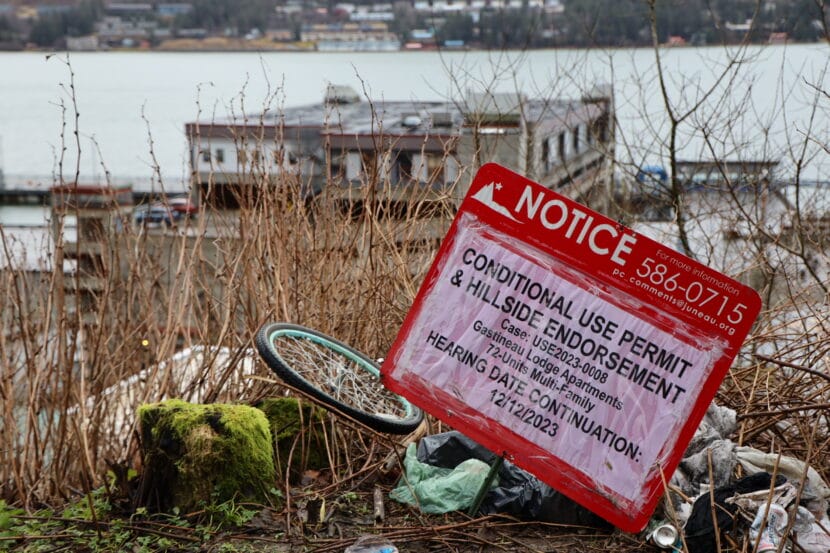
A sign sits at the site of a future 72-unit apartment building downtown on Wednesday. The project was OK’d for a conditional land-use permit by the city planning commission on Tuesday, Dec. 12, 2023. (Clarise Larson/KTOO)
A project meant to bring dozens of new apartments to downtown Juneau cleared a major hurdle Tuesday when the city planning commission approved a conditional land-use permit for a 72-unit apartment building despite safety concerns from some top city officials.
Juneau resident Ke Mell told the planning commission she thinks the project will be “a tremendous asset to downtown.”
“I realize there are significant technical challenges and maybe they all haven’t been addressed yet, but I would definitely be very supportive of seeing this move forward,” she said.
Of the eight commissioners, only one voted against the permit. But that decision came after hours of discussion.
The six-story building is set to be located on three vacant lots on Gastineau Avenue, just uphill from the downtown library. Capital City Fire Rescue Chief Rich Etheridge said the department would not support the project due to its location.
“It is a higher risk of damaging personal vehicles, damaged equipment, getting equipment stuck, not being able to access people having emergencies,” he said. “Landslides definitely, especially this day and age, that’s always a concern.”
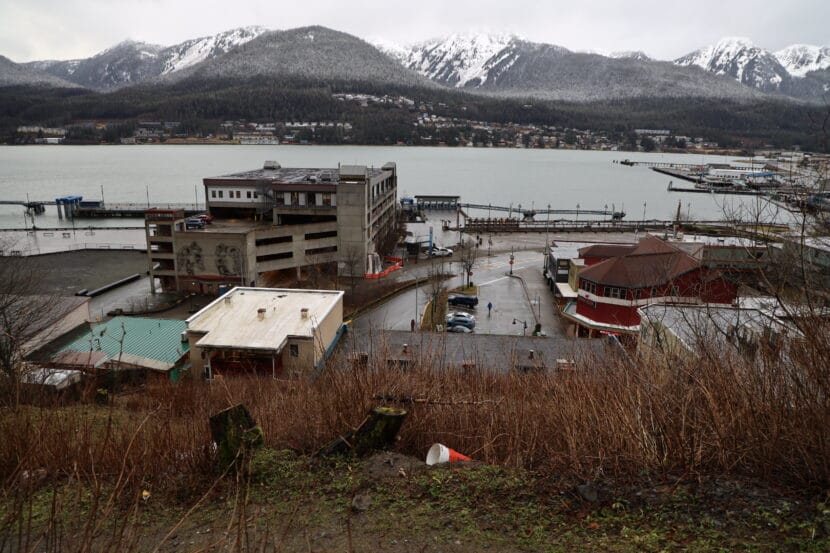
Gastineau Avenue is a dead-end street, and there isn’t an easy turnaround point. The project’s site is on a downhill slope toward South Franklin Street on the Mount Roberts hillside. It’s a short walk away from the place where a landslide damaged homes and displaced residents last year.
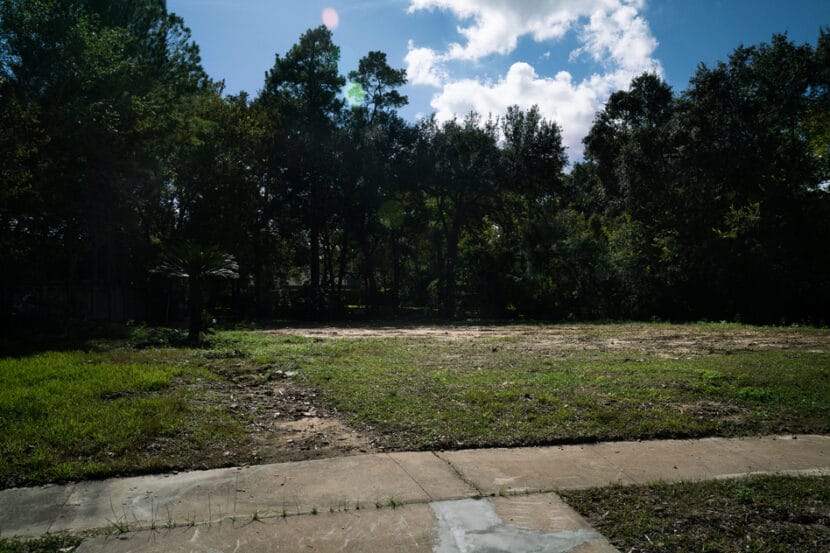
This is a photo of the site for a future 72-unit apartment building downtown on Wednesday. The project was OK’d for a conditional land-use permit by the city planning commission on Tuesday, Dec. 12, 2023. (Clarise Larson/KTOO)
Etheridge shared a memo outlining several public safety concerns, pointing to vehicle congestion, limited parking, natural hazards and the lack of easy access. And he said increasing the number of units in the area would only make those problems worse.
City staff also recommended the commission deny the permit, citing similar concerns.
The applicant from private development group Gastineau Lodge Apartments LLC, Steve Soenksen, said much of the building will be for workforce housing. Of the new units, 61 will be studios and another eight will be handicapped-accessible. All are slated to be fully furnished and ready by the summer of 2025.
Only seven parking spots will be constructed for the 72 units. However, that’s seven more than is required per the zoning in the area. The developers say an additional two bike racks will be built nearby.
Vehicle congestion and lack of parking was a concern for Commissioner Mandy Cole.
“This design works if people aren’t bringing their cars,” she said.
Commissioner Paul Voelckers voted in favor of the project. He said it should be celebrated for what it will mean for downtown housing.
“At the end of the day, we all understand and have all been working at some fashion to increase housing downtown for years and years,” he said. “I think this has historically been a successful site for housing.”
The project was granted $700,000 in a predevelopment loan from the city’s affordable housing fund in October 2022. It will still need to go through a building permitting process before construction can begin.
Fire code requires a second emergency access point. Jill Maclean, the city’s director of community development, said she is unsure what that would be.
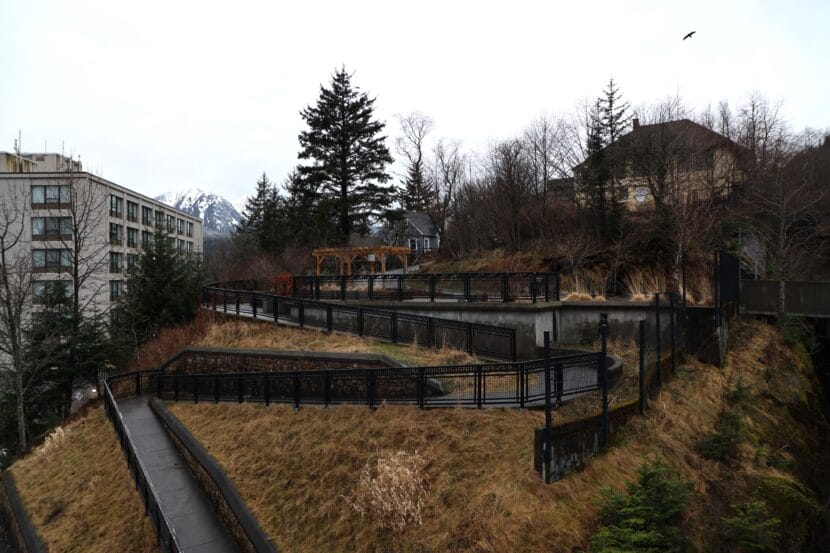
Stairs lead up to Telephone Hill downtown on Wednesday, Dec. 13, 2023. (Clarise Larson/KTOO)
Juneau residents have until Jan. 9 to weigh in on a survey seeking input on how to redevelop the city’s four-acre Telephone Hill property.
“We’re trying to figure out what the needs are and how we can use Telephone Hill to fulfill those,“ said Nick Druyvestein, the project’s manager.
The online survey opened Tuesday and includes descriptions of four concepts the city’s design contractors shared with the public this fall. Participants can select their favorite option and suggest improvements.
All four options include adding more housing to the area. The lowest-density option includes 32 units, while the highest-density option would add 200. The city estimates 17 people live on the hill currently.
Druyvestein said the survey results will be key in directing what the project will look like.
“What we’re trying to figure out is our needs in Juneau that could be fulfilled with the land on Telephone Hill,” he said. “And then also presenting just our development concepts and getting input based on those.”
The units range from townhomes to apartments and hotels. Some of the designs incorporate public gathering spaces and tree canopies.
Many residents who live on Telephone Hill have opposed the city’s plan to redevelop the area. At two community events for gathering public input on the project, most who spoke said the city should preserve the existing houses and not add more housing.
One of the proposed designs does preserve the old houses, but it still suggests developing around them.
The survey can be found on the city website. Druyvestein said the next step will be to send the findings to the Assembly for further direction. That will likely happen at the end of January.
Close
Update notification options
Subscribe to notifications
Subscribe
Get notifications about news related to the topics you care about. You can unsubscribe anytime.


9(MDEwMjQ0ODM1MDEzNDk4MTEzNjU3NTRhYg004))
9(MDEwMjQ0ODM1MDEzNDk4MTEzNjU3NTRhYg004))