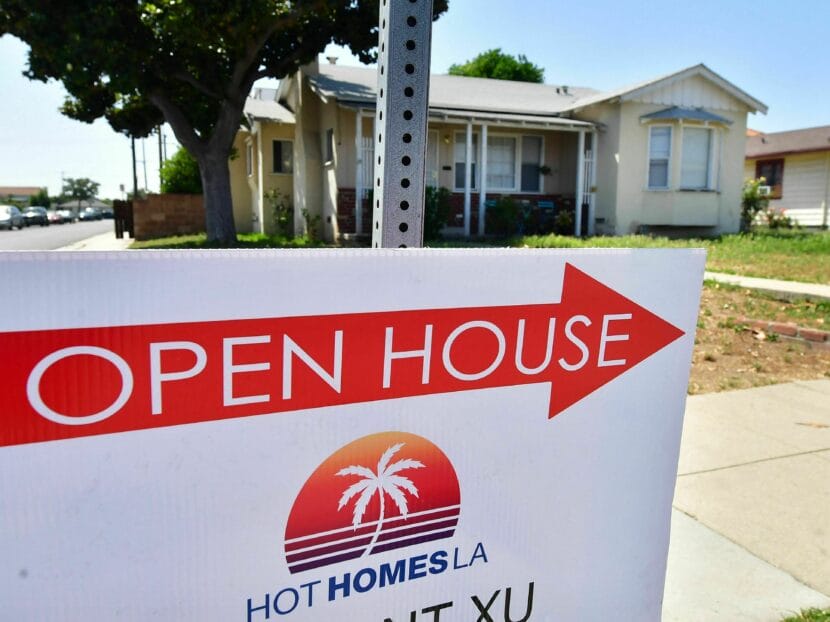
Would-be home buyers are battling high prices and high interest rates, but some are finding a way to make it work. (Frederic J. Brown/AFP via Getty Images)
Anyone shopping for a home right now has to contend with a double whammy of high prices and high interest rates. To make matters worse, there aren’t a lot of homes on the market to choose from.
Still, some people are taking the plunge. First-time buyers accounted for nearly a third of home sales during the 12 months ending in June, according to an annual snapshot from the National Association of Realtors. A record 70% of all buyers didn’t have children under 18 living at home.
Lance Zaldivar bought his first home over the summer, not long after getting out of the Marine Corps. He socked away money for the down payment during his last deployment in Kosovo. His fiancee, Jasmin Benitez, also had some savings from her job as a nurse practitioner.
“My fiancee is a little pickier than I am, and at this point now I’m glad that she was,” Zaldivar says. “She was looking for a little bit of a yard. A little larger square footage inside the house. Somewhere that we can raise a family in.”
Paying up front to lock in a lower mortgage rate
The couple found a three-bedroom house in Montgomery County, Texas, north of Houston, for $245,000 — well below the national average.
Their mortgage rate will be 6.25%, but they paid additional money paid up front to get a lower rate for the first two years, while Zaldivar finishes his bachelors degree.
“I was real happy about that,” Zaldivar says. “That eased my concern, compared to some of the other interest rates I’ve seen.”
Average mortgage rates have climbed even higher in the months since Zaldivar bought, approaching 8% this fall before settling back to 7.5% last week, according to Freddie Mac.
Sellers are holding tight to their low-rate homes
Rising interest rates have put homes out of reach for many would-be buyers. They’ve also discouraged people who already own homes from selling and giving up their cheaper loans. That’s a big reason there aren’t many “For Sale” signs out there right now.
Kristina Dunlap says there wasn’t much to choose from when she and her husband began looking for a house this year. But after three years of renting in Nashville, the couple was determined to buy a place.
“We calculated how much we had spent in rent over three years essentially and I think that number was a lot scarier than what the interest rates are right now,” she says.
Dunlap is a freelance marketer and her husband Eric is a construction manager. They thought of buying a fixer-upper, but decided that was more work than they wanted. Instead, they opted for a newly-built home near Springfield, about 25 minutes north of Nashville.
“The whole neighborhood is still under construction actually at the moment. We don’t even have paved roads currently,” Kristina Dunlap says.
New homes are a bigger share of sales
About 13% of homes sold this past year were newly built, according to the Realtors’ report, up from 12% the year before.
Like many successful buyers, Dunlap made tradeoffs — moving farther from the central city and giving up the bonus room she was hoping for. She did get the open floor plan and the two-car garage she wanted, as well as a yard for her dog, Kujo.
“The yard was a must,” Dunlap says. “When he gets — I call them the zoomies– When he gets those twice a day, we just send him out there and let him run it all out.”
The purchase price was just under $350,000 so the Dunlaps needed about $30,000 to cover the 6% down payment and closing costs.
Down payment is the hard part and average income of buyers is at a record high
According to the Realtors’ report, coming up with a down payment is the biggest challenge for many first-time buyers, especially those who are saddled with high rent and student loans.
The average income for all home-buyers hit a record high: $107,000. That highlights the challenges that middle-income people face in buying a home.
“Down payment, finding that right home — inventory is still incredibly tight — We know that they have a hard time, especially finding an affordable property,” says Jessica Lautz, deputy chief economist at the Realtors’ association. “But these homebuyers are somehow making it work and getting in there.”
Lance Zaldivar and his fiancee moved into their new house in June and wasted no time unpacking. While the average buyer plans to stay in a house for 15 years, Zaldivar plan to keep his home much longer.
“Whenever we do have a family, grandkids, great grandkids, they can always come over to our place, and it will be home for the Zaldivars,” he says.
Copyright 2023 NPR. To see more, visit https://www.npr.org.
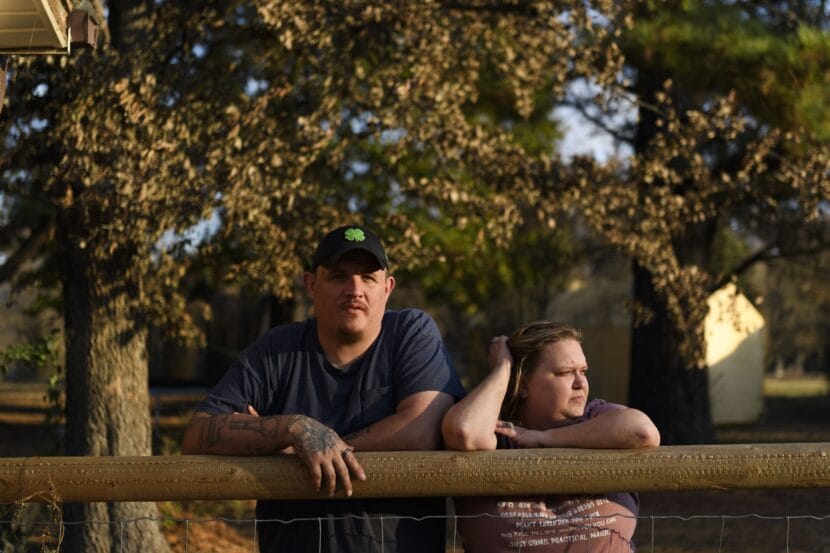
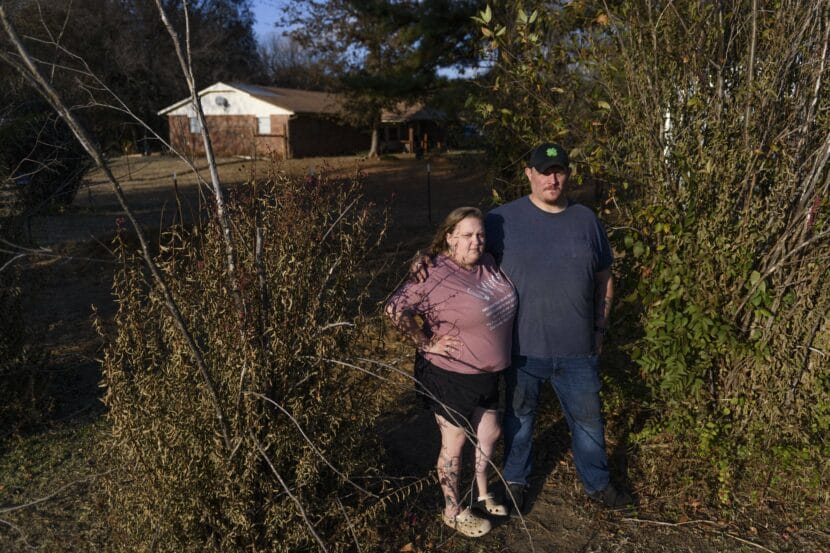
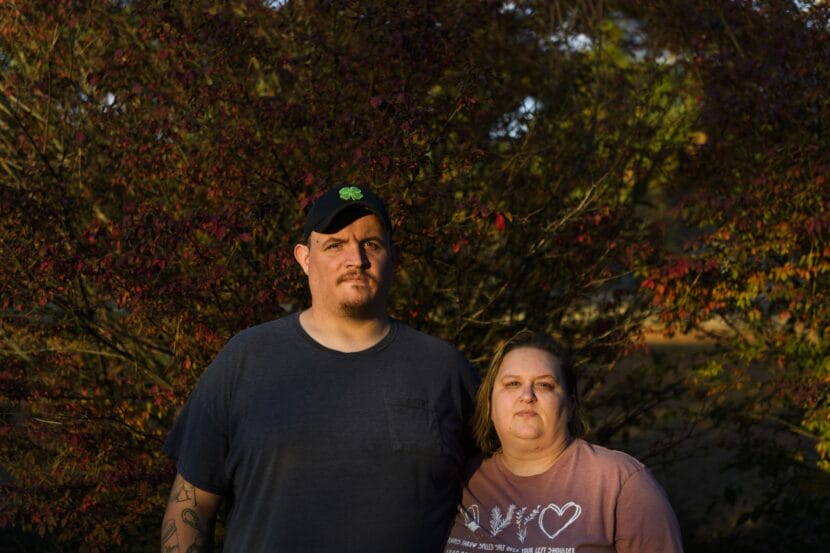
Army veteran Ray Queen stands with his wife, Rebecca Queen, outside their home in Bartlesville, Okla. An NPR investigation has found that thousands of U.S. military service members and veterans, including the Queen family, are at risk of losing their homes through no fault of their own. (Michael Noble Jr. for NPR)
Becky Queen remembers opening the letter with the foreclosure notice.
“My heart dropped,” she said, “and my hands were shaking.”
Queen lives on a small farm in rural Oklahoma with her husband, Ray, and their two young kids. Ray is a U.S. Army veteran who was wounded in Iraq. Since the 1940s, the federal government has helped veterans like him buy homes through its VA loan program, run by the Department of Veterans Affairs.
But now the VA has put this family on the brink of losing their house.
“I didn’t do anything wrong,” says Ray Queen. “The only thing I did was trust a company that I’m supposed to trust with my mortgage.”
Like millions of other Americans, the Queens took advantage of what’s called a COVID mortgage forbearance, which allowed homeowners to skip mortgage payments. It was set up by Congress after the pandemic hit for people who lost income.
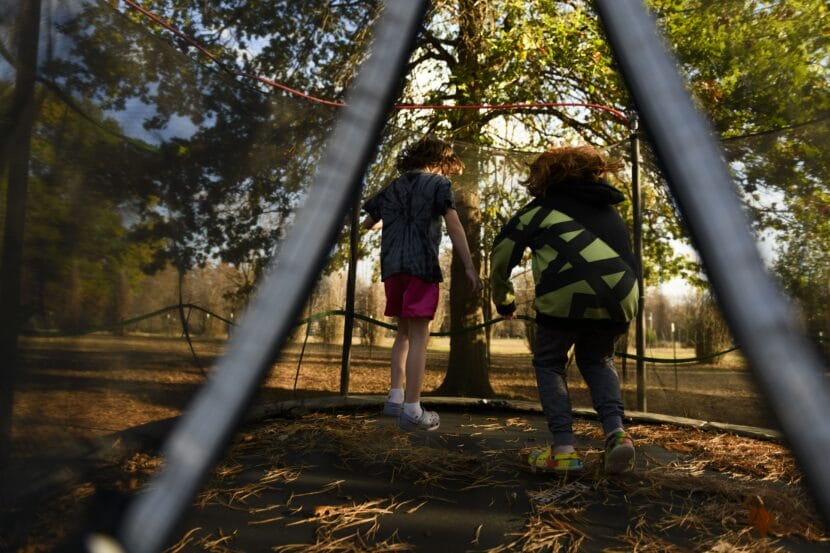
The Queens’ two young children jump on a trampoline in the front yard of their home. (Michael Noble Jr. for NPR)
But an NPR investigation has found that thousands of veterans who took a forbearance are now at risk of losing their homes through no fault of their own. And while the VA is working on a way to fix the problem, for many it could be too late.
For the Queens, this all started in September of 2021, when Becky’s mother died of COVID-19. She had to take an extended leave from work and lost her job.
So last year, with their savings dwindling, the couple says they called the company that manages their mortgage, Mr Cooper, and were told they could skip six months of payments. And once they got back on their feet and could start paying again, the couple says they were told, they wouldn’t owe the missed payments in a big lump sum.
“I very specifically asked ‘how does this work?'” says Becky Queen. “They said we’re taking all of your payments, we’re bundling them, and we’re putting them at the end.”
That is, the missed payments would be moved to the back end of their loan term so they could just start making their normal mortgage payment again.
But that’s not how it worked out.
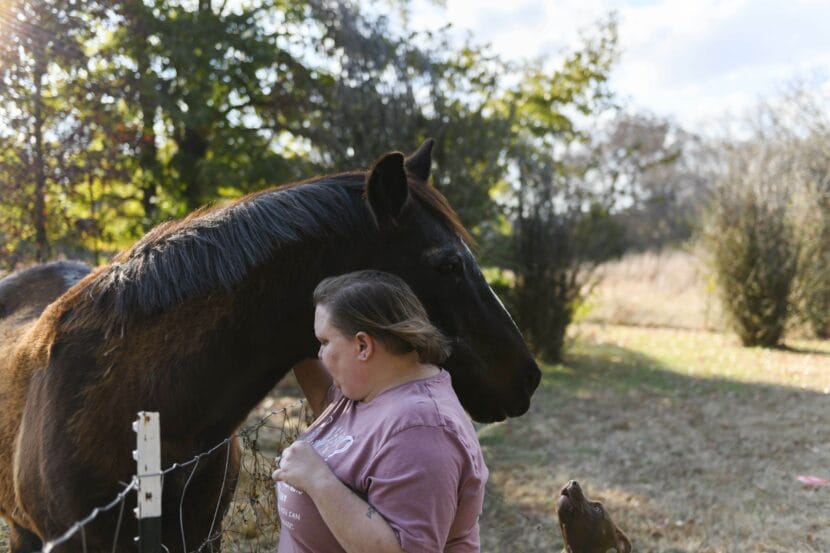
Becky Queen greets one of her horses outside her home. (Michael Noble Jr. for NPR)
In October 2022, the Department of Veterans Affairs ended the so-called Partial Claim Payment program, or PCP, that enabled homeowners to do that. This happened even though the mortgage industry, housing advocates and veterans groups all warned the VA not to end the program, saying thousands of homeowners needed to catch up on missed payments. Interest rates had risen so much that many couldn’t afford to refinance or get back on track any other way.
Ray Queen says nobody told him about any of this.
“How does that happen?” Queen asked. “This is supposed to be a program that you all have to help people in times of crisis, so you don’t take their house from them.”
The Queens say they tried to come off their forbearance in February of this year and resume paying their mortgage. They were both working again. But they ran into delays with the mortgage company.
Then, in September, the couple says they were told they needed to come up with more than $22,000, which they don’t have, or either sell their house or get foreclosed on.
Their mortgage servicing company, Mr Cooper, said in a statement it “explored every possible avenue to work through a solution for this customer.” But it said the VA needs better loss-mitigation options and referred NPR to a letter from advocates, industry and veteran groups urging the VA to restart the PCP program.
The VA “has really let people down”
“The Department of Veterans Affairs has really let people down,” says Kristi Kelly, a consumer lawyer in Virginia who says she is hearing from a lot of other veterans in the same situation as Ray and Betsy Queen.
“The homeowners entered into COVID forbearances, they were made certain promises, and there were certain representations that were made,” says Kelly. “And the VA essentially pulled the rug out from under everybody.”
The Queens say they tried to come off their forbearance in February of this year and resume paying their mortgage. They were both working again. But they ran into delays with the mortgage company. (Michael Noble Jr. for NPR)
For some homeowners, ending the program may not mean foreclosure, but it still means a financial hardship.
“Many of these people have 2 or 3% interest rate loans,” Kelly says. With the PCP program they could keep that interest rate. But now, she says, the only way they’ll be able to save their home is to enter into a loan modification where the interest rate will be around today’s market rate of 7.5%.
“For most people, their payments will increase by $600 or $700 a month, because the VA has decided to end the partial claim program.”
Many homeowners can’t afford such a huge increase in their monthly payment.
According to the data firm ICE Mortgage Technology, 6,000 homeowners with VA loans who had COVID forbearances are currently in the foreclosure process. And 34,000 more are delinquent.
Kelly says most other homeowners in America — people with FHA loans, for instance, or loans backed by Fannie Mae and Freddie Mac — still have ways to avoid foreclosure by moving missed payments to the back of the loan term.
But homeowners with VA loans don’t, because the VA ended that program. So veterans are being treated worse than most other homeowners, Kelly said.
“Service members are in a position where they’re going to lose their home,” she says. “And for most people, that’s everything they work for — and all their wealth is in their homes.”
VA has a plan to help, but it could be too late
The Department of Veterans Affairs says it had no choice but to end the program.
“We had a short-term authority for that specific program during COVID,” says John Bell, executive director of the Veterans Benefits Administration’s Loan Guaranty Service. “It wasn’t part of our normal authority.”
“Service members are in a position where they’re going to lose their home,” says Kristi Kelly, a consumer lawyer in Virginia. “And for most people, that’s everything they work for — and all their wealth is in their homes.” (Michael Noble Jr. for NPR)
Some in the industry think the VA did, in fact, have the authority to extend the program. But either way, it ended it.
Now, though, the VA is taking the situation seriously.
NPR has learned that the VA is working on a new program to replace the old one. It will work in a different way but to similar effect, to save people from foreclosure. Bell says it’s going to take four to five months to get it up and running.
That’s too long for many of those 6,000 VA homeowners already in the foreclosure process. Not to mention the many more who are delinquent.
Already, data shows that more VA homeowners have been heading into foreclosure since the VA ended its PCP program. The same is not true for FHA loans or loans backed by Fannie Mae or Freddie Mac.
Will the firetruck arrive too late?
With so many homeowners at risk, there’s growing pressure on the VA to stop foreclosing on veterans until it gets its fix up and running.
“There should be a pause on foreclosures,” says Steve Sharpe, a senior attorney at the National Consumer Law Center. “Veterans should really be able to have an ability to access this program when it comes online because it’s been so long since they’ve had something that will truly work.
Sharpe says the VA could also restart the PCP program that it shut down. “They have the authority to do both,” he says.
Pausing foreclosures sounds like a good idea to veteran Ray Queen in Oklahoma.
“Let us keep paying towards our regular mortgage between now and then,” he says. “Then once the VA has that fixed we can come back and address the situation. That seems like the adult, mature thing to do, not put a family through hell.”
The Queens are hoping the VA does pause foreclosures until the new program can offer people help. (Michael Noble Jr. for NPR)
NPR repeated Ray Queen’s plea to John Bell at the VA directly. Bell said the VA is “exploring all options at this point in time.”
“We owe it to our veterans to make sure that we’re giving them every opportunity to be able to stay in the home,” Bell said.
Ray and Becky Queen are hoping the VA does let people keep their homes until the new program can offer them a way to get current on their mortgages. Because if the firetruck shows up after the house has burned down, it’s not going to do much good for the thousands of veterans and service members who need help now.
Copyright 2023 NPR. To see more, visit https://www.npr.org.
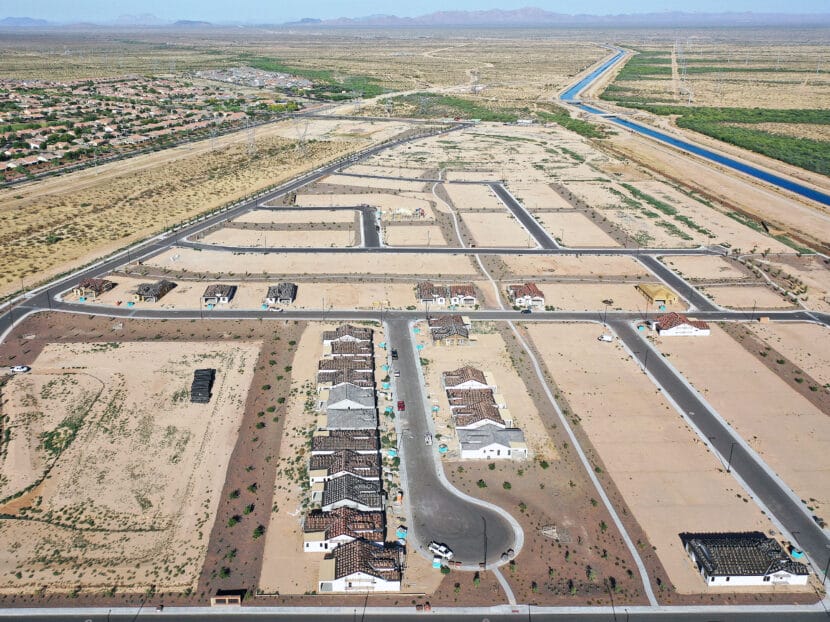
New homes are under construction in June at a housing development near Buckeye, Ariz. A growing number of local governments are considering limits on homebuilding in the face of floods, droughts and wildfires driven by climate change. (Mario Tama/Getty Images)
With climate-fueled disasters killing hundreds of Americans annually and costing communities billions of dollars, a growing number of local governments are asking a basic question: Are there some places where people shouldn’t build homes?
It’s one of the most difficult choices a community can make. Local governments typically want more housing, not less, because budgets are generally funded by the property taxes from those homes. At the same time, a nationwide housing shortage is creating even more pressure to build.
“[If] you’re a local government, of course you want to develop,” says Katharine Mach, who studies climate change and housing at the University of Miami. “You’re building a community. You’re supporting livelihoods. You’re supporting tourism oftentimes. [And] there’s the pragmatic dimension of, you need the property taxes.”
As a result, putting limits on homebuilding can feel like a non-starter for the local officials who generally control land-use decisions.
But with often deadly extreme-weather disasters on the rise, the problem can no longer be ignored. In the last five years, floods, wildfires, severe storms and droughts have caused more than $580 billion in damage and killed hundreds of people. And some states are passing laws that put conditions on future growth.
NPR visited three places that are grappling with the question of how to stop building homes in harm’s way — with varying degrees of success. Whether it’s flooding, wildfires or drought that threatens a community, similar conversations are now playing out across the United States.
California: Building homes in places that could burn
Two things are painfully apparent for many California cities: the massive statewide housing shortage and a growing danger from wildfires.
With some of the most expensive housing in the U.S., California’s cities face requirements to build more housing to boost supply. But where to put it is tricky. About one-quarter of California is at high risk of burning, according to state wildfire authorities. And as the climate gets hotter, tens of thousands of homes have been lost in destructive wildfires in the last five years alone.
With few statewide regulations, navigating housing needs and wildfire risk falls to local governments, like Santee, Calif., a largely suburban town on the outskirts of San Diego.
Santee is nestled next to miles of open space, and at the edge of town, a major new development of almost 3,000 homes, known as Fanita Ranch, is being planned. For years, residents like Van Collinsworth have fought the project, which would be tucked away in the golden, shrubby hills. As a wildfire inspector by day who examines flammable brush, he knows the city is at risk. It barely escaped the 2003 Cedar Fire, which destroyed more than 2,000 homes.
“I don’t think the project should be built — that’s the bottom line,” he says. “I don’t think developers and decision-makers are willing to acknowledge that we are living in a new era of extreme weather and really grapple with what that means for the desire to build and build and build.”
Collinsworth directs Preserve Wild Santee, an environmental group that joined several others to file a lawsuit to stop the development after the city approved it in 2020. A judge agreed, finding that the developer didn’t adequately analyze how long it would take residents to evacuate during a fire or whether they could do so safely.
The developer, HomeFed Corp., proposed the project again in 2022, this time with a phased evacuation plan that works by zones, so neighborhoods could be cleared more efficiently. Houses would be built with fire-resistant materials and have fire sprinklers. Inspectors would check that flammable vegetation was cleared twice per year, something that would be paid for by homeowners association fees. Those funds would also ensure vegetation was cleared around the outskirts of the community, creating a buffer.
“Other parts of the country are in a hurricane zone, and they have codes and standards that say, if you build to these standards, you can go ahead and build a home,” says Kent Aden, senior vice president of HomeFed. “We have all these standards for building in wildfire zones, but there seems to be a resistance to allow projects to move forward that meet or exceed those standards.”
In 2023, the City Council approved the project again, with several members saying they were satisfied with the wildfire safety measures after local fire officials supported the plan.
“We tried to take everything we can learn from the fires plus even more, making it, in my opinion, the best example of what can be done to make a defensible community,” Aden says.
Collinsworth and environmental groups filed a second lawsuit to halt the project, and it will be heard in court next year. It’s one of several lawsuits aimed at stopping developments in California, and some of these suits were supported by state Attorney General Rob Bonta. He recently released guidance for cities about how to analyze wildfire risk.
Still, while California leads the nation in some wildfire policies, like building codes for individual homes, there are few statewide laws about making development decisions in high-risk zones. Those decisions fall to local governments alone. A bill now being considered from state Sen. Ben Allen would require developers to analyze fire behavior and create evacuation plans in cooperation with local fire authorities as part of their projects.
“If we site houses and infrastructure in places better, safer, that makes it easier to keep people safe as climate change intensifies into the future,” Mach says. “But it’s not as if we have easy choices of just building in the safe places, because there are no places that are devoid of hazards right now.”
Arizona: Limiting growth where water is scarce, with a catch
Located in a desert, cities around Phoenix are constantly facing questions of water supply — not just at water management agencies but also at city councils considering where to develop. That’s because Arizona has one of the most powerful laws in the country linking water with the decision to build.
In Casa Grande, about an hour south of Phoenix, Mayor Craig McFarland knows his city’s future is linked to water. Housing is already in high demand. Industry is moving into the area, with both a battery and an electric car manufacturer offering thousands of jobs near town.
“We have this huge need for workforce housing, and that workforce housing needs a place to go,” McFarland says. “And so that’s why all of a sudden the rush is on.”
But whether that housing can be built is a question. A two-decade drought in the Southwest has triggered cutbacks to Arizona’s water supply, as climate change strains the Colorado River, one of the state’s biggest water sources. Underground aquifers are the state’s other major water source. But in Pinal County, where Casa Grande is located, overpumping of aquifers is a big concern.
So when it comes to development, McFarland consults a map that looks like a patchwork quilt. Some parcels of land are blue, which means a water supply would be ensured for new homes. But many other parcels are white. There, developers would have to find their own water supply in order to build. State law limits growth where water is in short supply, requiring new subdivisions to show they have 100 years of water for their customers.
“Arizona is the only state in the country that requires 100 years’ worth of water,” McFarland says. “It’s a consumer protection.”
This year, regulators announced they would not be guaranteeing water supplies for new subdivisions around Phoenix, limiting future construction. That has been the situation for several years in Casa Grande.
Still, McFarland isn’t discouraged. In the long term, the city is looking at water recycling and conservation. And in the short term, building hasn’t stopped.
That’s because developers have found a profitable workaround. Arizona’s water law applies only when lots are subdivided into smaller lots for six or more homes and those houses are either sold or made available for long-term rentals. Instead, developers have turned to building short-term rentals on a single large piece of land.
Not far from the center of town, construction workers are putting the finishing touches on new single-story homes in a 331-unit development. Water supply hasn’t been a barrier to building because these units will be part of one large rental project.
“We don’t need an assured water supply because it’s one lot,” says Greg Hancock of Hancock Builders, which is constructing the project. “Although it’s 331 units, it’s one lot.”
Casa Grande, like several other Arizona cities, has seen a boom in these “build to rent” projects. Hancock says after decades in the business, his company started building them only recently and has more than 10,000 units built or in development.
“It’s been one of the greatest housing markets forever,” he says. “People will not stop moving here.”
But with the growth, that unaccounted-for water demand is raising red flags. Already, Arizona water regulators say there won’t be enough groundwater to meet existing needs over the next 100 years.
“If you build houses and you rent them, there’s no way to go back and undo the fact that they’re there and people are living in them,” says Kathleen Ferris, senior research fellow at the Kyl Center for Water Policy at Arizona State University.
Ferris helped write Arizona’s 100-year water law four decades ago. She says its strength is that it tethers building decisions to water decisions. Back then, build-to-rent wasn’t common. Now, she says, the state is reaching a pivotal moment when all water use needs to be accounted for.
“Climate change and aridification have come on so much faster than most people thought,” she says. “Yes, there is still opportunity for growth, but there needs to be an understanding of the limits.”
This year, Arizona legislators drafted two state bills to close the loophole, which would require rental projects to have a water supply. Both failed to pass. Some cities pushed back, saying it would limit a key way to address the housing shortage. Now, a working group convened by Gov. Katie Hobbs is examining the issue.
Still, the overriding conversation is about growth. With droughts expected to worsen, Arizona’s water law is pushing cities to look at boosting their water supplies locally, whether that’s through building water-recycling projects or amping up conservation.
“I used to say, ‘Maybe we’re at our limit. Maybe we can’t build any more houses,'” says Pinal County Supervisor Stephen Miller, who works on water issues. “So now I say, ‘If we’re going to maintain any type of growth, we have to bring water in.'”
New Jersey: A little bit of everything adds up to a lot of flood protection
New Jersey may offer a blueprint for how to get people out of harm’s way while continuing to grow and prosper economically, according to climate experts.
The marshy coastal state is a decade into a systematic statewide effort to protect residents from floodwaters. And those efforts appear to be successfully limiting new construction of homes in flood-prone areas and better protecting people who live in flood zones or are considering moving into them.
“This is an area where New Jersey is very proactive,” says A.R. Siders, a climate researcher at the University of Delaware who studies climate risk and housing.
New Jersey has attacked its flooding problem from every angle. Since Superstorm Sandy devastated the region in 2012, New Jersey has passed regulations that make it harder to build new homes in flood zones. If you want to substantially renovate a home that already exists in a flood-prone area, the new rules require major upgrades to protect the house from water, such as putting the whole house on stilts or moving air conditioning units and other crucial utilities off the ground so they can survive a flood.
This year, New Jersey also passed some of the strongest flood disclosure laws in the country, which means that people who are buying homes in the state get information about whether their prospective new house has flooded in the past or is likely to flood in the future.
And the state has purchased more than 1,000 houses in the last decade through a permanent home-buyout program known as Blue Acres, which acquires homes that have flooded and knocks them down to provide more open space for floodwater.
As a result, New Jersey appears to be doing significantly better than the national average when it comes to the number of homes in flood zones, according to preliminary findings by a group of climate scientists including Siders and Mach.
That’s particularly notable since New Jersey is both the most densely populated state in the country and one of the most flood prone.
The town of Woodbridge, N.J., has been on the front lines of New Jersey’s strategy.
After Superstorm Sandy flooded the town, the local government decided to support home buyouts.
“[It’s] not something we wanted to do, but we had to do it,” says longtime Mayor John McCormac. “We didn’t want to lose residents.”
But it was equally unthinkable that homes would be rebuilt in places that had flooded, he says. And there were alternative ways for the town to grow economically.
Because home buyouts are voluntary, the town could move forward only if people agreed to move. McCormac remembers a town meeting he presided over in the high school auditorium.
“It was difficult. People were angry,” he says. “It wasn’t an easy process. You know, somebody’s talking to you about moving out of their home that they’ve been in for 60 years. And it’s their biggest investment in their life.”
Similar conversations have played out across the state in recent years, says New Jersey’s chief resilience officer, Nick Angarone. “These are very complicated and very difficult conversations to have,” he says. “You’re talking about some of the basic principles of the country, you know? Where and what you can do with your property.”
But unlike in other states, New Jersey residents who are considering a home buyout are assigned a case manager who can help navigate both the paperwork and the emotions that come along with such a momentous decision.
“Our case managers are sort of our secret sauce,” says Courtney Wald-Wittkop, who runs the Blue Acres program. “They’re very good about developing that rapport and relationship with the homeowners.”
One reason New Jersey is able to match people up with experienced case managers is that, unlike other state buyout programs, Blue Acres exists all the time, not just after major disasters. Because it’s permanent, it’s more accessible to both homeowners and local officials, without whose support buyouts cannot happen.
Ultimately, more than 180 homeowners in Woodbridge decided to accept buyouts and move away, says McCormac, the mayor.
The homes that remain in flood-prone areas of Woodbridge are subject to New Jersey’s new, tighter regulations that require them to be elevated. Instead of building new homes in marshy areas, Woodbridge is allowing more units to be built in denser parts of town near train stations and highways. The town’s population is stable, and its economy is growing.
The town’s flood plain manager, Tom Flynn, says the strategy is also paying off in the form of less flood damage. When the remnants of Hurricane Ida dropped 8 inches of rain in Woodbridge in 2021, Flynn says, it flooded dozens of homes instead of hundreds.
Copyright 2023 NPR. To see more, visit https://www.npr.org.
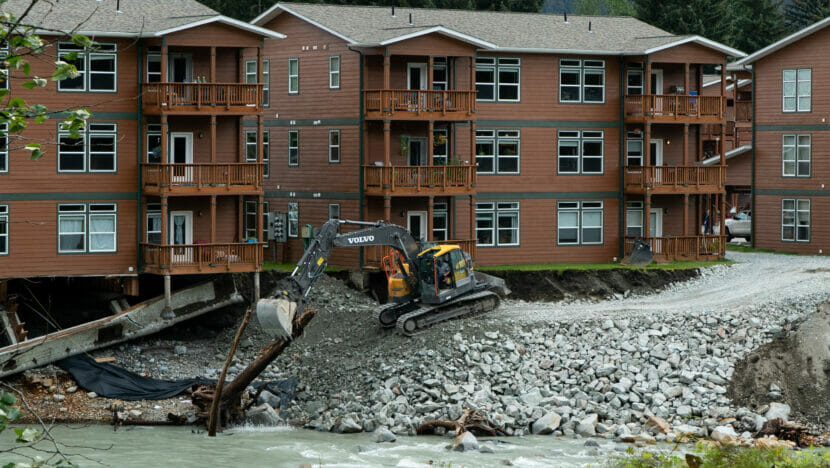
Workers removed debris and added rock fill along the bank at Riverside Condominiums on Aug. 8, 2023. (Andres Javier Camacho/KTOO)
Juneau’s record-breaking glacial outburst flood in Augustnearly sent a condo building on Riverside Drive into the Mendenhall River.
The morning after the disaster, Riverside Condominium Homeowners Association treasurer John Dittrich saw the building hanging over the edge of the riverbank. He called a meeting of the HOA board.
“It seemed very precarious, where it was sitting. So we acted immediately,” Dittrich said. “We authorized emergency use of our reserves. Which were never intended for something like this.”
Money collected from residents for routine maintenance like trash pickup or the occasional paint job became a disaster relief fund instead. There was enough money to stabilize the precarious Building D, but that was just a fraction of the necessary repair work. Building D needs a new foundation, and the erosion left three more buildings vulnerable to future floods.
The cost to fix those things is estimated at more than $1 million.
The state disaster declaration freed up some recovery money — up to $20,500 per homeowner. But the way Alaska law treats HOAs — and the way state disaster aid is doled out — makes the Riverside Condo residents ineligible for state aid.
“You’re stuck paying, but you can’t put your hat out for some more money,” Dittrich said. “So it’s frustrating for a lot of people.”
Recovery aid falls short
Condo residents say recovery aid from familiar safety nets like insurance and federal and state disaster aid has fallen short of their expectations. In the weeks since the flood, insurance has denied most of their claims. Then, in late September, the Federal Emergency Management Agency denied requests for disaster aid.
Brenna Heintz still hasn’t been able to get into her unit on the top floor of Building D. She applied for individual disaster assistance from the state, which can hypothetically cover repairs for property that’s damaged in a natural disaster. But she was denied.
The state told her that repairs for her damaged building were not her responsibility.
“It’s the HOAs responsibility. But in order for them to fix that they need money, and that comes from us,” Heintz said. “I am not eligible for homeowners aid, even though the money is coming out of my pocket.”
That’s because Alaska state law requires that homeowner’s associations share responsibility for “common elements.” In this case, all of the Riverside Condo buildings count as a common element, and all 51 homeowners in nine HOA condo buildings are on the hook for repair costs, even though most of the buildings were untouched by the flood.
Each individual condo owner will have to pay between $21,000 and $26,000 for the repair work, depending on the size of their unit. But under those same state laws, the HOA is treated like a nonprofit business, not a group of individuals. Which means people like Heintz can’t access most forms of individual state disaster aid.
“I was naive about the scope of this when it first happened. And I was naive about the actual amount of money it would take,” Heitz said.
Donations, private loans fill the funding gap
Heintz and some of her neighbors are relying on donations from family, friends and the community at large. One of Heintz’s friends set up a GoFundMe that raised almost $28,000 — just enough money to cover Heintz’s share of repairs.
She said that without those donations, she’d have to take out a loan. And that’s what many residents in the undamaged buildings are doing. A local lender, True North Federal Credit Union, offered loans with below-market interest rates for up to 20 residents. Dittrich says most of those loans have been claimed.
Loans from the federal Small Business Administration recently became available. Unlike aid from FEMA, homeowner’s associations are eligible. But Dittrich said that option came too late. Individual condo owners might pursue it, but the HOA won’t.
Other condo owners, like Joanna Forst, took money out of their savings. Forst owns a unit in the undamaged Building A along the riverbank, which she rents out. She said her obligation to pay for the cost of repairs came as a shock at first.
“That’s a lot of money out of everybody’s pocket. Yet, that’s what I signed into,” Forst said. “And that was a hard pill to swallow.”
Forst was able to make her payment in full, but as a stay-at-home mom, she said that money had been an important supplement to her husband’s income.
“My spending has basically been cut to absolutely no spending,” Forst said.
But in the end, she said repair work felt like a worthy investment to protect her unit from future flooding.
Dittrich says about three-quarters of Riverside Condo residents have made their payments, while the rest navigate different payment options.
“Our goal is to get much of this work done before winter sets in,” Dittrich said. “And that’s certainly a tall order.”
Much of the initial work to armor the bank is nearly done.
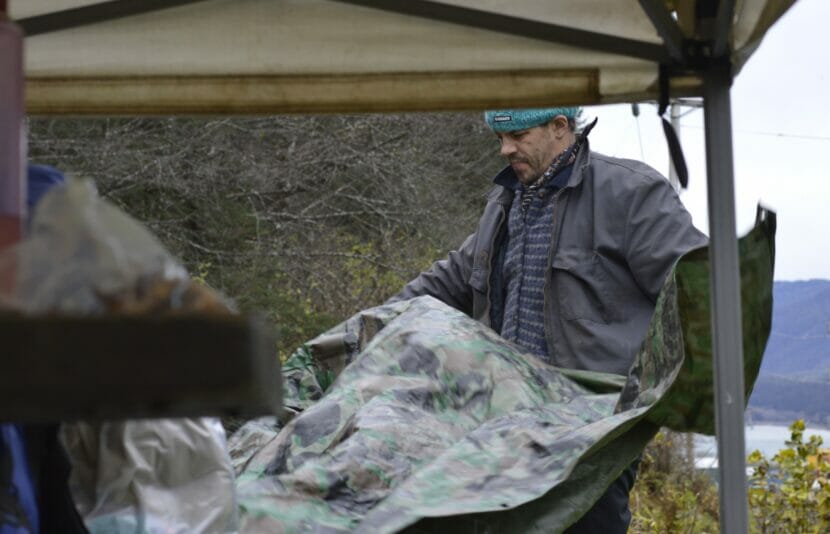
Garrett Derr shakes out a tarp that covered his campsite at the Mill Campground on Oct. 16, 2023. (Katie Anastas/KTOO)
Campfires burned among more than a dozen campsites still standing at the Mill Campground in Juneau on Monday morning.
The city-run campground – where people can camp free of charge – officially closed for the season at noon. Battling strong winds, people gathered up their things in tarps and plastic totes.
Garrett Derr was one of the campers packing up his belongings. He said this was his first summer at the campground after more than a year of struggling to find stable housing, and he wasn’t sure where he was going next.
“Pretty much just the streets. I’ll try the Glory Hall, I think. We’ll see what happens,” he said. “I’m allowed there today, after a month and a half of being kicked out.”
Unless they can get beds at the Glory Hall, many campers like Derr will spend the next week waiting for the city’s emergency cold weather shelter to open. The city and St. Vincent de Paul aim to open it on Friday. Meteorologists expect temperatures as low as 33 degrees on Saturday night.
But even worse weather could hit before the cold weather shelter opens. Juneau’s forecast calls for the remnants of Typhoon Bolaven to bring heavy rain this week, starting Tuesday.
Glory Hall Executive Director Mariya Lovishchuk said some space may be available there. Their emergency shelter beds were full this summer, but staff have spent the last few weeks trying to find more permanent housing solutions for some of those patrons.
Lovishchuk said that as of Monday, two people were about to move in with family members and a few others were headed to the Glory Hall’s permanent supportive housing units.
“There’s definitely movement, in terms of availability,” she said.
The city’s emergency cold weather shelter will be at a city-owned warehouse in Thane this winter. City leaders at first ruled out the warehouse because of its location and use as a storage facility, but homeless service providers had no other spaces available. Resurrection Lutheran Church ran the shelter for the last two years, but the congregationcould not agree to host it again until last week. By then, the city had made other plans.
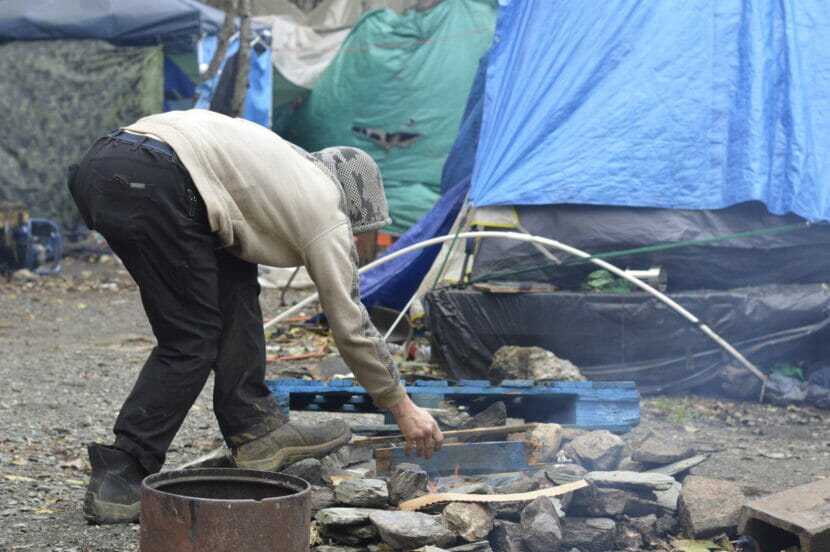
A camper who asked to be identified as Tom adds wood to a campfire at the Mill Campground on Oct. 16, 2023. (Katie Anastas/KTOO)
Matthew Wilson was at the campground Monday morning to help his daughter and her boyfriend pack up. He worried the Thane location could add transportation challenges for those trying to use the warming shelter.
“Downtown is more convenient,” he said. “It’s a long ways down here. They think it’s a little ways because the Assembly members have cars to drive down here. These people are walking.”
Derr said he used the warming shelter last winter, and he said he’s just glad there is one this year.
“Wherever it is, that’s where it is,” he said.
St. Vincent de Paul and the Glory Hall will run a shuttle in the evening from downtown to the warehouse. Lovishchuk said they have a driver ready to operate a 15-passenger van. In the morning, a Capital Transit bus will be there when the shelter closes and take people to the Glory Hall and other stops in between.
A camper named Tom, who said he wasn’t comfortable sharing his last name, also plans to use the warming shelter. He’s lived in Juneau for nearly a decade. He said he likes staying at the campground compared to the other options for unhoused people in Juneau.
“Wish we could stay up here all year round,” Tom said.
He was packing up his things and tending to a campfire Monday morning.
“Some of us are up here, not because we want to be, but because we have to,” Tom said. “The cost of living here in Juneau is way high. Affordable housing? There’s no such thing as that.”
Deputy City Manager Robert Barr said people who’ve been staying at the campground can access services with the help of community navigators at St. Vincent de Paul, the Glory Hall and AWARE.
The Glory Hall’s day shelter is open from 7 a.m. to 9 p.m.
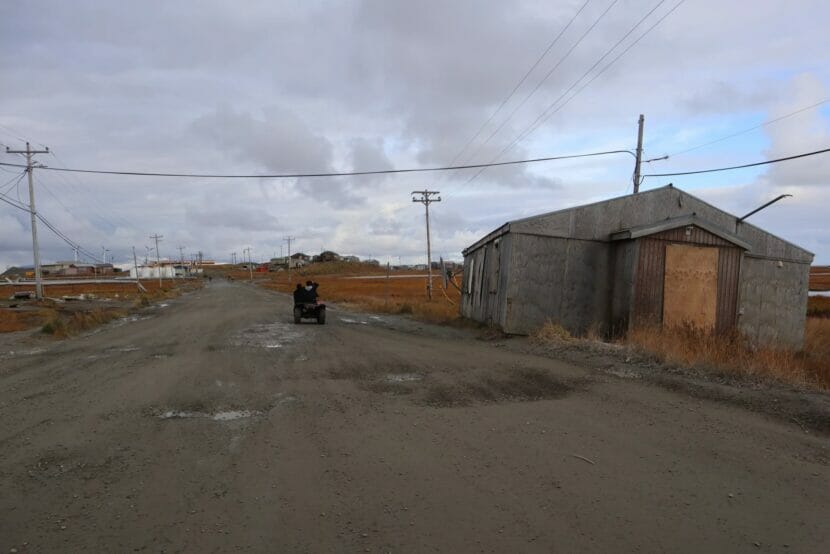
Flood waters from Typhoon Merbok ripped the Joe family’s home from its foundation, turned it around, and dropped it on the side of one of Hooper Bay’s main roads. The windows are broken out, the walls and floors are warped and moldy. Even so, the Joes miss having their own space. (Emily Schwing/KYUK)
Loretta Smith has gotten three letters from the Association of Village Council Presidents Regional Housing Authority, her landlord. She only has one of them, though. The others she said that she tossed out.
“I was trying to keep all of it for my records, you know. I threw the other ones away because I was like, ‘Ugh, forget these guys,’” Smith said.
Smith lives in one of more than a dozen apartments set up as low-income housing in Hooper Bay. The floor is spotless, the furniture is sparse: there’s a small couch, a table and chairs in the kitchen, and another table with a television against one wall. A blanket with the Lord’s Prayer woven in brown cursive letters hangs on another.
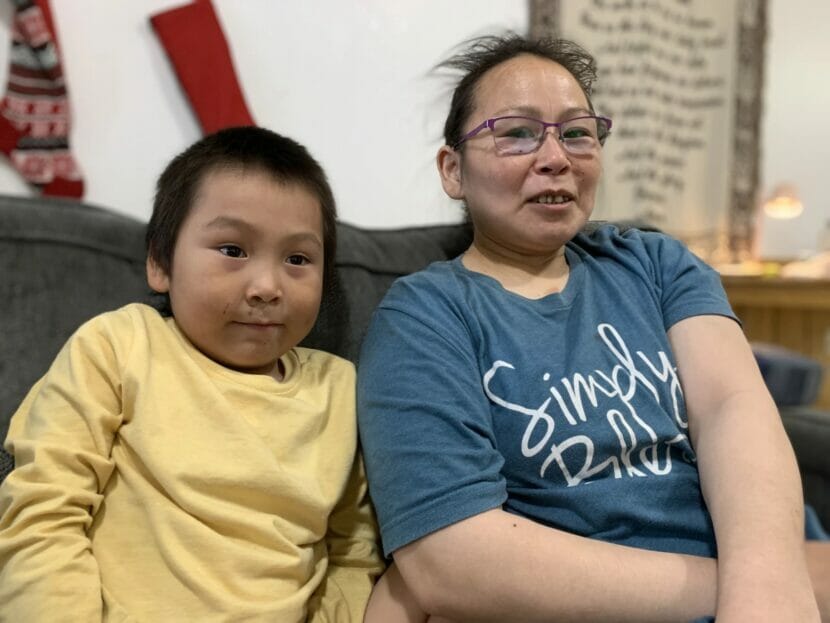
Smith moved here with her 5-year-old son, Jackson, about a year ago after their home was damaged by Typhoon Merbok in 2022.
“It couldn’t be fixed or anything,” Smith said. “It belonged to my great-grandpa. And it’s pretty old. So, you know, it was probably already in a rotting state. It got flooded. The porch collapsed.”
Loretta Smith and her son, Jackson, are living in low-income housing on a temporary emergency basis after their home was destroyed in 2022 by the remnants of Typhoon Merbok. Smith doesn’t have a safe housing alternative, but her request to extend their time in an apartment owned by the Association of Village Council Presidents, Regional Housing Authority was denied. (Emily Schwing/KYUK)
Smith’s family is one of three who lost their homes and most of their possessions during the storm last year. Two of those families, including Smith’s, are still trying to find a permanent solution.
Smith didn’t own her house, so she only qualified for rental assistance from the Federal Emergency Management Agency. She said that she received between $3,000 and $4,000. A letter from FEMA dated Oct. 22, 2022 confirms that. But it also says that the agency expects her to either return to her old home or find other long-term housing as soon as possible.
It’s unclear what FEMA means by long-term housing.
Smith’s placement in the Regional Housing Authority apartment complex was granted on a temporary emergency basis, but she said that she can’t stay after Oct. 31.
“Where do they expect us to go with no place to live?” Smith said. “This is pretty frustrating, you know, with the lack of housing here, especially for my son. If I have no choice, I’ll probably ask to live with some relatives.”
Smith was careful with her words as she tried to explain why her options were limited.
“Living in the women’s shelters and living with relatives. Nah. I just want to be in my own space with my son. You know where we, because I’m a sober person,” Smith said. Memories of her past living situations brought her to tears.
Smith isn’t the only resident in Hooper Bay who was displaced by last year’s storm. And hers isn’t the only family that could be without housing by the end of the month.
Martin Joe, his wife Lois and eight children ranging in age from 1 to 18 live right next door. They share a wall with Smith.
“I’d rather have my old house back,” said Joe. “Everybody misses it.”
Martin Joe and his wife Lois (in gray) live in a low-income, three bedroom apartment with eight children ranging in age from one to 18. They were placed here on a temporary emergency basis after Typhoon Merbok destroyed their house in Hooper Bay. Their placement in the apartment expires at the end of the month. (Emily Schwing/KYUK)
Joe said that it was easier on his kids. They had more space to play and run around, and they could be loud in a house. Here in the apartment they have to stay quiet and go to bed early.
But their old house is unlivable. The storm surge lifted it from the foundation, spun it around and dropped it along the side of one of Hooper Bay’s main roads. It has been sitting there, wedged up against a power pole, ever since. The family has to see it every time they drive to the store.
“I’ve been in there and it’s real moldy,” Joe said. “Walls are getting all warped and everything. It’s real bad mold. And right when you go in there, you just smell the mold right away.”
The house used to belong to Joe’s grandfather, who gave it to him. Because he owned the home, it’s unclear why FEMA didn’t provide assistance to rebuild it. Joe said that FEMA gave his family $50,000. That money has been spent on new clothes for their kids, a new couch and two new beds. It has also covered their rent and utility bills, and kept this family of 10 fed for the last year.
An accident this summer left Joe with two broken feet, so he is unable to work. He said that he has been told that he doesn’t qualify for disability benefits.
Lois, Joe’s wife, works two to three times a week selling pull tabs for the Hooper Bay tribe.
“I keep wondering where we’re going to stay, what we’re going to do and how we are going to do this,” Lois said. Although she’s happy around her children, she also said that she’s exhausted. Joe said that they’ve had a lot of sleepless nights in the last year.
Rental housing in Hooper Bay is severely limited. Both Smith and the Joe family have requested extensions to stay in their apartments. Smith recently received a call from the Regional Housing Authority. It denied her request.
The regional housing authority has not yet responded to emails or phone calls for more information.
This reporting was supported by a grant from the Center for Rural Strategies and from the nonprofit media organization Grist.
Close
Update notification options
Subscribe to notifications
Subscribe
Get notifications about news related to the topics you care about. You can unsubscribe anytime.

9(MDEwMjQ0ODM1MDEzNDk4MTEzNjU3NTRhYg004))
9(MDEwMjQ0ODM1MDEzNDk4MTEzNjU3NTRhYg004))
9(MDEwMjQ0ODM1MDEzNDk4MTEzNjU3NTRhYg004))