Housing

Designers share proposals for Telephone Hill redevelopment, with one including existing homes

First Forty Feet designers presented four possible development plans for Telephone Hill on Wednesday, Oct. 11, 2023. (Katie Anastas/KTOO)

Designers unveiled four possible development options for Telephone Hill at a community meeting on Wednesday.

About 50 people attended to review potential plans, and many of them called for the city to consider a “no build” option instead of adding new units.

There are currently seven houses and one five-unit apartment building on Telephone Hill, and the city estimates that 17 people live there. All of the designs presented Wednesday add new housing to the area, and just one involves preserving the existing homes.

The city contracted First Forty Feet, an Oregon-based design company, to come up with a development plan for Telephone Hill after the state transferred ownership of the property to the city in March. Then-City Manager Rorie Watt said the city would likely put more housing on the property. 

Telephone Hill residents, many of whom have rented homes there for decades, have objected to any plan that involves displacing them and forcing them to find new housing in an expensive, limited market. But city leaders say Telephone Hill is an ideal place to expand that market.

“Everything is possible,” First Forty Feet designer Jason Graf told attendees on Wednesday. “The four concepts we’re showing you today are not concepts that say, ‘No change.’ So there is some anticipated change on the hill.”

Wednesday’s meeting was the second community engagement event meant to gather input from residents on the potential designs. First Forty Feet aims to have a master plan ready for the city manager, city staff and Juneau Assembly in December.
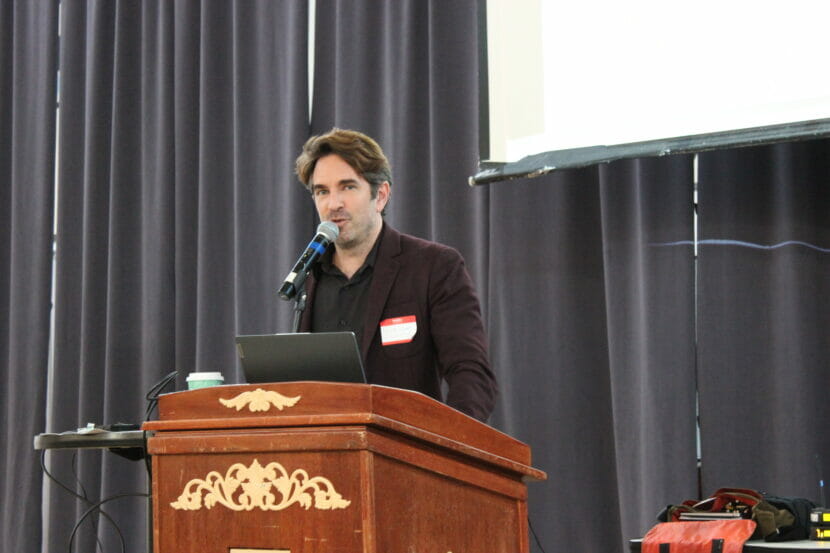
First Forty Feet architect James Brackenhoff speaks to meeting attendees on Oct. 11, 2023. (Katie Anastas/KTOO)

The design options

All four designs shared on Wednesday add more housing to Telephone Hill, but the types of housing vary. One design has just townhomes, one just has apartments and the other two have a mix of both.

Graf said the parking structure next to the downtown transit center could either have additional parking levels or two floors of office space added to it.

Option A is the lowest density option. It would include about 30 single-family townhomes. Small groups of them would be attached to each other, and they could be one, two or three stories tall.

Option A is the only option that puts office space on top of the parking structure.

“We felt we could do that because there’s lower density on the site – you don’t need as much parking on the site itself,” First Forty Feet architect James Brackenhoff told attendees.
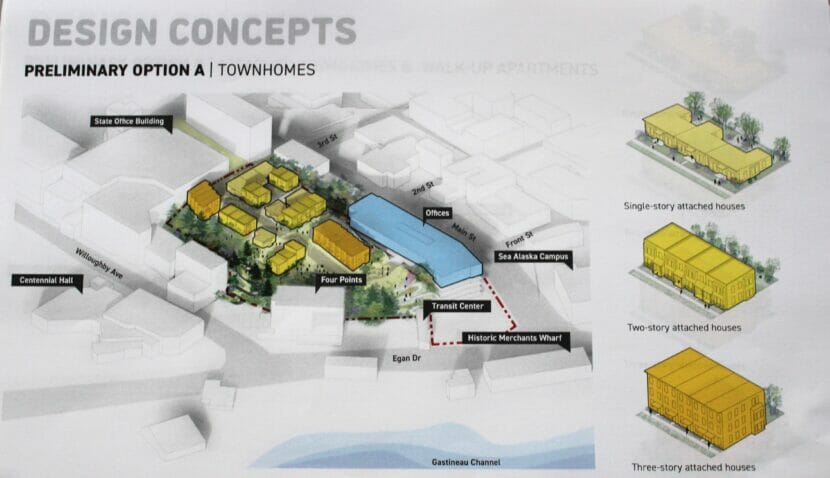
First Forty Feet’s Option A would include single-family townhomes and office space on top of the parking structure. (Katie Anastas/KTOO)

Option B has about 60 units, with a mix of attached townhomes and three-story apartments without elevators. Option B would add parking to the parking garage.
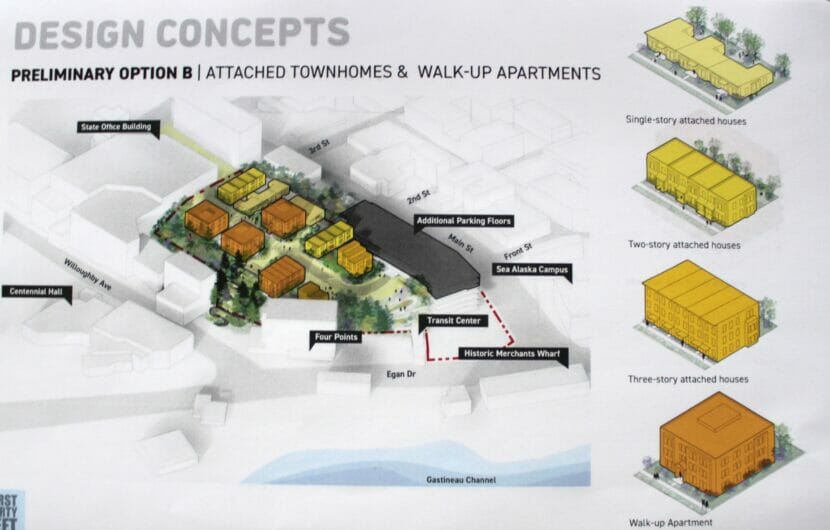
Option B from First Forty Feet has about 60 units, with a mix of attached townhomes and three-story apartments. (Katie Anastas/KTOO)

Option C features mid-rise apartment buildings, which would have elevators. Brackenhoff said there could be 100 to 200 units, with parking levels added to the parking garage. Those apartment buildings could have space on the first floor for restaurants or other commercial spaces.

Option C also has a hotel, which Brackenhoff said may work with other types of housing, too. The design features a plaza in the center of the hotel and apartments.
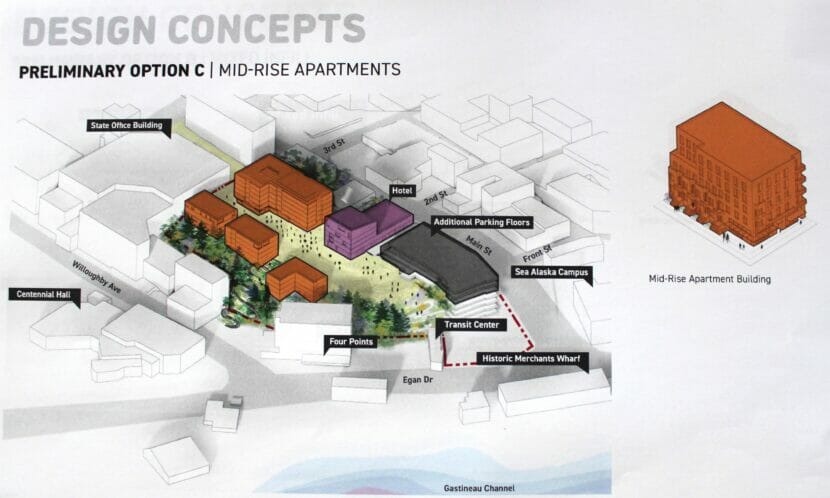
First Forty Feet’s Option C features a hotel and mid-rise apartment buildings, which could add 100 to 200 housing units, according to designers. (Katie Anastas/KTOO)

Option D would put walk-up apartment buildings in spaces between some of the existing houses. Brackenhoff said the design adds 40 units to Telephone Hill. He called it an “acupunctural approach” that would mix the old with the new.

“We wanted to make sure we provided an option that took on board what we’ve been hearing from some of the folks in the community about preserving some of the homes,” Brackenhoff said at the meeting.
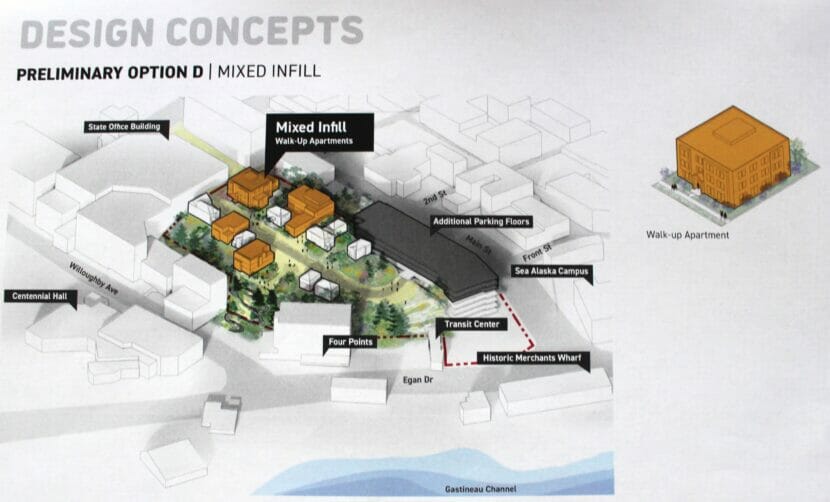
Option D from First Forty Feet would put walk-up apartment buildings among some of the existing houses. (Katie Anastas/KTOO)

Brackenhoff said they still need to determine whether or not it’s feasible to preserve the homes.

“What we have to do is go through the survey process to make sure these homes are actually structurally sound, that there’s not a significant burden that the city would need to carry to renovate these homes,” Brackenhoff told attendees.

Downtown resident Joshua Adams told the designers and attendees that he was skeptical the city would consider keeping the homes, even if the community favored that option.

“We all know that the city is going to look at this and say none of these buildings can be feasibly restored. Anybody who knows anything about historic restoration knows it’s at least three times as expensive to restore something properly than it is to tear it down and build it new,” he said. “Does that mean we shouldn’t preserve our history?”

Some attendees suggested the city sell the homes in their current condition. But Graf said those kinds of decisions are up to city leaders, not the designers.

“What we’re trying to look at is, if we preserve those, can we add additional housing, and what is that development like?” he said.

Community response

Most of the Juneau residents who spoke at the meeting said the city should preserve the houses and not add additional housing.

Tony Tengs, who lived on Telephone Hill for nearly three decades before moving out this spring, looked through the designs before the meeting started. He pointed to Option D, which has orange apartment buildings amid gray houses.

“The only one that has the buildings in place, they look like ghost buildings on the drawing,” he said. “Even in the one where they’re still shown, they look like ghosts.”

Skip Gray, who has advocated for the city to restore the existing houses, said he’s frustrated that questionnaires haven’t given him the opportunity to vote for a “no build” option.

“There just aren’t any answers on these surveys that I want to push the button on,” he said in an interview.

But Betsy Brenneman, a former Telephone Hill resident, told attendees that the planning commission and Assembly were the right people to contact about a “no build” option.

“You’re shooting the messenger a lot tonight,” she told attendees. “The city asked for this plan.”

Brenneman was a member of the Blueprint Downtown Steering Committee, which drafted a revitalization plan for downtown Juneau that lists adding housing as the top priority.

“If we don’t get more people living downtown, you are going to have more closed storefronts in the winter, you are not going to have any businesses downtown,” she said. “We have to get more people downtown.”

Brenneman said she favors keeping the existing homes, but she’s open to adding more units around them.

“I will be laying down in front of the bulldozers if anybody tries to take down the historic homes,” she said. “However, I do think there are ways on Telephone Hill to add a little more housing.”
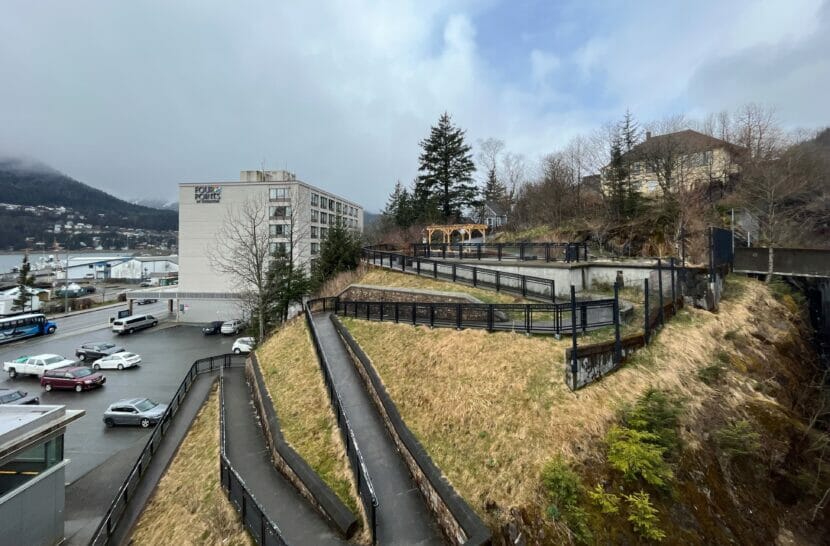
A ramp leads up to the houses on Telephone Hill from the Capital Transit center. (Katie Anastas/KTOO)

Incentivizing affordability

Some attendees wanted assurance that the new houses or apartments would be affordable. 

Graf said the city will have the opportunity to require a certain amount of affordable housing in its contracts with developers.

“Because it’s under the CBJ, they create the carrots to incentivize affordability as an option as well as market rate,” Graf told meeting attendees. “There will be an opportunity for affordability if that’s valued, which I think it is.”

Chris Zahas, a consultant with Leland Consulting Group, agreed. He’s tasked with identifying developers who can make the master plan happen. He said in an interview that the city could offer subsidies to developers, which could come with conditions.

“The city is in a position to kind of put strings attached to it to get what the community wants out of it,” he said.

Zahas said developers’ proposals usually go before the Assembly for approval.

“So there’s going to be multiple points along the way where the public and the Assembly get to have a conversation about it,” he said.
Juneau’s cold weather shelter likely will be in a Thane warehouse this winter

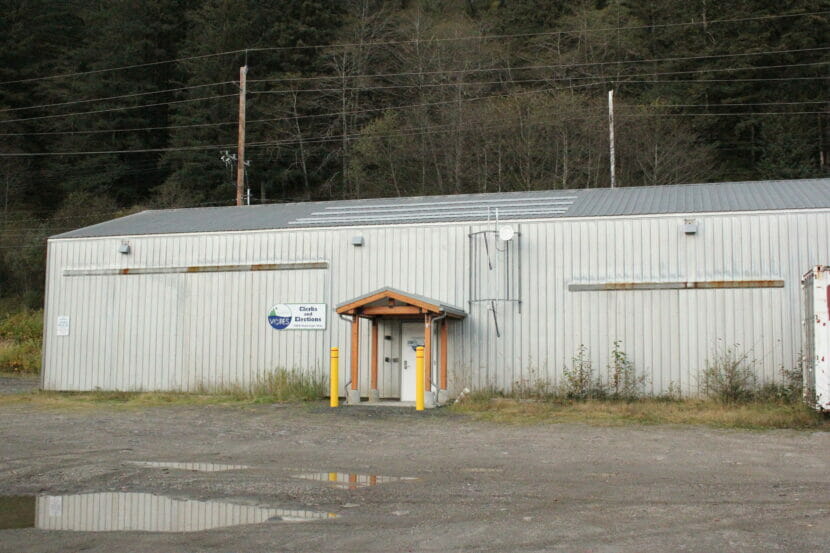
A city-owned warehouse in Thane, part of which is used to process ballots, is the likely location of Juneau’s emergency cold weather shelter this winter. (Katie Anastas/KTOO)

City leaders say Juneau’s emergency cold weather shelter will likely be operated by St. Vincent de Paul at a city-owned warehouse in Thane, about a mile from downtown. 

Resurrection Lutheran Church ran the shelter for the last two years at its church in the Flats neighborhood downtown. But this summer, that congregation voted twice not to run it again. No other providers applied because they didn’t have suitable space.

In a third vote on Sunday, the congregation finally approved the shelter — by one vote. But Deputy City Manager Robert Barr said he’d already been working on an alternative with St. Vincent de Paul.

“Since Resurrection Lutheran has voted this down twice, and it was obviously a super narrow vote this Sunday, I have been working closely with St. Vincent’s on a backup plan,” he said.

Barr said city leaders are moving forward with the Thane plan — a decision that Resurrection Lutheran Pastor Karen Perkins said was “baffling” to her. She said the warehouse’s location would make it harder for people to access services there. 

“I was surprised, frustrated, disappointed and hurt,” she said. “And concerned, because at the end of the day, what matters is how well does it address the problem.”

Perkins said the warehouse is better than an idling city bus, which Barr had floated as a “last-ditch option.” But now that her congregation has voted in favor, Perkins thinks the city should take them up on their offer. She said there’s still enough time to get the church ready, and that it’s a better, more welcoming location than the warehouse.

“Of course, if that’s the way things go, we’ll do whatever we can to help,” Perkins said. “But I hope somebody changes their mind because this is a bad idea.”

Transportation

The warehouse is a mile away from the downtown library. It’s surrounded by industrial buildings and parking lots. Perkins worries that the distance from the downtown core will prevent many patrons from going there, especially if they try to get to the shelter by foot.

“That road, because of the way the road goes, gets a lot of wind. The sidewalks are narrow and are going to be covered with berms once there’s snow,” she said. “Walking there is going to be dangerous.” 

Barr said the location does make transportation more complicated. It’s one of the reasons the city initially ruled out the warehouse. But he said St. Vincent de Paul, the Glory Hall, police and the fire department’s CARES program could help get people to the warehouse.

But Perkins worries that people who usually use the warming shelter – many of whom experience chronic sleep deprivation – may have trouble knowing how to access that transportation. She said that’s especially true if people are experiencing homelessness for the first time.

“I think there’s an illusion that everybody is going to access the services where you’re providing them,” she said.

Barr said the location could address some of the concerns residents had when Resurrection Lutheran ran the shelter during the last two winters. Some congregants and neighbors worried about vandalism and loitering at the church, which is in a neighborhood and near Harborview Elementary School.

“Thane has some advantages to it,” Barr said. “Most notable among them being that it is not in a residential neighborhood, not close to a school.”

But Perkins said people have become familiar with services offered at the church. They also run a food pantry there each week. She said having the warming shelter in a neighborhood can provide consistency for the people who use it. 

“It’s not detrimental to communities, the way a lot of times people assume it is,” she said. “Having it away from communities doesn’t support better outcomes for the patrons.”

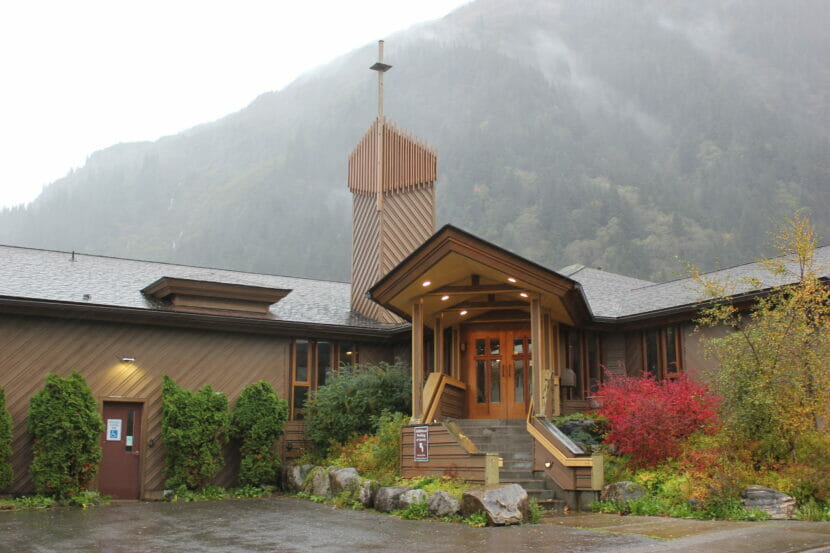
Resurrection Lutheran Church, photographed on Oct. 9, 2023. (Katie Anastas/KTOO)

Part of a provider network

Dave Ringle, executive director of Juneau’s St. Vincent de Paul chapter, was still drafting a potential contract on Wednesday morning. But in an interview, he said they plan to keep the shelter open from 9 p.m. to 7 a.m. A city bus would pick people up in the morning and take them to the Glory Hall or other locations.

Ringle said his organization has strong relationships with other homeless service providers in Juneau – relationships that can help connect warming shelter patrons with more stable housing.

“I would expect, if we started to have over 40 to 50 people, we would meet with service providers, look at the numbers, and identify what are the options within our other service providers where some of these people would go,” he said. 

St. Vincent de Paul, the Glory Hall and AWARE have community navigators who help connect people to housing, medical care and other social services.

“I think that’s going to make a big difference,” Ringle said. “The goal would be to have us all work together to keep the shelter numbers down.”

St. Vincent de Paul has affordable apartments, transitional housing and supportive housing throughout the borough. Some of that housing is just for seniors, who make up a growing portion of their clientele, Ringle said.

Staffing and capacity

Ringle said he plans to ask the city for flexibility on weather requirements that prompt the shelter to open. The shelter is required to open when temperatures are expected to dip below 32 degrees, but Ringle said he’d like the option to stay open when it’s slightly warmer, too.

“We will submit a budget to the city as if we need to open every day,” he said. 

Ringle expects that budget to be between $240,000 and $250,000. That would fund at least three staff members. Resurrection Lutheran leaders had said they would ask for about $290,000 to run the shelter, plus a usage fee to cover repairs and maintenance. They planned to have three staff members available and a full-time manager.

Ringle said they also had three staff members when St. Vincent de Paul ran the warming shelter at the armory from 2020 to 2021. The space became unavailable once the Juneau Arts and Humanities Council started using it again.

“If there is an emergency, having three people is the safest way for staff to handle that,” Ringle said. “We received excellent compliments from Juneau police and Capital City Fire and Rescue about that, and we’re going to hope that we can build on those relationships we established when we were running it before.”

Barr said they plan to serve 35 to 50 people a night at the warming shelter. But Ringle said the warehouse has enough space to accommodate more, if needed.

“Another advantage of having a very large space would be it might allow our guests more space and eliminate some of the conflict and confrontations that might come up when you have everyone crowded into a smaller area,” Ringle said.

The warehouse has heating, insulation and electricity. Part of it is used to process ballots, and the rest is used for storage. The city will have to remove items it stores there and add bathrooms, which would be port-a-potties. Barr said he hopes to have that done by the end of October.

The city provides cots for the warming shelter. Ringle said St. Vincent de Paul will provide food at night and in the morning. As the opening date gets closer, Ringle said they’ll likely accept donations of blankets, hats and coats.

The Juneau Assembly still has to approve the use of the warehouse for the shelter. The Assembly’s next meeting is Oct. 23.

A tense afternoon of vehicle towing and a microcosm of frustration over homelessness in Anchorage

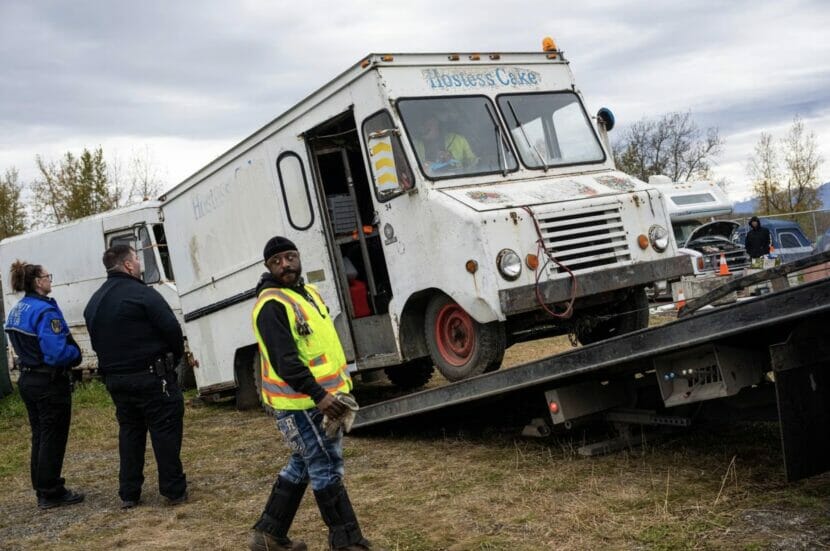
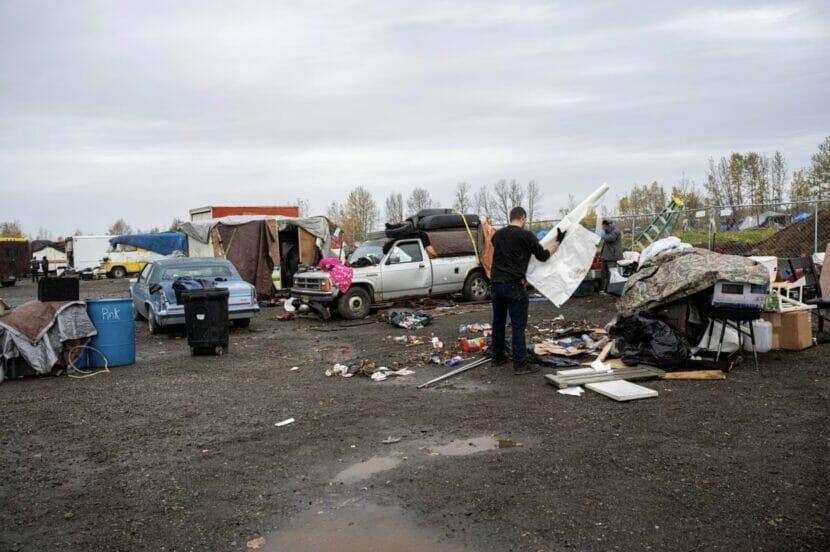
Tow truck operators on Thursday remove a box truck that Madison Greenewald had been living in. The truck was impounded and Greenwald said she was not allowed to retrieve her belongings before it was taken away. (Loren Holmes/ADN)

In a tense scene on Thursday, the city towed away many of the vehicles that have crowded an Anchorage lot at a sprawling homeless camp near downtown.

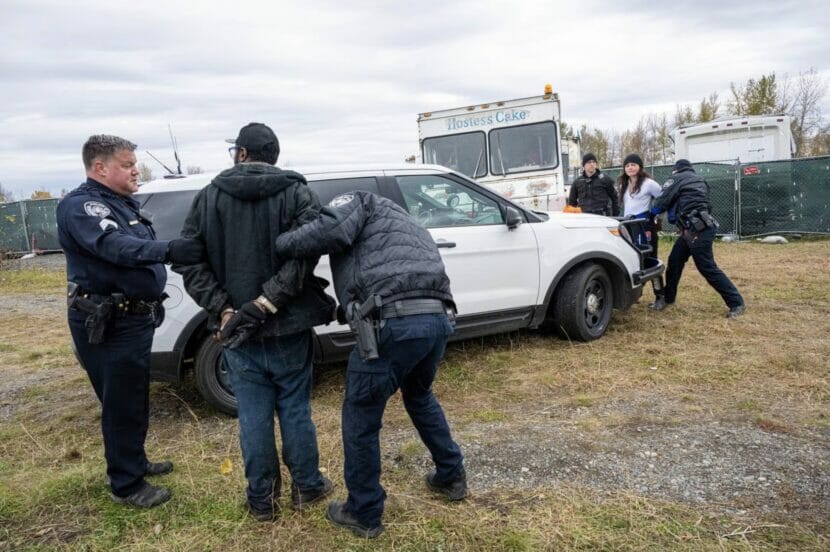
Several campers were handcuffed and detained by police. The Anchorage Police Department said the city towed two buses, two box vans, a boat, a fire engine and two cars.

What unfolded at the Third and Ingra camp was a microcosm of the exasperation felt over this moment in Anchorage’s homelessness crisis, with emergency winter shelter not yet open and hundreds of people still camping on public land.

Jarvis Wallace, left, and Madison Greenewald are handcuffed while vehicles are towed on Thursday at the homeless camp at Third Avenue and Ingra Street. Greenewald was arrested for criminal mischief, according to police. Wallace was charged with multiple violations, including interfering with vehicle impoundment, according to police. (Loren Holmes/ADN)

The towing — expected among camp residents for more than a week — started just as ice pellets were starting to fall on a raw October day. Cold puddles filled a pockmarked lot where a collection of vehicles had been growing since the spring, when the city shut down the large shelter at Sullivan Arena.

Frustration moved in every direction in the parking lot.

The people living in the vehicles said they were frustrated and angry that their dwellings were being carted off to languish in impound lots. One woman, Madison Greenewald, said the box truck she had been living in for three weeks was towed without a chance for her to gather any belongings from it. All she had was what was in her pockets, she said: “A screwdriver, a lighter and two bolts.”

Greenewald said she had been handcuffed after trying to push the non-operable box truck through a hole in the fence. Police said she was arrested and charged with criminal mischief.

As all this was unfolding, Mayor Dave Bronson arrived. The situation, he said, was due to the Anchorage Assembly’s unwillingness to agree to build a large homeless shelter. The Assembly has twice voted down the Bronson administration’s proposals to finish building a large shelter in East Anchorage, first after the administration pushed ahead with millions of dollars’ worth of construction work without required Assembly approval, and later after members questioned the costs associated with constructing and operating the shelter.

“All this is unnecessary,” he said, gesturing at the acres of soaked tents and vehicles. “It’s been unnecessary for more than a year. If we had a large shelter to put about 500 people in, we wouldn’t have to go through this over and over and over.”

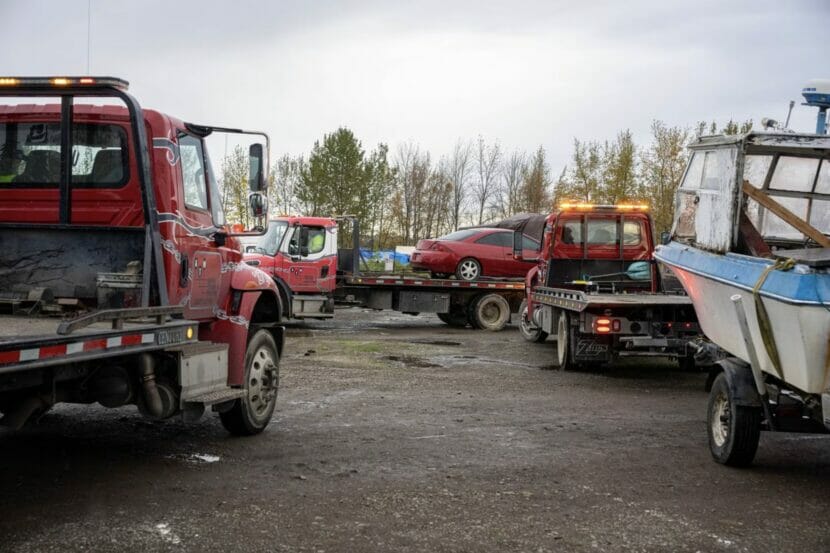
Three tow trucks move cars and a boat on Thursday at the homeless camp at Third Avenue and Ingra Street. (Loren Holmes/ADN)

Police officers stood by as private tow truck operators hauled away vehicles people had been living in.

The scene drew observers: A private security guard, who said he’d been working at the site since last week, had a pizza delivered, handing out slices to anyone who asked for one. Eric Glatt, an emeritus attorney with the ACLU of Alaska, stood nearby observing, occasionally filming with his phone. Two citizen journalists filmed exchanges between campers and police.

Mike Poirier, a mechanic from Mat-Su who had been living at the camp, said he was sitting in his Toyota Camry when he was pulled from the vehicle by police and handcuffed for trespassing.

“They physically removed me out of the car and impounded the car.”

Poirier said he was in handcuffs for “five or 10 minutes” until he could call his brother, who paid a fine over the phone. He was then released.

“That’s what me and my wife were living in, is my (vehicle),” Poirier said. “Now we’re homeless with nothing.”

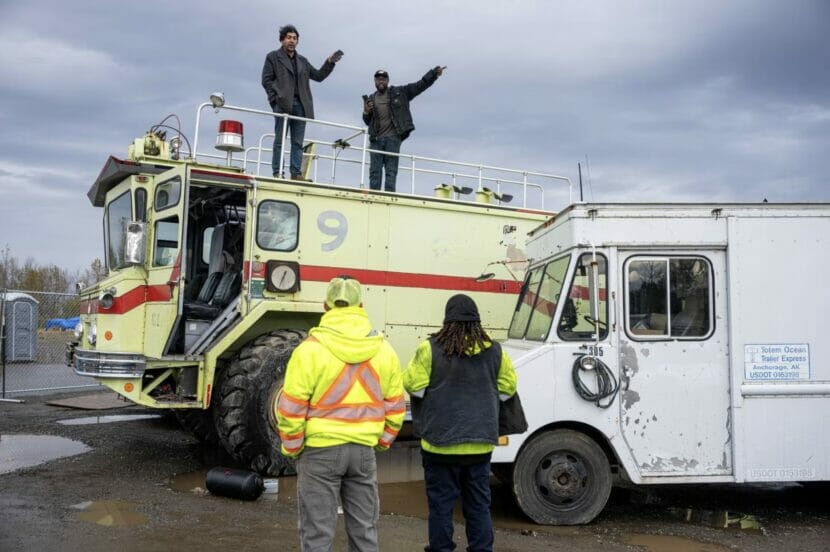
Apollo Naff, standing at left on top of a large airport fire truck, and Jarvis Wallace gesture toward a bus that Naff owns and Wallace had been repairing, while talking with tow truck operators who were preparing to tow the bus on Thursday. (Loren Holmes/ADN)

Apollo Naff, the owner of about 15 of the vehicles, hung back and engaged on his phone, trying to figure ways to keep his fleet out of the impound lot.

Jarvis Wallace, a diesel mechanic, revved the engine of a large surplus fire truck. Police told him to stop. At one point, he stood on top of it. Later, police said Wallace was arrested and charged with interfering with vehicle impounding, violating conditions of release, criminal mischief and misconduct involving a controlled substance.

Jarvis Wallace goes stiff as he is handcuffed on Thursday. Wallace had been working on a large airport fire truck that the city wanted to tow. Wallace was charged with multiple violations including interfering with vehicle impoundment, according to police. The city began towing vehicles from the camp on Thursday, in preparation for closing the camp before winter. (Loren Holmes/ADN)

Then, in the early afternoon, a line of tow trucks arrived, parking on Third Avenue.

Soon after, Bronson showed up with city homeless coordinator Alexis Johnson and parks director Mike Braniff.

He said the visit wasn’t planned. They had been at a separate homeless camp at Cuddy Family Midtown Park and had driven by Third and Ingra, noticed the tow trucks and decided to stop, he said.

Wallace, the diesel mechanic who had twice been handcuffed by police on Thursday, approached the mayor.

“Hey, I spent a lot of time getting that thing to run,” he said, gesturing to the mammoth Anchorage airport fire truck. The mayor nodded.

“If you shut this down, it’s just going to happen somewhere else,” Wallace said. “I’ll get another big ass truck just to prove it to you.”

The mayor told him the lot was public property, and not a place to store things.

“I’m sorry it’s not working out for you, but it’s not working out for a lot of people,” Bronson told Wallace.

Bronson said that until Anchorage has a large shelter, things will not change.

Homeless coordinator Alexis Johnson, left, and Mayor Dave Bronson speak with journalists on Thursday at the camp. (Loren Holmes/ADN)

Winter is coming, and the temporary shelter the city is planning to offer at the former Solid Waste Services headquarters is not ideal, Bronson said.

“It’s a garage, where we worked on garbage trucks,” he said. “That’s what I’m forced to do.”

A city bus that several people had been living in was towed away using specialized equipment for large vehicles.

As a steady rain falls, people scramble to cover belongings removed from a bus before it was towed away on Thursday from the homeless camp at Third Avenue and Ingra Street. (Loren Holmes/ADN)

Right before it was hauled off, residents had hastily pulled belongings out of the bus and piled them on the muddy ground. As the rain pelted down, they scrambled to cover the items with a tarp.

More tow trucks arrived to continue removing vehicles.

Daily News multimedia journalist Loren Holmes and reporter Tess Williams contributed to this report.

This story originally appeared in the Anchorage Daily News and is republished here with permission.

Anchorage joins long list of cities petitioning US Supreme Court to hear key homelessness case

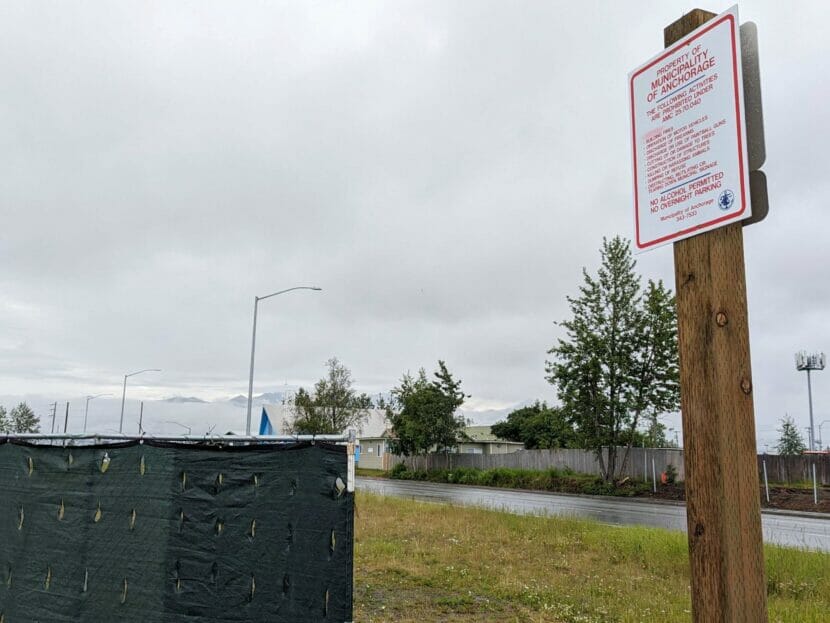
A city sign posted at a large, unofficial campground on a vacant lot along Anchorage’s Third Avenue, pictured here on July 10, 2023, lists prohibited activities. Someone rubbed “camping” off the top of the list. (Jeremy Hsieh/Alaska Public Media)

Anchorage has joined a long list of organizations and local governments petitioning the U.S. Supreme Court to hear a case that challenges a precedent on a key homelessness issue: when and how a city can clear camps.

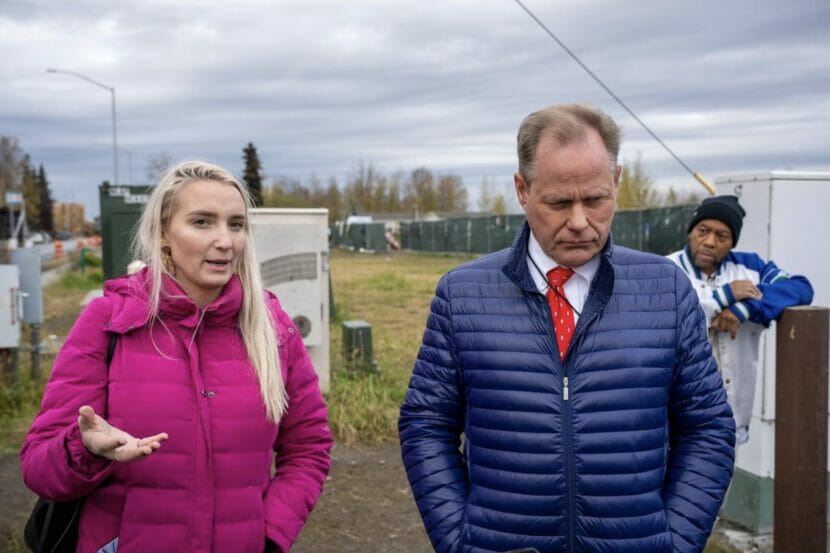
Mayor Dave Bronson announced the move at a news conference on Tuesday.

“Last week, the Municipality of Anchorage at my direction joined the amicus brief … to ask the Supreme Court to nullify the Ninth Circuit Court ruling so cities can effectively address their homelessness crises,” Bronson said.

Amicus briefs are a way for third parties to formally weigh in on court cases. This particular case stems from Grants Pass, Oregon, trying to enforce a local ordinance dealing with homeless campers. The city was sued over it and lost. Grants Pass appealed to the Ninth Circuit Court of Appeals and lost.

That means the Ninth Circuit precedent set in a case called Martin v. Boise in 2018 is still the law in Alaska and eight other western states: It is unconstitutional to punish homeless people for camping in public spaces when they have nowhere else to go. There are some exceptions, but for Anchorage, that means the city can’t clear homeless camps if shelter spaces are full. Anchorage’s shelters have been full since the city shut down its winter emergency shelter in the Sullivan Arena in the spring.

In August, Grants Pass petitioned the U.S. Supreme Court to hear its case. A lot of amicus briefs in support have followed.

Meghan Barker with the American Civil Liberties Union of Alaska said these briefs are a pretty common move.

“We don’t think it’s very significant,” she said. “Nothing, from our perspective, has changed.”

Barker said the ACLU maintains that the municipality has a legal and moral obligation to develop meaningful solutions to homelessness.

The amicus brief Anchorage joined argues that the Ninth Circuit’s decisions were “flawed in theory and unworkable in practice.” It says they force local governments to “build more shelter or surrender public spaces.”

Bronson has previously said that the Martin v. Boise decision created problems, but “was not that bad.” On political blogger Jeff Landfield’s podcast in July, Bronson said he wouldn’t fight it.

“I’m not gonna fight Martin versus Boise,” he said. “But I don’t think principally we ever want to get to the point where we punish people for being homeless. But we do need to compel them to do what’s best for them – and I don’t think that’s punishment, whatsoever – and get them into treatment.”

Anchorage officials are in the process of standing up the city’s winter shelter plan, which relies on reserving hundreds of hotel beds and paying some nonprofits to provide extra space. The city is also exploring setting up a temporary winter shelter. They hope to bring all of the elements online in October, clear camps and move Anchorage’s entire unsheltered population indoors.

Experts gather in Sitka to talk Southeast housing solutions

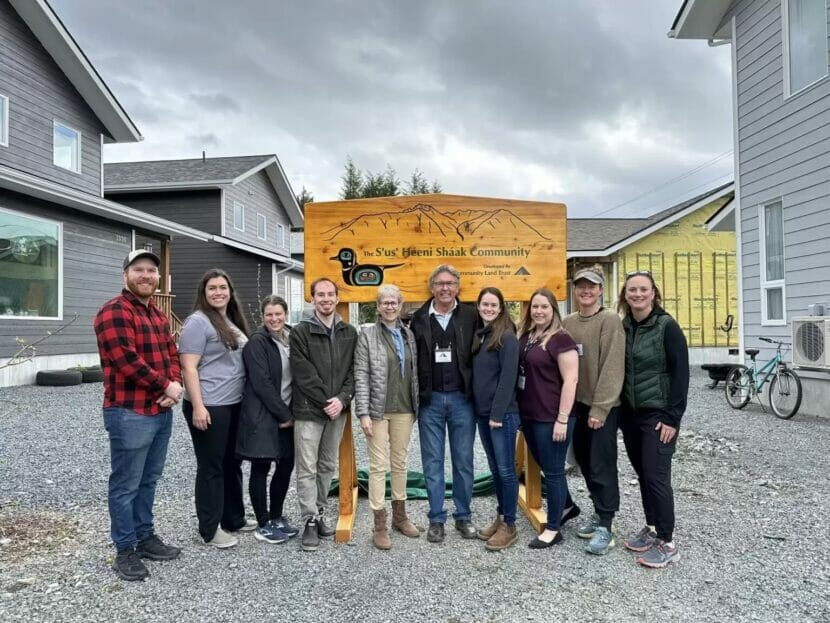
The Sitka Community Land Trust, pictured here at the May 2023 naming ceremony for the S’us’ Héeni Sháak community, provides one model for affordable housing in Alaska. (Sitka Community Land Trust/2023)

Alaska’s population is shrinking, so why does the housing market feel tighter than ever? At Southeast Conference on Thursday, a panel of housing specialists highlighted key problems in the Alaska housing market and specific strategies to fix those issues.

A housing shortage in Alaska is not really news, nor is it new.  Nolan Klouda leads the University of Alaska’s Center for Economic Development.

“I don’t think housing has ever been a particularly great spot in our economy, for a lot of reasons,” Klouda said. “You know, we’ve always had high costs and problems with availability.”

Klouda said that although Alaska’s population in most communities has declined slightly, housing demand has gone up about 9% since 2016. That’s because families are having fewer children, so average household size has decreased.

“When adults live together, you know, there are usually one or two of them in a household,” he said. “And so we have basically, more households, even though we have fewer people per household.”

Klouda said efforts to build more housing can be stalled by a variety of factors.

“Sometimes it’s topography, and sometimes it’s land ownership that doesn’t allow for it,” he said. “Anything that can be done to make land available is important, including the building of access or site infrastructure, which sometimes local governments have the ability to oversee.”

He zeroed in on growing short-term rental markets as another area of concern.

“Even if it’s not a big percent of your overall units at any point in time, it keeps growing,” he said. “And so it puts your community on sort of a collision course, you know, with housing availability and affordability.”

Jackie Pata is the president and CEO of Tlingit and Haida Regional Housing Authority, which provides housing assistance and financial support to communities across Southeast. Pata said that in addition to questions of infrastructure and regulation, she’s been focused on financial education for homebuyers and training for local build crews. That approach has seen some success. She pointed to several small communities in Southeast, including Yakutat and Angoon, that are constructing new housing at a per capita rate above the statewide average.

“My apprenticeship programs, like we have in Angoon – they can now build houses year over year with their own local crew creating their own jobs,” Pata said. “Because we definitely have a need. We leverage our dollars, we build our crew, and we continue to utilize them. And we realized that we were not going to have build-and-bust communities anymore.”

Randy Hughey, the Executive Director of Sitka’s Community Land Trust, shared another model for providing what he called “permanently affordable housing.” Under Sitka’s land trust model, eligible low- to moderate-income buyers purchase a small home on land owned by the trust. When they sell the home, their profits are capped to keep the home affordable for the next buyer.

“Like all other models of portability, it turns renters into owners, and isn’t that what we really want to do in our communities? ” Hughey said. “Provide a way for young families to own a home and stay there and raise their kids and be a part of our communities. We want to turn renters into owners.”

Hughey said land trusts are one small piece of the Alaska housing puzzle. Pata echoed a similar sentiment, saying that a multifaceted approach is necessary to work towards solving Alaska’s housing crunch.

“We love where we are, we are part of the fabric and we’re going to be here,” Pata said. She added that towns across the region were looking for every opportunity to make homes affordable, in order to help slow outmigration and allow residents “to stay in our villages and in our communities.”

Thursday was the final day of Southeast Conference. You can find resources on their website at seconference.org.

Can this robot print a whole house? Nome is going to find out

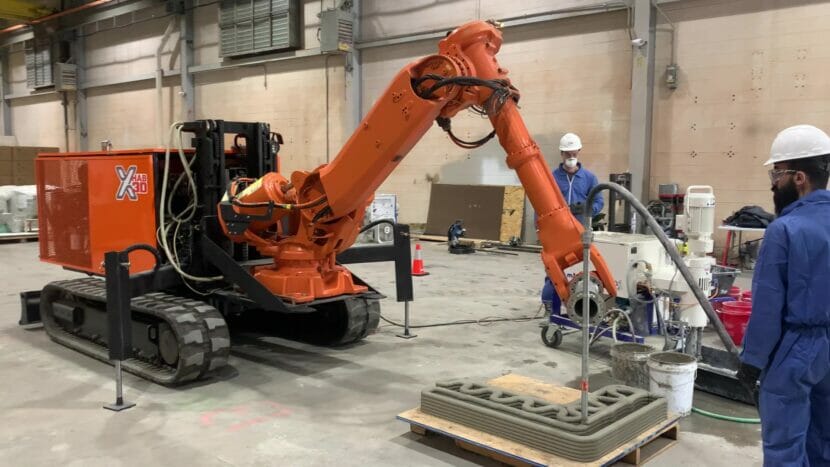
A robot arm guides a concrete extruder in a precise path, demonstrating 3D printing in concrete. (Courtesy of Additive Construction Laboratory, Penn State University)

The City of Nome and its partners are planning to build a demonstration home next summer – using a robot that prints concrete.

They hope the project will prove that the technology can slash the time and cost to build quality housing, even in Alaska’s most remote communities where it’s expensive to build and housing shortages are chronic.

The 3D printing system to build the home will come from 3,600 miles away, in Pennsylvania. Researchers and entrepreneurs working at Penn State University have built a prototype of the system. They’ll use it, or a newer version of it, in Nome to print the unfinished portions of an entire house.

“We are interested in printing everything: the foundation, the walls and the roofs by finding and developing the technology to print domes and vaults,” said Penn State architecture and engineering Professor Jose Duarte. He works in the university’s Additive Construction Lab and its spinoff business, X-Hab 3D.

Sending building materials and skilled workers off the road system is particularly expensive, and the short shipping and construction seasons further complicate the logistics. In some communities, materials must be over-wintered because there isn’t enough time to build after delivery.

Theoretically, 3D concrete printing systems have huge competitive advantages under rural Alaska’s construction constraints and logistics challenges.

Here’s why. Penn State’s system has three main pieces that all fit inside a 20-foot shipping container: A concrete mixer, a pump and a beefy, bright orange robotic arm with a 12-foot reach. The robot arm is mounted on a mobile platform.

“Our current system that we’ve designed at X-Hab 3D is a mobile expeditionary 3D concrete printer,” said Penn State engineering Professor Sven Bilén, who’s also on the team. “It’s on tank tracks. It’s able to roll out of the shipping container and then move around the site on those tank tracks.”

Once in place, the robot arm holds an extruder vertically, like a big pen, putting down a smooth, ropey stream of concrete in precise patterns. As the ropes stack up in layers, a three-dimensional form takes shape.

Without molds holding the soft concrete in place, it’s a bit of an engineering feat to get shapes to come out as intended, instead of a sagging, lopsided mess. Duarte said the system has to account for the particular properties of its concrete mix, how the concrete deforms as more is layered on top, even how the ambient temperature affects the curing time.

“So when you go to a place that is very cold, like, you know, the case of Alaska, or you go to a place that’s very hot, like the case of a desert, you change completely the environmental factors,” he said. “But if you have this platform, you can use the same type of rules, the same type of simulation analysis tools to find out what’s the best configuration for that type of environment. So in a nutshell, that’s the idea that we’re trying to explore.”

The Penn State team says it isn’t ready to share specifics about the project in Nome yet, but their past research was part of a 2021 feasibility study on 3D printed homes in rural Alaska. The study found a ton of benefits over traditional homebuilding.

Traditional builders would need one to three months to do what the 3D printing system could do in as little as one to three days.

A lot of the sand and gravel used in the different concrete mixtures can be locally sourced, which means huge time and cost savings, plus a lower carbon footprint.

The study says the homes should stand up to snow loads, frost heaves, extreme winds and earthquakes, and last longer with less maintenance than a regular home.

The cost savings are also potentially huge. Based on pre-pandemic Fairbanks market data, the researchers estimated that the shell of a concrete home would cost about one-fourth what a traditional one would.

And Duarte said because the different building elements are designed digitally, mass customization becomes possible. That’s good for aesthetics; buildings don’t have to be cookie cutter copies to keep costs down.

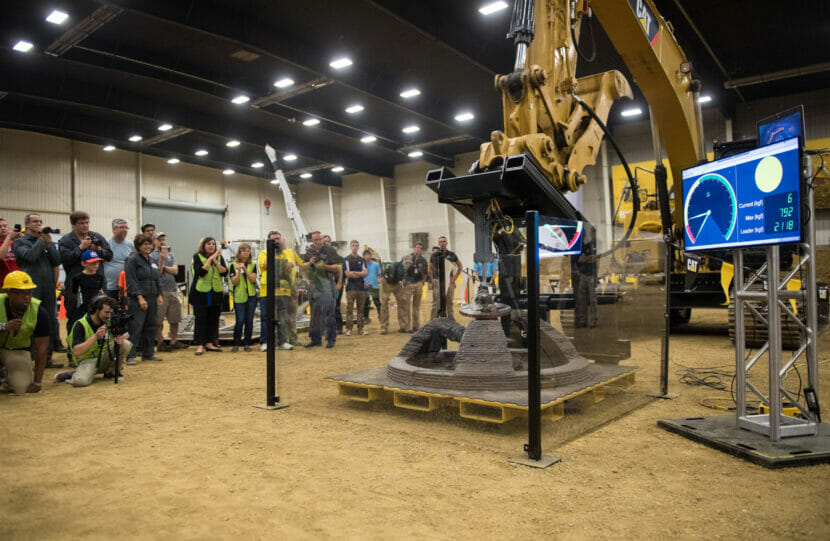
Teams, spectators and judges watch as the 3D-printed dome structure from Penn State’s team is strength tested during NASA’s 3D-Printed Habitat Challenge on Aug. 26, 2017, at Caterpillar, Inc.’s Edwards Demonstration and Learning Center in Illinois. (Joel Kowsky/NASA)

But there are practical benefits, too. Duarte said artificial intelligence can generate design options to fit specific build sites, individual families’ needs, the raw materials locally available and a range of expected weather.

“So you can actually customize the building materials for the performance,” Duarte said. “Because, when you have extreme conditions, it’s more difficult to find solutions that are satisfactory, and that’s why you need to use this technology. So we search to work for environments where the conditions were very difficult.”

A lot of eyes are on the Nome project. The Alaska Housing Finance Corp. and Denali Commission paid for the feasibility study.

“There’s really some Alaska-specific challenges to it,” said AHFC CEO Bryan Butcher. “But it’s really exciting to look and to see if it’s something we might be able to solve, because if we can build high energy efficiency homes in rural Alaska at an affordable price, it’s really going to be a game changer.”

The federal Department of Housing and Urban Development recently awarded Nome and its partners a $600,000 grant for the demonstration build.

Nome is contributing land. City Manager Glenn Steckman shared his own housing situation. He rents an older, 900-square-foot house that he said “tilts a little bit” for $2,000 a month plus utilities.

“On top of that, Nome has been working to get people to either tear down old housing or to try to get it repaired,” Steckman said. “But some of the housing is past saving. So we just need to get more housing up here, and quality housing and safe housing. And that’s been a priority for the four years that I’ve been city manager in Nome.”

Steckman hopes the demonstration home will be the first of many. The city is expecting the demand for housing to only increase as construction on a port megaproject gets underway and medical facilities expand.

Bilén with Penn State said right now, the 3D concrete printing industry doesn’t really exist. His team’s origin story only goes back to 2015, when it came together to compete in a NASA challenge to develop 3D printed habitats for Mars. Here on Earth, building codes and regulatory agencies still have catching up to do.

But Bilén thinks the technology is poised for widespread commercialization, with applications far beyond housing. Like cable housings, sewers, even artificial reefs to mitigate coastal erosion.

“And as those applications grow, and more uses in this, I think you’re just gonna see 3D concrete printing explode,” Bilén said.

Site notifications
Update notification options
Subscribe to notifications