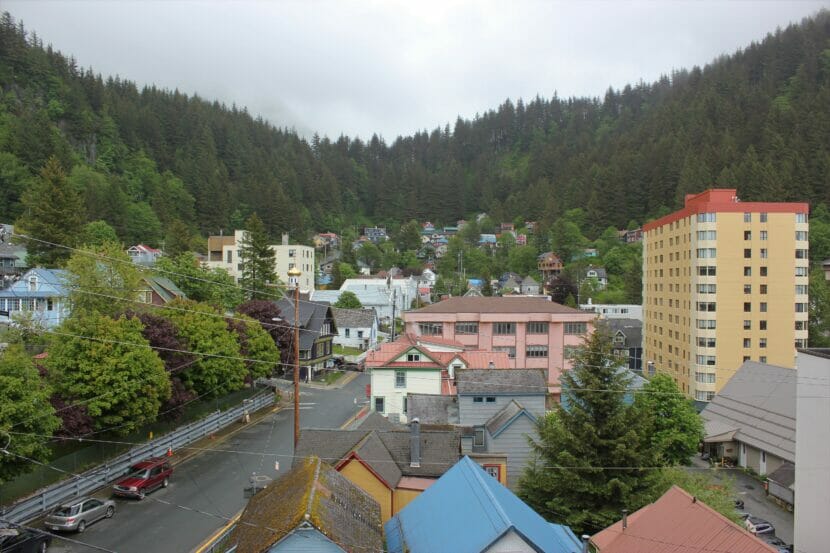
Downtown Juneau seen from across Gastineau Channel on Aug. 11, 2023. (Andrés Javier Camacho/KTOO)
Juneau residents interested in building mother-in-law apartments can now get even larger grants from the city to help with construction costs. They’ll just have to wait a few more years until they can list them as short-term rentals.
At a meeting Monday night, the Juneau Assembly voted to update a grant program that helps residents build accessory apartments on their property. The previous version, which offered $6,000 grants, expired in June. The new grants will be $13,500.
The previous version of the program required that grant recipients wait three years before renting the unit as a short-term rental. Reading from the resolution, Deputy Mayor Maria Gladziszewski suggested that increasing the wait to five years could help prioritize new housing for Juneau residents.
“That’s the purpose of this,” she said. “It’s not to create short-term rentals.”
Assembly member Michelle Hale worried that further restrictions would dissuade people from participating in the program.
“Communities that have a lot of rules and have a lot of restrictions in place are much less successful overall at building housing,” she said. “I think we need to accelerate housing building, rather than put requirements in place.”
The amendment passed in a 5-2 vote, with Hale and Wade Bryson voting against increasing the short-term rental limit. Assembly members Christine Woll and ‘Wáahlaal Gíidaak were absent from Monday’s meeting.
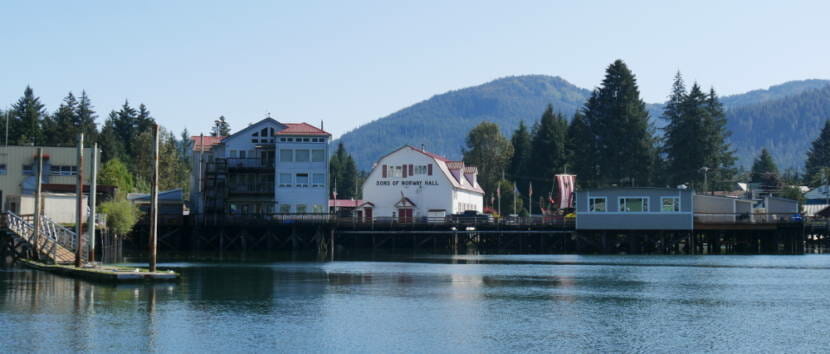
Petersburg’s waterfront in 2019 (Joe Viechnicki/KFSK)
Petersburg has a new fourth grade teacher this fall — Sharon Paulson. She moved to Petersburg this summer. The floor of her home is strewn with musical instruments played proudly by her son, five-year-old Glenn. Maracas, ukuleles and tambourines. In the middle of the room, he was playing a steel drum marked with the first seven letters of the alphabet.
Paulson signed her contract in March. She broke the news to her husband and her son, and then she started house-hunting in Petersburg.
“I looked on Zillow, which was laughable,” said Paulson. “Someone said, check on Facebook and I saw that there really wasn’t very much there. I looked with the realtor companies, both of them. I had my administrators putting the word out for people. We had a list of AirBnBs to ask if maybe they would rent to us.”
After nearly two months of searching, Paulson spotted a classified ad in the local paper.
“That was the last hope that I had for being able to find housing,” said Paulson. “It really was like, if we can’t find housing, we can’t make this move. So when we finally did find a house and our offer was accepted, like I could visibly see the stress fall off of my husband’s face.”
Stories like hers are common around Petersburg. So last fall, the Borough Assembly set up a housing task force. Assembly Member Dave Kensinger chairs the task force.
“I think we need to figure out a way to start building more housing,” said Kensinger. “It’s pretty simple. If we don’t deal with it, we won’t have as many people in town.”
Kessinger says that’s the easy bit. The hard part? What type of housing. To answer that question, the task force launched a community housing needs survey. It ran for a month in the summer, and it was all overseen by Anchorage-based Agnew Beck Consulting. Now, the results are in. Katie Scovic is the senior manager at Agnew Beck.
“We had 366 responses to the Community Housing Survey in Petersburg, which is awesome,” said Scovic. “That’s about 10% of the population and a really great rate for this kind of survey.”
The survey was ten pages long with 39 questions, but here some of the headline results: a quarter of respondents aren’t happy with their housing, and most of those who aren’t happy are under 45 years old, working and still renting. Most of them want to move into family homes, but apartments and duplexes are popular too. 80% of all respondents want to see more land with utilities opened up for housing.
The survey shows that a lack of skilled labor and the cost of repair is holding people back from renovating their homes. However, Scovic says that even those who don’t fall under any of those categories still care about this issue.
“The majority of Petersburg residents are satisfied with their own housing,” said Scovic. “But also the majority of residents say that housing is a community issue. And so to see both of those things, at the same time, is encouraging.”
Now, the team at Agnew Beck have been sifting through all that data to calculate what housing they think Petersburg needs.
“So according to our housing need forecasts over the next ten years, there’s a need for roughly 316 housing units in Petersburg,” said Scovic. “We’re really looking at about six new units a year and 18 rehab or renovation units each year for the next ten years.”
So, once the consultants submit their final report at the end of September, Dave Kensinger says there’s no time to waste.
“The time to done something was ten years ago,” said Kensinger. “And if we want to keep a vibrant community and we just don’t want a community of a bunch of retirees, we need to address the housing problem now — not next year.”
But that’s easier said than done, between land, labor and logistics. And many folks in Petersburg will have big concerns that need to be addressed first. Back at the Paulson family’s home, Sharon has shifted her focus to a different challenge altogether — the first day of school. Perhaps she can whip up a quick housing plan while she’s at it.
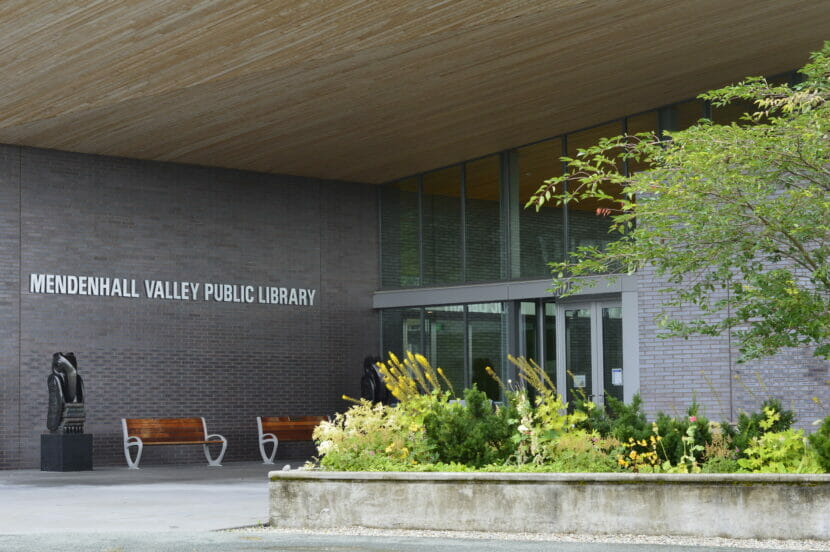
The state’s emergency management division, the city and volunteer groups will open a disaster assistance center at the Mendenhall Valley Library from Aug. 21-23.
Division of Homeland Security and Emergency Management spokesperson Jeremy Zidek said the state has received 60 applications for individual assistance so far.
“We think that that’s a good number of the people that have had damages,” he said. “Our DAC will give those who haven’t registered an opportunity to sit down face-to-face and register that way.”
He said those who’ve already applied can still go to the library to talk about their applications.
State assistance can help homeowners cover property damage, cleanup work and other costs.
Zidek said renters can also apply for assistance if they’ve lost “critical and essential items,” like clothing, furniture and kitchenware.
Those who were displaced may also be eligible for help paying for temporary housing. Renters can get up to three months of housing assistance and homeowners up to 18 months.
Those interested in applying for assistance at the library should bring documentation of damages or losses — which could include photos, videos or written records — along with proof of occupancy and home ownership, insurance information and an ID.
Zidek said state assistance is for people whose primary residence was lost or damaged.
“If it was a vacation home or some type of second home, then they may not be eligible for our state’s individual assistance program,” he said. “One of the items that we ask for is proof of occupancy — this can be a utility bill.”
Deputy City Manager Robert Barr said that if homeowners have already started repair work, documenting that is important. It will help with the permitting process and ensure good record-keeping for state assistance applications.
“It is a good idea to document with pictures and with narrative about what the state of whatever the repair work was before, during and after,” he said. “How many loads of rock were laid, or what have you.”
City staff will be at the library to answer questions about immediate needs, and volunteers from other organizations will help identify long-term assistance.
The disaster assistance center will be open from noon to 7 p.m. on Monday, 9 a.m. to 7 p.m. on Tuesday and 9 a.m. to 1 p.m. on Wednesday.
Homes in downtown Juneau, photographed on June 6, 2023. (Katie Anastas/KTOO)
The Juneau Assembly is considering updating a grant program that helps Juneau residents build accessory dwelling units — new housing units like mother-in-law apartments, built on lots that already have a house. If approved, the size of the grants would more than double.
The city defines accessory apartments as being no more than 1,000 square feet or half the size of the main house on the lot — whichever is smaller. They can be standalone structures or part of an existing house.
The previous program, which expired at the end of June, offered $6,000 grants. Applicants had to wait three years after building a new apartment to use it as a short-term rental. Since July 2016, the city has issued 41 of those grants.
Joseph Meyers, the city’s housing and land use specialist, told Assembly members in April that $6,000 was no longer a strong enough incentive for Juneau residents to build accessory apartments. At the start of the program, it could cover nearly a quarter of the construction cost. In 2022, it covered about 10%.
“While funding has been distributed and ADUs built, the $6,000 grant in many cases has not been a deciding factor in development of an ADU; rather a small bonus after the development decision has been made,” he wrote in a memo.
The updated program, if approved, would offer $13,500 grants. Like the original program, recipients couldn’t rent the unit as a short-term rental for three years. Applicants would have to be Juneau residents, and the new units would have to be occupied within two years.
Assembly members are still considering adding a second tier with much larger grants, though they’ll continue discussing that in committee.Tier 2 recipients would get $50,000, and short-term rentals wouldn’t be allowed for 10 years.
Apartments built with Tier 2 grants would also have to be affordable for people who make 60% of the area median income. Right now, that would mean rent would be capped at $1,284 for an efficiency unit, $1,375 for a one-bedroom and $1,650 for a two-bedroom.
But at a committee meeting on Monday night, City Manager Rorie Watt said it would be time-consuming for city staff to monitor things like the rent property owners charged and their tenants’ income.
And he said staff worried that property owners would just rent affordable units to friends and family rather than making them available to the broader community.
“We couldn’t figure out a way to ensure that that kind of program wouldn’t be misused,” he said. “If somebody added a unit with an affordability component, that they might not make that available to the public or there might be some kind of an inside deal.”
The Assembly Committee of the Whole will continue to discuss a potential second tier. The updated $13,500 grant program next goes to the full Assembly for a final vote.
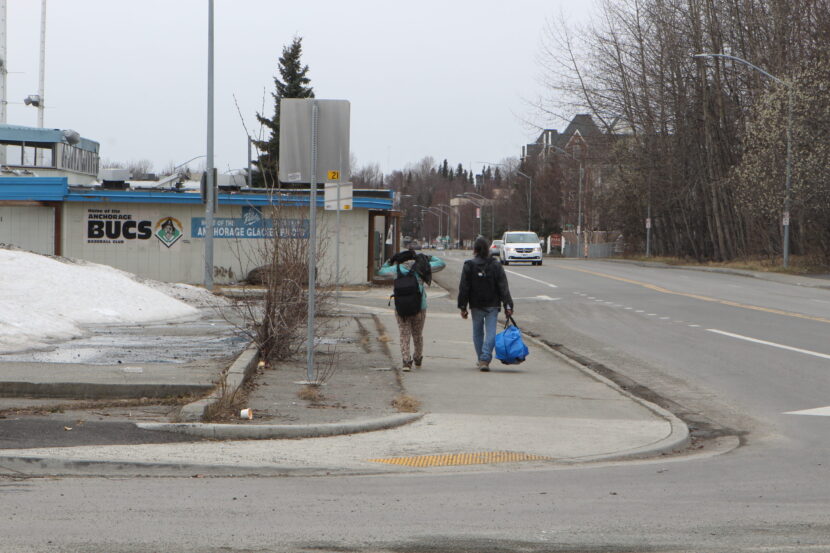
Two homeless residents walk away from the Sullivan Arena shelter on May 1, 2023, when capacity was slashed to a quarter of its winter capacity. Before the scale-down, the Alaska Coalition to End Homelessness provided blue tote bags with sleeping bags, a waterproof document container, food and personal hygiene kits. (Wesley Early/Alaska Public Media)
Alaska’s largest city has broken its record for outdoor deaths.
So far this year, 29 people believed to be homeless have died outside in Anchorage. That surpasses last year’s grim milestone of 24 outdoor deaths, and there are still five months left in the year.
The numbers come from reporting by the Anchorage Daily News and ADN reporter Michelle Theriault Boots, who writes about the city’s homelessness issues. (In another recent story, Theriault Boots chronicled one woman’s yearlong journey from homelessness to getting housed).
Theriault Boots says six of the outdoor deaths happened in just a four-day period, from July 18 to July 21, and that more than half occurred after the city closed the Sullivan Arena shelter.
Listen:
The following transcript has been lightly edited for clarity.
Michelle Theriault Boots: That (number of deaths in a short time) really says something. Why is this happening? I think we have incomplete information. A little bit about the data: This is something that we have requested for years from the Anchorage Police Department. And what they give us is incident reports. You know, police were called to the scene of X place and found a person not breathing. Few details, and it notably does not include the cause of death. I mean, one kind of speculative explanation offered by Alexis Johnson, the homeless coordinator for the city, is that this summer you just have a bunch of people, who otherwise might have been in some kind of shelter, who are all camping. So in many of these recent cases, you know, people are found dead in a tent that’s hidden away in the woods somewhere. So there was kind of a thought that maybe people are more isolated, and there’s fewer opportunities for intervention. Like, no one can give you Narcan if you’re alone in a tent, whereas maybe if you’re overdosing in a shelter environment, or somewhere where there are more people, there might be more of an opportunity for someone to intervene.
Casey Grove: Yeah. And the city continues to work on that. But it does sound like there’s not going to be anything here in the very near term in regards to a homeless shelter or navigation center going into the fall in winter. What do you expect to happen?
Michelle Theriault Boots: Well, I mean, there also is the threshold where the city, I think legally, has to provide some kind of cold weather shelter. What I was hearing was that the city believes that with all the new non-congregate housing that’s come online recently, with the hotels that are converted to, you know, so people can live in the rooms, many people see as a success story. They think that’s gonna make a really big dent in the number of people who need shelter this winter. And they think that they — I mean, what, again, city homeless coordinator Alexis Johnson said is they think they can handle the need for winter shelter, using that non-congregate space, those hotel conversions. Whether that’s true remains to be seen. And that also doesn’t exactly address the issue of the person who is, you know, functioning maybe on a really low level on the street and who needs immediate, just a place to get warm on a frigid day. So I think that that’s something that people believe needs to be addressed.
Casey Grove: Well, this high number of outdoor deaths is obviously troubling. But you also recently wrote a story about somebody’s journey from homelessness to getting housing. And I think it’s fair to say that it’s a little bit more complicated than just somebody getting a job and getting an apartment. And that person, her name is Monique. Can you tell me about her story? And I guess maybe just starting with how you met her?
Michelle Theriault Boots: Yeah, Monique, she was raised in Anchorage, went to high school in Anchorage, spent some time Outside in San Diego, trained as a medical billing and coding specialist. And then found herself homeless in Anchorage about eight years ago for the first time. You know, homelessness was kind of driven by alcoholism and some mental health issues. Monique is a really smart, really funny, witty person. And we actually met her on the steps of the Sullivan Arena the day that it closed for the summer in 2022, so about a little over a year ago. And she was one of the folks that was just sitting there waiting for what was next. She had nowhere to go. She had been kicked out of most of the shelters in Anchorage for what she described as her outbursts of anger. And she was just very articulate about her situation. She did not want to go camp, but that was her only choice. So the city sent her to Centennial Campground, and she went from being, you know, having all of her belongings in garbage bags, at the closed Sullivan Arena to moving into an apartment. And, you know, through that time, she really worked on herself. I mean, she is completely responsible for her success. She addressed a lot of longstanding difficult issues. But she was also really helped by being able to live at a place called Complex Care, which is a small shelter for people with medically complex situations. And that place just really worked for her.
Casey Grove: In a photo that you took, she was sitting there on her bed with her cat under her arm.
Michelle Theriault Boots: Yes, her cat Coco was a really big motivator. You know, someone she knew had been caring for Coco for years, and she just wanted to be reunited with her cat and have that freedom and dignity to have a pet, which I think a lot of people take for granted. But when you’re homeless, that’s, you know, that’s not something you can always do. And so just having that autonomy to have her pet with her meant the world to her, I think.
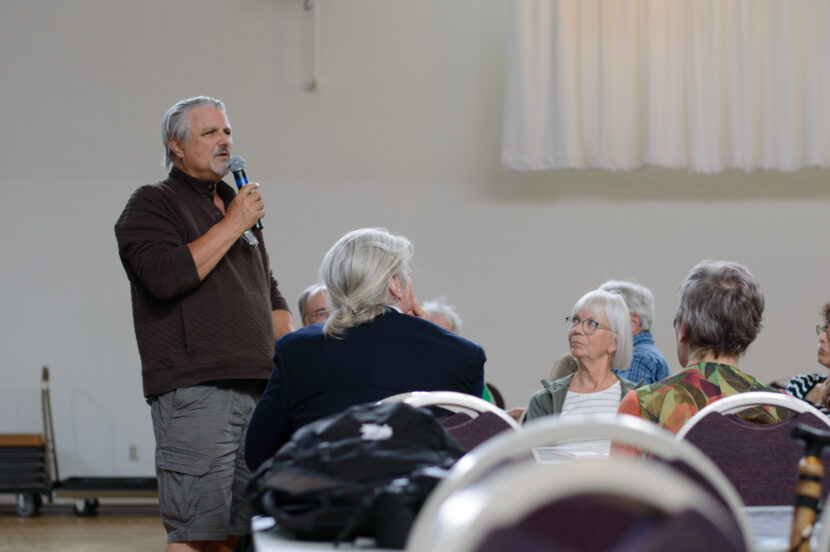
Juneau resident Mark Whitman speaks to attendees at an open house on Telephone Hill developments on July 26, 2023. (Photo by Yvonne Krumrey/KTOO)
The City and Borough of Juneau hosted an open house Wednesday to gather public opinion on what to do with Telephone Hill.
About 50 attendees answered survey questions like, “What types of uses would you like to see on Telephone Hill?”
For some who live there, the uncertainty around the downtown neighborhood’s future is getting old.
“It’s been really exhausting mentally and emotionally,” said Callie Conerton.
Telephone Hill is home to a small apartment building and seven houses, including some of the oldest in the state. Until this spring, the state owned the neighborhood. In March, ownership transferred to the city. Since then, the city has been working toward redeveloping the neighborhood, possibly by building new housing.
But that redevelopment means that the people who already live there will have to move. And some say they’re worried about finding new homes in Juneau’s competitive housing market.
Conerton grew up on Telephone Hill and rents there now. She said she’s glad the city is involving and listening to the residents in this process — and so far, the city hasn’t given them a move-out date or an eviction notice. But she’s concerned about her father’s quality of life if he ends up having to move.
“My family lives up there, and my father has Parkinson’s — he has a TBI,” Conerton said. “Housing is really hard to find, especially with wheelchair access.”
City officials said the event was meant to get a sense of what residents think of Telephone Hill, and what should happen to it. Presenters from Oregon-based urban design firm First Forty Feet asked the attendees to share what opportunities and challenges exist for future development in the neighborhood.
During the survey, most attendees stressed things like “preserving the historic neighborhood,” “preserving the homes” and “preserving the trees and greenery.” The second most common theme was adding affordable housing.
Mark Whitman doesn’t live on Telephone Hill himself, but he says he values what the neighborhood has to offer — green space, historic buildings and few tourists wandering around. He said he doesn’t want it to be redeveloped beyond making the neighborhood better for the people who already live there, and certainly not bulldozed and completely redeveloped.
“We’ve seen neighborhood after neighborhood taken over by tourism, concrete, steel and glass,” he said during the open house. “This is an opportunity to show that we can do something for local people.”
The City and Borough of Juneau is working with MRV Architects and Oregon-based design agency First Forty Feet. Jason Graff with First Forty Feet said there will be more opportunities for public comment next month, and that not redeveloping the area at all is still on the table. But he said plans for the neighborhood should be mostly drafted by October or November.
In the meantime, Conerton said her neighbors and her family are scrambling to figure out what to do. “One family just, like, peaced out,” she said. “Another person was just like, ‘I’m worried about everything.’”
Close
Update notification options
Subscribe to notifications
Subscribe
Get notifications about news related to the topics you care about. You can unsubscribe anytime.