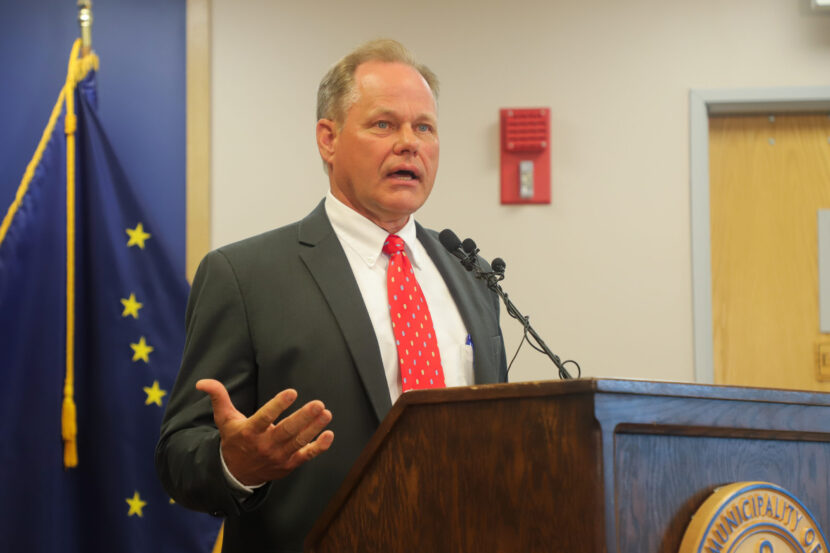
Anchorage Mayor Dave Bronson speaks at a press conference on Tuesday. (Dev Hardikar/Alaska Public Media)
Anchorage Mayor Dave Bronson says he doesn’t foresee the Sullivan Arena becoming a mass homeless shelter again this winter. Instead, he says his administration is working on a proposal to pay for one-way plane tickets to send homeless people to their loved ones or move to warmer locations.
“It’s not difficult to administer,” Bronson said. “Someone says, ‘I want to go to Los Angeles or San Diego or Seattle or Kansas.’ It’s not our business. My job is to make sure they don’t die on Anchorage streets.”
Bronson said the plan would work similarly to efforts made by the Salvation Army last year, getting tickets for homeless campers who were staying at Centennial Park campground. The Bronson administration moved many homeless people there after shuttering the Sullivan Arena shelter that summer.
City officials estimate there are currently roughly 750 homeless people in Anchorage.
The mayor said the city set a record for outdoor deaths among homeless people last winter, and he’s concerned it’ll be worse this year, especially without a mass shelter.
“This winter we’re looking at possibly even doubling that,” Bronson said. “So I have a moral imperative here, and that’s to save lives. And if that means giving them a few hundred dollars for an airline ticket to go where they want to go, I’m going to do that.”
Other cities across the country have opted to fly homeless residents elsewhere, with varying degrees of success. While some have successfully been reunited with families, others have ended up on the streets of a new city.
Assembly Chair Chris Constant said in an interview Wednesday that the Assembly hasn’t been briefed on the mayor’s plan. He said he has questions, including how much it would cost. He also said a majority of homeless people in Anchorage are from Anchorage.
“I just don’t think there are that many people who are from far away places, that we would be returning them home,” Constant said. “And so, practically speaking, it raises so many questions.”
Bronson said he doesn’t have a funding source for the proposal yet.
Constant and Bronson both agreed that Anchorage has had little help from the state to address its growing homelessness crisis, but they will continue to seek funding from the legislature and governor. While Anchorage has 40% of the state’s population, it also has roughly two-thirds of the state’s homeless population.
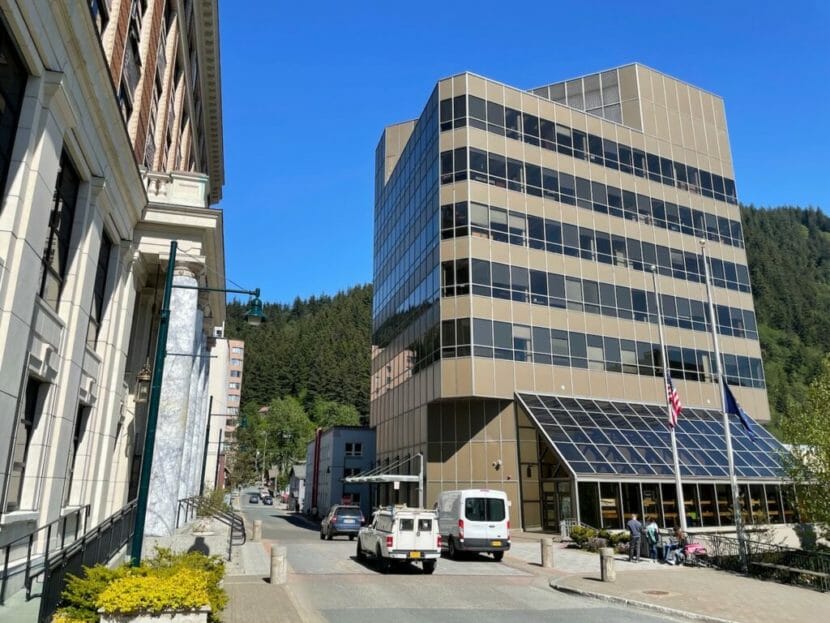
The Dimond Courthouse building, home to the Juneau offices of the Alaska Department of Law, is seen across the street from the Alaska State Capitol on Friday, May 27, 2022. (Photo by Lisa Phu/Alaska Beacon)
When Raven Tulugak Lopez got an eviction notice on his door, it came with another piece of paper that listed resources to help avoid eviction. He was behind on rent by about $900 and was a couple weeks out from a paycheck.
“It’s been really tough with inflation and everything,” he said. “The cost of food here in Anchorage, from a year ago to now, literally almost doubled on a lot of the stuff we get.”
He has lived in the same apartment in the Muldoon area of Anchorage for four years, with his wife, his 12-year-old daughter and now his 5-month old son, who just started teething. But this year, he said his rent leapt from $995 to about $1,260 — a more than 25% increase — while his wages in the meat department in a local supermarket didn’t go up at all.
Lopez called a few names on the list of resources and was eventually connected with the Alaska court system’s eviction diversion program, which is new this year.
He said his landlord was understanding, and waited on eviction proceedings when they heard he was working on a solution.
Eviction cases in Alaska are returning to pre-pandemic levels as COVID-19-era eviction moratoriums and rental assistance programs end. Meanwhile, the cost of goods, home prices and the cost of rent have risen statewide.
This has put pressure on the lives of many tenants; eviction can lead to instability or homelessness. It’s also prompting Alaska’s court system and social service agencies to consider new ways to ease that pressure for tenants — and landlords, who are also experiencing a financial crunch.
Eviction diversion
A court-ordered eviction can live on someone’s record forever, which can reduce their chances of finding stable housing. And Will Walker, a staff attorney who runs the Alaska court system’s eviction diversion program, said it can help solve eviction disputes before they reach the courtroom and connect people who must leave their housing with resources.
“A lot of landlords are unwilling to rent to tenants with an eviction on their record, or at least it poses a barrier,” he said.
Walker said landlords are more likely to rent to an applicant without a record of eviction, and that the record could even be a barrier to accessing certain public housing benefits.
The eviction diversion program launched in March. Walker said its existence is a recognition of the pervasiveness of homelessness across the state — and the courts’ role to assist. Most tenants and landlords are trying to do the right thing, he said, but don’t understand the legal system very well.
He said the program’s goals include mediating eviction disputes before they make it to court and educating both landlords and tenants on how the justice system works around evictions. It also includes connecting people with community resources if they do have to leave their homes — either through mutual agreement with the landlord or a court order.
Recently, he worked with Debra Thomas after she got an eviction notice from her apartment on the Kenai Peninsula. Thomas said her heater wasn’t working and the landlord wouldn’t fix it, so Walker attempted mediation. “He did whatever he could to help me and I really appreciate it,” she said.
Thomas’ landlord didn’t want to participate in mediation, but Walker connected her with Alaska Housing Finance Corporation, which helped her find an apartment in Kasilof before her eviction case went to court.
“I just found it was best that this opened up and I took it,” she said, referring to her new apartment.
Walker said the program serves between 10 and 20 people a week. Sometimes he helps landlords navigate the eviction process, but he mostly hears from tenants who have gotten an eviction notice or have had an eviction case started against them. “They’re trying to navigate what to do and wanting information on the process,” Walker said.
There’s a lot at stake: Walker said eviction is a significant entry point into homelessness and a barrier to finding housing in the future. The vast majority of people who reach out to the program are threatened with evictions because they are unable to pay rent.
“It feels really great when I’m able to help people,” he said. “Sometimes there’s not much that can be done. One of the limiting factors is just the availability of resources and services in the community.”
One of those resources is rental assistance. The state was flush with it through the pandemic, but now it’s much scarcer.
Over the course of the pandemic, the Alaska Housing Finance Corporation distributed more than $250 million in federal rent relief. The program allowed people to hang on to their leases because it paid rent directly to their landlords. It helped more than 66,000 Alaskans stay housed, according to the corporation’s data. That program ended in 2022, and social service providers say that people have missed the help.
“That well has dried up”
Mercy Pulou, who runs homelessness and family programs for Catholic Social Services, said she works with families who no longer receive federal rent relief dollars.
“The trend that is often repeated is that the funding for the COVID dollars is — that well has dried up,” she said.
The well isn’t completely dry — Alaska Housing Finance Corporation still offers a stabilization grant that houses people who are experiencing homelessness for a year — but the rental assistance program for people with leases is over. Catholic Social Services was a partner with the corporation to distribute pandemic rental assistance.
One of the programs Pulou runs still does something similar to what the federal pandemic rent relief money did — it helps people who already have housing stay in their homes. Basic Housing Assistance provides one-time financial help for people who have received an eviction notice, called a notice to quit. But Pulou said there’s a very limited amount of those funds. Catholic Social Services can only help about 70 households a year.
“We’ve been seeing a lot of requests come through for households that are looking for assistance to pay for rent,” she said. “Sometimes we have folks that have either lost jobs, or maybe they were on a rental assistance program. And those funds have run out and they haven’t quite attained enough income to make ends meet.”
She said that when other aid services fail, it can lead to housing insecurity, too. When thousands of families lost access to food stamp benefits over the last year, it meant tough financial choices for some of them. “Some of the households have reported choosing between putting food on the table, feeding the children, or paying the utilities or paying the rent,” she said.
But she said the end of pandemic assistance isn’t the toughest part of the post-pandemic housing landscape — what’s really hurting renters is that the housing market has changed significantly. So as pandemic-era assistance programs end, renters are facing a much tougher market and higher monthly rent.
“Prior to the pandemic, a one-bedroom would be under $700. Now, that same one-bedroom is probably $1,200 to $1,400 a month,” she said, citing costs for low-income housing in Anchorage.
“Families that would have been able to be on their own are now doubling up, they’ll pool resources. We have multigenerational households and sometimes that doesn’t work out well with a landlord because of the household size, and the number of people that they want for the apartment,” she said. For example, six people will squeeze into a three-bedroom apartment, or more than eight people will live in a single-family home, she said.
Tenants are falling behind on rent
Inflation, heightened housing costs, and the end of pandemic-era housing protections are stressing landlords as well as renters.
Kassandra Taggart, a property management broker for what she described as “middle-income” properties from Wasilla to the Kenai Peninsula, said she hasn’t seen an increase in evictions on the 700 properties she manages, but she has seen more tenants fall behind on rent.
“Anytime a tenant doesn’t pay, we work really hard on creating payment plans and connecting them to resources to avoid evictions,” she said. “But I am having an increase in people that are having temporary issues with life — whether it’s job, whether it’s family, whether it’s the car broke down, something of that nature — that has increased. Seeing the number of people tight on funds has increased.”
Taggart said that tightness is true for landlords, too, who often rely on rent payments to pay their own bills. She runs a group for landlords on social media.
“The day that you’re not paying rent is the day that they’re also not able to pay any of their bills,” she said. “They’re in jeopardy of not being able to pay the mortgage, the taxes, the insurance, that plumber that they just had to take care of and all the other outstanding bills that are associated with the property.”
She said it’s why her company encourages direct communication between tenants and landlords — and why she thinks the state court system’s eviction diversion program is on the right track.
It worked for Raven Lopez, in Anchorage. He is employed, so he qualified for some of the limited rental relief funds that are available in the state through the United Way. On Thursday, he got a check that covered his past due rent. Now he and his family can make a plan for next month.
“The only thing I think I could really do is get another job, you know, part time and keep doing what I’m doing full time,” he said. “Everything has just gone up a crazy amount.”
He said he wants other people to know about the eviction mitigation program. It doesn’t always lead to rental assistance, but it can also connect renters to information and other resources.
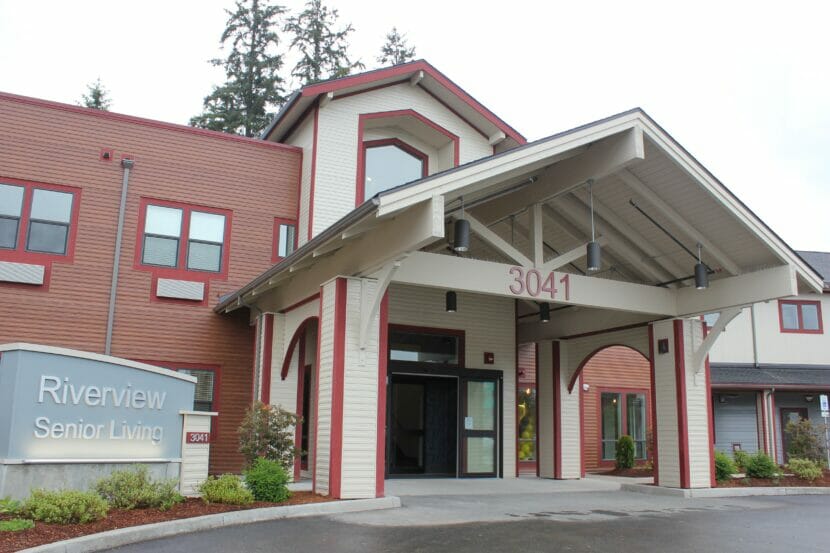
Betty Marriott, 83, plays her baby grand piano at Riverview Senior Living. (Katie Anastas/KTOO)
When 83-year-old Betty Marriott moved out of her Douglas home into the Riverview Senior Living facility, she asked if she could bring her baby grand piano with her.
“I’ve been playing piano since I was 10,” she said. “I just love it. It’s my emotional release, you might say. You’re happy, you’re sad or whatever. It just comes out in your music.”
On a recent Monday afternoon, she played a cheery melody called “Snowbird,” a song she picked out to play during happy hour in the dining room. Marriott had lived at Riverview for about a month, and she was enjoying it so far.
“It’s brand new, so it’s very clean,” she said. “I like the people who work here. They’re all very friendly and helpful.”
Finding housing in Juneau is hard. It can be even harder for seniors who want to stay in Juneau but need a bit more care. Alaska’s population of older adults is growing rapidly, and in Southeast Alaska, nearly one in four adults are 60 or older, according to state data. As local seniors seek to age in place, Riverview provides a new place to do it.
A needed model
The facility is located in the Mendenhall Valley. It has 58 assisted living apartments and 29 memory care units, and they’re filling up fast: about 70% of apartments have been claimed by people intending to move in in the next three months.
“We expect to be 80% full in the next four to six months, if not 100% full,” said Carrie Pusich, Riverview’s community relations director. “The interest that we have gotten from the community has been overwhelming.”
The apartments have their own wheelchair-accessible bathrooms and kitchenettes with a refrigerator, microwave and sink. Riverview is an assisted living facility, meaning there are staff there to help with daily activities like taking medications, getting dressed or using the restroom. New residents are screened by a nurse to determine the level of care needed from the nurses, medical technicians and caregivers on staff.
Monthly rent starts at $6,000 for a studio and $7,500 for a one-bedroom apartment. That includes all meals cooked by the community’s chef and activities, like field trips to the Mendenhall Glacier and the Jensen-Olson Arboretum. Additional monthly care fees start at $650 and go up in $400 increments depending on the level of care required. Pusich said the prices are in keeping with the national average.
“I know it seems high to some people, but it’s not,” she said. “We want to make everybody comfortable. We want them to feel like their apartment is theirs.”
The first residents moved in in mid-May. Pusich said others are moving in in stages so the facility can hire staff as needed.
Riverview Senior Living welcomed its first residents in mid-May 2023. (Katie Anastas/KTOO)
Years in the making
Riverview has key differences from other housing geared toward older adults in Juneau. Wildflower Court is a long-term care facility meant for people who need more extensive medical care. Trillium Landing and Fireweed Place are apartment communities. The state-run Pioneer Home offers its 49 residents multiple levels of care like Riverview does – with monthly rates starting at $3,458 including room and board – but it has a long waitlist.
That’s what inspired Pusich’s mom, Sioux Douglas, to try to bring another option to Juneau. She was president of the nonprofit Senior Citizens Support Services, Inc.
“Some people who needed assisted care, but weren’t on the Pioneer Home list or would have to wait way too long, found that the only thing they could do is move out of state or move up to Anchorage,” Douglas said. “We lost several good senior citizens who were longtime community members who had to go elsewhere for the care and the housing they needed.”
In 2012, the nonprofit held an open house at Nugget Mall to hear from Juneau residents about the need for assisted living in Juneau. Douglas said she talked to individuals who were “desperate” for assisted living options and families preparing to move out of state with aging grandparents.
“We already knew in our hearts that this was needed, but having that public forum convinced us to go forward,” she said.
The nonprofit spearheaded the search for a developer who could create an assisted living community in Juneau.
“That took several years,” Douglas said. “It took a lot of meetings with the city and with two or three developers. And when Torrey Pines Development decided to invest in Juneau, it was the answer to our dreams.”
A perfect partnership
Torrey Pines, a California-based developer, owns Riverview. It’s operated by North Star Senior Living, also based in California. The City and Borough of Juneau provided some incentives to help Torrey Pines see the project through, including property tax abatement and a lease structure that helped reduce upfront costs for the developer.
“I refer to this as the perfect kind of public-private project that communities should have,” Douglas said. “There’s an appropriate role for government – a small role – and it incentivizes private development.”
Juneau Assembly member Michelle Hale agrees. She’s the Assembly liaison to the Juneau Commission on Aging. She said the city’s work with Douglas’ nonprofit and Torrey Pines shows the city can make meaningful contributions to the housing market without constructing a city-run facility.
“The city does a huge amount in this community. We own our hospital, we own our docks and harbors, we own Eaglecrest, we own our airport,” she said. “I don’t think the answer is for the city to take on new roles, but rather to find those nonprofits and other entities to partner with to help make things work.”
Along with helping longtime Juneau residents stay in the community, Hale said more housing options for seniors could help open up the local real estate market. The number of people aged 65 and older living alone more than doubled from 2015 to 2020, according to the Juneau Economic Development Council.
“That’s actually one of the reasons pointed to for the housing shortage – where you might have had a family of four or five in a house, you might be down to just one person,” Hale said.
Helping Juneau residents stay in town as they age is important to Hale. She’s 61, and her mother lives with her and her partner. They’ve watched friends and neighbors leave Juneau as they get older.
“One of the things that has been the most heartbreaking for me over the years is having very dear friends who, once they retire, move south,” she said. “That always seems so sad to me – that we lose them in our community when they’ve been such a vital and vibrant part.”
Riverview represents a new part of Juneau’s community. As Betty Marriott performs on her baby grand for her friends and new neighbors, it’s clear she’s found her place in it.
Betty Marriott, 83, smiles in her new apartment at Riverview Senior Living. (Katie Anastas/KTOO)
Homes in downtown Juneau, photographed on June 6, 2023. (Katie Anastas/KTOO)
Juneau residents who run short-term rentals will have to register their businesses with the city starting this fall.
The Juneau Assembly approved the program at a meeting Monday night. City leaders say it will help ensure operators are paying sales tax and provide data on the growing short-term rental market – data that could eventually shape restrictions on them amid Juneau’s housing crunch.
Assembly member Wade Bryon said it was the result of many meetings over the last year.
“We’ve had probably 20 hours worth of discussion of short-term rentals,” he said. “This ordinance did not come about overnight.”
The registration program will assign a unique number to each unit and require operators to include that number in online listings. They’ll face a $25 fee each time they fail to include the number with a listing.
The Assembly considered an earlier version of the program at its June meeting but decided it needed more work after rental operators spoke against it. The new version removes requirements for rental operators to give emergency contact information or describe amenities when registering.
The Assembly also approved a later start date for the program – it’ll go into effect in 90 days instead of 30.
Still, five short-term rental operators spoke in opposition to the revised version. Bed-and-breakfast owner Dale Anderson told the Assembly the additional paperwork would be a burden on the operators who do pay their taxes.
“I find it objectionable that you are placing these onerous restrictions on my business, that I have totally run above board according to CBJ guidelines, in order to catch the bad guys,” he said.
Mayor Beth Weldon introduced an amendment to allow property managers to register on behalf of the property owners. It came after Juneau resident Kelli Ballou described her role as a broker for short-term rental owners.
“If the property owner who pays me also has to have his own business license and tax account, and also do quarterly reporting and annual registration renewals, then that takes all the value out of the service I’m selling them,” she said. “I won’t be worth much if they have to do all the work.”
The amendment passed, along with one that notes the financial responsibility for taxes and penalties ultimately falls on the property owner.
The registration program doesn’t limit the number of rentals one person can register, nor does it charge a registration fee. But Assembly members acknowledged that they’ve already been talking about steps they could take to further regulate short-term rentals. For example, Sitka requires short-term rental owners to live on the property for half of the year.
“There is the possibility that regulation might be coming,” Juneau Assembly member Michelle Hale said on Monday. “That might be happening, and I don’t want to pretend that it might not be happening.”
Member Maria Gladziszewski said the registration program will help ensure they take those next steps thoughtfully.
“This is, for me, about getting data. We have some pressure from our community to do something about short-term rentals,” she said. “I’m not in favor of quote ‘doing something’ about short-term rentals when we don’t have data.”
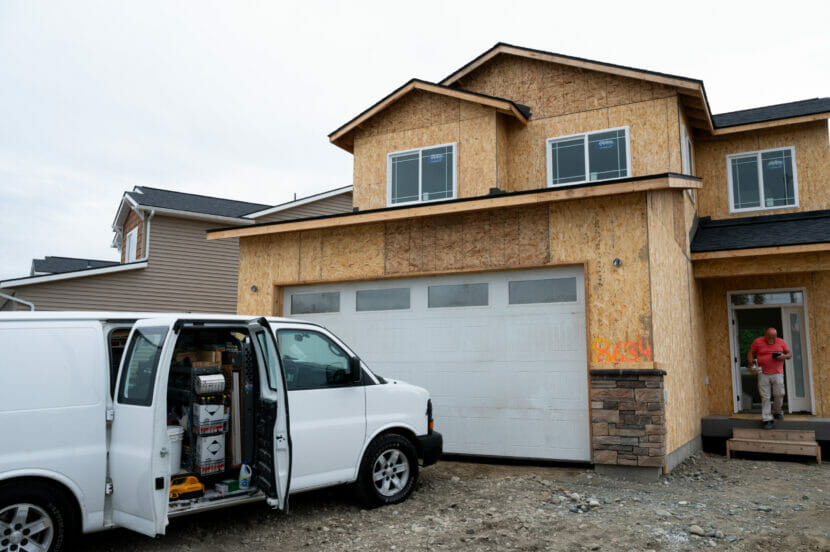
Homes are being built in a neighborhood near Sand Lake in Anchorage, pictured here on July 5. (Matt Faubion/Alaska Public Media)
There’s a truism that comes up a lot when Alaska experts talk about ending homelessness.
“Housing is the pure solution to homelessness, hard stop,” said Alaska Coalition on Housing and Homelessness Executive Director Brian Wilson on Talk of Alaska in December.
“We know that the answer to ending homelessness is housing,” Anchorage Health Department homelessness coordinator Alexis Johnson said on Alaska Insight in May.
“You will hear me say it every time I get the chance to speak: The solution to homelessness is housing,” said Anchorage Assembly member and Anchorage Coalition to End Homelessness Executive Director Meg Zaletel at a press conference in April 2022.
In recent years, Anchorage taxpayers, charities and businesses have invested millions of dollars converting hotels into low-income housing. These units have helped hundreds of people sleeping in cars and tents and emergency shelters get into permanent housing.
Anchorage has also been spending a lot of time, money and effort helping the city’s homeless people with their most basic needs: food, shelter and health care.
“There’s that tension between the emergency safety net and the longer term investment,” Zaletel said on Talk of Alaska in December. “The solution to homelessness is housing. So if we’re intending to solve homelessness, we have to make investments in housing, and we need to maintain a safety net to keep people alive and well in the mean time.”
The pockets for directly investing in housing are only so deep, and there are only so many properties that can be converted. In an ideal free market, this wouldn’t even be a public sector problem – private developers would build the supply to meet the demand.
Instead, when experts look at the big picture, they see a lopsided housing market, where limited supply drives up rent and home prices — and the housing insecurity that contributes to homelessness.
Almost everywhere in AK, housing is too expensive and in short supply. Last Friday I shared some observations about housing with the Anchorage Assembly. A?.
Housing construction in Anchorage has been in a long decline. Census Bureau data show that most of Anchorage’s housing was built in the 1970s when the Trans-Alaska Pipeline System was being built, and the 1980s after the oil started flowing. Today, Anchorage has more homes that were built in the 1950s than in the 2010s.
“Most of our real estate is over 40 years old in Anchorage – means we’re not even building enough to replace the older homes that are getting dilapidated,” said Anchorage Assembly member Kevin Cross.
Cross and Zaletel are proposing a dramatic simplification of the residential zoning rules that govern home building in the Anchorage bowl, Eagle River, Chugiak and Girdwood. Right now, zoning rules block building anything but single family homes and duplexes in huge swaths of the municipality.
Cross, who is a commercial real estate broker, said the current rules drive up building costs excessively, and also create perverse incentives for developers to build extra large, single-family homes and duplexes on a given piece of land, while market trends and demand are for more modest homes.
Cross said zoning is an initial hurdle that may block a developer from building multiple small homes with the same overall footprint and number of bedrooms as the hypothetical megahome.
“We just need to get out of our own way,” Cross said. “Let’s simplify zoning, let’s get private development back at the table.”
Cross and Zaletel are working together on a residential zoning reform ordinance. In the Anchorage bowl, it would take the 15 existing residential zoning types and collapse them into two. Similarly, in Chugiak and Eagle River it would go from 13 to two, and in Girdwood from six to two. Utility infrastructure like sewer and water would be the key distinction between the two new zones.
The specifics of the new, simplified zoning types aren’t in the proposal. Instead, it sets a goal to write them after the ordinance passes, and have the new rules go into effect in 2025. But the intent is clear: simpler building rules and more homes per acre.
Cross said that will lead to more affordable housing.
There are critics of Cross and Zaletel’s proposal. Two former Anchorage Assembly members who worked on the current zoning rules told the Anchorage Daily News it would “decimate single-family home neighborhoods” and that it would be like “throwing a bomb” at those neighborhoods.
Cross said if homeowners’ immediate reaction to zoning reform is fear, he asks them, “If you had to buy your house today, could you afford it? And the answer is alarmingly, ‘No.’”
He said that plays a big role in today’s labor shortages, outmigration and declining school enrollment.
“Affordable housing solves all our problems,” Cross said. “It gets us the workforce we need, it attracts skill and attracts competent labor. It provides that and it quits the rapid inflation of housing prices that drive people out of their homes. That’s why I’m so passionate about this zoning reform.”
The ordinance is scheduled for public hearing at the Assembly’s July 25 meeting. Cross said he expects that hearing will be delayed to allow for more Assembly deliberation in work sessions.
Homes in downtown Juneau, photographed on June 6, 2023. (Katie Anastas/KTOO)
Short-term rental owners in Juneau voiced their opposition to a proposed registration program this week. City staff said the program would help them collect sales tax and get better data on Juneau’s short-term rental market.
The Juneau Assembly was set to vote on the program at its Monday meeting. But after hearing from rental operators, they decided it needed more work.
Several speakers, like Douglas resident Maryann Ray, said the additional paperwork would be onerous.
“There’s a lot of control in here that is being applied to, what ends up being in most cases, just small mom and pop operations,” Ray said.
The program would assign a unique number to each short-term rental unit and require owners to include that number in online listings. They’d face a $25 fee each time they list rentals online without proper registration.
Assembly members began discussing further regulations at a meeting earlier this month, looking to communities like Sitka and Wasilla as examples. Sitka requires short-term rental owners to live on the property for half of the year, while Wasilla issues just 75 permits per year.
Dawn Dulebohn, who also lives in Douglas, has been an AirBnb host since 2019. She said regulating short-term rentals went against efforts to support local businesses.
“I’m local, I live here year-round, I work here year-round,” she said. “But when the city takes steps to hinder my income, which is necessary to live in such an expensive city, it reminds me of the actions the city has taken to put seasonal people first by supporting the cruise industry.”
Throughout the country, the increase in short-term rentals has left housing markets with fewer, more expensive options. But on Monday, several operators said the solution to Juneau’s housing shortage was to open up more land for development, not restrict short-term rentals.
In an interview, Assembly member Michelle Hale said the amount of muskeg and elevation changes on city-owned land makes it harder to develop than the public might realize.
“Very little of the city land that is out there is easily developable,” she said.
Three people spoke in support of the registration program. Hanna Davis runs an AirBnb out of her duplex. She said she understood the city’s need to collect data on short-term rentals while housing continues to be scarce.
“The city deserves metrics on our current housing issues,” she said. “If we are lucky enough to own property in this wonderful city, then it is our job to be transparent with the city as well.”
The Assembly voted 5-3 to send the ordinance back to the Committee of the Whole. Member Wáahlaal Gíidaak was absent.
“I think we can bring this back in a package that the public will understand, that the users will be able to comply with,” said member Wade Bryson. “Let’s make sure we get this right.”
Close
Update notification options
Subscribe to notifications
Subscribe
Get notifications about news related to the topics you care about. You can unsubscribe anytime.