Housing

Alaska communities scramble to keep unhoused people sheltered

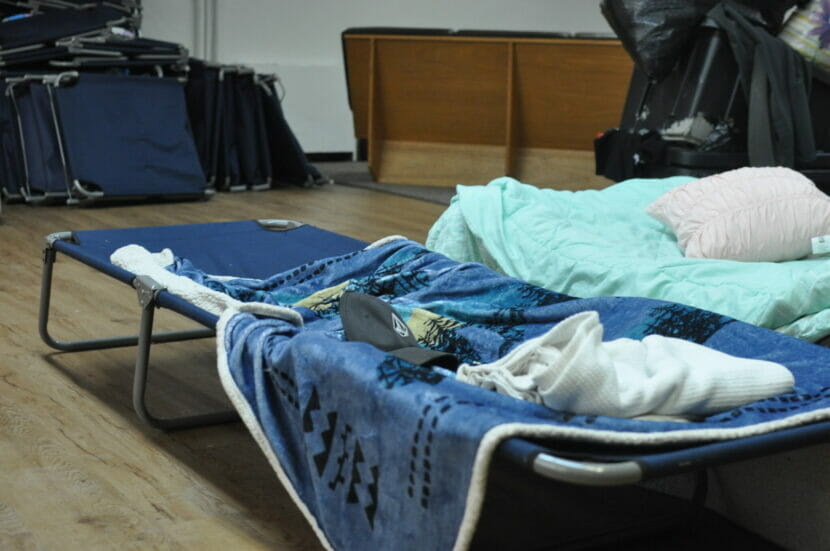
Blankets and personal items rest on a cot in the Resurrection Lutheran Church basement in downtown Juneau. April 13, 2023. (Photo by Claire Stremple/Alaska Beacon)

At 10:30 p.m. on a misty Thursday night, dozens of people streamed into the basement of Resurrection Lutheran Church in downtown Juneau for a late dinner and a place to sleep. The temperature hovered around freezing. This is an emergency “warming shelter,” a seasonal, stopgap solution to keep the city’s unhoused population from freezing to death at night.

Pastor Karen Perkins has managed the shelter at the church for two years. She sipped a can of Diet Coke and checked people in at the door. She said the emergency shelter was meant to house about 40 people each night, but they’ve been seeing nearly twice that since January.

“We just started getting more people — and more people who it was their first time being homeless,” Perkins said. “People who had been in a place for a long time, who were not equipped to be on the street. Just extremely vulnerable.”

There’s an estimated 2,000 people experiencing homelessness in Alaska. Most of them aren’t chronically homeless.

By 2:30 a.m., 60 people will have crossed the threshold, eaten and found a place to sleep on a cot or the floor. And when the shelter closed this week, they all had to find someplace else to go.
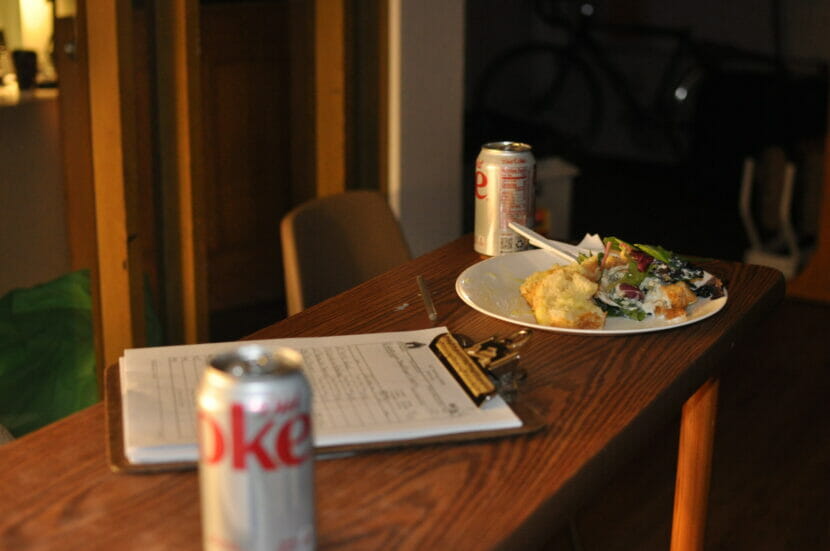
A half-eaten dinner sits on the check-in table at the seasonal emergency warming shelter in downtown Juneau on April 13, 2023. (Photo by Claire Stremple/Alaska Beacon)

Emergency shelter is a statewide concern that’s managed on a municipal level. There aren’t dedicated funding sources for these shelters, so Alaska communities must scramble each year to protect their most vulnerable residents. The strain has been acute in Anchorage and Fairbanks. Housing advocates say an infusion of state money could jump-start sorely needed housing development.

Yearly scramble

Brittney Paul and Melody Bierely have been friends for years and consider each other “street family.” On one of the emergency shelter’s last nights, they staked out space on cots and blankets against the wall of the basement, and took turns holding a small dog named Shaggy.

“We all appreciate the dinner that they have here. That’s gonna be missed,” Bierely said. “People want to say that they don’t appreciate this, but they should, for real. And we do. It’s a place for us to be there for each other.”

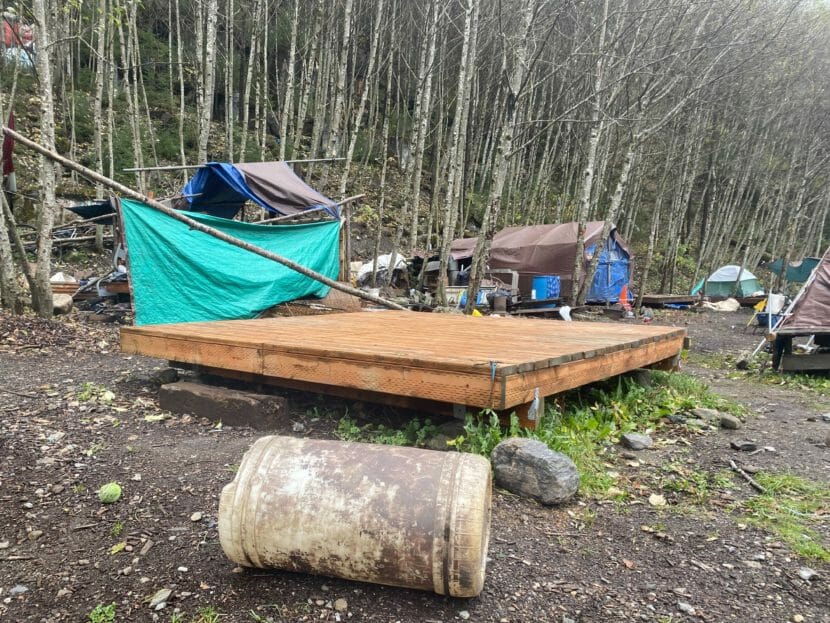
They, like many people at the shelter that night, planned to head up to the city operated “campground” in the woods above downtown. There’s no recreational camping there — it’s a relief valve for the unhoused people that don’t fit in its permanent homeless shelter or low-income housing. It is also seasonal; it opens as the emergency warming shelter closes.
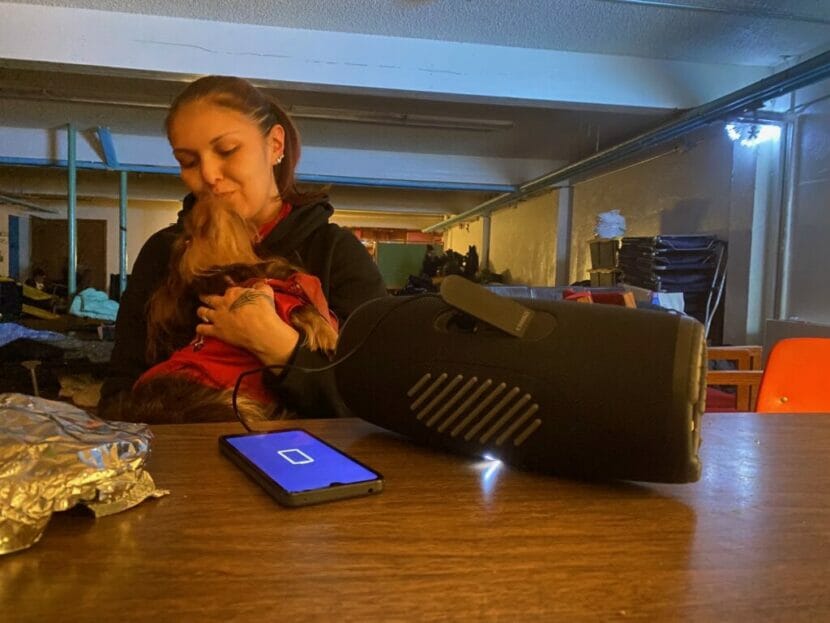
Brittany Paul kisses her dog, Shaggy, on the nose in the emergency warming shelter in downtown Juneau on April 13, 2023. (Photo by Claire Stremple/Alaska Beacon)

Bierely said she’s spent summers camping there before and likes it because she knows people. She and her friends have an informal roll call to check in on their street family.

“Just got to make sure everyone’s OK and accounted for, especially lately. Seems like people are dropping like flies,” she said.

Derek Lepoidevin, who said he became homeless after spending time in jail, is headed that way, too, but he hasn’t camped there before. “This is my first year being homeless, this is all kind of new for me,” he said.

Some other patrons said they may end up at the campground also, but it’s a last resort — too crowded and stressful, they said.

The campground is located in the woods above Juneau’s cruise ship dock; the first ship of the season arrived the same day it opened. It has space for about 20 tents on wooden platforms built above Juneau’s damp soil. People who don’t find space there often end up in the surrounding forest near town. In the first week after the shelter closed, temperatures are predicted to be in the 20s at night.

People who aren’t prepared to camp or sleep on the street often end up at the Glory Hall, the city’s homeless shelter.

“We were full, now we’re fuller,” said Mariya Lovishuk, the executive director of the Glory Hall. “This happens every year.”

This week she’s working hard to find beds for people around town—so far she’s found shelter for about two dozen people at resources like the Gastineau Human Services Corporation and through the Tlingit-Haida Regional Housing Authority. She’s even bought a few people plane tickets out of town, so they can be housed with family members elsewhere.

“We’re in a bad spot right now, but we’ll work through it,” she said. “We just need more long-term housing.”

Lovischuk said she’s seeing more families who have been evicted this year. She said it’s become really noticeable since the pandemic-era eviction moratorium ended in 2021.

Additionally, a year’s worth of housing assistance is starting to expire for about 900 Alaskans housed by a statewide housing stabilization grant. The program housed about 180 people in Juneau. Lovischuk said about 60% of them have been able to hang on to that housing, but the rest are unhoused again.

Upstream solution

Brian Wilson advocates for better access to housing as the executive director of the Alaska Coalition on Housing and Homelessness. He said if the state had more housing there would be far less need for emergency shelters like the one that just closed in Juneau.

“We haven’t been developing houses at all, most of the houses in the state were developed decades ago and are deteriorating,” he said. “People just are running out of the resources to pay for what’s out there, if that even exists in their community.”

Housing in Alaska is expensive and tough to develop. That’s contributed to very few vacancies in the state, which drives costs up.

Nearly a quarter of adults in Alaska are behind enough on rent or mortgage payments that imminent eviction or foreclosure is a threat, according to current national data. Alaska’s overcrowding rates are double the national average. So Wilson said the state needs to get involved in making housing projects happen.

“We are one of three states without a flexible statewide housing fund,” Wilson said. “It’s a best practice. It’s not reinventing the wheel. It’s not creating something new. It’s a novel concept to Alaska. It’s just what, you know, 94% of the country is already doing.”

A fund technically exists, but there isn’t much money in it yet. It’s called the Housing Alaskans Public Private Partnership, or HAPPP, and it has requested $50 million in this year’s capital budget to get housing projects off the ground statewide.

The newly launched partnership announced its board this week. Preston Simmons is the chair. “Housing is a social determinant of public health,” he said. “It is a fundamental need.”

He said he joined because his years leading Providence Alaska Medical Center showed him the dire need for housing in the state. “We are 27,500 units short in Alaska,” he said. “And there are multiple projects ready to go that just need some funding.”

Simmons said building more housing, even at the middle and high income levels, can help alleviate homelessness, because it reduces pressure on the whole continuum of the housing system.

He said Sen. Forrest Dunbar’s office has agreed to sponsor a resolution that would acknowledge the state’s housing crisis. Simmons said HAPPP asked the Alaska congressional delegation for an additional $50 million.

HAPPP made an identical request of the state last year, but it wasn’t funded. Simmons says this year is different: It has a board and a technical advisory committee and is primed to get started.

Simmons said the state needs more housing across income brackets and the lack of housing is holding back the workforce and the economy. Housing advocates say unhoused people have significantly better chances of reentering the workforce if they have stable housing.

“I fear for them”

On one of the shelter’s last nights, Karen Lawfer, the church council’s president, sipped coffee at one of the dining tables adjacent to the sleeping area.  It was about 3:30 a.m., as quiet as the shelter gets.

“A lot of our patrons here — they’re not equipped to camp out. They’re just not,” she whispered over the snores of a man sleeping on a nearby couch. Light from the muted television played across his face. “I fear for them.”
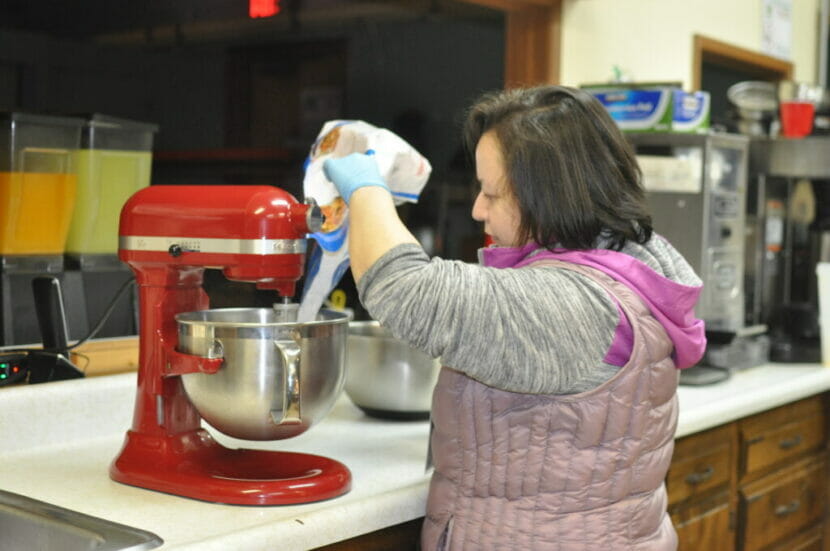
Leora Barrett mixes waffle batter at the emergency warming shelter in downtown Juneau on April 13, 2023. (Photo by Claire Stremple/Alaska Beacon)

Around 4 a.m. Leora Barrett, one of the shelter’s employees, started making breakfast. It takes a couple of hours to prepare enough food for 60-70 people. She mixed waffle batter and kept an ear out for any disturbances. She said patrons were stressed because they knew they’d have to find a new place to sleep.

“A lot of tears this week,” Barrett said. “I’ve had to console a lot of people.”

At 6:00 a.m., the lights went up and employees played Michael Jackson’s “Thriller” on the speakers. All 60 patrons lined up for breakfast, used the restroom, and dispersed into the wet, gray morning.

Correction: This story has been revised to reflect the correct legislation that Dunbar has agreed to sponsor as well as the number of housing units that Simmons said is needed.

This story originally appeared in the Alaska Beacon and is republished here with permission.
Anchorage’s winter shelters are closing soon. What then?

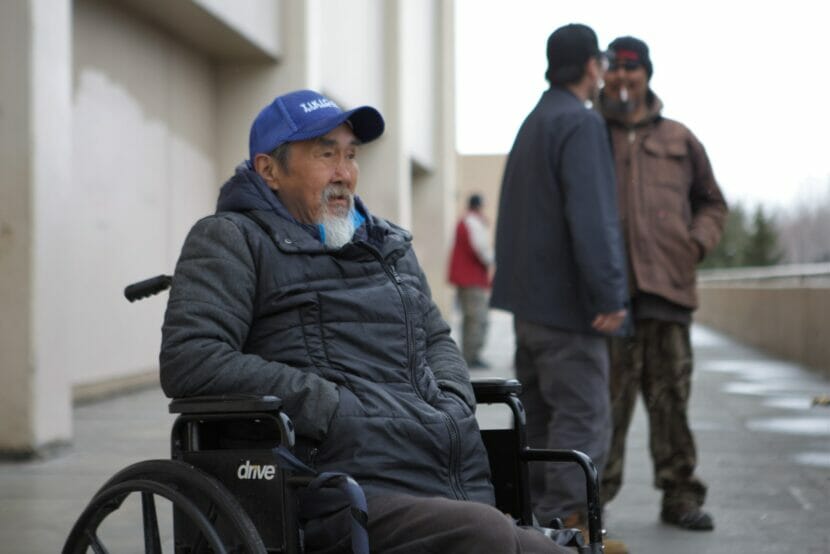
From his wheelchair, Alfred Koonaloak looks out across the parking lot of the Sullivan Arena in Anchorage on Thursday. (Jeremy Hsieh/Alaska Public Media)

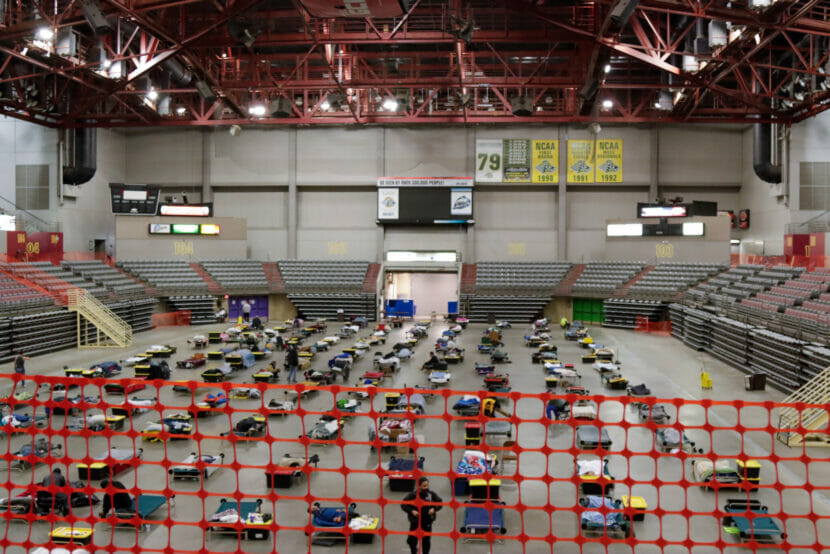
Walter Tikiun has been staying at the Sullivan Arena since October. The Anchorage hockey arena turned into an emergency shelter at the beginning of the pandemicclosed last June, and then reopened as a cold weather emergency shelter last fall. It’s set to close on April 30.

When it does, Tikiun thinks it’ll be more dangerous for everyone.

“It’s stressful,” he said. “We’re growing gray hairs left and right, all of us. And we don’t even know what we’re gonna do. We don’t even have a plan.”

He said it can be chaotic at the Sullivan. It’s a low-barrier shelter, meaning being intoxicated or having a criminal record aren’t disqualifying. But he prefers it to sleeping outside on his own.

“That’s our only option right now,” Tikiun said.

He’s one of about 460 people staying in the Sullivan Arena, the biggest of Anchorage’s three winter shelters. Another 140 people are staying in hotel rooms contracted for winter shelter use. They’re all set to close in two weeks.

Most people will have to start camping outside, as Anchorage Assembly members and service agencies plot what’s next. Homelessness experts expect the number of people sleeping outdoors to swell from about 300 now to as many as 800.

“We may have a couple weeks of chaos,” said Assembly member Daniel Volland.

The Sullivan Arena in November. (Elyssa Loughlin/Alaska Public Media)

Volland represents North Anchorage, where the Sullivan and many other resources are located for people without homes. He has repeatedly pressed to close the Sullivan. Its neighbors attribute graffiti, littering, pedestrians in the road, trespassing, open drug use, assaults and even outdoor deaths to people drawn to the shelter.

Volland thinks the shelter has to shut down for the rest of Anchorage to take part in managing homelessness.

“I think Anchorage as a whole is going to be better here, as we engage in this conversation and get some solutions online and are willing to think outside the box,” he said.

Instead of a mass shelter, he said multiple, smaller sites around the city would be better for the clients and for neighborhoods.

“For so long we’ve been fixated on the Sullivan,” he said during a discussion on shutting down winter shelters at Tuesday’s Assembly meeting. “One more month – just one more month. Just three more months. Just six more months. Just another year. How long is this going to draw out? So now’s the time. Now’s the time for a reset. And it’s going to be hard.”

Assembly members said they don’t want another version of last summer’s haphazard, mass relocation of Sullivan shelter residents to a dangerous campground.

Their attention is split, but one quick change will be to increase summer outreach, and they’ll vote on that soon. More outreach means meeting people where they are, including if it’s in a tent in the woods, with food, medical care, hygiene services, case workers and help with transportation.

They say there may be some last-minute opportunities to lease some rooms for the most vulnerable, there’s a new push to pilot a 30-unit tiny home village at some point this summer, and the former Golden Lion Hotel and Barratt Inn are both in the process of being converted into low-income housing.

The Assembly also wants to stand up a new, low-barrier shelter by next winter, so that the Sullivan Arena doesn’t reopen as a mass shelter for a fourth year.

All that work may be too late for the immediate reality of shelters closing.

Everyone’s situation is different. For some people, the conditions at the Sullivan were already more discouraging than the cold, and they chose to sleep outside.

Alfred Koonaloak has done both, but spent this winter at the Sullivan. Even though he uses a wheelchair – he lost a leg in a train accident years ago – he’s surprisingly at ease about what’s next. He hopes he can get housing for people with disabilities.

“If I don’t get housing, that’s OK,” he said. “At least I’m still alive and making it throughout the winter. … I’ve been sleeping outside for years. You know, I’ve just had to be in here because it was a very harsh, very, very difficult winter last year, and it got way below zero.”

Koonaloak said he’s grateful that he was able to stay in the Sullivan.

Juneau’s housing strain continues as warming shelter closes for the season

Juneau’s Mill Campground on October 14, 2022. (Photo by Claire Stremple/KTOO)

“Every time we house somebody, somebody else comes on our radar,” said Dave Ringle, who works with St. Vincent de Paul Juneau helping families and seniors find housing. 

Juneau’s housing crunch usually worsens in the spring, as seasonal workers make their way to town. But this year, Ringle said the situation is scary.  

He got an email from a fisherman who planned to bring his large family to Juneau from the Lower 48 for the summer while he fished. Ringle knows how hard it will be to find housing for a family and he’s worried he won’t be able to help.

“I don’t want to see people like that come up here and become homeless,” he said. “And I wish I had a better answer for people.”

St. Vincent de Paul housed 16 families in the last year, and they’re working with around six more right now. 

By many metrics, Juneau’s housing issues are getting worse. State data shows that in the first week of February last year, there were about 270 people experiencing homelessness in Juneau. In the same week this year, that number is around 330. 

Ringle said there are housing projects and programs in the works that will alleviate the strain on the community, but those projects take a lot of time. 

“So it’s a short term emergency with few answers,” Ringle said. “And yet, long term, we’re at a point where as a community, we cannot be healthy without a larger supply of housing.”

Some people who do have housing are facing eviction due to large amounts of overdue rent from the pandemic-era eviction moratorium. St. Vincent de Paul helps with rental assistance, but their funds have been spread thin.

“We ran out of the money that was used for that, because it was going out almost 50% faster than it had any other year,” Ringle said. 

While the evictions open up rentals that Ringle can move other people into, the people being evicted then face the same issues. He said often people end up on the streets while looking for another place. 

“I’m just hoping we keep people safe through the summer,” he said.

The warming shelter at Resurrection Lutheran Church closes down until next winter Sunday, and the city-run Mill Campground opens for the summer on Monday. That campground is above the cruise docks and is meant for unhoused people to use in the warmer months.

Alaska Senate passes bill to allow municipal blight tax, property tax exemptions

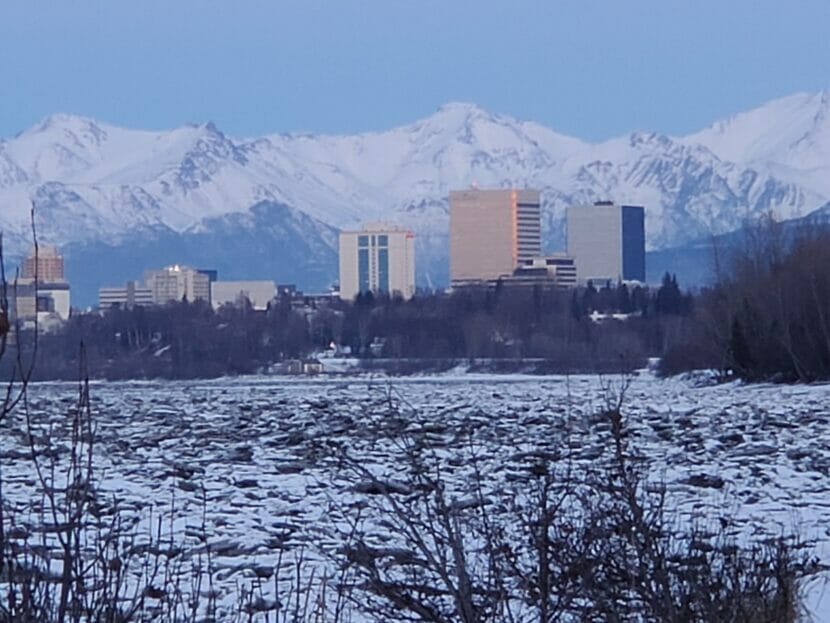
Downtown Anchorage skylline, viewed from Tony Knowles Coastal Trail on Nov. 18, 2022. Economic development advocates in the city support a bill to allow increased development property tax exemptions and blight taxes. (Photo by Yereth Rosen/Alaska Beacon)

The Alaska Senate voted 13-6 on Tuesday to pass a bill that would apply both a carrot and a stick for local governments to encourage the construction and maintenance of developments.

One provision of Senate Bill 77 would allow municipalities to exempt the owners of newly developed or redeveloped commercial properties from paying property taxes. Another provision would allow municipalities to increase the property taxes of owners whose properties have become blighted by as much as 50%.

Bill sponsor Anchorage Democrat Forrest Dunbar said the bill is aiming at spurring housing development, adding that the high cost of construction in Alaska doesn’t justify new building. The exemption would lower the cost to property owners.

“Housing in all of Alaska has become incredibly difficult to pencil out,” Dunbar said.

Under current state law, municipalities can only exempt a portion of new commercial developments, including apartments. The bill would change that to allow the entire value to be exempt for a designated period of time.

The blight tax would not apply to any primary residence, so people with low incomes would not be taxed out of their homes. It would leave it up to municipalities that implement a blight tax to determine what their definition of “blighted” is. These municipalities would be required to establish an appeals process. The tax penalty would end when owners fix up their properties.

Dunbar said he believes municipalities are more likely to take advantage of the exemption provisions of the bill than they are to apply a blight tax. But he said the blight tax would address cases where property owners choose not to take care of their properties.

“If it is falling into such disrepair that it’s become a danger to the neighborhood, then frankly that person who owns it, whether they’re in state or out of state, should either fix up the property or sell it to someone who can,” he said.

There is a House version, House Bill 84, sponsored by Wasilla Republican Rep. Jesse Sumner. Sumner said properties that are allowed to deteriorate bring down the values of neighboring properties.

“Blighted properties often become a magnet for criminal activity, which impose additional costs upon local government,” Sumner said at a March 24 House Community and Regional Affairs Committee meeting where the House bill had its first hearing.

Bill supporters point to success Anchorage has had with property tax exemptions to spur some construction.

Big Lake Republican Rep. Kevin McCabe expressed concern that the Anchorage Assembly would use a blight tax to “willy nilly” take property.

“I just want to make sure that a … ‘rogue’ is the wrong word, but that an Assembly that is sort of taking their own direction doesn’t create a problem,” for property owners who are experiencing hard times but have hopes for the future, McCabe said. “So I think we have to protect the individual rights as well as the city rights.”

The bill is supported by homebuilders and people working in economic development. Some spoke at the March 24 hearing.

Anchorage Economic Development Corp. CEO Bill Popp noted that the bill requires a public process for a municipality to adopt a blight tax, and that business organizations would participate in the process in Anchorage.

Mike Robbins, executive director of the Anchorage Community Development Corp., predicted the bill would stimulate economic and housing development around the state.

“We’re suffering from shortages at all levels. Multiple factors have contributed to this environment, which we have no control over,” Robbins said. “But there are some that we can and should work to solve.”

Robbins said the exemption provision would help close the gap for builders between costs and the returns needed to make the investment.

A prominent national opponent of taxes has weighed in against the bill. Grover Norquist, the president of the Washington, D.C. nonprofit Americans for Tax Reform, wrote a letter saying the blight tax in the bill would be the broadest in the country.

Norquist raised particular concern over how the bill leaves it to municipalities to define blighted, which he suggested would open it up to abuse.

“Since SB 77 allows for any and all standards, no matter how broad or unnecessary, ordinary Alaskans could face strict supervision and a 50% property tax hike for something as simple as a broken window or front door,” Norquist wrote.

Palmer Republican Sen. Shelley Hughes opposed the bill due to the blight tax, saying that she would have supported it if it only included the carrot of the exemption. Hughes said private property is central to the United States.

“We work to cherish it and protect it, unlike the ability in communist countries or under dictatorships,” she said. “We have the right to have property. And I believe that our measures should be to help protect, and not to put a property owner in risk of, eventually, that property possibly being taken from them if the taxes are such that they cannot pay them.”

Hughes attempted to amend the bill on the Senate floor to require that any definition of blighted include that the property endangers public health or safety. The amendment failed, with five votes in favor and 14 opposed.

Democratic Sen. Matt Claman, a former Anchorage Assembly member and acting mayor, predicted that the tax exemption would prove to receive more rapid attention from local governments than the blight tax, which he described as “very complicated.”

“It’s another step we can take in making Alaska ready and open for business,” Claman said of the bill.

On the final vote on the bill, all eight Democrats present voted in favor, while Sen. Donny Olson, D-Golovin, was absent. Five Republicans also voted in favor: Sens. Click Bishop of Fairbanks; Cathy Giessel and James Kaufman of Anchorage; Kelly Merrick of Eagle River; and Gary Stevens of Kodiak. The no votes were Republican Sens. Jesse Bjorkman of Nikiski; Robb Myers of North Pole; Mike Shower and David Wilson of Wasilla; Bert Stedman of Sitka; and Hughes.

The Senate version of the bill is already scheduled for a hearing with the House Community and Regional Affairs Committee on Thursday. If both chambers agree to pass the same version of the bill, it would go to Republican Gov. Mike Dunleavy, who could allow it to become law or veto it.

James Brooks contributed to this article.

This story originally appeared in the Alaska Beacon and is republished here with permission.
Alaska gets $38M federal grant for climate-related housing disaster recovery

The frame of a boardwalk, with most of its planks gone, extending out into flooded tundra
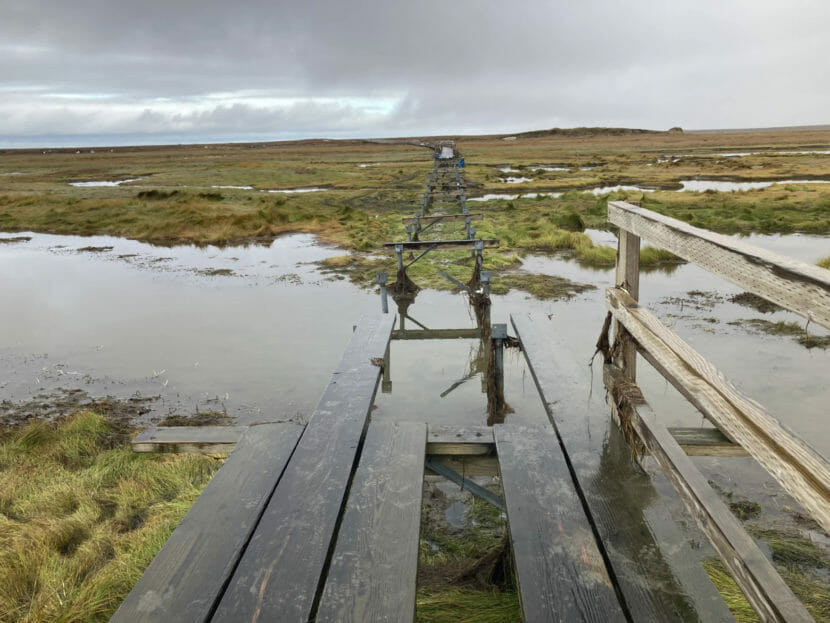
The boardwalk to high ground in Hooper Bay was wiped away by floodwaters. (Photo by Will McCarthy/KYUK)

The state of Alaska recently received $38 million from the Department of Housing and Urban Development with the aim to ease the burden of climate change.

Margaret Salazar is HUD’s Northwest Regional Administrator. She oversees HUD programs in Alaska, Oregon, Washington, and Idaho. Last week she attended Arctic Encounter, the largest annual arctic policy event in the country, where she made the announcement.

Salazar says the new funding is to help villages get ahead of natural disasters.

“We’re helping folks work upstream with things like technical assistance to start planning ahead for housing development, as opposed to just funding the sticks and bricks part of housing supply,” she said.

The money was made available through the Community Development Block Grant Disaster Recovery Program. These funds are aimed at helping communities better rebound from presidentially declared disasters, but Salazar says the state will be allowed to allocate the new funds for preventative measures.

“Now when the state of Alaska, who’s our grantee, when they get those dollars, they can use some of them for that planning work,” she said. “This is brand-new policy that we’ve rolled out.”

Salazar says she hopes to fund plans before natural disasters happen.

“Village relocation, and rising water levels and soil erosion are forcing folks to make some impossible choices about relocating their homes,” she said. “And one of the exciting opportunities we have right now is the opportunity for HUD to align and join forces with our other federal agency partners.”

Some of the departments she listed include the Environmental Protection Agency, the Department of Energy, and the Department of Transportation.

But climate change isn’t the only issue Alaskans face when it comes to housing. Unlike communities on the road system, folks in bush Alaska can’t commute for work, so housing can be a limiting factor for growth.

Salazar said her trip to Kodiak last week gave her a new perspective on the issues Alaskans face when compared to their rural counterparts in the lower 48.

“What we see and what we heard today in Kodiak was just the lack of being able to expand economic opportunities because of a lack of housing,” she said. “So if we can’t find ways to house our folks, we can’t find ways to expand job opportunities and it becomes a cycle.”

But developing new housing is especially difficult for communities that aren’t directly connected to Anchorage. Rural communities often face high costs for shipping, difficulty accessing building supplies, and even finding workers to do the construction.

To reduce some of the barriers local governments face, Salazar says HUD also approved new grants to help them work out regulations that prevent housing development.

“Whether it’s things like zoning or building codes or permitting process, we can be a partner in terms of federal dollars but we want to make sure that the local folks are doing their work to have a plan ready to have shovel ready dirt so that when we can funding housing development, we can get that done quickly,” she said.

And while she praised local entities like the Kodiak Island and Cook Inlet Housing Authorities, Salazar says there’s still more work to do and looks forward to continuing partnerships with entities around Alaska.

Juneauʼs property assessments show a sharp increase in home values

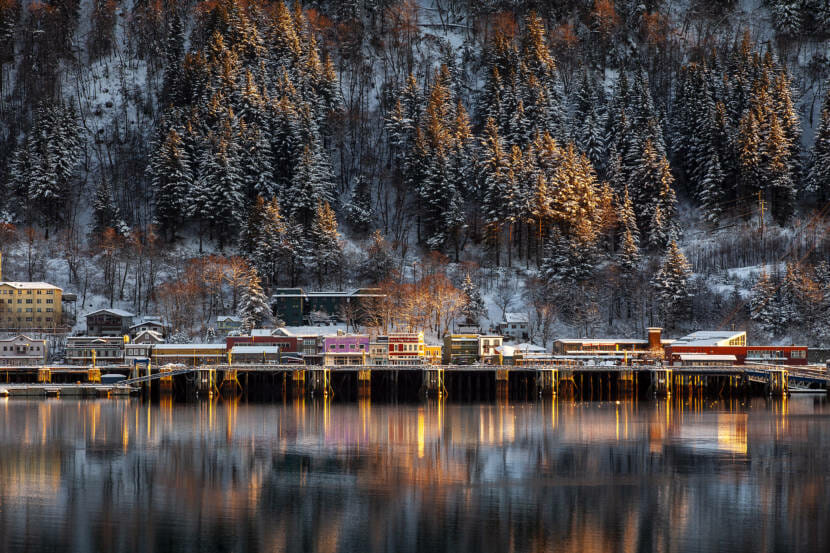
The sun rises over downtown on Dec. 22, 2021, in Juneau, Alaska. (Photo by Rashah McChesney/KTOO)

The City and Borough of Juneau sent property assessment notices to Juneau homeowners earlier this month. And for some, they were way up — on Facebook, homeowners reported increases as high as 40%. 

Jeff Rogers, the city finance director, said the assessments should be close to the amount a home could have sold for in January when the data was collected.

“Property assessment is about one thing and one thing only,” he said. “It is an objective determination, by a non-biased party, of what every property in the borough is worth.”

Rogers said the city assessors rely on sales data, which is more limited here than in most of the country. Alaska is one of only several states that doesnʼt require disclosure of real estate sale prices. In 2020, Juneau mandated disclosure of real estate prices, but that was repealed in October of 2022

But Rogers said the appraisals are based on sales prices that have been disclosed for similar types of homes and locations.

“Generally speaking, somebody who bought a house in the last year or two is not surprised by their assessment. Because they paid that high price for it, probably, right?” Rogers said.

Axel Gillam and his partner bought their downtown one-bedroom house in 2021 — and they are surprised. Gillam says this yearʼs assessment was $100,000 higher than last year’s assessed value of $400,000. 

“We’re in the community, we’re here long term and we’re permanent,” Gillam said. “We’re contributing to the community, and it seems like a little slap in the face for our one-bedroom to be assessed at such a high value.”

Rogers said some houses can appreciate more rapidly because their values are affected by the sales prices of other, similar homes. But he cautioned that an increased assessment doesnʼt mean property taxes will increase proportionally. The Juneau Assembly will set a mill rate during its budget process, and that will determine property taxes. 

If the mill rate stays the same as last year, some Juneau homeowners will have to pay far higher taxes. Likewise, if itʼs set low enough, property taxes could stay flat. 

Rogers said the Assembly has to factor in the cityʼs financial needs when determining the mill rate. 

“The Assembly is going to be looking at the question saying, what is the cost growth in the budget?” he said. “How much do we need property taxes to increase in order to pay for those things?”

Gillam is worried about how that will turn out. Last year, he saw a $40,000 increase in his property assessment, and his monthly mortgage payments rose by $100. If the mill rate stayed the same with this year’s even higher jump in value, Gillam said it would strain their finances. 

“It will put stress on us for sure,” Gillam said. 

He said they are planning to appeal the assessment.

Correction: An earlier version of this story misstated when the city sent 2023 property assessments to homeowners. 

Site notifications
Update notification options
Subscribe to notifications