City officials say Juneau’s short-term rental listings may have increased by about 300 in 2022, more than doubling the previous year’s total.
Most of the listings are for entire homes or apartments. Scott Ciambor, Juneau’s planning manager, says the trend is contributing to Juneau’s housing crunch.
“Short-term rentals are definitely impacting the overall housing stock, and the availability for folks looking for housing to find it,” he said.
City Revenue Officer Ruth Kostik tracks sales tax in Juneau. She presented the investigation’s findings at a Juneau Assembly finance committee meeting earlier this month and said the Ironman Alaska race contributed heavily to the increase — but many of those listings are still up.
“I was curious to watch and see, post-Ironman, especially with the cancellation (of next year’s race), if we’d start to see some of that tick back down,” Kostik said. “But we haven’t really seen that play out in the numbers just yet, so it’s actually still growing.”
Kostik says it’s hard to get an exact count of short-term rentals. Some listings were duplicates, and some appeared on some days and not others — possibly because people were putting up and taking down listings to hide their unregistered rentals.
A 2022 survey of Southeast Alaska business owners found that 72% cited the region-wide housing shortage as a major concern. Ciambor says other factors play into the housing crunch, like rising housing costs and limits to development in Juneau, and there’s no easy fix.
“There’s no real magic bullet or a definite guidance to follow,” he said.
But he says other cities have taken actions on short-term rentals that the City and Borough of Juneau could consider.
Across the country, tourist towns have limited the types of units that can be used as short-term rentals, how many nights a rental can be rented, and how many short-term rentals can exist in a municipality.
Last fall, Sitka approved a requirement for owners of new short-term rentals to live on the registered property for half of the year. Ketchikan is also looking into various limitations on short-term rentals.
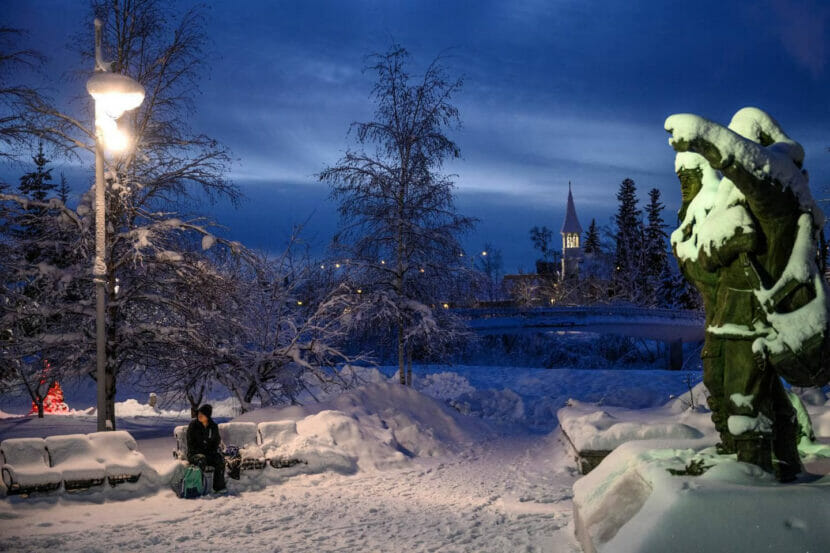
Daylight fades in Fairbanks in this view from Golden Heart Plaza downtown. (Marc Lester/Anchorage Daily News)
A man’s death while sleeping outside in Fairbanks a few days before Christmas, when the windchill was around 50 below, has highlighted a disturbing fact about Alaska’s second-largest city.
Fairbanks has no low-barrier shelter for people experiencing homelessness. Advocates say that leaves a gaping hole in the already-thin safety net Fairbanks has to help the unhoused survive winter in the coldest city of its size in the country.
ADN reporter Michelle Theriault Boots says 55-year-old Charles Ahkiviana’s death, in a snowbank not far from a grocery store, brought into focus a difficult truth, that living unhoused in Fairbanks can be deadly.
Listen:
The following transcript has been lightly edited for clarity.
Michelle Theriault Boots: It was just a clear case of, this person died because they were exposed to the elements. And I think it was just one of those things that we all kind of know, on some level, happens. But it was just put in such stark terms that it was hard to ignore. You know, this unhoused man died in a snowbank in weather that really no one can survive outside. And, you know, there were a lot of questions. Did he try to seek shelter? What was he doing out there? That’s what got us interested in looking. And talking to a few advocates up there, we found out that there is no, I guess what people in Anchorage might consider, a low-barrier shelter, a place where just anybody, regardless of if they’ve had some something to drink, if they’re on a substance, that anybody can just walk into and seek shelter for the night. And so that combination of weather that is deadly, frequently, and no low-barrier shelter, just got us curious. So we decided to go up there and see for ourselves.
Charles Ahkiviana, who lived unhoused in Fairbanks for years, died in December 2022. Troopers say his body was discovered in a snowbank. (Courtesy Kiatcha Nyquist)
Casey Grove: What does that mean to not have a low-barrier shelter? And, I mean, we’re sitting here in Anchorage, it’s not like Anchorage has done a great job of helping folks that are unhoused either, but there is a difference between those types of shelters, right?
Michelle Theriault Boots: Yeah. Fairbanks has something called the Fairbanks Rescue Mission, which is a very established organization. But there are some pretty stringent rules and guidelines you have to meet to get in the door. And that includes taking a breathalyzer and being sober — 0.0 sober — and taking a drug test to see if you’re on drugs. So they don’t allow people who are on any kind of substance, and that, you know, advocates would say, that’s a lot of the people who are seeking shelter. That’s a lot of the people who are, kind of, remain chronically unhoused or homeless in Fairbanks. And so while everybody agrees, or seems to agree, that the Fairbanks Rescue Mission does a lot of good and important work, advocates say there’s a huge hole in that safety net. And that would be a low-barrier shelter that accepts anybody. You can walk in anytime of night and day and just take refuge from the cold.
Casey Grove: And you were partnered up with photojournalist Marc Lester with the Anchorage Daily News. You and Marc went with folks to see how they were surviving in Fairbanks as unhoused folks, and Marc took some amazing photos that are a huge contribution to telling that story, I think. But describe it for me, you know, for the radio listeners, what did you see? What kind of things were people doing to survive?
Michelle Theriault Boots: Yeah, I mean, first we saw some tent encampments, where people had set up camps in, you know, greenbelts, little patches of forest. We were also taken to an abandoned house where people were squatting. It was just filled with stuff, filled with belongings probably. Who knows how many people had gone through there. It was dark, but it was somehow being heated, or an attempt was made to heat it, with just leaving the oven door open. And that looked like a pretty rough way to live. And then we talked to a guy named Scott who just described walking around all night. You know, people try to have bunny boots or as warm of shoes and coat as they can, and then they just keep moving, just constant motion. And then also, the strange logic is that to get into the sobering center, which is a warm, safe overnight place, you have to be drunk. And to get into the mission, you have to be sober. So a few people pointed that out to us, that those are the two options. And we really saw a lot of different attempts being made to provide safe shelter for people, but the system just isn’t developed enough to have, I guess, fully what’s needed.
Casey Grove: And speaking of the services like that, that people are able to provide in Fairbanks, you talked to the folks at the soup kitchen there. And there was a part in that story about how someone there told you, in terms of how these people are suffering, they just said look around, right? Tell me about that.
Michelle Theriault Boots: Yeah, I mean, the chef, Matt said, “Look around. A lot of the people who are here for breakfast are missing fingers due to frostbite.” It’s hard to imagine a more rugged, difficult place to be homeless, honestly, than Fairbanks. And the people we met, especially the unhoused people we met, who were very generous in talking with us and showing us how they live. Really, that’s true. It takes constant, kind of ingenious, hard work to be homeless in Fairbanks and to survive, and the climate is just so unforgiving. That margin between living a night and dying is, it’s really small, and I think that’s always on people’s minds.
Casey Grove: Yeah. And like you said before, what a lot of folks are saying is needed is a low-barrier shelter. So what’s going to happen with that? Are they on the path to getting something like that? Or no? What do you think?
Michelle Theriault Boots: You know, it sounded like there was some reason to think that things were moving in that direction. The City of Fairbanks has a housing coordinator who would really like to see a low-barrier shelter of some kind, but it’s not something that I think the city is going to take on itself, as has happened in Anchorage. And we have to remember in Anchorage, that’s a relatively recent development that only really happened during the beginning of the COVID pandemic. But I think that there’s an increasing understanding that what’s available is not sufficient.
Casey Grove: Gotcha. Yeah. You describe talking to these folks out in the street, you know, the guy that you mentioned that, to stay warm, would walk all night long. And they’re in a real risky situation, of course, and I wondered, as a reporter, we’re not supposed to get like, emotionally involved or invested or whatever. But did you wonder if that guy was gonna make it through the winter?
Michelle Theriault Boots: Oh, absolutely. I mean, I think every person that we talked to, people who were, again, generous with their time and kind to talk to us, you know, there’s always that thought and worry in the back of your mind. None of them really knew where they were going to spend that night. And so it’s impossible to know what the future holds. But I hope for the best for all of them. And I also know that some of the toughest people on the planet are people who are unsheltered in Fairbanks, Alaska, and finding a way to live and make it work.
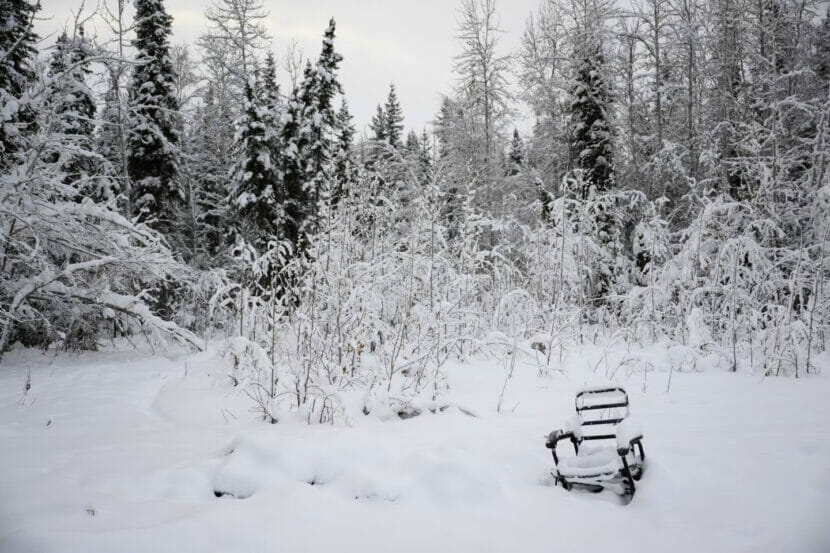
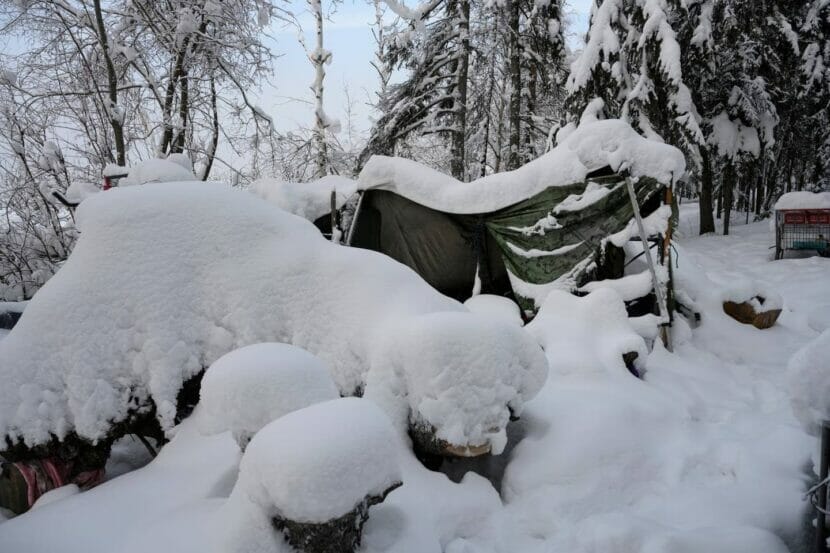
Snow covers a chair, tents and tarps near woods close to Old Airport Road on the west side of Fairbanks on January 30, 2023. Charlie Ahkiavana was found frozen in a snowbank nearby on Dec. 23, 2022. Ahkiavana lived unhoused in Fairbanks for years, a family member said. (Marc Lester/ADN)
FAIRBANKS — Charles Ahkiviana died here, just beyond the lights of a Fred Meyer parking lot.
Two days before Christmas, a man on a smoke break found the 55-year-old’s body frozen in a snowbank bordering a scrap of spruce forest.
It was cold in Fairbanks that day — a low temperature of 32 degrees below zero, with a windchill at one point of 54 below. Alaska State Troopers determined Ahkiviana died of hypothermia.
Ahkiviana had been homeless in Fairbanks for years, his sister Kiatcha Nyquist said.
He was diagnosed with schizophrenia and had long struggled with drugs and alcohol. Whenever he visited her, he brought a small gift — an eyeglass chain, a trinket.
“He wanted to feel like he had something to offer,” Nyquist said.
Charles Ahkiviana, who lived unhoused in Fairbanks for years, died in December 2022. Troopers say his body was discovered in a snowbank. (Courtesy Kiatcha Nyquist)
He drew the public’s attention in death more than he had in life.
Local news media published stories based on the troopers’ account, making public a quiet reality: Unhoused people sometimes die in the Fairbanks cold.
Fairbanks is the coldest city over 25,000 people in the United States, said Rick Thoman, a climate expert at the International Arctic Research Center.
Ahkiviana’s death was a moment for community reflection, and for “fury and shame,” Jennifer Jolis, the former director of the soup kitchen, wrote in the Fairbanks Daily News-Miner.
“How many other camps are there?” she wrote. “How many others are in danger?”
Activists in Fairbanks, a city of 30,000 people, describe a caring, creative community that helps its vulnerable homeless residents with a patchwork of offerings.
But the Fairbanks safety net has a gaping hole.
Despite an average January temperature of 8 below zero, the city lacks a low-barrier emergency shelter. No place consistently offers an open door and an unconditional warm cot to anyone, at any time, no matter how frigid outside.
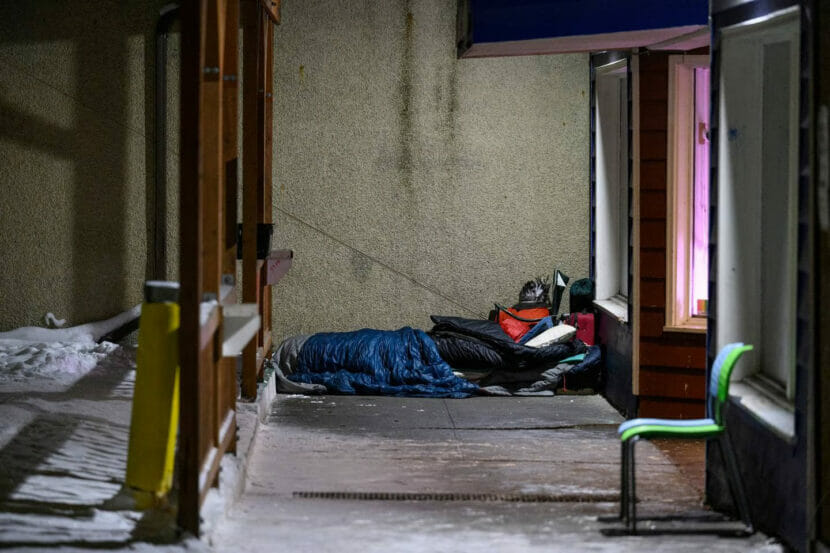
So the estimated 50 to 100 unsheltered people who live in Fairbanks find ways to survive. They walk all night in bunny boots, trying to stave off frostbite. They crowd into motel rooms 10 at a time. They build forested encampments and dig snow caves. They squat in abandoned houses and sleep in cars.
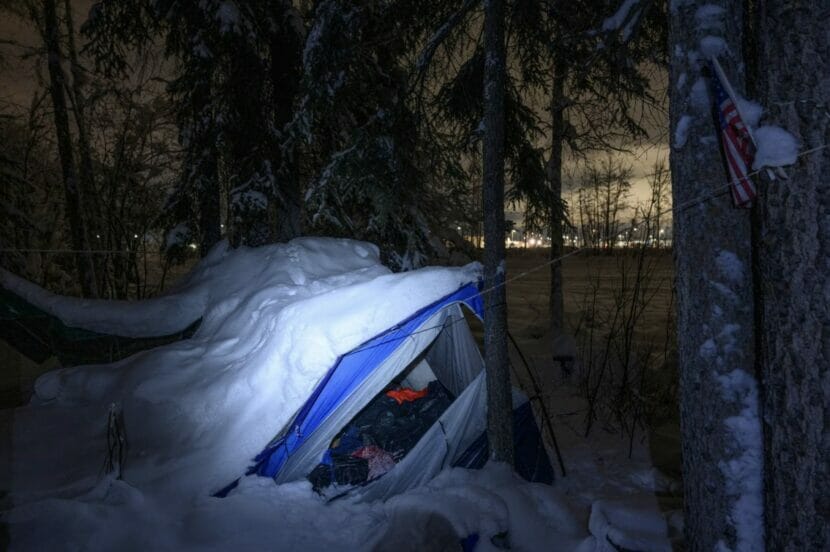
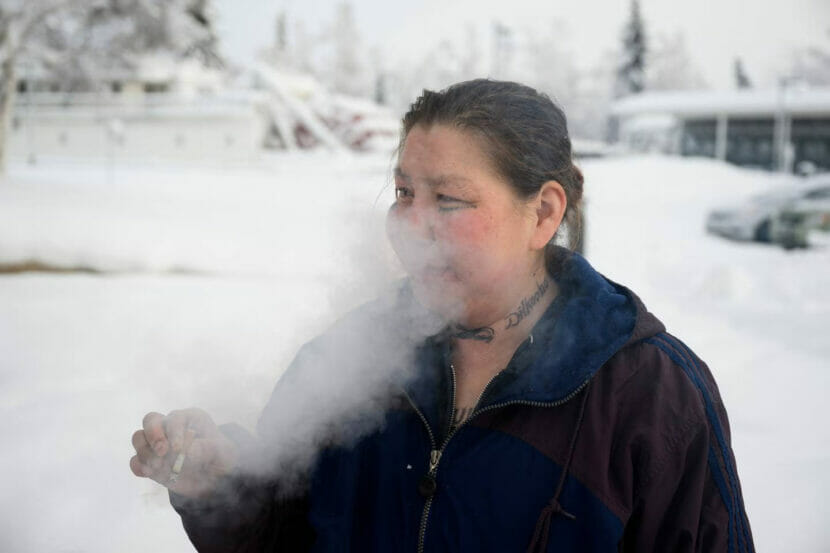
An unoccupied tent appears recently used in an encampment on the east side of Fairbanks on January 30, 2023. (Marc Lester/ADN)Robyn Demientieff, who lives unhoused in Fairbanks, smokes outside the Project Homeless Connect event in Fairbanks. She said she didn’t know where she’d stay that night. (Marc Lester/ADN)Niko Thompson looks through an abandoned building in Fairbanks for unhoused people while conducting the Point-In-Time count of unsheltered people. (Marc Lester/ADN)
Six weeks after Ahkiviana’s death, a man who said his name is Ryan perched on the curb of the busy Fred Meyer parking lot holding a sign: “NEED HELP God Bless.”
He was just down the block from the empty lot where the body had been found. A rumpled nylon tent remained in the lot, buried by new snow.
Ryan said he’d spent years intermittently homeless in Fairbanks. He’d known several homeless people who died.
How did they die?
“From freezing,” he said.
Golden Heart city
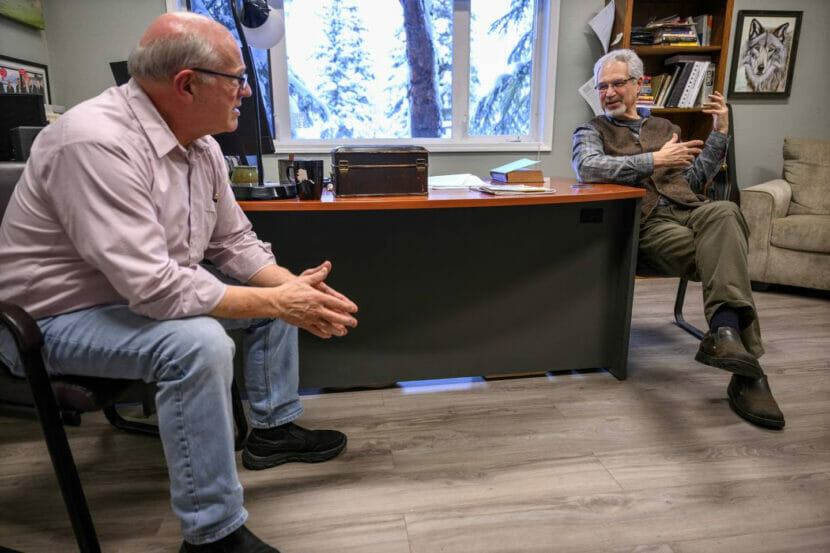
Fairbanks Rescue Mission emergency services director John Coghill, left, and executive director Pete Kelly, both former Alaska state senators, talk in an office. (Marc Lester/ADN)
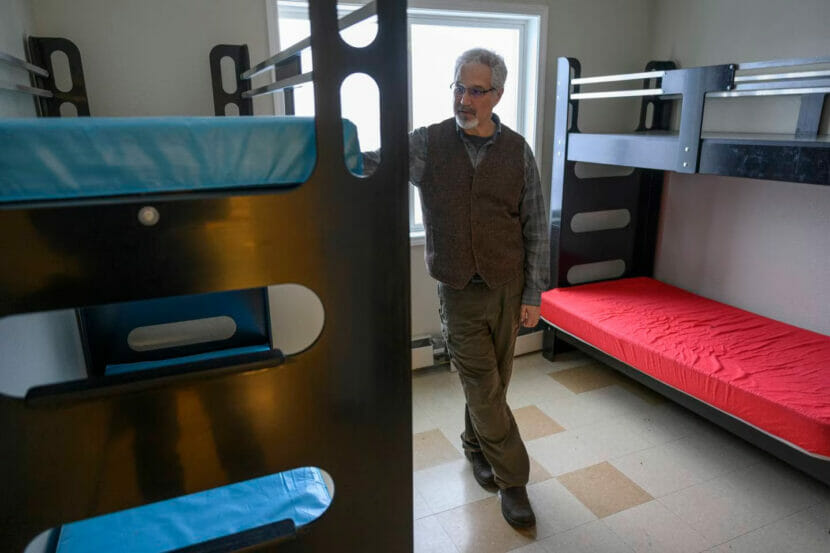
Upstairs at the Fairbanks Rescue Mission, Pete Kelly and John Coghill examined a shiny plastic bunk bed designed and constructed locally. It was built to resist infestations of bed bugs and other menaces of close-quarters living.
“This is space-age plastic,” said Kelly, the executive director.
The Rescue Mission is the biggest provider of emergency shelter in Fairbanks and a longtime Fairbanks institution. It can house up to 200 people in a disaster.
The mission has plenty of space, with comfortable rooms that look more like a college dorm. About 90 people, including women and families with children, stayed overnight on a recent weekday, Coghill said.
But some say the mission’s rules — you have to be sober and drug-free to enter — mean it isn’t sheltering the people who need it the most.
The men who run the shelter were among the most powerful lawmakers in Alaska for decades.
Kelly, the Rescue Mission’s executive director, spent more than 14 years representing Fairbanks in the Alaska Senate, including four as Senate president.
John Coghill served for more than 20 years in the Legislature, with a stint as Senate majority leader. He’s in charge of the day-to-day operations of the shelter.
Both say their faith guided them to shelter work. Each had recently lost a bid for reelection when they joined the shelter staff.
The skills of politics have transferred to their current work at the Rescue Mission, Kelly said.
In Juneau, he said, he learned, “Don’t promise things you can’t deliver.”
It’s the same at the Rescue Mission, he said.
Fairbanks Rescue Mission executive director Pete Kelly shows one of several kinds of sleeping arrangements at the facility. (Marc Lester/ADN)
Under their leadership, the shelter runs with a tight set of rules: To enter, prospective guests must pass a breathalyzer test and submit to a urinalysis for drugs. Clients are expected to move through a structured program toward self-sufficiency.
“If you’re willing to help yourself, we’re willing to help you,” Kelly said.
The rules are in place because the shelter needs to be an orderly, secure place, especially for people who are newly in recovery, Kelly and Coghill say. Women and families with children also stay there.
The mission can’t help everyone, they say.
“We have been criticized because there’s a level of mental illness that we just can’t take care of,” Kelly said.
Both talk about “extending grace” — allowing a man who stole back in, letting people ride out extreme weather in the foyer — but there are limits.
“If we have to tell (someone) to leave, we make sure they have hats, gloves, good boots, winter clothes, sack lunches,” Coghill said. “We’ll send them out with as much as we can.”
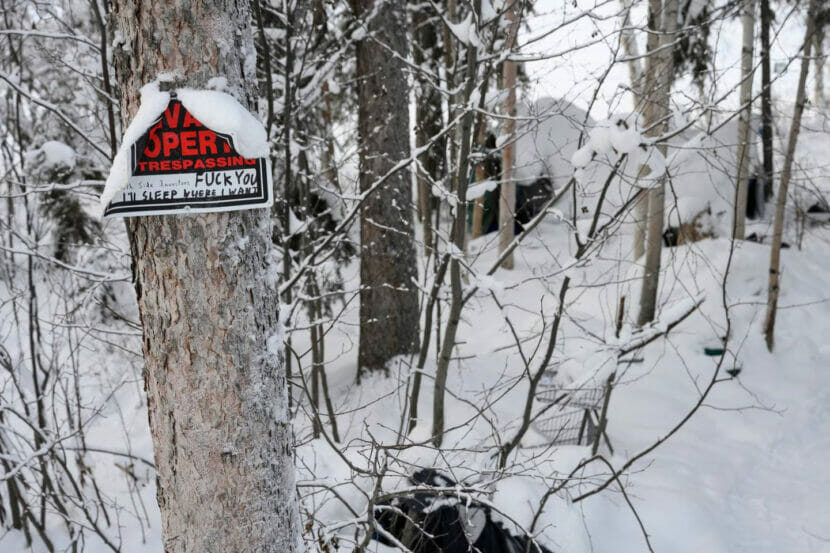
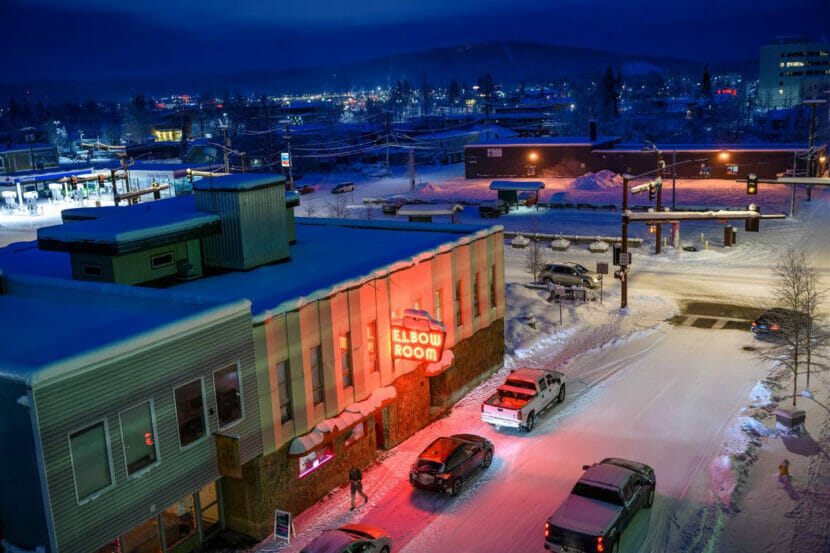
A handwritten message is left on a sign warning against trespassing in a wooded area on the east side of Fairbanks. (Marc Lester/ADN)Dusk falls in downtown Fairbanks in this view overlooking Second Avenue. (Marc Lester/ADN)
Advocates say the Rescue Mission does important work — but it shouldn’t be the only option for emergency shelter in Fairbanks.
“I understand why they have the limitations they do. I really do,” said Hannah Hill, executive director of Stone Soup Kitchen. “And we need to have low barrier shelter. … It’s very much about the lack of alternatives.”
Sobriety as a precursor to housing “just isn’t how homelessness works,” said Brynn Butler, housing coordinator for the city of Fairbanks. People can’t really work on their addictions, she believes, until they have stable and secure housing.
A person camps on a walkway in front of Stone Soup Cafe, which provides meal service to many unhoused people in Fairbanks. (Marc Lester/ADN)Daylight fades in Fairbanks in this view from Golden Heart Plaza downtown. (Marc Lester/ADN)
She was once an addict and homeless herself, living in cars and abandoned houses. Later, in recovery, she worked in encampment outreach and got to know people who lived without shelter in Fairbanks. She became the city’s housing coordinator in December, less than a month before Ahkiviana’s death.
Lynda Purvis, a case manager with the Tanana Chiefs Conference, hears a lot about Anchorage’s current version of a large, low-barrier shelter: Sullivan Arena. To her, it sounds like what Fairbanks needs.
“I really wish that we had something like that here,” she said. “Somewhere you could throw cots down, give you something warm to drink and just get out of the cold.”
Barriers
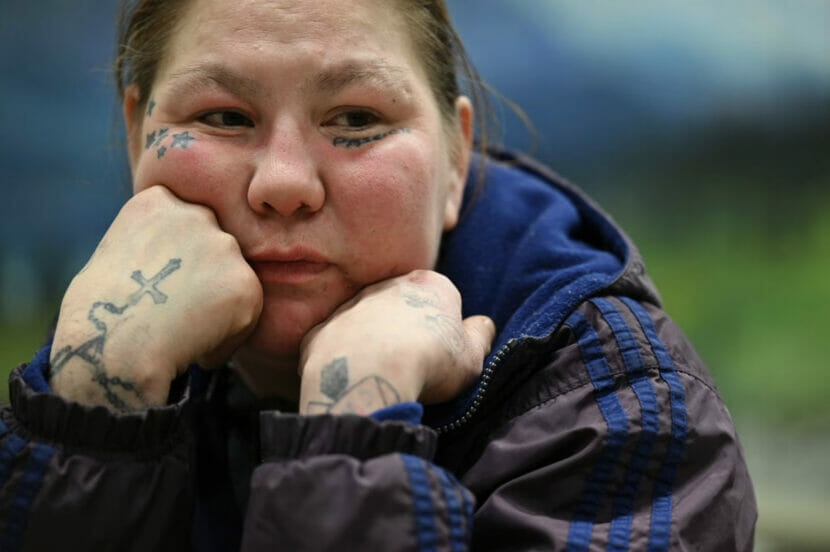
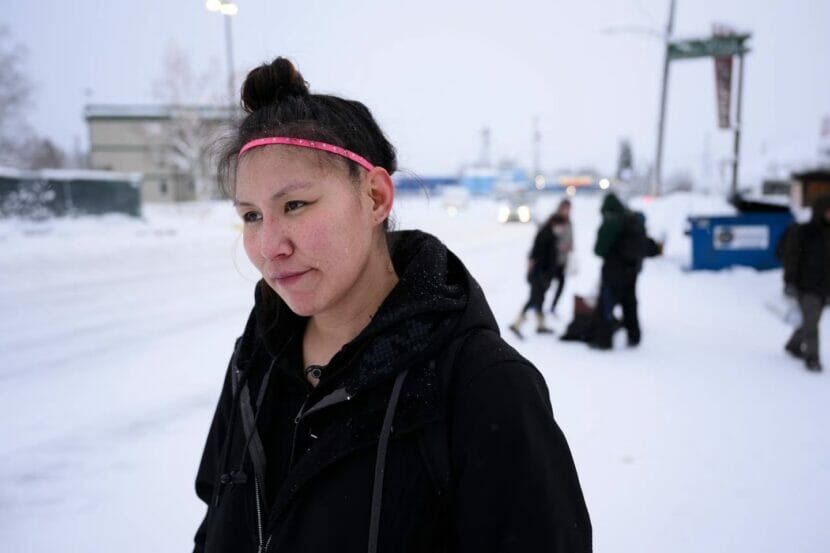
Robyn Demientieff, who lives unhoused in Fairbanks, said she slept in a motel hallway on a recent night and woke up early to avoid detection. (Marc Lester/ADN)
Robyn Demientieff soaked up the warmth inside the Centennial Center, a conference space at the city-owned Pioneer Park.
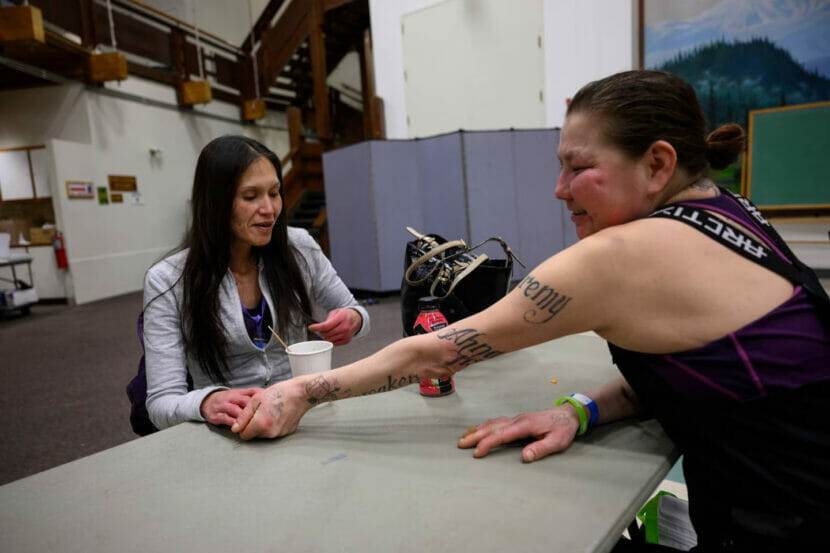
Demientieff, with short hair and a sprinkling of tattoos under her eyes, spent the previous night huddled in a hotel hallway grasping a few hours of sleep, then disappearing before anyone could kick her out, she said. She’d made her way to Project Homeless Connect for snacks and an application for a Housing First apartment. Her old friend Starla Adams sat with her.
Around them, behind folding tables, sat representatives of Fairbanks’ many social service groups, offering snacks, free haircuts and applications for housing and ID cards. A yearly event, Project Homeless Connect is meant as a one-stop shop for unhoused people to connect with services in a single location.
Demientieff said she’d been homeless on and off in Fairbanks for years. There was a strange logic to the way emergency shelter worked here, she thought:
“To go to the mission you have to be sober,” she said. “To go to the sobering center you have to be drunk.”
People get drunk simply to qualify for admission to the sobering center to dodge a night in the cold, she said. Demientieff was hoping her application for a Housing First apartment would be accepted.
“At least I’d have somewhere to go at night,” she said. “They won’t judge me.”
Starla Adams, left, talks with Robyn Demientieff during Project Homeless Connect in Fairbanks. The event gathers social service organizations in one place to help unhoused people. (Marc Lester/ADN)
The friends agreed that surviving homelessness in Fairbanks involves strategy and hard work. A “warming center” is open sometimes, but not always. People can be taken to the downtown crisis recovery center but can’t stay more than 23 hours. The soup kitchen is open 7:30 a.m. to 9:30 a.m. A food pantry serves meals on Wednesdays.
On this afternoon in January, the temperature was dropping into the teens and single digits. Demientieff wore snow overalls with no shirt underneath, a sweatshirt and a thin jacket.
“I can get you a jacket if you need one,” Adams quietly offered from across the table. She was staying at a women-only shelter.
Demientieff slid out of her chair and headed for the bus stop, lugging a bag. She had no idea where she’d spend the night. The Rescue Mission wasn’t an option for her, she said. Maybe she’d head downtown.
“If you could walk a mile in my shoes and survive, I commend you,” she said.
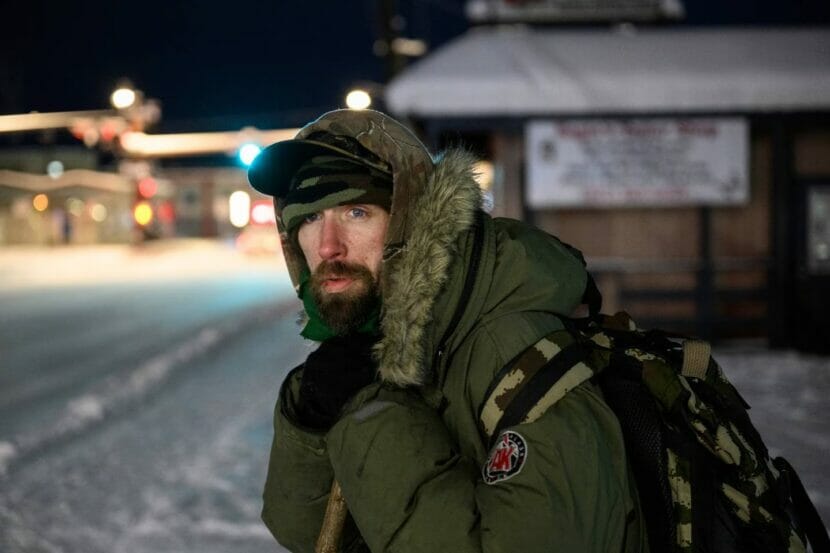
Scott Walston has spent years living unhoused in Fairbanks off and on, he said. On recent nights he walked all night to stay warm, he said. (Marc Lester/ADN)
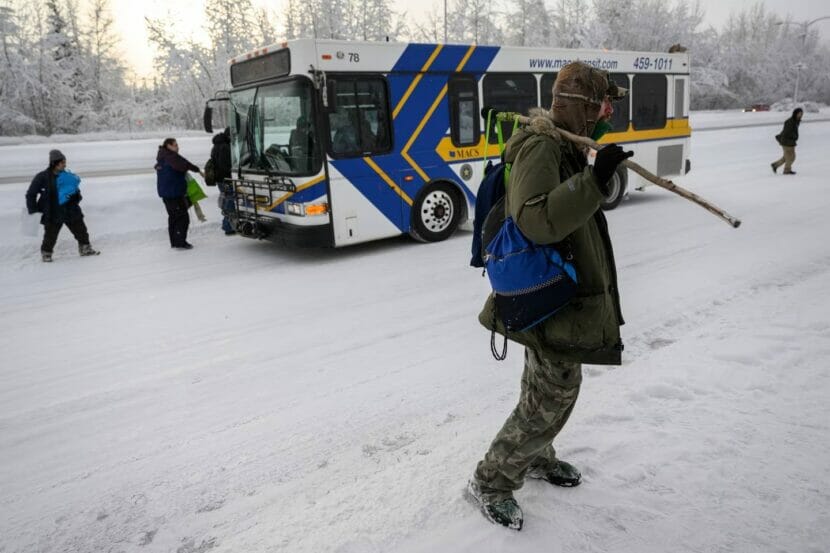
Scott Walston was standing at the bus stop, carrying his belongings over his shoulder with a stick. Walston is from Utah but said he’d been homeless in Fairbanks for about five years, on and off. His shelter options are limited: He’d been to the Rescue Mission but had been kicked out.
“I couldn’t stop drinking,” he said.
He spent all night walking. He does that sometimes. He prefers the big-box stores of East Fairbanks, he said. Safer to be among the Walmarts and Safeways. He’s practically become nocturnal, he said: Walk all night, ride the bus all day. In the coldest weather, he’s passed nights in empty houses. You curl up against your friends, hedging body heat against freezing.
“Been there, done that,” he said.
Searching for camps
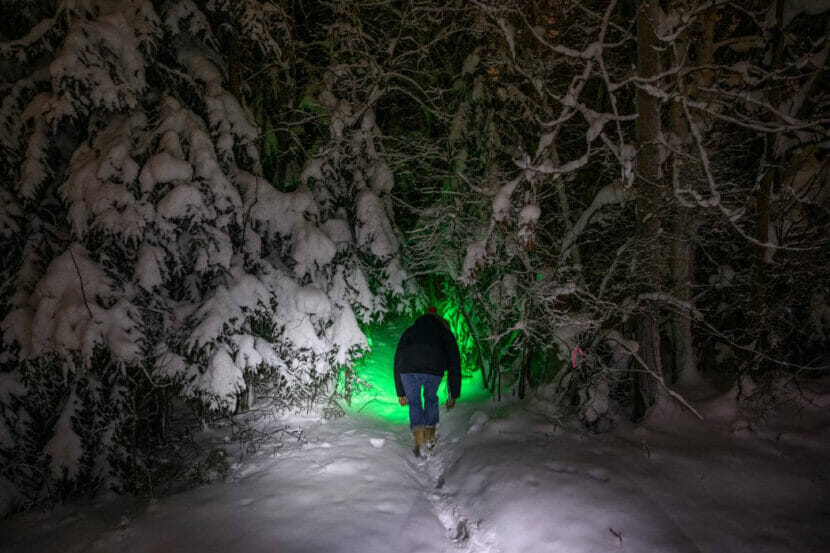
Niko Thompson walks into a wooded area of Fairbanks to look for encampments while conducting the Point-In-Time count of unsheltered people on January 30, 2023. Thompson runs programs for veterans for the Fairbanks Rescue Mission. (Marc Lester/ADN)
Niko Thompson trudged through heavy snow, his path lit by a headlamp. He was searching for the camps of unhoused people he knew existed in Fairbanks. They were proving elusive.
At one trail into a greenbelt, he saw only fox tracks in the new-fallen snow.
At the northeast edge of town, he called toward an empty tent in the trees. He stepped into a dilapidated building.
“Anybody there?” he hollered. “I have some bus passes, McDonald’s gift cards.”
No one answered.
Thompson, a veteran who got out of the military in Fairbanks and stayed, runs a program through the Rescue Mission that aims to help homeless veterans but extends help to all unhoused people. Tonight, his job was to survey camps as part of an annual point-in-time count of unhoused people.
In Fairbanks — unlike in Anchorage — the camps tend to stay hidden, invisible from roads. Usually, the camps are small. The biggest he’d seen was seven people living in one place: a junked bus.
After hours of searching, he’d found only one active camp. Nobody seemed to be there.
“Doesn’t mean they aren’t out here,” he said.
Morning
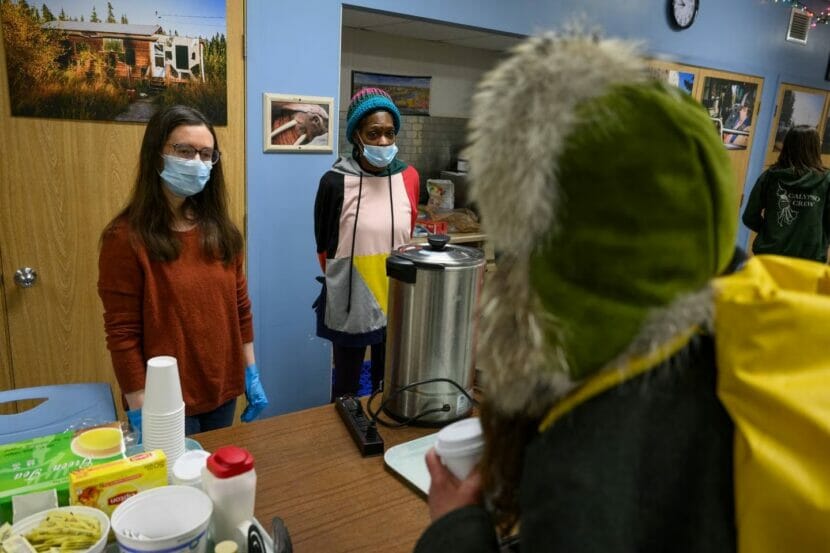
Wherever the unsheltered in Fairbanks may have secreted away for the night, about 100 people showed up for breakfast the next morning at the Stone Soup Cafe, a no-judgments grassroots soup kitchen.
The philosophy of The Bread Line, which operates Stone Soup Cafe, is different from the Fairbanks Rescue Mission: It’s a come-as-you-are place, with minimal rules. It also offers a place to be indoors for two hours a day.
On this January morning inside the building near downtown, volunteers served apricot oatmeal with lentil stew and pork chops available to go.
Rachel Garcia, left, and Teena Henry serve visitors to Stone Soup Cafe, whose morning meal service recipients include unhoused people in Fairbanks. (Marc Lester/ADN)
Ahkiviana’s death may have momentarily raised community consciousness about the dearth of shelter, said Matt Davis, a longtime cook at the Stone Soup Cafe. But he wondered if it would be long-lasting enough for action. The suffering was everywhere if you noticed it. Look around, he said: Lots of the guests eating breakfast were missing fingers due to frostbite.
“We bring (concerns about adequacy of shelter) to the attention of our local governments. And every time we do, it’s, ‘Well, we have a rescue mission.’”
After breakfast, people filtered outside to splinter into smaller groups or to walk off alone.
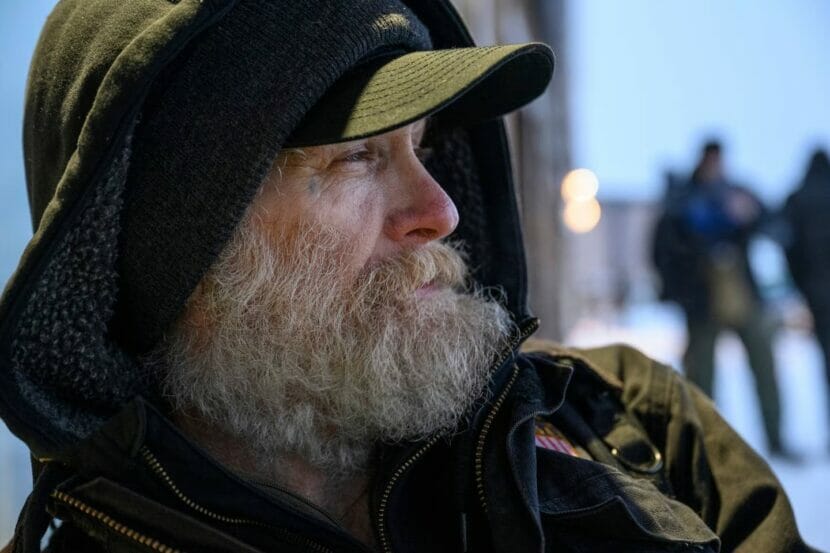
Kenneth Cooper, who has been homeless on and off in Fairbanks for years, said he sometimes stays with friends. On occasion he has made a dugout in a snowbank, he said. (Marc Lester/ADN)Kenneth Cooper, who is homeless in Fairbanks, said frostbite had damaged his fingers. (Marc Lester/ADN)
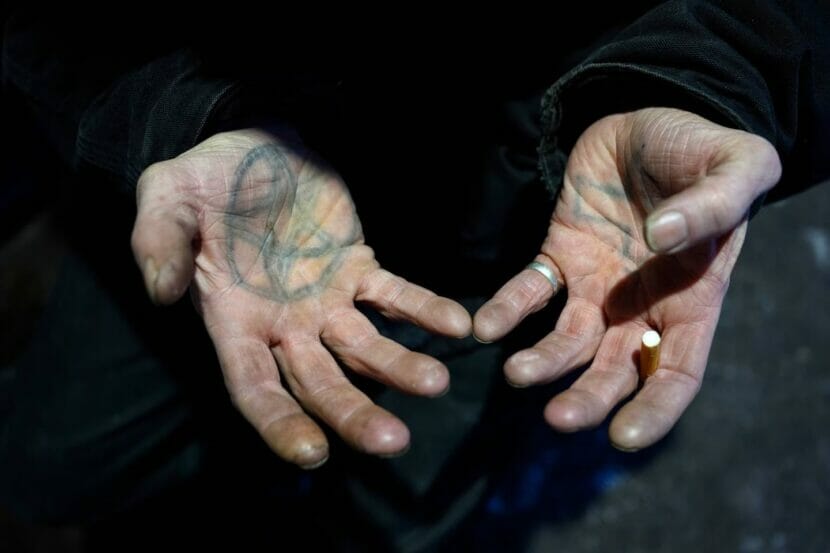
Kenneth Cooper, in fatigues and a long white beard, smoked a cigarette with fingertips made tender by repeated bouts of frostbite. On the best days he crashes with friends, he said, though he tries to avoid staying for more than a night at a time.
He’s no longer welcome at the Rescue Mission, he said. Now, in the coldest weather, Cooper sometimes burrows into a snowbank and makes a dugout shelter, big enough for just himself, he said. He runs a PVC pipe up through the snow to create a vent and burns a candle for warmth. Or he waits until the coldest, darkest hours to nurse a single cup of coffee at the only all-night diner in town.
Several other people said they stay in abandoned houses.
People come and go and others camp inside an apparently abandoned house in Fairbanks. (Marc Lester/ADN)
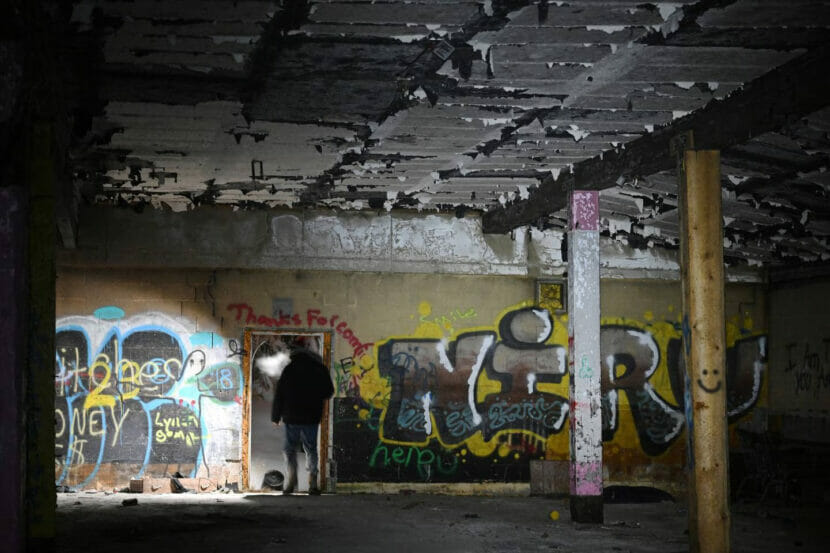
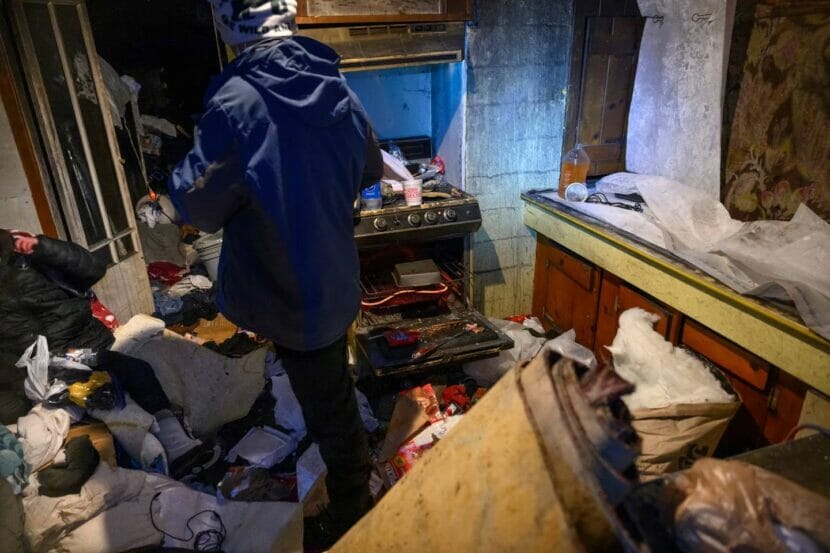
One such house was midnight dark in midmorning, the walls mildewed and molded. The only source of warmth was an electric oven left open and glowing red. Trash and random belongings — piles of clothes, a power drill, fast-food cups, towels — were heaped hip-deep on the floor. Someone was sleeping on a mound of detritus, partly covered with a blanket.
Back in the parking lot of the soup kitchen, Lakota Head, tall and wearing capri leggings in the cold, was in mid-beef with the occupant of an idling truck.
“Fuck you, Donna!” she shouted.
Anger tends to dissipate fast in a place this cold, Head said a few minutes later. People need each other too badly. The ethos would extend to Donna, the woman she had been cursing out.
“She could come to me later today or tomorrow or next week or, you know, whenever and just be like, ‘Dude, I’m cold,’ or ‘I’m sick.’”
Head, who sometimes comes to the soup kitchen for breakfast, said she’d help her however she could.
“If we’re mad at each other, it don’t matter — that just evaporates. Because what becomes important is the fact that we have to survive.”
Lakota Head said homeless people in Fairbanks help each other survive in the cold. (Marc Lester/ADN)
Momentum
Butler, the city’s housing director, senses there’s momentum for change. She doesn’t see Fairbanks directly taking on a low-barrier shelter as the Municipality of Anchorage has in the form of Sullivan Arena. But at minimum, the city could develop a cold-weather plan that might allow it to activate emergency shelters in extreme weather.
She thinks the need for more shelter may be becoming obvious enough that if a funding source can be secured, a site located and workers hired, it could become a reality. Not this winter. But maybe next.
“That’s my hope,” she said.
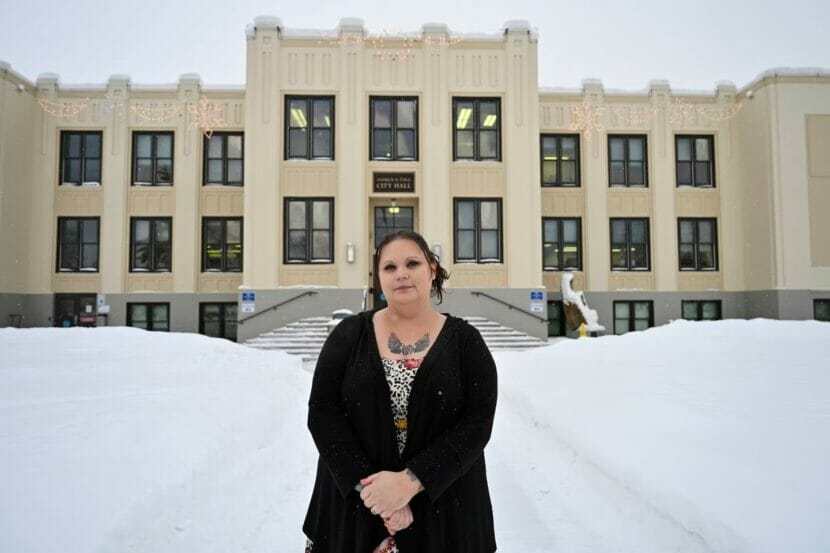
Brynn Butler, Fairbanks housing coordinator, who has experienced homelessness, said she’s hopeful an agency will establish a low-barrier shelter. She stands in front of Fairbanks City Hall. (Marc Lester ADN)Snow covers an encampment on the east side of Fairbanks. (Marc Lester/ADN)
There’s still a belief among some in Fairbanks and beyond that homelessness, and the addiction that often presages it, are essentially self-inflicted conditions, Butler said. It’s a pull-yourself-up-by-the-bootstraps perspective that’s at odds with what Butler says is now known about addiction as a disease.
The idea is that “if they just wanted it bad enough, they could have a house,” Butler said. “And that’s just not the case.”
“Addiction … is a trauma response,” she said. “It’s not going to heal until you’re safe and secure. And then you can start to focus on that.”
In January, Charlie Ahkiviana’s family held a funeral service and placed an obituary in the News-Miner describing his independence and pride. Instead of flowers, they asked for donations to the Fairbanks Native Chapel. Or the Fairbanks Rescue Mission.
Scott Walston walks the streets in Fairbanks. Walston, who has spent years, off and on, living on the streets, said he sometimes walks all night to stay warm. (Marc Lester/ADN)
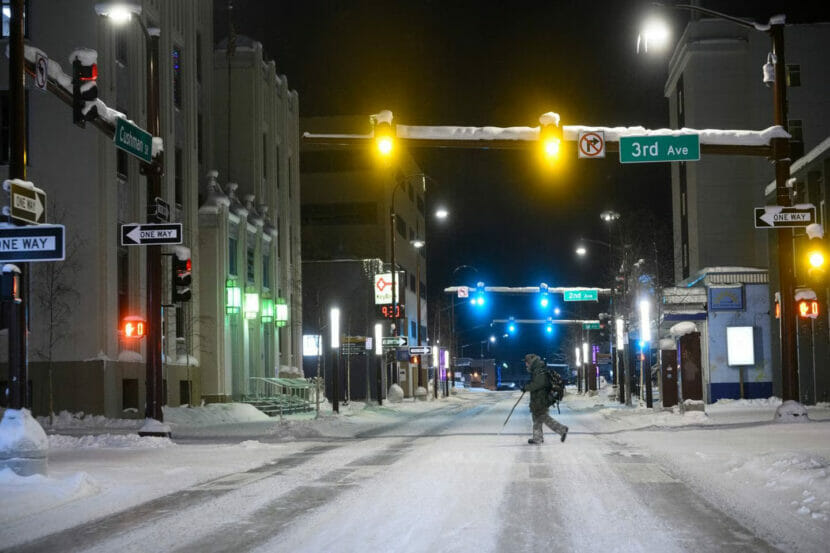
On a Tuesday night at the end of January, Scott Walston walked into a pool of light from a streetlamp on Gaffney Road.
He’d taken a bus to a spot where he had cached supplies in an encampment, only to discover someone had ransacked it. No great loss, he shrugged.
In the distance, he watched two figures walking bunched together. At this point he knew the streets of Fairbanks and their inhabitants so intimately he could recognize people by the shape of their silhouettes, he said.
Walson didn’t know where he’d end up, whether a door would open to a warm room or if he’d wander the streets until morning.
“Well, I’d better keep walking,” he said.
Scott Walston crosses Cushman Street in downtown Fairbanks. Walston, who has spent years off and on living unhoused in Fairbanks, said he sometimes walks all night to stay warm. (Marc Lester/ADN)
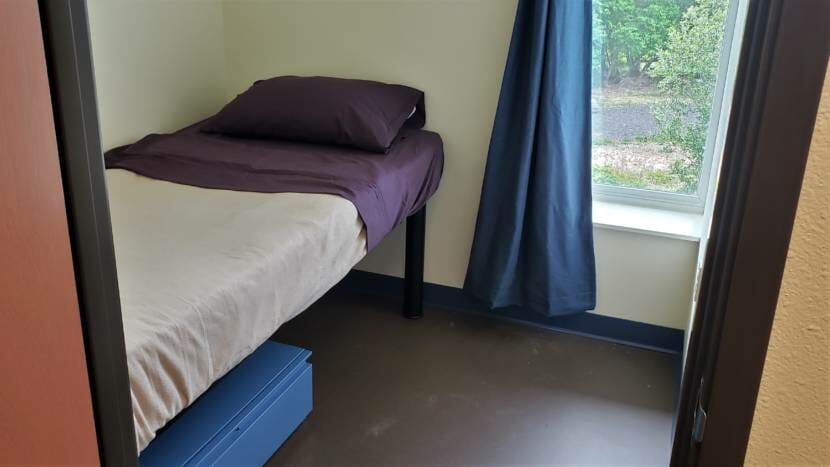
The Glory Hall emergency shelter has 42 individual bedrooms like this one, pictured on July 20, 2021. (Jeremy Hsieh/KTOO)
In an effort to measure the number of people experiencing homelessness in communities across the country, this year’s point-in-time count will take place on Tuesday, Jan. 31.
Dave Ringle is the executive director of St. Vincent de Paul Juneau. On Juneau Afternoon, he said the count helps homeless service providers take stock of community needs and apply for funding.
“Getting an annual count helps us see the patterns and modify our services,” he said.
Juneau’s homeless service providers will be at two locations for this year’s count. Volunteers will be at the Marine Park pavilion from 7:00 to 10:00 a.m. giving out toiletries, socks and other essentials. The Glory Hall will be open all day and offer a catered lunch.
At both locations, people will be asked to fill out a form to help with the count. They’ll get a $10 IGA gift card if they do.
The forms will also be available at St. Vincent de Paul’s Teal Street shelter, the Family Promise day center, the warming shelter at Resurrection Lutheran Church and the SEARHC Front Street Clinic.
The point-in-time count measures both sheltered and unsheltered homelessness. Ringle says it can also be a chance for people to access services for the first time.
“We have the visible homeless — those are the people that are obvious, and they’re served at our shelters. But we also have the invisible homeless,” he said, referring to people who might be living in their cars or have other forms of short-term shelter.
Last year, volunteers in Juneau reported 229 people experiencing homelessness. Nearly half of them were in emergency shelters, 78 had temporary housing and 39 were unsheltered.
Luke Vroman is the deputy director of the Glory Hall. He said, based on the number of people the Glory Hall serves, the point-in-time counts tend to be low, but they’re important “because they lead to funding, eventually,” he said.
Vroman said he hopes that conducting the count at locations throughout Juneau will yield a more accurate count.
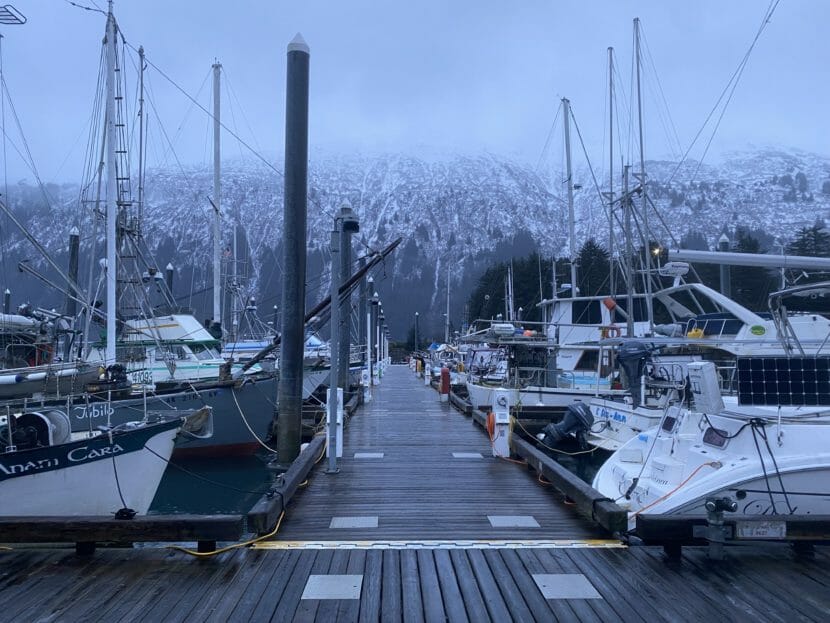
The Douglas Boat Harbor on Jan. 6., 2023. (Photo by Claire Stremple/KTOO)
It was raining softly at the Douglas Harbor when Candi Spicer popped out of the 30-foot sailboat she just started renting. She grew up on boats in California and is used to being on the water.
“I think it’s a little rustic,” she said. “I love it though. I think it’s very nostalgic.”
Silver insulation lines the walls inside, but she has plans to cover that up. There’s a bed, a bathroom with a shower and a small kitchen. The stove doubles as a heater. She says it’s nice falling asleep to the gentle rocking of the water in the harbor.
Spicer is the latest recipient of an Alaska-specific grant that helps people who are homeless maintain one year of housing — even if it’s alternative housing, like this boat. She’s one of about 1,800 people statewide who have gone from insecurity to stable homes through the program.
Candi Spicer aboard her new home, a 30-foot sailboat called “Daybreak” on Jan. 6, 2022. (Stremple/KTOO)
Quarters on the boat are tight, but Spicer says it’s a big step up from the last two years. She was homeless after some relationship trouble when she first got to Juneau.
“I found myself walking down the street with a backpack, not knowing where I was gonna go,” she said.
She was new enough in town that she didn’t have a safety net of friends and family, so she ended up in the shelter system.
“The Glory Hall, the warming center and stuff like that — those are supposed to be stepping stones. They’re not supposed to be life choices,” Spicer said. “So two years ago, I was walking down the street. And now it’s like, I have a job. I have a car. I have a place of my own.”
A tailored solution, with a shortfall
The flexibility of the grant is unique — usually federal housing money can’t be used to rent non-traditional housing like boats, hotel rooms or rooms in a home. The program side-steps these requirements. The Alaska Housing Finance Corporation, the state’s housing authority, designed it specifically for Alaskans, and for the realities of Alaska housing.
Luke Vroman manages the grant program with Juneau’s homeless shelter. He says the Glory Hall has placed 175 people in the program, and it’s saved the shelter from overcrowding.
“We’re full as is,” he said. “So, you know, there’s 175 other homeless people in town this year.”
But a year may not be enough time for all of them to find longer term solutions.
This grant has been effective at getting people out of vulnerable or unsafe living situations, but keeping them on track for permanent housing is much harder to accomplish.
The typical path to long term stability from homelessness involves a Section 8 voucher, which is federal rental assistance. But the wait time has ballooned over the last year or so, according to Vroman.
“Since the program started, the waitlist has gone from 12 months to like 19 to 24 or something. So nobody’s name has come to the top of the list,” he said.
Even if some of the 175 people in the program had gotten Section 8 vouchers, Vroman says there’s simply not enough affordable housing for them. He estimates Juneau needs 300 more affordable units to solve the problem.
A problem that keeps getting worse
“It’s a national problem,” said Bryan Butcher, the Housing Finance Corporation’s executive director. He said that 30 – 40 years ago, there was a severe lack of housing in rural areas, but the crunch wasn’t as bad in bigger cities.
“That has changed. It’s now statewide, it’s in our regional hubs. It’s in our cities,” he said. “And as the affordable housing crunch has gotten worse in the larger areas, that tells you it’s probably and certainly gotten even worse out in the rural areas.”
Butcher said the program has been a good use of the federal funds. He said they’re already seeing people move out of the program into their own apartments because the stability of housing allowed them to find work and daycare — pieces that are almost impossibly hard to put in place while navigating homelessness.
He says the housing authority didn’t anticipate how many communities would participate, nor the number of people that would sign up.
“The positive is we’re able to help a lot of people,” he said. “The negative is there are a lot of people in this more dire situation that needed the help in the first place.”
Candi Spicer is a likely success story for the program. While the grant pays her rent for a year, she’s saving to buy the boat outright.
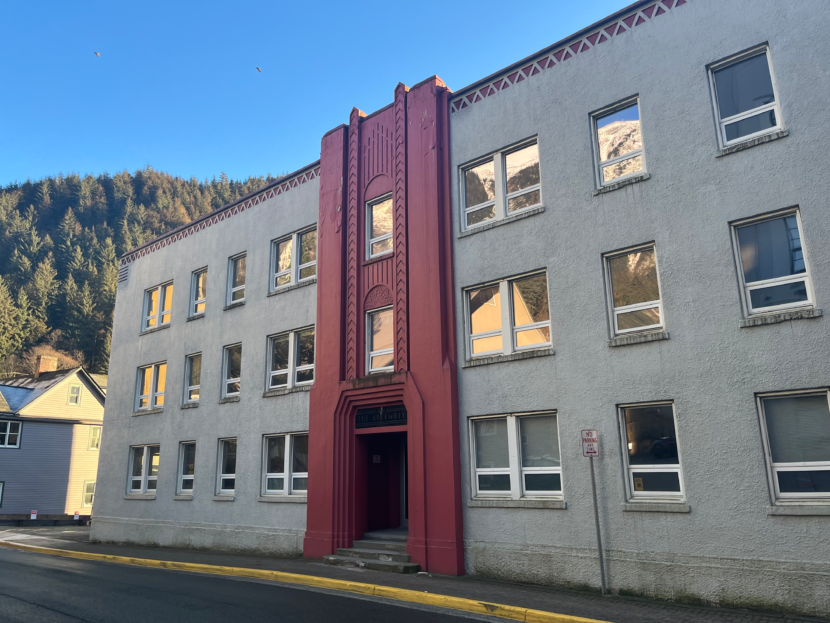
The Assembly Building, located steps away from the Capitol, is set to become legislative apartments as early as next year. (Photo by Katie Anastas/KTOO)
Members of the Alaska Legislature will soon have more housing options in Juneau.
Last month, a House-Senate committee approved spending $6.6 million to convert the Assembly Building, a state-owned office building just steps away from the Capitol, into 33 apartments as early as next year.
Lawmakers and staff say it could help address common challenges they face when it comes to housing during the legislative session.
The downtown location could reduce the need to bring cars to Juneau. That’d be a perk for legislators like Anchorage Sen. Bill Wielechowski, who stopped bringing a car with him to Juneau after an icy, windy stop in Whittier to drop his car off at the ferry a few years ago.
“It was like a comedy scene,” he said. “I fell down and I couldn’t get back up. I was crawling, trying to get back to my car, because it was sheet ice and 80 mile an hour winds. And then my glasses flew off into the ocean. It was crazy.”
It would also bring the amount of session housing closer to pre-pandemic levels. The Legislative Affairs Agency keeps a list of rooms, apartments and houses for rent submitted by landlords. Executive Director Jessica Geary said the list got significantly smaller during COVID; there were nearly 100 fewer listings last year than there were in 2019.
The cost to rent an Assembly Building apartment has yet to be determined, according to Juneau Rep. Sara Hannan, the chair of the committee that approved the spending.
“The goal is not to undercut the market, and the goal isn’t really to become a profitable landlord,” she said. “We’re not going into the landlord business to make money, but I think there will be an expectation that it pays for itself and doesn’t undercut any market that’s out there.”
According to state data, the average rent for an apartment in Juneau is around $1,300. On top of their salaries, legislators who don’t live in Juneau receive $307 per day during the session to cover housing, food and other expenses.
Hannan said they also haven’t determined what will happen with the units when the Legislature isn’t in session. But she said the goal is to have the units available for legislators and staff during special sessions, which can happen throughout the tourist season.
Market rate apartments have become harder to find. In the last few years, Geary said, more and more listings submitted to the agency have also been posted on AirBnB.
“We’ve had some people try to list using their short term AirBnB rental rates, so a few hundred dollars a night,” she said. “We’ve turned down those listings, because we want it to still be affordable.”
Earlier tourism seasons have also brought challenges. Many leases meant for legislators and staff end in late April or early May. If the session goes longer than 90 days, it can put those renters in a tough spot.
“Ships are coming earlier and earlier,” Geary said. “We’re usually good on housing until May 1, and then it starts getting a little bit difficult.”
Mike Mason has been a legislative staffer since 2015. He said flexible lease dates could be a major benefit of the Assembly Building apartments.
“I can tell you horror stories,” he said. “I had housing for when we had five special sessions in a year. I did not have to lose my housing, but almost everybody else did. I’m stashing people’s clothes in my house because people are just couch-surfing.”
Mason is working for Anchorage Sen. Löki Tobin this year. Tobin said the housing crunch in April and May can have an impact on legislators’ ability to get work done.
“That 90-day period of time actually results in some work having to be shifted, because many staffers are moving out of the place they had secured into new accommodations,” she said. “You really see an impact to the speed and efficiency of some of the bills moving forward because of that unfortunate blip.”
Whether it’s getting a bill passed on time, or simply being able to walk to work, Tobin said the Assembly Building apartments will be a welcome addition.
In the meantime, Geary said, Juneau residents are offering their support in a tough market.
“The housing market here, just like other places, is pretty tight,” she said. “But the Juneau community continues to graciously open their homes for legislators and legislative staff who come here and do the work for the people of Alaska. I think that really speaks volumes.”
The Legislative Affairs Agency still has rentals listed for the upcoming session, which starts Jan. 17. Legislators and staff in need of help finding housing, as well as Juneau homeowners with rentals available, can contact the agency’s office.
Close
Update notification options
Subscribe to notifications
Subscribe
Get notifications about news related to the topics you care about. You can unsubscribe anytime.