Housing

Telephone Hill residents in limbo as timeline for neighborhood redevelopment remains unclear

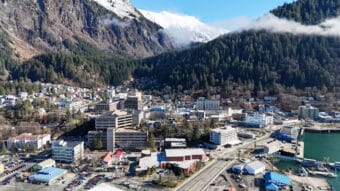
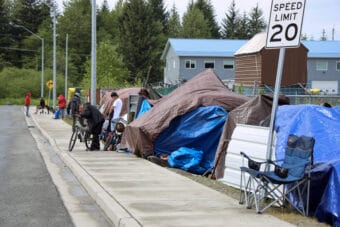
The Telephone Hill neighborhood in downtown Juneau on Thursday, April 3, 2025. (Photo by Clarise Larson/KTOO)

It’s been more than a year since the Juneau Assembly voted to move forward with a plan to demolish the downtown Telephone Hill neighborhoods’ historic homes and add more than 100 new housing units.

But since then, there hasn’t been much movement on the project. Residents say that has left them in limbo. 

Joe Karson rents an apartment on Telephone Hill. He’s been living there for two decades. 

Since the City and Borough of Juneau took over ownership of the neighborhood’s land about two years ago, he’s been checking his mailbox for an eviction notice. So far, nothing’s come.

“I don’t know if I could be evicted this summer or I could be here forever — I don’t know,” he said. “I have not heard from the city. Nobody has.”

The neighborhood is on roughly four acres of land on a hill that straddles the State Office Building downtown. It was state owned from the 1980s until 2023 when the city took it over. The state originally intended to build a new Capitol complex there, but that obviously never happened. 

Last year, the Juneau Assembly voted to redevelop the neighborhood to build denser housing there. Members said the decision was in response to Juneau’s severe lack of housing. 

But Karson said that same severe lack of housing is exactly why he — and many of his neighbors — haven’t looked for another place, despite knowing the city’s plan.

“I don’t really have a plan B to tell you the truth, given what the housing is. If I wasn’t living here, I’m not sure what I would do,” he said. “This is not a good time to find yourself without housing in Juneau, that’s for sure.”

Another Telephone Hill resident, Morgan Dufseth, said she’s stressed about finding a new place and also worried that any new units built in the area will be unaffordable for most residents.

“There are a lot of different things you could do with this, other than turn it into condos,” she said. 

Last year, the city put out a request for interest to developers who might want to take on the project. The deadline to reply was in late February and only one developer responded.

It’s a Washington and Idaho-based developer called Johnson & Carr. In its response to the city, the company says it wants to take on the project in spite of “significant economic obstacles.” 

It outlined a plan to build “no less than some combination of 40 affordable units for all income groups, modest-price single-level housing for seniors, and, likely, market-rate for-sale condominiums.” 

“It does take collaboration with the city to figure out the different financing vehicles that are available for different depths of affordability,” said Tyler Carr with the company. “Not to be vague, but at this level, it still has to be widely bracketed until we get further collaboration from the city and market analysis.”

Last year, the Assembly agreed to set a goal for the project to offer about a fifth of the new units at below-market rent. 

But there are no actual mandated requirements in place yet. If those come, they are likely to be discussed by the Assembly later down the line. Though some members, like Mayor Beth Weldon, have said they worry that adding any requirements might discourage developers from doing the project.

“My personal feeling is we should just let an outright bidding war happen and get as much money we can from Telephone Hill. It’s prime real estate. We would get prime costs,” she said during an interview last fall. “If we go that route of getting the most bang for the buck, then we don’t have to put any money into doing any project development or any landscaping or anything like that.”

City officials have warned that if the Assembly wants to mandate affordability requirements as part of the development, they can expect to have to pay for it. 

According to City Manager Katie Koester, the project still has quite a few steps to go before breaking ground.

“Telephone Hill will be redeveloped. However, we’re not evicting anyone without having real solid timelines and a plan for what that development looks like,” she said. “I know that there’s some uncertainty in that.”

Koester said Telephone Hill residents should be looking for other places to live in the meantime. The Assembly will likely get an update on the project in the coming months and decide how to move forward with redevelopment.

Juneau’s short-term rental task force only has one member who rents

Downtown Juneau on Wednesday, March 26, 2025. (Photo by Clarise Larson/KTOO)

For some people in Juneau, short-term rentals are an opportunity to bring in some extra cash or to make ends meet. But as the number of Airbnb and VRBOs increases, others feel they’re taking away housing desperately needed in the community. 

City data and different analyses suggest there are likely around 300 to 400 short-term rentals in Juneau, but that the number could be even higher. 

Short-term rentals are largely unregulated in Juneau, although the city did start requiring registration in 2023. But a new city task force is meeting regularly to decide whether there should be some firmer rules in place. 

But, there’s a problem with the group, Assembly member Alicia Hughes-Skandijs says — she’s the only member out of 11 who is a long-term renter. 

“We need to have people affected by the industry, and that would be renters, and that’s a demographic that sometimes is not represented,” she said. 

She said the makeup of the task force doesn’t fully represent the diversity of Juneau’s housing needs. According to the U.S. Census Bureau, about a third of residents are renters. That’s a starkly different makeup from the task force. 

“I don’t want to suggest that people can’t make really good civic contributions to a place they care about. But it is not marked by that sense of urgency, because they’re not affected in the same way,” she said. 

Both renting and owning in Juneau are expensive. The average single-family home costs more in Juneau than anywhere else in Alaska, and it ranks fifth in the state for the highest average rental costs for a two-bedroom.

The task force’s goal is to assess the short-term rental market and make recommendations that improve housing availability. Mayor Beth Weldon hand-picked the members of the group. 

She said, despite the lack of renters, she believes the group can still make decisions that represent the various viewpoints on short-term rentals in town. 

“Are we missing the people that are going to come and say, ‘I can’t find rental places?’ Yes. But are we still accounting for people there that want to regulate? I think that’s already represented,” she said. 

She noted that she did ask a handful of people who were renters to join the task force, but they declined. 

“Quite honestly, when you do a task force, it’s hard to get all the voices, but keep the group a manageable group,” she said.

The task force has been meeting biweekly since January. They plan to host two public meetings in the coming months to get feedback from residents on what kind of regulations they’d like to see. Hughes-Skandijs said it’s important that people, specifically long-term renters, go to those meetings and make sure their voices are heard. People can also submit comments and suggestions on the task force’s website. 

“That is a real opportunity to be heard. We would love to hear your thoughts on what you think we should do, how you think we should do it,” she said. “If people have strong thoughts about the process, then we would love to learn from that.”

Once the task force makes its recommendations, it will ultimately be up to the Assembly to decide how to implement them. 

If they pass regulations, Juneau wouldn’t be the first community in Alaska to do so. Communities around the state and country have already taken steps to curb the increase in their markets. 

In Sitka, short-term rental owners are required to live on the property for half of the year. And Wasilla only offers 75 short-term rental permits per year. Vacation destinations in states like  Colorado have also put into place similar laws.

Alaska legislators seek to ease planning for new housing projects

Sen. Forrest Dunbar, D-Anchorage, speaks Monday, March 17, 2025, in favor of Senate Bill 50. (Photo by James Brooks/Alaska Beacon)

Alaska’s organized borough governments would be encouraged to make long-term plans for housing projects under a bill passed Monday by the Alaska Senate.

Senate Bill 50, from Sen. Forrest Dunbar, D-Anchorage, would change state law to say that boroughs’ comprehensive plans — long-term planning documents — may include a housing development plan.

The bill passed the Senate 17-0 with three excused absences and advances to the House for further consideration.

Alaska housing prices have risen by nearly 50% over the past 10 years. The National Association of Realtors estimates that Anchorage and the Matanuska-Susitna Borough alone have a shortage of 5,066 homes.

Speaking on the Senate floor, Dunbar said the bill is part of a larger effort to encourage new housing construction.

The bill doesn’t require boroughs to create new comprehensive plans for their land, and it doesn’t require them to include housing as part of those plans, but it does encourage them, he said.

“In the process, boroughs will assess how their regulations impact housing supply, engage and inform the public, and recommend reforms,” Dunbar said.

Anchorage senator proposes ‘homeless bill of rights’ for Alaskans

TJ Beers holds a sign to advocate for the rights of people experiencing homelessness outside the state Capitol on April 9, 2024. Beers was homeless for four years and in three states. “I don’t know how I survived,” he said. (Photo by Claire Stremple/Alaska Beacon)

Over the past two years, nearly 100 homeless Alaskans died on the streets of Anchorage.

Last week, Anchorage Democratic Sen. Elvi Gray-Jackson introduced legislation that seeks to codify the rights of homeless Alaskans, including the right to take shelter in a public place as long as doing so doesn’t obstruct traffic.

“(My bill) doesn’t say ‘homeless bill of rights,’ but that’s what it’s basically about,” Gray-Jackson said by phone on Friday.

“What the bill would do is ensure that individuals experiencing homelessness are not denied access to essential services such as medical care, clean and safe living conditions, and equal opportunities for employment” just because they’re homeless, she said.

Last year, a former homeless man-turned-advocate named TJ Beers traveled to the Alaska Capitol to urge lawmakers to pass a “homeless bill of rights” in order to keep homeless Alaskans from being unnecessarily harassed by civil authorities.

Rhode Island, Connecticut and Illinois have already enacted laws affirming that homeless residents have equal rights to housing, medical care, movement and private property.

Last year, Gray-Jackson said, she wasn’t in a position to answer Beers’ request, but this year, she could make it happen.

“When I tell somebody I’m going to do something, I keep my word,” she said.

Gray-Jackson, a former member of the Anchorage Assembly, said that during her time in that role, she made a point to visit homeless camps “because I wanted them to know that I’m their legislator, and I represent them too.”

Anchorage’s many homeless encampments are a hot topic in the community, and the city has been in several legal disputes about whether it has the power to remove those encampments.

Gray-Jackson said she doesn’t believe her bill would stop the city from clearing camps.

She said she doesn’t agree with people who say they’re going to “solve homelessness.” Instead, she said, “what we’re going to do is mitigate homelessness and make the situation better for all.”

Is Juneau’s housing market stabilizing? Not along Mendenhall River

Water fills the streets and floods houses in the Mendenhall Valley early the morning of Tuesday, August 6, 2024. (Photo courtesy of Rich Ross)

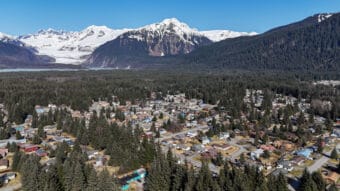
Many homes in the Mendenhall Valley near the riverfront are seeing a decline in their assessed values following last August’s glacial outburst flood, according to new data shared by the city this week. 

City Finance Director Angie Flick said homes in the area are selling for less than they did just a few years ago. 

“The glacial lake outburst flooding has created a situation where we have some homes that are perhaps valued less than they might otherwise be because they’re in that area of the Valley that’s threatened by annual flooding,” she said.

This week the City and Borough of Juneau began mailing out its annual property tax assessment values to homes and businesses. 

Flick said most Juneau homeowners shouldn’t see too much of a change from last year. The average residential property assessments rose by less than 1%. And on average the assessed value of a single-family home dropped by about half a percent. 

She said overall, this year’s data indicates that the housing market in Juneau might finally be stabilizing. 

“Juneau’s market a few years ago, really prices skyrocketed. What we’re seeing now is a leveling of prices,” she said. “Even though it’s higher than it may have been five or 10 years ago, we’re not seeing that dramatic increase.”

Last year, residential assessments rose by less than 2%. The year before that, values increased by about 16%, though some residents reported a more than 40% rise. 

This year, commercial property assessments remained mostly the same except for warehouse property values, which saw an 18% spike.

High housing costs persist in Juneau despite the market cooling down. For the past two years, Juneau has had the highest average sale price for a single-family home in the state, according to a study by the Alaska Department of Labor and Workforce Development. 

Though property tax assessments are in the mail, residents won’t be billed until this summer. The city calculates property taxes by multiplying a property’s assessed value by the local mill rate. The Assembly will decide on a mill rate in the coming months.

This Fairbanks couple saved money on housing by building their own home

A man stands with his hands on his hips, looking at a series of beams on support pillars. The pillars and man stand in a green field, surrounded by trees, with a partly cloudy blue sky above.
Josh Paul in July 2022 working on the beams that the floor — and whole house — would eventually rest on. (Photo credit: Courtesy Josh Paul)

This story originally aired on “Marketplace” on Jan. 23, 2025.

While biking near their rented home in Fairbanks, Alaska, Justine Schmidt and her partner, Josh Paul, stumbled upon a plot of land that spoke to them. 

At that point, it had only a roughed-in driveway, but Schmidt and Paul saw it as the perfect location for their future home.

A man and a woman stand side-by-side in construction gear. They are smiling and standing near an upright wood panel.
Josh Paul and Justine Schmidt in September 2022 after putting up the first wall panel on their new home. (Photo credit: Courtesy Paul and Schmidt)

Schmidt and Paul, who both work at the University of Fairbanks, purchased the land in May of 2021. Though they both lacked construction experience at the time, they decided to design and build a house themselves. 

“Josh is a very good researcher,” said Schmidt. “He spent many, many hours on YouTube University, learning how to do all the things.”

By sticking to a simple design, they managed to build a livable home in about two and a half years. 

Overall, Schmidt said the project cost around $200,000. That’s significantly lower than the median home price in Fairbanks, which is around $290,000, according to Redfin. 

“It was essentially both of us having part-time jobs — like at least 20 hours a week for two years, on top of our normal jobs, so that definitely cost something,” said Schmidt. “But we definitely could not have gotten this house on the market here in Fairbanks for that much money.”

You can listen to Schmidt’s full story here or read an edited transcript below:

Justine Schmidt: I’ve lived here about six years. It’s a lovely, cold place. Me and my partner, Josh, saw this property up for sale on a bike ride once, and we were like, “You know, that’s a great spot.” It’s at the end of a dead-end road. It goes right up against state land that there’s a bunch of trails on.

It was pandemic time, so we had a bunch of, you know, pent-up energy and had saved some money, you know. So, we were like, “This is a great idea.”

We built and designed and did the whole thing from the ground up, starting with cutting down all the trees and stacking all the firewood that we’re still using. We started in 2021 and we moved in last fall.

So, there’s a fun thing about living in Alaska, especially — we’re outside of the town of Fairbanks, right? There’s very little regulation. So, there’s a lot of people, kind of like us, who have almost no experience in construction and are like, “You know what? I can do this.” And that means a couple things: One, that you can kind of build what you want, which is really cool. And then the second thing is, there’s a lot of houses that end up for sale that are really weird.

We built basically a large box. We have no, like, indoor walls and like doors, which we’re fine with because it’s just the two of us. We like the big open space. We have giant windows that are Arctic-grade, and the walls are super thick.

A little less than $200,000 is how much this house costs us to build, which, you know, housing prices are different all over the place, but we definitely could not have gotten this house on the market for that much money.

You know, I think a lot of people would come into this house, and it is not like a normal house, right? It’s all open, but it is exactly what we wanted.

I think we both feel very connected to our house, like it’s a little baby that we had. It’s our child.

This series is part of Marketplace’s “Adventures in Housing” series, because an adventure is exactly what finding and affording a place to live has become.

Site notifications
Update notification options
Subscribe to notifications