American Public Media

American Public Media is the largest station-based public radio organization in the U.S. Its multi-regional station operations include 49 public radio stations and 42 translators in the Upper Midwest and California.
This Fairbanks couple saved money on housing by building their own home

A man stands with his hands on his hips, looking at a series of beams on support pillars. The pillars and man stand in a green field, surrounded by trees, with a partly cloudy blue sky above.
Josh Paul in July 2022 working on the beams that the floor — and whole house — would eventually rest on. (Photo credit: Courtesy Josh Paul)

This story originally aired on “Marketplace” on Jan. 23, 2025.

While biking near their rented home in Fairbanks, Alaska, Justine Schmidt and her partner, Josh Paul, stumbled upon a plot of land that spoke to them. 

At that point, it had only a roughed-in driveway, but Schmidt and Paul saw it as the perfect location for their future home.

A man and a woman stand side-by-side in construction gear. They are smiling and standing near an upright wood panel.
Josh Paul and Justine Schmidt in September 2022 after putting up the first wall panel on their new home. (Photo credit: Courtesy Paul and Schmidt)

Schmidt and Paul, who both work at the University of Fairbanks, purchased the land in May of 2021. Though they both lacked construction experience at the time, they decided to design and build a house themselves. 

“Josh is a very good researcher,” said Schmidt. “He spent many, many hours on YouTube University, learning how to do all the things.”

By sticking to a simple design, they managed to build a livable home in about two and a half years. 

Overall, Schmidt said the project cost around $200,000. That’s significantly lower than the median home price in Fairbanks, which is around $290,000, according to Redfin. 

“It was essentially both of us having part-time jobs — like at least 20 hours a week for two years, on top of our normal jobs, so that definitely cost something,” said Schmidt. “But we definitely could not have gotten this house on the market here in Fairbanks for that much money.”

You can listen to Schmidt’s full story here or read an edited transcript below:

Justine Schmidt: I’ve lived here about six years. It’s a lovely, cold place. Me and my partner, Josh, saw this property up for sale on a bike ride once, and we were like, “You know, that’s a great spot.” It’s at the end of a dead-end road. It goes right up against state land that there’s a bunch of trails on.

It was pandemic time, so we had a bunch of, you know, pent-up energy and had saved some money, you know. So, we were like, “This is a great idea.”

We built and designed and did the whole thing from the ground up, starting with cutting down all the trees and stacking all the firewood that we’re still using. We started in 2021 and we moved in last fall.

So, there’s a fun thing about living in Alaska, especially — we’re outside of the town of Fairbanks, right? There’s very little regulation. So, there’s a lot of people, kind of like us, who have almost no experience in construction and are like, “You know what? I can do this.” And that means a couple things: One, that you can kind of build what you want, which is really cool. And then the second thing is, there’s a lot of houses that end up for sale that are really weird.

We built basically a large box. We have no, like, indoor walls and like doors, which we’re fine with because it’s just the two of us. We like the big open space. We have giant windows that are Arctic-grade, and the walls are super thick.

A little less than $200,000 is how much this house costs us to build, which, you know, housing prices are different all over the place, but we definitely could not have gotten this house on the market for that much money.

You know, I think a lot of people would come into this house, and it is not like a normal house, right? It’s all open, but it is exactly what we wanted.

I think we both feel very connected to our house, like it’s a little baby that we had. It’s our child.

This series is part of Marketplace’s “Adventures in Housing” series, because an adventure is exactly what finding and affording a place to live has become.

For the first time, women will outnumber men in the Alaska House next year

The 21 women who will serve in the Alaska House next year, in order of House district. (Candidate photos)

There will be more women than men in the Alaska House of Representatives for the first time in its history when the Legislature convenes in January, according to final unofficial election results released Wednesday. Twenty-one women will serve in the 40-member Alaska House, assuming that — as expected — the winners in the unofficial tally are certified at the end of the month.

Rep. Genevieve Mina, D-Anchorage, said it’s great to see women better represented in state government. It’s a self-reinforcing trend, she said: the more women are elected, the more likely women are to get involved.

“It’s really exciting,” she said. “This is what it looks like to have genuine gender parity and representation in our government and politics.”

It’s the first time either the state House or Senate will be majority-woman, according to records maintained by the Center for American Women and Politics, part of the Eagleton Institute of Politics at Rutgers University. A review of legislative rosters dating back to the first state Legislature in 1959 confirms the milestone.

Mina says she expects the record number of women in the House to drive conversations about things like child care, education and family policy.

“Just having that empathy and experience with children and knowing those hardships, I think, makes a huge difference in trying to figure out what policies we can tweak to make our government and our state more welcoming for parents, for families and for children,” Mina said.

Five of the Alaska Senate’s 20 seats will be held by women in the next Legislature, the same number as last session. The one woman senator up for election this year, Kelly Merrick, R-Eagle River, won reelection. That makes the total number of female lawmakers 26, or 43% of total seats in the state Capitol, which is also a record, according to CAWP. The previous high, 23, was set in 2019.

Six women were newly elected to the Alaska House this year, according to unofficial results: Carolyn Hall, D-Anchorage, Jubilee Underwood, R-Wasilla, Elexie Moore, R-Wasilla, Rebecca Schwanke, R-Tazlina, Nellie Unangiq Jimmie, D-Tooksook Bay, and Robyn Niayuq Burke, D-Utqiagvik.

Fourteen women won reelection and will return to the House: Rebecca Himschoot, I-Sitka, Andi Story, D-Juneau, Sara Hannan, D-Juneau, Louise Stutes, R-Kodiak, Sarah Vance, R-Homer, Julie Coulombe, R-Anchorage, Alyse Galvin, D-Anchorage, Genevieve Mina, D-Anchorage, Donna Mears, D-Anchorage, Jamie Allard, R-Eagle River, DeLena Johnson, R-Palmer, Cathy Tilton, R-Wasilla, Maxine Dibert, D-Fairbanks and Ashley Carrick, D-Fairbanks.

And one female former lawmaker is making a comeback: Mia Costello, R-Anchorage.

Sen. Cathy Giessel, R-Anchorage, said she’s planning to start a “Women of the Alaska Legislature” caucus in the coming term. Too often, she said, male-dominated committees and leadership teams discount the input of their female colleagues.

“My goal with this caucus is, of course, to talk about, probably, some women’s issues — pay parity, child care, things like that — but also to be a place where women legislators can feel encouraged and can be mentored,” she said.

Giessel said she’s expecting the large number of women to make the Legislature as a whole more productive. She pointed to research from MIT that found that teams with a greater number of women outperformed male-dominated groups.

As for why the number of women in the Legislature has grown, Giessel points to the state’s open, nonpartisan primary system.

“There’s no blessing from a political party required,” she said. “That alone is empowering, I think, for women considering entering public policy.”

Alaska’s record-high number of female lawmakers matches a trend seen across the country.

record number of women will serve in state legislatures across the country next year. Women will hold a third of the more than 2,400 seats in statehouses nationwide, according to the Center for American Women and Politics. That eclipses the record set just this year.

In addition to the Alaska House, just seven state legislative chambers are majority-female or at gender parity in the U.S., according to CAWP.

Alaska Senate rolls out operating budget with roughly $1,300 PFD plus energy relief check

Senate Finance Committee Co-Chair Sen. Bert Stedman, R-Sitka, listens to testimony from Alaska Department of Transportation and Public Facilities Commissioner Ryan Anderson on Feb. 28, 2024. (Eric Stone/Alaska Public Media)

The Alaska Senate rolled out its first draft of the state’s operating budget Wednesday. The budget includes a roughly $1,300 Permanent Fund dividend for residents, plus about $175 in an energy relief check. The Senate’s PFD proposal earmarks 25% of this year’s drawdown on the Permanent Fund for the state’s annual payout.

That is substantially lower than the roughly $2,300 payout passed by the House. The Senate’s operating budget chair, Sen. Bert Stedman, R-Sitka, said the state has been “blessed” the last couple of years by high oil prices. But Stedman warned that high prices won’t last forever.

“I would suggest that we use a reasonable dividend expectation that can be attained going forward so we don’t put ourselves in a position where we have fairly strong dividends and we get up one year and there is no dividend. That’s what I want to avoid,” Stedman told reporters on Tuesday.

Stedman and other members of the bipartisan Senate majority have warned in recent weeks that the larger dividend passed by the House doesn’t leave room for agreed-upon spending on capital projects or recently bills.

Meanwhile, Gov. Mike Dunleavy, who has made large dividends a key part of his platform, said on the statewide call-in show Talk of Alaska Tuesday that he’d prefer a dividend above $2,000. He suggested spending a portion of the state’s roughly $2.8 billion savings account known as the Constitutional Budget Reserve.

“Well, the CBR’s got money in it, too,” Dunleavy told host Lori Townsend. “And during these difficult inflationary times, I think we have to give due consideration to what people are going through, as the caller kind of alluded to, but certainly the Legislature is going to make their decisions. And again, I know it’s, from all indications, it’s not going to be a full PFD. Hopefully it’s somewhere north of $2,000 to help people.”

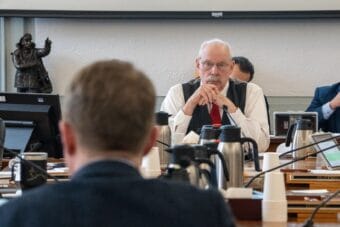
House Speaker Cathy Tilton, R-Wasilla, said Tuesday she’d like the biggest dividend lawmakers can provide, but she said she’s not sure that spending from the savings account will be possible.

“I think that the bigger question would be, would we be able to go into the Constitutional Budget Reserve, and have the votes available for that?” Tilton said in a news conference.

It takes a three-quarters vote in the House and Senate to spend from the account. That means the Republican-led majority couldn’t do it alone, and they may not get support from their colleagues — minority-caucus Democrats and independents spoke out against what they saw as an unbalanced budget as it passed the House earlier this month.

There was a similar debate last year between the House and Senate over the size of the PFD and whether to spend from the savings account. In the end, the House voted to adopt the Senate’s budget after negotiators added some $34 million in projects to the spending plan.

That led lawmakers this year to agree on a budget timeline with specific checkpoints. Lawmakers have stuck to the plan so far.

The Senate’s draft budget also addresses a disputed funding shortfall that threatens federal grant funding. Earlier this year, the federal Department of Education said the state had underfunded school districts in violation of a first-of-its kind grant requirement attached to a COVID recovery bill. The Senate’s draft budget would send some $11.9 million to two Alaska school districts to make up for the shortfall.

The Dunleavy administration has resisted the federal government’s call to pay up, saying the state’s funding formula did not change over the life of the grant. Though a policy expert recently told senators that many states initially failed to comply with the requirement, Alaska is the only state that has yet to resolve the issue.

The budget also includes $175 million in one-time aid to school districts, equivalent to a $680 increase in per-student funding. That provision was also included in the House budget.

Senate leaders say they hope to pass a final budget by early May. It’ll then likely go to a conference committee to work out the differences between the House and Senate.

A closer look at the Harvard charter school study making waves in Juneau

A school bus full of preschoolers, their parents, caregivers and advocates pulled up to the Capitol building on Monday to hand out Valentine’s Day cards to state legislators on Feb. 13, 2023. (Katie Anastas/KTOO)

A Harvard study on charter schools is driving conversations at the state Capitol about ways to improve Alaska schools.

The study ranks charter schools in Alaska as the best in the nation. Gov. Mike Dunleavy has cited it repeatedly and called on lawmakers to expand the charter school system.

For the lead author of the study, Paul Peterson, director of Harvard University’s Program on Education Policy and Governance, the results were unexpected.

“I have to say, I am surprised that Alaska came in number one,” Peterson said in a video interview in late January.

It was a surprise for several reasons. First of all, Alaska’s traditional neighborhood schools rank near the bottom in national comparisons.

And the finding doesn’t really fit in with some of the other top-ranked states. Other high-ranking states like Massachusetts, New York and Colorado tend to have highly educated populations clustered around universities and colleges, Peterson said.

“The odd state out really is Alaska,” Peterson said.

Why does Alaska perform so well? It’s hard to say, Peterson said – that wasn’t the focus of the study.

“You’d have to do a sort of a case study of every state, and that was beyond our resources,” he said.

Instead, Peterson and coauthor Danish Shakeel set out to produce the first state-by-state ranking of charter schools in the U.S. using a test given to a representative sample of fourth- and eighth-graders in every state, the National Assessment of Educational Progress. It’s often referred to as “The Nation’s Report Card.”

And while the researchers can’t say exactly why Alaska’s charter schools outperform those of other states, their data does indicate that the benefits of charter schools are widespread in Alaska. When just looking at charter school students on free and reduced-price lunch, Alaska’s still near the top, ranking third.

“I found that sort of interesting, that this was not sort of like, ‘OK, this is just a bunch of rich kids who are doing well,’” he said. “This is what we’re seeing for kids pretty much across the board.”

And there’s some data suggesting that nonwhite students perform especially well in Alaska charter schools. The data is limited – there was only enough data to isolate white students, not other racial or ethnic groups in Alaska – but among white students, Alaska came in third.

“So what’s pulling Alaska up to the top level seems to be the performance of the nonwhite students in Alaska compared to other parts of the country,” Peterson said.

Another key finding of the paper is that it matters who authorizes a charter school – basically, who allows a charter school to be created, whether it’s a school district, a university, or a state agency.

“Local school districts look pretty good. They’re sort of in the middle,” Peterson said. “But the ones that stand out, where students seem to be performing the best, are those where it’s a statewide agency.”

That’s because it’s the state’s job to make sure schools operate effectively, and they’ve been doing it a long time, Peterson said.

“And if you assign them the job doing the same thing for charter schools, probably they’re going to do a better job of it than some newcomer on the block,” Peterson said.

That’s been a topic of discussion at the Capitol. The leading House education bill, Senate Bill 140, would allow the Alaska Board of Education to directly authorize charter schools. As it stands, the state board has to wait for an application from a local school district or an appeal of a charter denied at the district level.

But the study has some important limitations – first of all, it’s based on data collected between 2009 and 2018, and things might have changed since the data was collected, Peterson said.

“A lot has happened in the last five years,” he said. “Call it COVID. Call it closing schools. You know, it’s just a lot of things that have happened, so whether or not we would get the same ranking for charter schools in Alaska today is an open question.”

It’s also possible that there are some differences between Alaska’s students and those in other states that make it difficult to compare, Peterson said. There’s also the possibility that given Alaska’s low population and relatively small number of charter schools, the test may not have captured a sample that represents the whole state.

Whatever the implications, lawmakers will have a chance to dig deeper into the study soon. Peterson is due to testify to the House Education Committee on Feb. 7.

Additional reporting was contributed by Alaska Public Media’s Tim Rockey in Anchorage.

Alaska heading toward fiscal ‘brick wall’ that could force end to PFD formula debate

An Alaska Permanent Fund Corp. sign in the office in Juneau, March 14, 2016. (Photo by Skip Gray/KTOO)

Eligible Alaskans will receive payments of roughly $1,300 on Oct. 5 from the state’s sovereign wealth fund. That Permanent Fund Dividend amount was originally set by a complicated formula, and since the state stopped using that traditional PFD formula in 2016, the legislature has struggled to come up with a new one.

James Brooks covers the legislature for the Alaska Beacon, and he told Alaska Public Media’s Michael Fanelli that lawmakers settled on the $1,300 figure only after continuing a familiar debate they’ve been having for several years.

Listen:

The following transcript has been lightly edited for clarity.

James Brooks: It was the end of a big back and forth as it has been every year since about 2018, and even going back before that. Since oil prices fell in 2015, the state has been operating without a secure formula for determining each year’s Permanent Fund Dividend. It’s basically set by fiat each year by the legislature. The legislature will debate between members and come up with the figure. And this year, it’s about $1,300 per recipient. That’s $880 million that’s gonna come out of the state treasury and head to Alaskans.

Michael Fanelli: Wasn’t there a provision for an extra $500 if oil prices were high enough? Does that apply for this year, or is that not until the future?

James Brooks: That’s next year, and right now oil prices are looking pretty good. So chances are that we will get that extra $500, which happens to be an election year next year. So if you’re a cynic, you could say, “Well, there’s a big incentive to make sure that happens next year.” And the oil prices are actually high enough that it could affect — you could see things happen even bigger next year, depending on if they stay that way.

Michael Fanelli: Gotcha, okay. So talk to me a little bit about what the discussions were looking like in the House and Senate. What did the debate look like? What were different parties pushing for?

James Brooks: The debate’s looked pretty similar since about 2018. So back in 2018, if you’ll recall, the legislature was dealing with the huge crash in oil prices that had happened a few years before that. The state legislature and the governor had cut the budget, but that wasn’t enough. And so what they decided to do was spend money from the Permanent Fund on state services, for the first time in a big way.

And the problem is that while they set up this system, they couldn’t agree on a new formula for the Permanent Fund Dividend, because the formula that’s still in state law and hasn’t been replaced, wasn’t written with the idea of this transfer in mind. And so lawmakers have been deciding, “Well, what replaces that old formula?” And the general idea is that the annual transfer gets split in some way, a portion for dividends, a portion for services. But where that split is, hasn’t been decided. And that’s been the argument for the past five years. And so we’re left in a position where there’s not agreement on what replaces that old formula.

Michael Fanelli: Back in July, you wrote about a new forecast from the Permanent Fund Corporation that said the spendable portion could run out within the next three years. How do you expect that to color the conversation around this next session?

James Brooks: If there’s something that could force an end to the annual debates over the dividend, and result in a new firm formula, it’s that. That seems to be a coming brick wall that the state’s fiscal car is driving towards at the moment. If trends continue, and something isn’t done, there won’t be an annual transfer from the Permanent Fund to the state treasury in a few years.

This is the big question in the state and has been for really, eight years now. It would take quite a bit to change where we’re at. Next year’s elections might move the needle slightly, but it would take some kind of wholesale movement, something extremely drastic, like the Permanent Fund running out of spendable money in order for things to change.

Anchorage School District closes 5 libraries due to snow load

The Anchorage School District Education Center street sign. (Mayowa Aina/Alaska Public Media)

The Anchorage School District has closed five elementary school libraries to evaluate potentially dangerous snow buildup on top of schools.

In an email sent to parents Monday night, the district said that libraries at two Anchorage elementary schools — Klatt and Spring Hill — were closed after the maintenance department identified ceiling damage.

The district also decided “out of an abundance of caution” to proactively close the libraries of Bear Valley Elementary, Fire Lake Elementary, and Ravenwood Elementary, which share the same building design with Klatt and Spring Hill.

“There is no risk of catastrophic collapse,” the email said. “There is a risk of ceiling pieces coming down. There is no indication that ceilings in these buildings are damaged outside of the libraries.”

Anchorage Fire Department Assistant Chief Alex Boyd said that three buildings and a carport have collapsed in Anchorage over the last month. One person died in a South Anchorage CrossFit gym roof collapse on Feb. 17 and two buildings suffered partial collapses over the weekend, but no other major injuries have been reported from the structural failures.

Prior to the fatal roof failure in Anchorage, the Palmer Public Library suffered a partial roof collapse on Feb. 15. The city is currently examining alternative sites to host library programs and store books, according to Palmer City Manager John Moosey.

Engineers assessed the snow load on the roofs of Anchorage schools after the first major snowfall in December, and began a second assessment recently. The district says all five school libraries will be closed until engineers can complete an assessment on the ceilings.

Site notifications
Update notification options
Subscribe to notifications