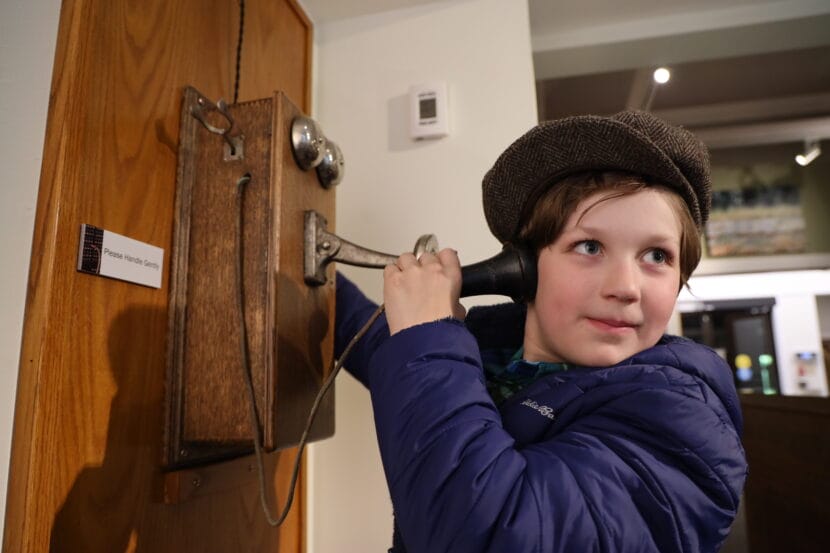
Sounds of early 20th century phones filled the Juneau-Douglas City Museum on Friday night. Ten-year-old Otis Beard studied them closely as they rang.
“There’s a little metal ball clanking from each one really fast,” he said. “It goes at almost light speed. It looks really cool.”
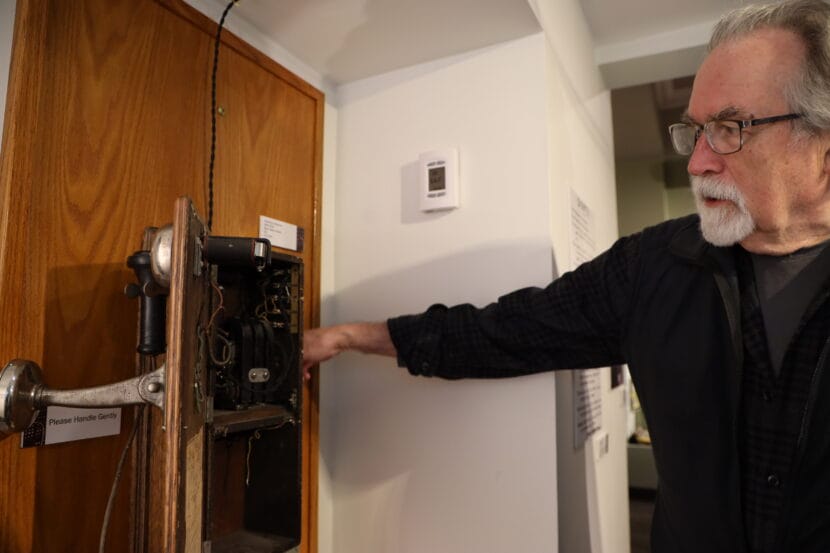
Jim Simard, the former head librarian at the Alaska State Library’s historical collections, says he used diagrams pasted inside the phones to help get them back in ringing condition.
“It’s a beautiful machine,” he said. “They’ve got a magneto that puts out about 60 to 80 volts.”
Museum Director Beth Weigel said the exhibit is a chance to showcase the phones while Juneauites are thinking about the future of the Telephone Hill neighborhood, which faces redevelopment and possibly the loss of its historic homes.
“We have these old phones in the education collection, and we’re always fascinated by all the stuff we have that people can handle,” she said. “I think there’s a lot of interest in Telephone Hill right now.”
Telephone Hill was home to Alaska’s first commercial telephone service. Edward Webster and his family ran the company out of their house there.
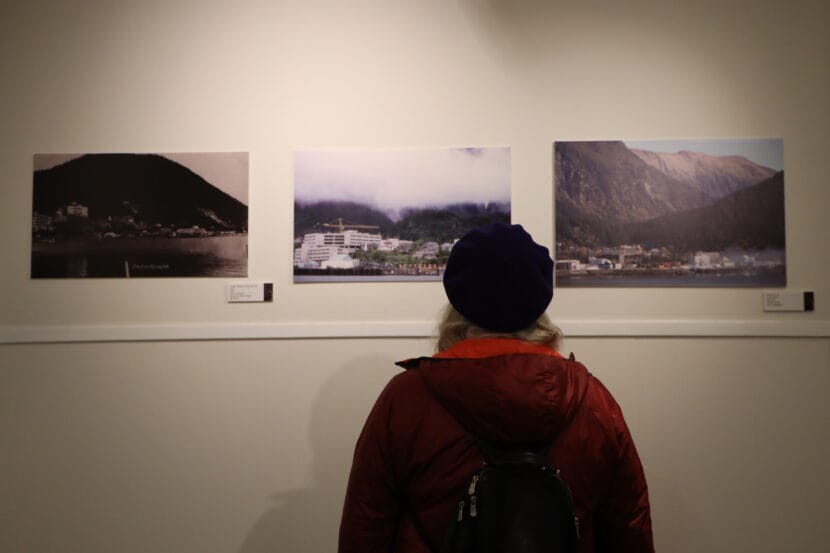
The exhibit also includes three photos of the neighborhood, each taken about 50 years apart. Juneau resident Skip Gray took two of them, in 1973 and 2022. He used to live on Telephone Hill, and he’s spent the last year and a half combing through photos he’s taken of the neighborhood as the city discusses a redevelopment plan for the area.
Looking at the photos on the wall, Juneau resident Katie Henry says it’s important to keep the green space that remains on Telephone Hill.
“I think that hill provides a relief for the encroaching urban feel of the downtown,” she said. “The green is critical. It’s part of what makes it still feel OK to be downtown.”
The state of Alaska transferred ownership of Telephone Hill to the City and Borough of Juneau last year. In October, designers shared four preliminary redevelopment ideas. One involves building new housing among the existing homes. Others would remove the houses and add new homes or apartment buildings.
Peter Metcalfe lived on Telephone Hill in the 1970’s and 80’s. He said he’s open to the city adding new housing, but he hopes they’ll preserve the greenery there, too.
“I’d prefer they consider some new housing, perhaps, but office buildings and apartment buildings? Give me a break,” he said. “It’s one of the very few open spaces. Does the city of New York regret Central Park?”
Stuart Sliter, whose grandmother operated a switchboard in Douglas, said the exhibit brought back lots of memories.
“When you look at some of the old directories that they have here available for us to paw through, I find that I knew almost everybody in the Douglas section, it was such a small town then,” she said.
Sliter remembers having tea at the Webster House. She said she’s unsure how the city or the current tenants could afford to keep all of the houses on Telephone Hill.
“I can’t imagine that the City and Borough of Juneau can keep it and maintain it as just a showpiece,” she said. “And the people that live there probably couldn’t afford to buy it at today’s prices. It’s prime property.”
Project leaders plan to give an update on Telephone Hill to the Assembly later this month. It will include results from a historic site study and a public survey. Tuesday, Jan. 9, is the last day to fill it out.
The Juneau-Douglas City Museum exhibit runs through November.