Housing

Juneau churches step in to feed people after Glory Hall limits services

Volunteer Xenia Fuamaila packs up a hot meal in a donation food truck on Friday, Sept. 26, 2025. (Photo by Clarise Larson/KTOO)

Standing outside a white food truck, nine-year-old Katrina Aitaoto handed out Styrofoam boxes of hot food to the people lined up in the rain in the parking lot of Juneau’s Salvation Army. Friday night’s menu was a classic: breakfast for dinner. 

She asked how many dinners each person wanted, and shouted the order back to her fellow volunteers in the truck. Most asked for more than one, for other people they were camping with.

Katrina was there with her youth group, from Aldersgate United Methodist Church. She said she didn’t mind spending her Friday evening in the pouring rain.

“It’s because I want to help people just get some food so they can eat,” she said.

Fourteen-year-old Xenia Fuamaila is another youth group volunteer. She put some French toast in a to-go box. Xenia said it meant a lot to her, to be able to help. 

“I’m just really happy that people are being able to get meals when they’re able to,” she said. “Seeing that smile on their face.”

In August, the Glory Hall reduced its day services due to what staff say is an unsafe environment on the streets around the shelter.

The city’s winter warming shelter opens in mid October. It offers food in the mornings and evenings. But until then, the city’s unhoused population has limited options for finding a warm meal.

So kids like Katrina and Xenia, along with volunteers from several other churches, stepped in. Before the Glory Hall reduced its services, several churches distributed meals every Tuesday in the Mendenhall Valley. Now, more churches are joining in. They’ve brought their operation downtown, and serve food three times a week. 

Inside the truck, Melanie Venables directed the youth chefs as they made and distributed about 100 meals over the course of the evening. 

“Our youth group does all the cooking and the serving,” Venables said. 

She said community members have really responded to the food distribution, including those who need food, and those who want to help. 

“A lot of churches jumped right in to help, and it’s gotten more and more people every week,” Venables said. “So like, it’s been busy.” 

Katrina Aitaoto (center) packs up a meal at a food distribution truck run by volunteers on Friday, Sept. 26, 2025. (Photo by Clarise Larson/KTOO)

Harold Lloyd Hassell is one of those people. He said he’s been coming to this food distribution when it’s open, as he navigates living outside. 

“I’ve never been accustomed to being jobless or homeless in Juneau,” he said. 

He said that especially on a cold and wet evening like Friday, a warm meal is more than just food. 

“[It] means a great deal, considering that some of the organizations that you know were around, aren’t around to help, such as the Glory Hall and some other places,” Hassell said. “But it’s good that Juneau pulls together when it does.”

As she handed out more boxes in the pouring rain, Katrina said any kids who want to volunteer, like she is, should try it. 

“Just don’t be scared,” she said. “Just have fun.”

The food truck serves hot meals in the Salvation Army parking lot Mondays at lunchtime, and Wednesdays and Fridays 6 to 7 p.m. until the warming shelter opens on Oct. 15. 

Who benefits and who loses if Juneau caps its mill rate after this election?

Homes in the Mendenhall Valley on Wednesday, April 2, 2025. (Photo by Clarise Larson/KTOO)

A proposition on Juneau’s local ballot this year asks voters whether to lower the cap on the local property tax rate, also known as the mill rate. Advocates say the proposition will help make Juneau more affordable. 

Proposition 1 seeks to cap the rate the city uses to determine how much residents pay in property taxes each year. 

“Everyone who owns property in Juneau pays property tax to the city based on the value of their property. This would be capping the rate at which the Assembly can charge them for that,” said Assembly member Christine Woll. 

The proposed cap is only slightly lower than what property owners are already paying currently. 

Right now, the city caps the mill rate at 12 mills. That limit excludes debt service, which goes toward paying off the city’s existing bonds and loans.

If voters pass Proposition 1 this election, that cap would be lowered to 9 mills. Juneau’s current rate, when excluding debt service, is 9.16. But the rate has been higher before, and the Assembly wants the flexibility to charge more in the future. 

But an advocacy group called the Affordable Juneau Coalition says the city needs to focus its spending on things it needs to fund, and not what it wants to fund. Angela Rodell is the treasurer of the group. 

“I think it’s really imperative that the city show its residents that they care about affordability and want to really focus on the things that make this community very livable,” she said.  

So, what would the change actually mean for your wallet? The city estimates that owners with property valued at half a million dollars or less would save about $80 per year in property taxes if the proposition passes. That’s assuming the home value stays the same. 

Now, let’s compare that to the top commercial property owner in the city: Hecla Greens Creek Mine. It owns property valued at just under $285 million based on its 2024 assessment. With the proposed cap, it could save just over $45,000, assuming the value stays the same. 

According to census data, more than a third of Juneau households are renters. And renters might not see any benefit from a cap — landlords have no legal obligation to pass any savings from the change on to their tenants. 

So, the winner in this scenario is those who own a lot of property in town. The city is the loser. That’s because the Assembly would have less money to fund city services. 

“The question that’s being asked this year is, ‘Do you think we should be focusing on making this a community that has services for our lowest-income people, or do you think that we should cut taxes for the wealthiest in the community to make things more affordable?’” Woll said. 

The change would result in a roughly $1 million loss in revenue to the city year over year. The rate cap wouldn’t be immediately devastating to the city’s roughly $140 million in annual discretionary revenue. But less revenue equals less money to pay for services. Woll says over time, the Assembly may need to make cuts to the budget if the proposition passes. 

For each dollar the city collects in property taxes, a bit more than 50 cents goes toward education and a little under 40 cents goes toward city services. 

“When I think long term, it’s maybe less about the money and more about the city’s ability to respond to changing environments,” Woll said. 

It’s unclear what services the Assembly might choose to cut. It would make those decisions after the election.

Rodell said she thinks the city can handle the change, and in doing so, it will prove to constituents that it, too, can tighten its belt. 

“We know that the city can deliver a lot of services for 9 mills,” she said. “What we’re asking the city to do is to continue to be really thoughtful about how and where and when they collect tax and spend that tax.”

If approved by voters, the rate cap would be applied next city budget season. Election Day is Tuesday, Oct. 7. 

Find the latest local election coverage at ktoo.org/elections.

Telephone Hill renters pack up belongings and memories ahead of eviction

John Ingalls looks at his flute-making shop in the basement of his longtime rental on Telephone Hill in downtown Juneau on Tuesday, Sept. 24, 2025. (Photo by Clarise Larson/KTOO)

Renters living on Juneau’s historic Telephone Hill have a week to pack up their belongings and vacate their homes before the city’s Oct. 1 eviction date. 

In the basement of a red-trimmed house with cedar siding on Telephone Hill, John Ingalls played a carbon fiber bass flute on Tuesday afternoon. He’s rented this space for decades. 

For the last 15 or so years, he’s been making flutes on the hill in his well-loved shop. There’s hardly an inch of open space on the tables and walls in there, all filled with tools, varnishes or half-finished flutes. 

John Ingalls plays a flute he made in the basement of his longtime rental on Telephone Hill in downtown Juneau on Tuesday, Sept. 24, 2025. (Photo by Clarise Larson/KTOO)

“It’s amazing the things that have happened in this little shop here — all the things we’ve built,” he said, looking around. 

But before next Wednesday, all of it will need to be packed up and taken off the hill. In December, the city plans to demolish the homes there in hopes of making way for newer, denser housing. The city does not yet have a developer signed on to the project. 

Juneau is facing a housing crisis — there are simply not enough homes to keep up with demand. Alarms of a crisis date back more than a decade. The Telephone Hill redevelopment would add more than 100 new housing units to downtown.

Sitting in his dining room alongside some of his neighbors on Tuesday evening, Ingalls said this isn’t the first time he’s had an eviction scare on the hill. 

“When I was younger, I sort of had a plan if I got evicted, that I would build a platform and scaffolding up on the roof, and hang up on the roof with a squirt gun,” he said, laughing. 

All the people living on Telephone Hill are renters, and have been since the state took ownership of the neighborhood in the 1980s. It was originally intended to be redeveloped to build a new Capitol complex there. But that didn’t happen.  

The state transferred the land to the city two years ago. Last year, the Assembly voted to redevelop the neighborhood

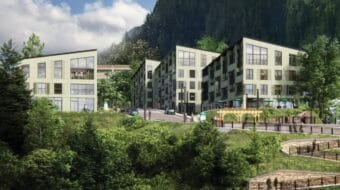
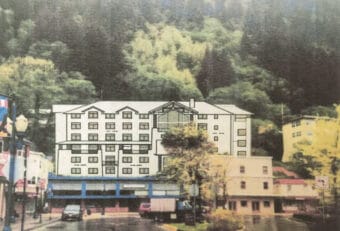
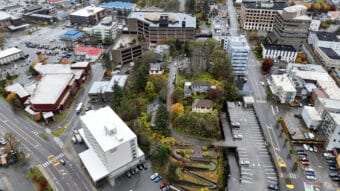
This is a preliminary concept drawing of what the Telephone Hill neighborhood redevelopment could look like. (Courtesy/City and Borough of Juneau)

Joe Karson just turned 80 years old. He rents an apartment on the hill. 

“My history on the hill goes back quite a length, but I’ve actually been in this particular unit for 20 years,” he said. “That’s enough to make it a home.”

Karson said he’s been struggling to find new housing since the Oct. 1 eviction notices went out almost four months ago. 

He said he’s applied for a spot in senior living facilities, but was told the waitlists are at least a year long. He said he’s looking for other options, but is still holding out hope that the Juneau Assembly will reverse course. 

“That’s my home,” he said. “It doesn’t make any sense. As far as affordable housing goes, to tear it down, it’s totally counterproductive to what they say that they want to do.”

Karson isn’t alone. Other Telephone Hill residents find themselves without a plan.

Residents hold signs in protest during a Juneau Assembly meeting at Centennial Hall on Monday, Sept. 22, 2025. (Photo by Clarise Larson/KTOO)

On Monday, dozens of residents attended the Juneau Assembly meeting to protest the city’s plans to evict residents. The Assembly could have chosen to rescind the eviction notices sent to residents at the meeting, but it did not do that. 

Instead, multiple members, like Alicia Hughes-Skandijs, shared why they stood behind their decision. 

“I love that neighborhood too, but I truly believe in my heart that to take a property that has a smaller number of houses on it and trade that for more dense housing is a right move for us, for where we are in our housing crisis,” she said.

As far back as 2010, a study by the Juneau Economic Development Council pointed to a lack of housing in town as a barrier for low-income and homeless populations to find and afford apartments. 

Juneau’s city attorney, Emily Wright, said the city is prepared to take legal action against residents who do not vacate by the eviction deadline. 

“Everybody on the Hill received an eviction notice for October 1,” she said. “If they don’t leave their homes by October 1, the city would initiate a legal action against them, the same as any landlord-tenant situation in Alaska.”

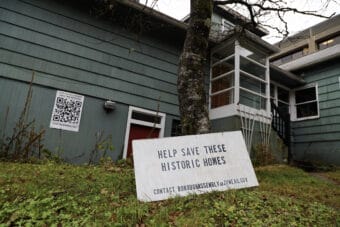
Trees outline the Telephone Hill neighborhood in downtown Juneau on Monday, June 9, 2025. (Photo by Clarise Larson/KTOO)

Back on the hill, Ingalls’ partner, Rachel Beck, said she and Ingalls own a home they’ll move into after the eviction notice. But, she said, they’d rather stay. She said Juneau is losing much more than just a couple of old houses — it’s losing history. 

“To me, it’s like throwing away your grandmother’s jewels,” she said. “This is a really special place.”

The neighborhood is one of the oldest continuously occupied areas in Juneau. It has a history for Beck; she gave birth to her children there. It has statewide significance, too. Alaska’s first commercial telephone service started out of a house in the neighborhood. 

“I think for Juneau, it’s important to have reminders of our past,” she said. 

But she fears that once the demolition begins, the memory of the neighborhood will fade, dwindling to just words on a plaque – the only reminder of what once was.

As eviction of Telephone Hill residents nears, protesters ask Juneau Assembly to delay

Residents hold signs in protest during a Juneau Assembly meeting at Centennial Hall on Monday, Sept. 22, 2025. (Photo by Clarise Larson/KTOO)

Dozens of residents attended the Juneau Assembly meeting on Monday night to protest the city’s plans to evict all residents of the historic downtown Telephone Hill neighborhood in less than two weeks.

The topic wasn’t on the Assembly agenda, but more than 20 residents testified at the meeting and held disapproving signs in the audience. Many people were also there to criticize the Juneau Assembly’s general spending in recent years. 

Mendenhall Valley resident Dawn Hammond called the city’s redevelopment plan for the neighborhood unacceptable. 

“I think this is a ridiculous proposal,” she said. “I think it’s offensive. I think it’s a terrible thing to do to people that have lived in this community for a very long time.”

All the people living on Telephone Hill are renters, and have been since the state took ownership of the neighborhood in the 1980s. It was originally intended to be redeveloped to build a new Capitol complex there. That didn’t pan out. 

The state transferred the land to the city in 2023. In 2024, the Assembly voted to redevelop the neighborhood and add more than 100 new housing units there in response to Juneau’s ongoing housing crunch. 

This June, the Assembly approved spending roughly $5.5 million in city dollars — pulled from a few different sources — to fund the first phase of demolition and site preparation for the area.

The total project cost is estimated at $9 million. They gave residents living there an Oct. 1 deadline to move out. That’s despite the city not having secured a developer to construct new housing there. Telephone Hill resident Paul Burke said there’s still time for the Assembly to reverse course. 

“It’s just a shame that people don’t listen to what the people have to say — the history in this town is just precious,” he said. 

The Assembly could have chosen to rescind the eviction notices sent to residents at the meeting. It requires a two-thirds vote of approval. But Assembly members did not do that. Instead, multiple members like Alicia Hughes-Skandijs shared why they stand behind their decision to evict Telephone Hill residents. 

“I love that neighborhood too, but I truly believe in my heart that to take a property that has a smaller number of houses on it and trade that for more dense housing is a right move for us, for where we are in our housing crisis,” she said.

Demolition is slated to begin in December. City officials say they hope that a developer will begin construction as soon as next summer. 

Juneau Assembly kills ordinance that would have made it easier to arrest people without housing

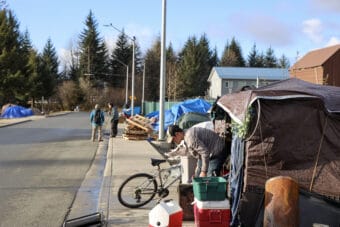
Tents line the sidewalks along Teal Street in Mendenhall Valley on Thursday, Aug. 7, 2025. (Photo by Clarise Larson/KTOO)

The Juneau Assembly voted to kill a proposed ordinance on Monday that would have made it easier for police officers to arrest people who are camping in public spaces. 

The Assembly made the decision unanimously. It came at the recommendation of City Manager Katie Koester, who asked members to table the ordinance, which means the proposal is dead and they can’t reconsider it. A similar ordinance could still arise in the future under a new Assembly. 

“I think that the ordinance in itself, both from an internal perspective, can really use some improvement,” she said. “From management’s perspective, we really would like to not take this up at this time or in the near future.”

Assembly members originally considered the change earlier this summer after escalating complaints from residents and businesses in town about the problems caused by homeless people who camp in neighborhoods. 

Recently Juneau’s homeless shelter announced it would reduce its services later this month due to what staff say is a deteriorating and unsafe environment in the neighborhood. 

Right now, city code allows Juneau police officers to arrest people for trespassing if they’re obstructing public spaces by camping — but that requires several steps. The proposed code change would have allowed officers to skip those steps by expanding what could be considered disorderly conduct. Therefore, it would make it easier to arrest people for obstructing public spaces by camping.

The city’s Systemic Racism Review Committee considered the ordinance earlier this month and formally asked the Assembly to reject it. They cited concerns that the change would disproportionately impact marginalized communities — and could be discriminatory.

Ephraim Froehlich chairs the board. He testified at the meeting on his own behalf. 

“The fact that it’s even being considered this far and up to this point is extremely concerning to me,” he said. “I think the proposed ordinance and the code changes therein demonstrate a lack of constitutional legal understanding, a lack of interest in real solutions for the issues that it’s attempting to address, and a clear lack of compassion for our neighbors.”

Martin Stepetin, Sr. is a former school board member and the brother of a man who has been missing since late June. At the meeting, Stepetin commended the Assembly for tabling the ordinance and encouraged them to focus on solutions that help people out of homelessness and into stable housing. His brother Benjamin was homeless when he went missing. 

“Those are the most vulnerable people in the community, my brother would have been one of them,” he said. “I think that you have heard from a community that in my language it means Wax̂talix. It means we hold something of high value or love. We Wax̂talix our homeless people. We hold them high and Juneau has shown up to defend those people.”

In an interview on Tuesday, Police Chief Derek Bos said he thinks the Assembly made the right call. He said he will continue to work with the city to find other solutions. 

“Our goal is not to make it easier to arrest people. Our goal is to make it easier to address specific problems as they relate to homelessness,” he said. “Making an arrest is our last resort solution in these circumstances.”

Last year, the U.S. Supreme Court ruled that cities can ban people from sleeping and camping in public places. Juneau city policy allows for dispersed camping but prohibits it on places like sidewalks or roads. In general, the city allows people to camp on unimproved public land as long as they keep their impact low on the surrounding community. 


Juneau’s homeless shelter reduces services amid ‘chaos’ and safety concerns

The Glory Hall homeless shelter on Teal Street in the Mendenhall Valley on Thursday, Aug. 7, 2025. (Photo by Clarise Larson/KTOO)

Juneau’s homeless shelter is reducing its services due to what staff say is a deteriorating and unsafe environment in the neighborhood. 

The shelter has seen an increase in homeless people camping nearby compared to other years. Shelter officials say the reduction may cut down on campers – and chaos. 

In a letter shared with patrons this week, Glory Hall Executive Director Kaia Quinto said the Glory Hall homeless shelter will stop offering daytime services — including meals — to people who are not sleeping there beginning Aug. 26.

Quinto said continuing assaults, a lack of security, criminal activity and general chaos are some of the reasons for the decision. She said the decision to reduce access to the shelter’s services was not an easy one — but necessary for the safety of staff, patrons and neighbors. 

“The situation around the neighborhood is pretty untenable right now,” she said. “It’s just really important that we focus on keeping as peaceful an environment as we can.”

Quinto said patrons will still be able to receive services inside the facility during office hours after the changes go into effect later this month. But their time inside will be limited to when they are actively meeting with service providers. 

She said she can’t say how long the reduction will last, but hopes it won’t be permanent. She said the current situation is affecting her staff’s mental health and wellbeing.

“It’s having a major toll,” she said. “It’s hard to recruit and keep staff when every other employer can provide better and safer working conditions. This job is hard enough.”

The announcement comes just days after the Juneau Assembly narrowly rejected a plan to create a shelter safety zone that would have tightened restrictions on camping in the area around the shelter. Shelter staff, patrons and neighbors asked the Assembly for the safety zone. 

“The vicinity has become an epicenter for sales of illegal substances and stolen merchandise,” the letter stated.

This summer, the shelter has seen an increase in camping nearby. That’s in part due to the closure of the city-run campground near downtown two years ago. 

Tents line the sidewalks along Teal Street in the Mendenhall Valley on Thursday, Aug. 7, 2025. (Photo by Clarise Larson/KTOO)

City leaders say the shelter safety zone was intended to increase protection for staff and people using the shelter’s services. But Assembly members who voted the plan down argued it would only be a stopgap solution for the larger issue of homelessness in Juneau.

“I just can’t see how it takes us forward as a community on this issue, more than just whack-a-mole on the next piece of the problem,” said Assembly member Neil Steininger.

On Monday, the Assembly asked the city to look into other potential safety measures for the Teal Street area, like hiring private security to patrol the area or establishing a city-sanctioned summer shelter.

Brittany Fuhr was outside the shelter on her lunch break Thursday. She was sitting with her friends by one of the more than a dozen tents that lined the sidewalk on Teal Street. She said it seems like there are a lot more people camping and in need of the shelter’s services than in previous years. 

“There are definitely more people, like bodies, as far as people walking around, people crossing the road, which is always scary,” she said. 

She said that uptick in people might be adding to the increase in issues staff say they are seeing. Though Fuhr worries that the change to services will only add to the chaos. 

“Closing a door doesn’t make the problem go away,” she said. 

Until the problem is resolved, the shelter is working with partner agencies to establish a meal program at an alternative location.

Site notifications
Update notification options
Subscribe to notifications