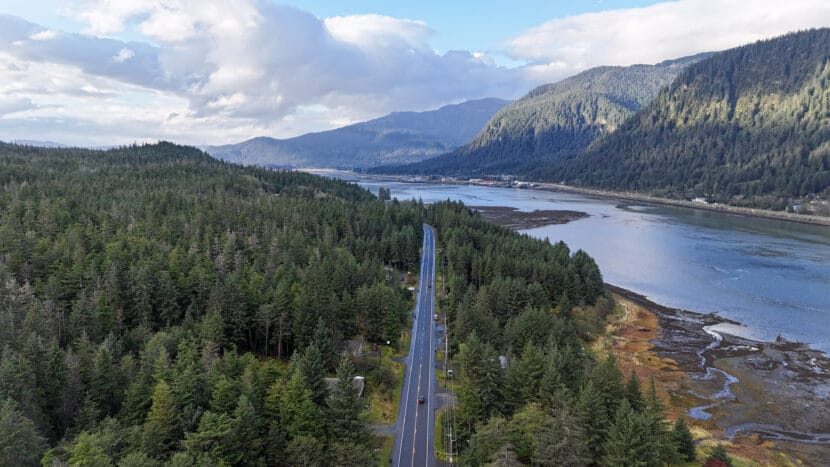
The Juneau Assembly upzoned more than 200 acres of city land for sale earlier this year in hopes of creating more housing opportunities throughout the city and borough.
The rezones included land north and south of Grant Creek and west of the Bonnie Brae and Blacktail Subdivisions on Douglas Island, and some land in the Auke Bay area.
The hope was that by allowing for denser housing in those areas, it would entice private developers to build units there. But so far, nobody’s biting. That might be because a lot more work needs to be done to make the land buildable, and that work could be expensive.
Dan Bleidorn, the city’s lands and resources manager, said the rezoning is just another strategy the city is using to try and tackle Juneau’s chronic housing shortage.
“The goals of the rezones were to initiate a process in which those properties could be disposed of by the city, and developers could acquire them, or people could acquire them to build housing on,” he said.
That’s especially needed as a U.S. Coast Guard Icebreaker is slated to be homeported in Juneau, bringing more than 100 crewmembers and their families to town in the coming years. It also comes as annual glacial flooding of the Mendenhall River threatens homes in the Mendenhall Valley, and major development projects are being proposed on North Douglas.
High-density, multi-family is generally cheaper to buy or rent than a traditional single-family home. According to a study by the Alaska Department of Labor and Workforce Development, Juneau has had the highest average sale price for a single-family home in the state for the past two years.
“I think the rezones are important because it provides opportunity that wasn’t present prior to the rezones,” he said.
Bleidorn said the rezones are just the first step in a long process to get housing built in those areas. But, just because the land is technically now up for sale, it doesn’t necessarily guarantee developers will want — or be able to afford — to build there. Bleidorn said just preparing the land to be developable will be a significant investment.
“I think some of the barriers to development include the fact that there’s no road frontage on a lot of these properties, and utilities are far away in some cases,” he said.
That, paired with high interest rates and the cost of materials, continues to block developers from breaking ground on new projects.
For other city housing projects like the redevelopment of the Telephone Hill neighborhood downtown, the Assembly controversially chose to front millions of dollars to fund the first phase of demolition and site preparation in order to entice developers to build housing there. The city does not yet have a developer signed on to the project. Demolition is scheduled to begin in December.
The Juneau Assembly similarly infused millions of dollars to spur the development of the Pederson Hill subdivision in 2017 to create more housing. Since then, private developers and individuals have bought some of the 86 lots to build single-family homes.
Both projects have been met with skepticism, with people questioning the city’s role in influencing the housing market. Deputy City Manager Robert Barr said public subsidies on projects like these are a way to tuck in affordability requirements.
“If it’s just left up to developers to kind of front all that principle, all that cash, that investment on their own, we’re gonna end up with one type of housing, right? Housing that they can make a profit on,” he said.
Bleidorn said it’s not clear which direction the Assembly will choose to go on the land it rezoned. It depends largely on the interest – or lack thereof — from the private sector. He said, regardless, the rezones lay the groundwork for a future Juneau where more housing could finally be on the horizon.
“I really do think that these rezones will make a difference,” he said. “Maybe they’re more mid-term to long-term projects, but I think lining them up for future development is key.”