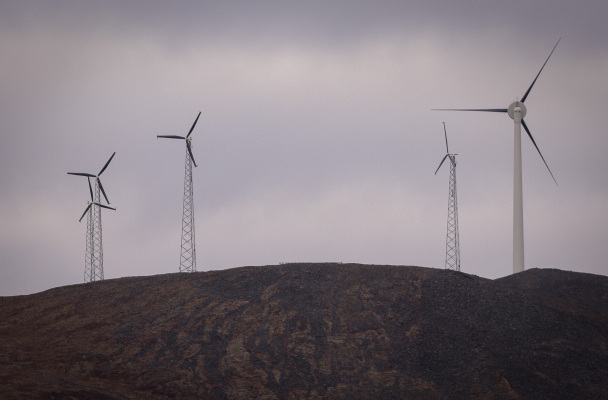
Depending on how the wind blows, Nome’s wind farm on Banner Peak can generate up to 30 percent of the city’s power.
This productive, six-year-old wind farm and its about 20 vanes generate a significant amount of energy to offset diesel fuel power for the city, said John Handeland, utility manager for Nome Joint Utility System.
“Wind will continue to be a valuable portion of the power production in the community, and we save about 150 thousand gallons of diesel fuel each year by utilizing the wind.”
Recently, not all of the vanes have been functional.
One of the smaller units was out of commission for a few months because of a hole in the middle of vane, but repairs have been made, and the wind vane is operational again.
On a windy day, the wind farm can generate up to 30 percent of the city’s power, Handeland said.
The utilities manager admits he was skeptical about the wind project at first, but he’s changed his mind, especially after NJUS took over operational control of the entire farm from Bering Straits Native Corporation and Sitnasuak Native Corporation a couple of years ago and installed two Dutch brand EWT 900 turbines.
Currently, those two EWT turbines are the largest wind vanes sitting on top of the hill surrounded by numerous 50 kilowatt units, or smaller vanes.
Though the smaller 50 kilowatt units are still of value to NJUS, Handeland said these vanes are slowly will be phased out of use.
“As time goes on, we weigh the maintenance costs versus the contributions they are able to give to us, and systematically, those units will be shut down,” he said.
The next challenge for the utility is finding a way to store excess wind energy generated by the farm that Handeland said is being thrown overboard.
And in terms of finding alternative sources of energy to decrease Nome’s reliance on diesel, well, that’s just a matter of seeing where the wind blows.