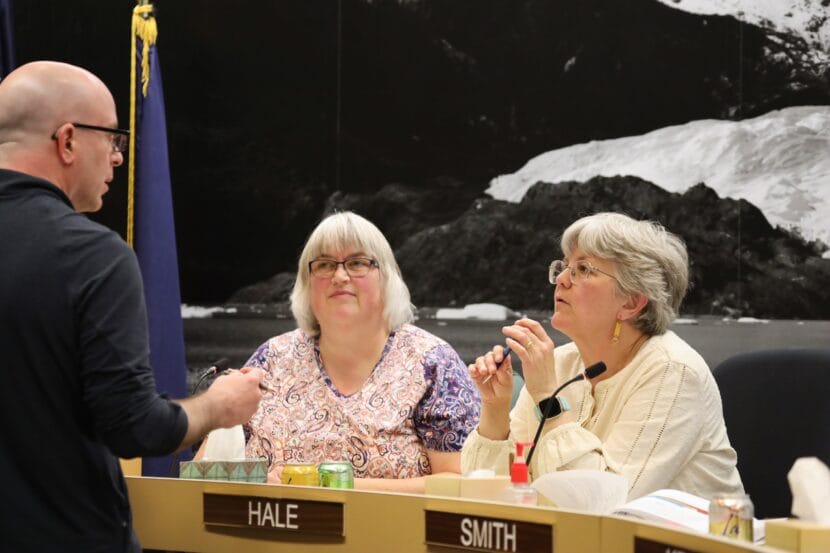
Members of the Juneau Assembly decided to lower the city’s property tax rate next year.
But, that means they had less money to work with in the city budget, so they had to use some creative thinking to cover costs.
At a meeting Wednesday night, the Assembly voted to approve a mill rate of 10.04 for next year, a reduction from last year’s rate of 10.16.
A mill rate determines how much property tax the city collects from residents. One mill is equal to $1 dollar per thousand dollars in property value. So, that means for every $1,000 in taxable property value, there would be a tax of $10.04 for next year.
Even though the Assembly decided on that rate, it could still change before the city budget is finalized in June.
The decision didn’t come easy. Members were split and spent multiple hours discussing different proposed rates that spanned up and down the scale. But, the general consensus was that most Assembly members, like Michelle Hale, wanted a decrease of some sort. She proposed one of the lowest rates of the night.
“It’s really driving from the outcry that we are hearing from our residents to offer some relief on property taxes,” she said.
This year, property values have increased a bit in Juneau, but not nearly as much as last year’s jump. Both residential and commercial property assessments rose by about 2% on average.
In her proposed budget, City Manager Katie Koester suggested a higher rate for next year of 10.32 — which is a .16 bump from last year. She said that an increase was needed to balance the cost of taking over the buildings that will close under the school district’s consolidation plan and to maintain current city services.
But Mayor Beth Weldon offered a creative idea instead that would allow the city to reduce the mill rate without using city savings. She suggested the Assembly dip into the City Hall fund to cover the costs.
“The money that is supposed to go to these three new buildings we have, instead of taking it from general funds, I would take it from the new City Hall,” she said.
The City Hall fund is made up of about $16 million that was squirreled away last year in hopes of building a new City Hall. But, voters said no to that idea – for the second year in a row — and the money has sat there since.
A lot of members applauded Weldon’s thinking, including member Alicia Hughes-Skandijs, who called it a “slick move” despite her opposition to decreasing the mill rate.
“I think it is incumbent on us to consider the finances of this city, and the impact to lowering the mill rate will be, and weigh that against what the financial impact to the individual tax payer will be,” she said.
Hughes-Skandijs argued the additional buildings could introduce unexpected recurring costs to the city in the future, and a mill rate increase would ensure there was consistent funding to cover that.
Assembly member Paul Kelly said he was nervous about using the City Hall fund because that money could be needed toward future plans to move City Hall functions and staff elsewhere. But, he was overruled.
The final vote on the rate was 7-2, with Hughes-Skandijs and Christine Woll voting against it. The Assembly will take public testimony on the final budget and mill rate in June.