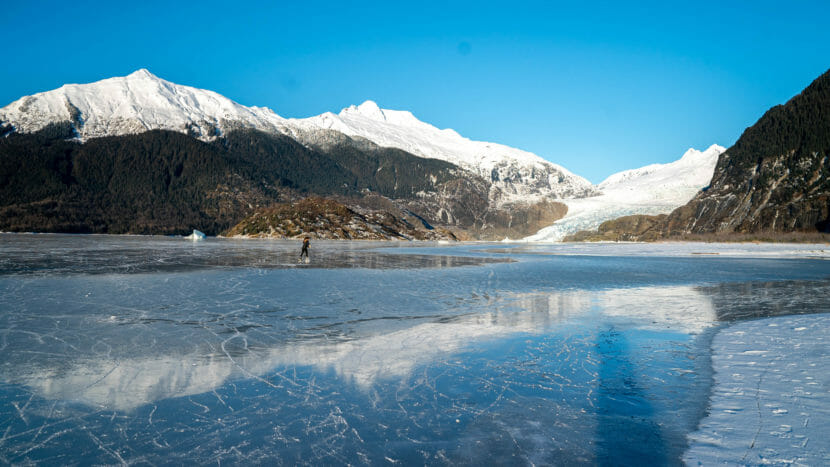
With Juneau expecting to see temperatures in the single digits and even below zero this week, residents may be tempted to recreate on frozen lakes around town.
KTOO spoke with Juneau Fire Chief Rich Etheridge about a recent incident of someone falling through the ice, what to do if it happens, and other safety precautions when venturing out on frozen bodies of water.
Listen:
This audio has been lightly edited for clarity and length.
Mike Lane: Welcome, Chief. Thanks for coming in.
Chief Etheridge: Thanks for having me this morning.
Mike Lane: We understand that somebody went through the ice on Mendenhall Lake recently. Can you describe what happened or how CCFR was involved?
Chief Etheridge: Sure, I can let you know our involvement. The person was out on the ice, recreating, doing their own thing. While they were doing that, we were busy taking care of an apartment fire out in the valley. And just as we were wrapping up and clearing from that incident, dispatch said that there was a person in the parking lot that had fallen through the ice, had hypothermia and needed some medical care. So JPD went racing out there to get them in a warm vehicle to get things going, and then our folks showed up in the ambulance to start the rewarming process and getting them taken care of and get them up to Bartlett to go get checked out.
Mike Lane: That rewarming process, what does that entail?
Chief Etheridge: Usually, it’s cranking up the heat in the back of the ambulance, warm blankets. You know, if they’re extremely hypothermic, we can do warm IVs to start getting some warm fluids in their blood and then getting them up to the hospital where they can do a lot more, like a lavage and put warm fluids through their stomach, things like that. The trick is, is to to warm them up controlled so that you don’t put their body in more shock, because they’re pretty fragile at that point.
Mike Lane: When someone does fall through the ice on Mendenhall Lake, or any other lake for that matter, what is CCFR’s typical response?
Chief Etheridge: Especially Mendenhall Lake, it takes about 20-25 minutes for people to get from Glacier station to the lake on their suits and headed out onto the ice.
Mike Lane: What precautions do they take as responders to not fall through the ice as well?
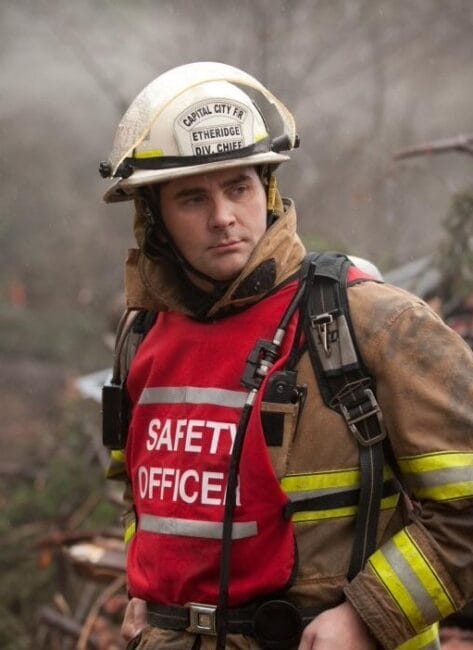
Chief Etheridge: We’ve got a couple of things, if the ice thickness is sufficient, we’ve got some four wheelers on great big tracks for getting out there as quick as we can. But they wear ice rescue suits. They’re like a big Gumby suit that insulates them and they’re buoyant and protects them from the temperature, so if they do go through the ice, you know, they’ve got quite a bit of time to self-rescue or have their partner rescue them. And we practice that every year. We go cut holes in some of the local ponds, or out of the float pond at the airport, and people jump in and practice getting rescued.
Mike Lane: What makes Mendenhall Lake particularly unsafe to go out on when it’s frozen?
Chief Etheridge: Sure, Mendenhall Lake’s really unpredictable. There’s a lot of currents, especially with Nugget Falls pouring into the lake, you get a lot of currents in there. And so any place you have moving water, you’re gonna have shallow, thin, thin areas of ice. And then also the icebergs, they act kind of like a heat sink, and so the areas right around the icebergs tend not to freeze as thick, and you can still have an iceberg roll in the wintertime and break the ice around it.
Mike Lane: Now, are there any lakes in Juneau that are okay to go out on when it’s frozen?
Chief Etheridge: You know, there’s some that I feel are safer than others. You know, if you go to like like Twin Lakes, you’re at least visible, you know, and you don’t have the currents flowing through it that you do in other places. You know, the duck pond out off Riverside Drive. Places where you’re more visible, you’ve got less travel distance to get to someplace warm, I think is a good thing to look for.
Mike Lane: How could a person determine whether the lake ice is safe to walk or skate or bike on, or or snow machine, whatever it might be?
Chief Etheridge: Sure, the rule of thumb I’ve always heard is, you know, four inches for people to be safe out on the ice. But I’m a big old chicken, so I like at least a good foot out there before I go out.
Mike Lane: And what warning signs should people look for before going on a frozen body of water?
Chief Etheridge: Look at the areas along the shore, you know, do those break up? You know, do you have the ability to kind of drill through the ice and, you know, with, like, a hand drill and see how thick it is?
Mike Lane: Now, if someone were to venture out onto a frozen lake but wanted to bring proper safety equipment, what would that be?
Chief Etheridge: You know, a PFD is not a bad idea. Ropes, you know, long poles that you know, if you do go through the ice, you got something to hang on to, to help pull you up out of the area, but you really only have a few minutes to do anything significant. Once you hit that water, it’s so bitter cold that your hands go numb really fast. And getting out is extremely important. You lose the feeling and gross motor functions pretty quickly.
Mike Lane: What if I witnessed somebody go through the ice? What would I do as a witness or a bystander?
Chief Etheridge: Sure, first thing is to call 911, because that response time does take time , keep an eye on where they were at if you’ve seen them, and if you’ve got equipment that you can safely, you know, attempt to help, help them get out of the ice, you could do so, whether you’ve got a rope you can throw them, or things like that, a sled you can scoot out to them, but going up to the area where they just fell through is kind of a bad idea.