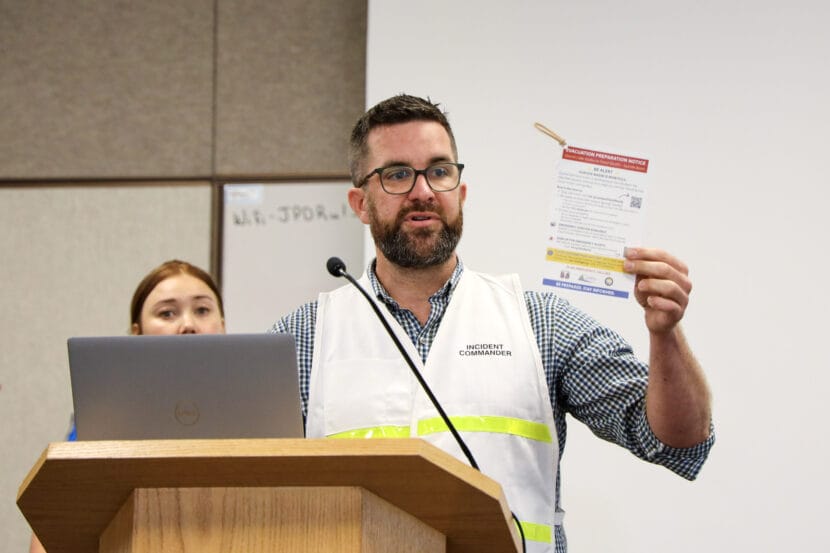
As the city’s Emergency Programs Manager, Ryan O’Shaughnessy leads emergency planning, response and recovery for the City and Borough of Juneau.
KTOO’s Mike Lane recently caught up with O’Shaughnessy to talk about lessons learned from the major storm events in December and January and how the department operates.
Listen:
The following transcript has been lightly edited for clarity.
Mike Lane: Ryan, what is your vision for CBJs Emergency Management Department and how did these new roles, avalanche advisor and tech fit into that vision?
Ryan O’Shaughnessy: Yeah, that’s a great question, Mike. My vision for CBJs emergency programs is really one of whole community engagement. our team really relies on strong partnerships with all kinds of different agencies for avalanche specifically, as well as for, you know, the flooding we experience in the summertime and any other hazard that we may face. You know, Juneau is an islanded community, and it really takes all of us – the public, our government agencies, our nonprofits, our private sector – to participate in emergency management.
Mike Lane: Right. Okay. Do you think you’ll be hiring for more roles in your department soon, like a geo hazard or landslide specialist, climate adaptation specialist, etc?
Ryan O’Shaughnessy: Those are great questions, Mike. I can’t speak for the Assembly on the allocation of funding for our division, but you know, we have a lot of work cut out for us. There’s, there’s no shortage of hazards in our community, our hazard mitigation plan cites many, many hazards ranging from everything from downtown fire to tsunami and earthquake, glacial lake outburst flooding, regular flooding. So there’s no shortage of hazards. And you know, we have identified in our hazard mitigation plan a lot of actions that we can take to mitigate those. But those do come with, you know, staff requirements.
Mike Lane: How do you see this past disaster declaration went? How do you think it it all unfolded? Was it organized? Was it chaos? What was it?
Ryan O’Shaughnessy: Organized chaos is where we like to live. You know, the practice of emergency management is taking those emergency scenarios and trying to bring some order to them. So, you know, I think we accomplished the objectives that we set out with which, you know, as always, we’re going to prioritize preservation of life, life/safety for the public, and protecting critical infrastructure. So always, always learning, right? There’s always things that we can do better. And we are continuing to reflect on this most recent event with our partners and internally and try to enact some lessons, some lessons learned.
Mike Lane: Excellent. Speaking of lessons learned: what did you see in this last episode of disasters that you’re now reevaluating how you’re going to do it later? Was there something that you went, “Oh, we got to change this.”
Ryan O’Shaughnessy: Yeah, I think there’s, there’s lots of stuff. A lot of, a lot of takeaways specific to avalanche. But, you know, we’re constantly looking for those things in emergency management, right? We’re training, we’re preparing, we’re executing and responding to disasters, and then the next phase of that cycle is to reflect and evaluate. Based on that evaluation, we again, we train and we plan. And you know, this disaster specifically, I think one of the core challenges was it affected everything about our community. You know, a lot of times when we see stuff like the flooding in the summer is a great example. It’s localized to an area. Whereas this disaster, it literally blanketed our community. People were tired. Both the people affected by it, the people working to respond to it, were tired from shoveling at their own homes. Everybody was exhausted. It impacted travel and the facilities we were able to use. So it was a challenging one, and some some unique and interesting lessons being learned for sure.
Mike Lane: Is there anything you’d like to add to this?
Ryan O’Shaughnessy: I never miss an opportunity to plug emergency alerts. Signing up for emergency alerts is absolutely the best way to stay informed and up to date on on anything going on related to this hazard and other hazards in our community.
Mike Lane: How would one do that?
Ryan O’Shaughnessy: The easiest way to sign up for emergency alerts is to text “CBJ” to the number 38276.
Mike Lane: 38276.
Ryan O’Shaughnessy: Yep. And you just type and just the in the message, just send “CBJ” and that’ll sign you up for emergency alerts.
Mike Lane: Awesome.
Ryan O’Shaughnessy: Alternatively, you can go to the CBJ website. Right there on the homepage, there’s a button that’ll get you signed up.