This is part two in a three-part series about Tracy Day and her family’s ongoing search for answers. Read part one here.
Kaelyn Schneider has a lot of questions about the police investigation into her mother’s disappearance. Tracy Day, a Lingít woman from Juneau, went missing in 2019 and police say they have no suspects.
At a presumptive death declaration hearing last year, Day’s family planned to ask Juneau police their questions, but the judge didn’t let them.
Listen:
Schneider says the lack of updates, communication and, finally, the judge blocking her questions during the hearing make her feel suspicious. That matches how other loved ones of missing and murdered Indigenous people have felt. Many report being dismissed by law enforcement and the justice system.
“When it comes to Native cases,” Schneider said. “Anytime something would pop up, they would be trying to just find the quickest exit instead of the truth.”
Juneau police denied KTOO’s requests to see Day’s case files, saying the case is still active.
But Deputy Chief Krag Campbell sat down with KTOO to answer some of the questions Schneider has had for years.
Many are about a specific moment in the investigation, about a year after Day’s disappearance. Someone found clothes and Day’s bus pass on the side of a mountain. Police told Schneider they called in SEADOGS — a volunteer nonprofit with trained search dogs.
Schneider then received an email with a photo which she shared with KTOO. It showed a search dog sitting next to a pile of large rocks, with a makeshift cross stuck in it. The email was from then-JPD detective Patrick Taylor, who was leading the case.
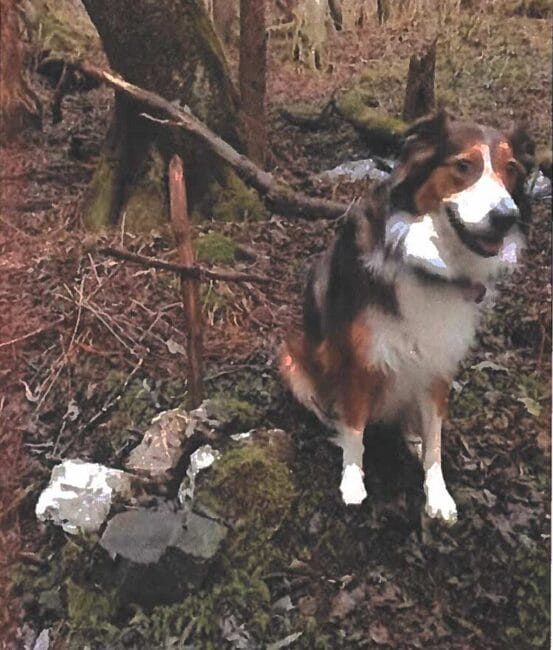
“They said the dog alerted them to the grave,” she said. “And then later, when I was like, ‘So why didn’t you dig it up?’ They were like, ‘Oh, the dog actually didn’t alert us. We set the dog up for the photo.’ That’s weird, like, why? What? Like, that makes no sense.”
In one email, Taylor first wrote that the dog alerted its handlers to the area and referred to a “quasi-grave marker thing.” In another email, he corrected himself. Taylor had called the handler, who said the dog actually did not alert to anything in the area.
Schneider wants to know why the site wasn’t investigated further. But Taylor is no longer with the department.
Campbell said the clothes were found a distance away from the site with the cross, and since the dog didn’t actually alert to it, the department didn’t investigate further.
“There doesn’t seem to be a reason just to start digging in places,” he said. “And that’s probably why they didn’t do anything.”
And as for the miscommunication — Campbell says JPD wasn’t with the SEADOGS team when they searched, and the officer must have misunderstood the photo the handlers sent as well.
Schneider says she doesn’t understand why police wouldn’t search the site when a missing person’s belongings were found nearby.
Day’s family also has questions about a man Day was romantically involved with — like if the police considered him a suspect, and if his property was searched. The man died in 2021.
Campbell said JPD spoke with the man, but no suspects in the case panned out in any meaningful way.
“They all had alibis where they’re out of town. They had no animosity or ill will towards Tracy, like, there just didn’t seem like a valid reason,” he said. “I need to get evidence to show he did it. I need to find evidence. I need people to say, like, ‘Yep, he told me this,’ or, you know, stuff like that, or ‘I saw this.’”
Schneider says the family did send JPD a recording of a call they had with the man, which was later also shared with KTOO.
In it, the man said he and Day would fight often, and violently. One time, he said he hit her over the side of the head with a boat oar and “she woke up the next day with a big lump on the side of her head.” That was around the time Day disappeared.
Campbell said the recording wasn’t mentioned in reports in Day’s file.

Lastly, Schneider wants to know what police are doing now with her mother’s case.
“Why they won’t let us look at the evidence, and they claim that it’s because it’s an active investigation. But then there’s no officer assigned,” she said. “So, why? Why is that?”
Campbell said JPD checks in on open and active cases annually to see if the person has been seen somewhere else in the United States.
“But it doesn’t mean that someone is knocking on doors and trying to, like, generate leads,” he said. “But we do always, when a case is active — or inactive a case could be closed and no one’s touching it for years — if you get information like, ‘Hey, XYZ, we heard this,’ we would open it up and look into it.”
Campbell said JPD is in the process of reviewing its policies for missing people. One part he wants to work on is communicating with families. He said that might help families feel like the police still care, even if no new information comes out. The department maintains a missing persons webpage where people can submit tips and information.
“It helps them understand that they’re not just forgotten and they’re not just disappearing,” Campbell said. “And communication is a big piece that we know we need to work on, trying to do better.”
But Schneider isn’t so sure.
“I’m glad that they’re acknowledging that,” she said. “But I will believe it when I see it, because they have been saying stuff like this for so long.”
Schneider says she’s felt brushed off by police since her mom disappeared, but she isn’t going to let it stop her from bringing attention to Day’s case.
“I don’t think they realize how beloved my mother was. I don’t think they realized how many people are angry that she’s missing and that there are no leads, there’s nothing,” she said. “I think that they believed she would just be forgotten, and they’re absolutely wrong, like we will never let this go.”
In part three of this series, Schneider talks about who Tracy Day was as a person and what her disappearance has cost her family.