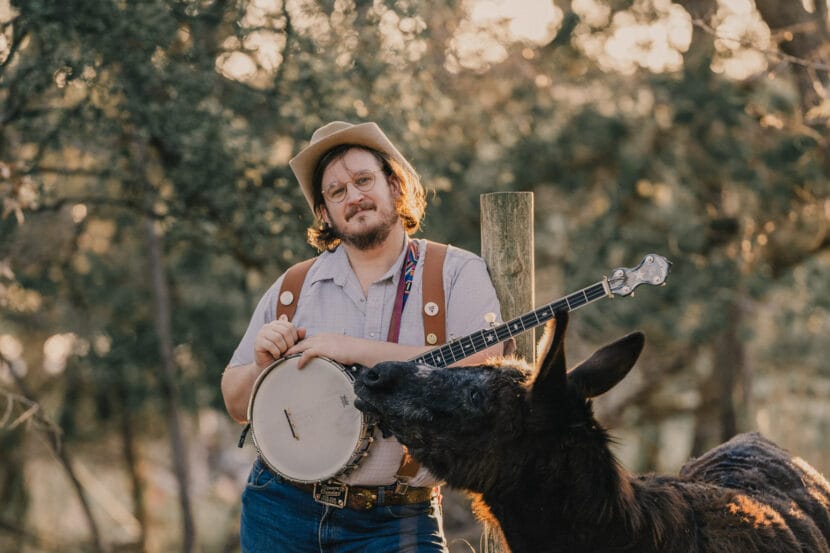
Folk singer-songwriter Willi Carlisle is the guest artist for the 51st annual Alaska Folk Festival in April.
Carlisle is from Kansas, and has spent his career in and around the Ozark mountains learning folk traditions and reimagining them. He previously performed at Juneau’s festival in 2019.
KTOO’s Yvonne Krumrey spoke with Carlisle about what makes Folk Fest special.
Listen:
The following transcript has been lightly edited for clarity.
Yvonne Krumrey: You were in Juneau for Alaska Folk Fest in 2019. What drew you to apply to do that and to come up and perform?
Willi Carlisle: I ran into the Alaskans at the Folk Alliance conference. They were so rowdy and welcoming.
It just felt like the stars aligned and I could make it to this amazing community event. By community event, I mean, like most of the people are just there to share with each other, and that’s a model for a folk festival that I kind of think that the rest of the world could learn something from.
Yvonne Krumrey: In your song, “Your Heart’s a Big Tent,” there’s a line that has become popular with your fans: “Just sing until you love yourself, love until you die.” And so much of, like you said, this festival is made up of everyday Alaskans who just want to get on stage and sing. What does that do for people?
Willi Carlisle: Music and community, oral traditions, collective rituals, perpetuate these connected ecosystems that can provide meaningful alternatives to late capitalism’s apocalyptic end run.
I don’t think that folk music or something like that is literally this thing that saves — saves the whales, saves the world, saves anything.
I do believe that that kind of connectivity, when done open heartedly and for community first, provides something meaningfully different than being a subject to whatever is next on TV, to being a subject to whatever is being forced down our throats by advertising.
Yvonne Krumrey: And so I’m wondering, what is it like for you to come back to Juneau for Folk Fest after seven years? And I know things have probably changed for you in your life, and what does that mean to you?
Willi Carlisle: Boy, for one thing, it’s just a dream come true. The idea that I can come back in this capacity is a little overwhelming and something I want to do right by.
It has been an honor to experience growing through word of mouth, but I’ll say that at festivals around the country, I sometimes experience very little folklore, but instead, like a sense of celebrity.
I want to try to take opportunities like the Alaska Folk Festival to, like break the mold a little bit, to be a part of reigniting folk music’s activistic edge, but also to just stay a perpetual learner and to stay curious. Because I’ll admit right now, I’m intimidated by the level of picking that I heard. At the very least, I’ve got some things to learn from guitar players and banjo players and fiddle players all over Juneau, too.
Yvonne Krumrey: On your newest album, there are some old school sounding folk and country songs about people who don’t often make it into those kind of stories, like Big Butt Billy. What do you think of expanding the cast of characters in the genres you work in?
Willi Carlisle: I could have a career where I could just try to pass as straight and someone who did not care, but that would feel so horribly dishonest that it would really be me harming myself, and I’ve already done that, and I’m not interested in it. And frankly, I don’t, I don’t understand how artists that are are not vocal about things. I don’t understand how they get up in the morning, and I don’t have a lot in common with them.
Yvonne Krumrey: In an interview, you said “a folk singer should be a dreamer with a long memory.” And I’m wondering, how do you think the moments that we’re living through right now are adding to that long memory and influencing your music?
Willi Carlisle: I think that folk music is a part of acknowledging, and not just acknowledging, but performing, the dialectical materials of the people that have struggled to get us where we are today, right?
I don’t just mean strictly protest music. I mean your grandmother singing a little song while she’s washing the dishes—is a part of the history of that, like unacknowledged, unaccounted for, work that we can acknowledge by living traditions in our bodies with each other.
When I say a dreamer with a long memory, what I mean is a dream deep enough to be compassionate to people that are no longer here, to listen to the ghostly voices that labored, worked, procreated, you know, loved, hated, and scrubbed and toiled to get us here, but also to have a memory long enough to attach those dreams to to reality, to our current lived scenario.
Yvonne Krumrey: Do you have any advice for musicians who are just starting out and trying to find their voice in folk music?
Willi Carlisle: If you want to get started in folk music, be an almanac, not an encyclopedia. You’re reading the palm of the past. To use archives, but don’t get trapped in them to study and practice, but don’t become confined to a single style or a single idea.
So I guess my advice would be: really bring it to people. Share it with people. Use it to make something that helps people feel good and feel connected, and the other stuff is just fun. And lean into the fun part, but don’t let it eat you.
Yvonne Krumrey: What are you hoping to give to and receive from an audience these days?
Willi Carlisle: Well, let’s see. I guess I like it when an audience sings and dances. I really do. I want that to be a part of pretty much everything.
So towards that end, we’re going to do some dancing. We’re going to do some singing. What do I expect from them? It’s just the same thing. I’m already getting so much just by being there, honestly. If I can show up and do my job well, I’d like for it to be a good value for the organizers. I really mean that. A s soon as cheddar is involved, I generally think, “how do I make sure that anybody who collected and or spends the cheddar gets their money’s worth?”
And it’d be great to find more of that, and it’d be great to stay up all night and play in the Alaskan that’d be great.