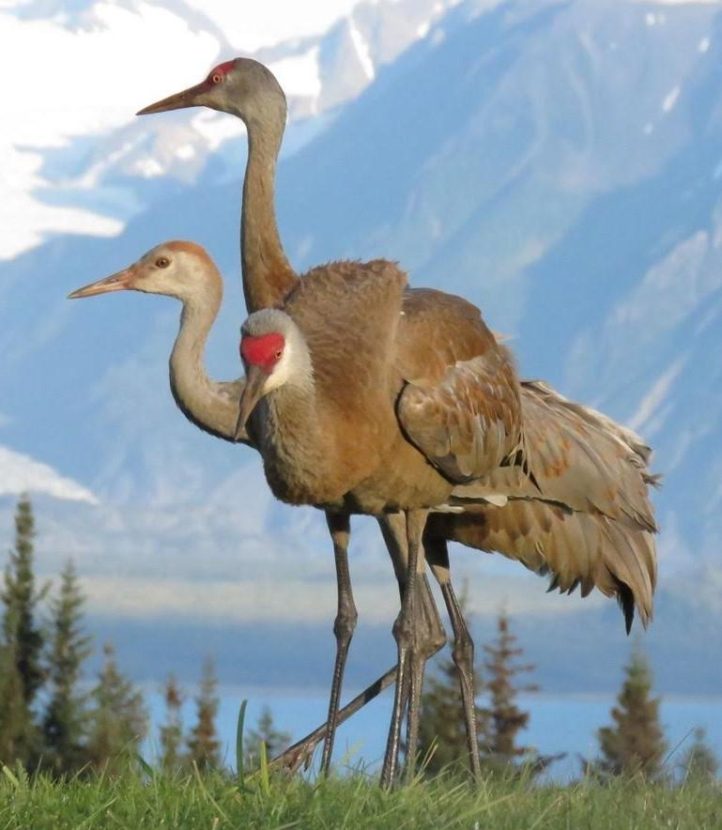
A sandhill crane looks and sounds like a modern day dinosaur.
They stand about 3 feet tall and have a 6-foot wing span.
They use their sharp 4-inch beak for probing in the dirt and catching insects and small mammals. And sometimes, they use that long beak for defense.
“That beak is a very very lethal weapon,” said Nina Faust, co-founder of Kachemak Crane Watch, a non-profit organization dedicated to the conservation of sandhill cranes.
“I think they’re very majestic birds,” Faust said. “A lot of people describe them as regal, they move like royalty and they’re just very elegant. When they dance, it’s just the most gorgeous thing you’ve ever seen.”
A flock of 20 lesser sandhill cranes forages in a grassy field at Inspiration Ridge Preserve in Homer.
Faust points to a group of three cranes standing close together.
“You can see a family right there,” she said. “The adults have red on the top and they have a yellow eye. The young are totally golden colored with no red top and a dark eye.”
They’re getting ready to migrate 2,400 miles to their overwintering grounds in Sacramento, California. But before the cranes leave in mid-September, Faust has a job to do.
Every fall, she organizes a “citizen science” survey of the crane population on the southern Kenai Peninsula.
On three specific days, residents contact her to report sandhill crane sightings. Using this information, she’s able to estimate how big the population is each year.
Habitat loss and predation can have a big effect on the crane population, Faust said. Around Kachemak Bay, bald eagles are a constant threat.
“It’s interesting to watch because sometimes they’ll see the eagle way off in the distance and they’ll start giving this little brrr growling call. Everybody stands up and looks and they all get ready. If it gets closer, poof, they’re gone!” Faust said, laughing.
A large-scale die-off of Common Murre seabirds in early summer attracted bald eagles to the Homer area. Many of the eagles appear to have stayed behind and are now preying on other animals, including cranes, Faust said.
Another potential hazard? Humans.
“You almost never see them on roads,” she said. “But this year, there’s been a problem because someone who lives on a busy road started feeding them. And they’ve been starting to walk all over the neighborhood. I’ve had people stopping me in the post office, calling me on the phone, saying what’s with the cranes marching down the middle of the road in Homer?”
Cranes strolling in downtown areas risk getting hit by cars. They can also fly into power lines.
“I mean, my gosh. They get panicked and they can fly right into ‘em,” she said.” It breaks their wings, it can rip their beaks off. Just a horrible death.”
Despite these threats, this year’s survey showed that the lesser sandhill crane population in Homer is holding steady at about 200 individuals.
The population produced 47 babies this year, but only 30 survived to the end of the nesting season. That’s about normal.
In early September, the sandhill cranes left Homer and headed back to California’s Central Valley.
Faust and her fellow “craniacs” watched the last cranes depart for the year, a time that always feels bittersweet.
“It leaves a big hole in your heart,” she said.
In California, Bart McDermott eagerly awaits the arrival of the cranes. He manages Stone Lakes National Wildlife Refuge, just south of Sacramento. The cranes start arriving in early October, he said.
“You start to hear them first. If you’re fortunate enough, you can hear their prehistoric sounding cackle,” McDermott said.
The cranes roost in wetlands at night and go out into neighboring agricultural fields during the day to forage for grain. But the cranes are facing a growing list of threats in the Sacramento area, McDermott said.
“Unfortunately there’s a lot of urban development. So we’ve seen a lot of these fields that cranes typically go out and forage in start to be converted into housing developments ,” he says.
The ongoing drought in California also poses a risk to cranes.
“In order to have a wetland you need water,” McDermott said. “And you need a lot of water. The birds also rely on the farmers having water to grow those crops. There’s also concerns of wildlife diseases. You get smaller areas where you have higher concentrations of birds roosting in water and there’s the risk of disease communication and outbreaks.”
The cranes will remain in California through the winter, before heading north in late February.
For now, craniacs in Homer will have to wait until spring before these graceful giants return to nest.