In recent decades, researchers around the world have become increasingly concerned about the introduction of invasive species to islands.
Some species, like cattle and foxes, were intentionally introduced to Gulf of Alaska islands and have wreaked havoc on ecosystems.
Biologists assumed that settlers also brought Arctic ground squirrels to Gulf of Alaska Islands around the turn of the 20th century. A new research study, however, has turned this notion on its head.
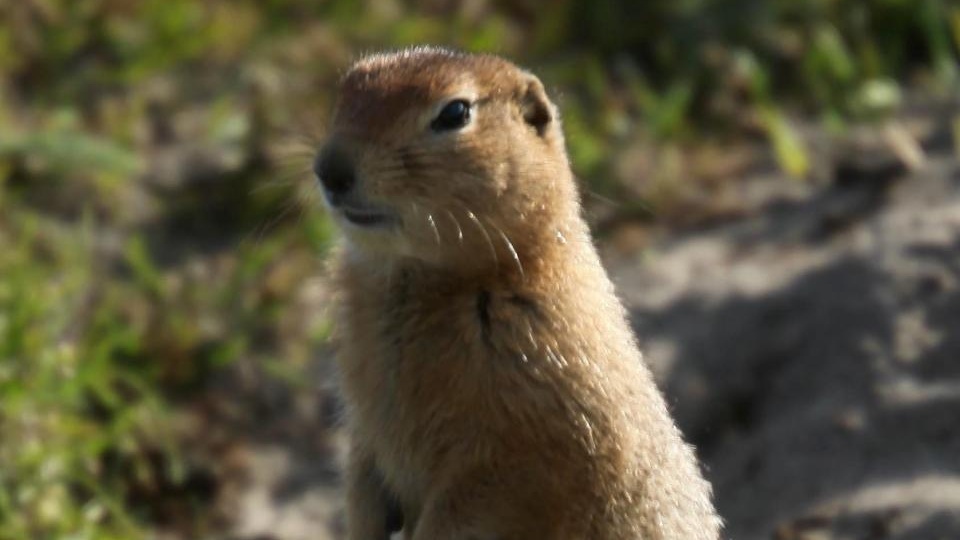
With its stubby tail and roly-poly body, the Arctic ground squirrel looks more like a groundhog than a squirrel.
It’s not the most eye-catching species, but on islands in the Gulf of Alaska, this little rodent is a pretty big deal.
Catherine West, a research assistant professor in the Archaeology Department at Boston University, said Arctic ground squirrels are voracious grazers and can strip an area of vegetation.
But that’s not all they eat.
“They’ll prey on bird eggs and even on small birds and baby birds,” West said.
The squirrels are commonly found across the far north of Alaska.
For years, biologists believed humans introduced the squirrels to Gulf of Alaska islands in the late 1800s as food for fox farms.
New research on Chirikof Island, southwest of Kodiak, however, suggests the squirrels have lived there for much longer.
The question of when the Arctic ground squirrel was introduced to the island isn’t just a matter of academic interest.
It can affect how the Alaska Maritime National Wildlife Refuge manages the species, West said.
“If they’re considered destructive to a landscape, the refuge needs to determine whether they’re native to that landscape or whether they’ve been more recently introduced and subject to management or eradication,” West said.
In the summer of 2014, West excavated middens left behind by Alutiiq and Unangan peoples. In these ancient trash heaps, she discovered thousands of squirrel bones.

A lab at Oxford University was able to determine the age of the bones using radiocarbon dating.
One form of carbon found in living things, carbon 14, is radioactive.
Once an animal dies, it starts to break down.
By measuring how much radioactive carbon is left in a bone, you can tell how old the bone is.
According to the lab results, some of the squirrel bones were at least 2,000 years old, far older than anyone had previously guessed.
The question remains: how did the squirrels first get to Chirikof Island?
“It might be that Native people brought them there because they know they’re a really great resource for making parkas in this really harsh environment,” West said.
West closely examined the bones and found evidence Alaska Natives had used the squirrels.
“On the bones you can see marks of stone tools where people were cutting the animals, probably removing the fur or the meat,” West said. “The bones were clearly burned in many cases, so people were either cooking them or they were throwing the bones in the fire after they finished skinning the animals,”
It’s also possible the squirrels made it to the island on their own, either by swimming or rafting over.
West said this is an unlikely possibility, given the extreme conditions and long distances.
In recent years, the Alaska Maritime National Wildlife Refuge, which manages Chirikof Island, has worked to eradicate non-native species from Alaska’s islands and restore habitats.
The fact that the squirrels have resided on the island for at least 2,000 years complicates the issue.
“It has introduced a conversation that wasn’t happening before about how you would actually define an invasive species,” West said.
The study was published this month in the journal Conservation Biology.