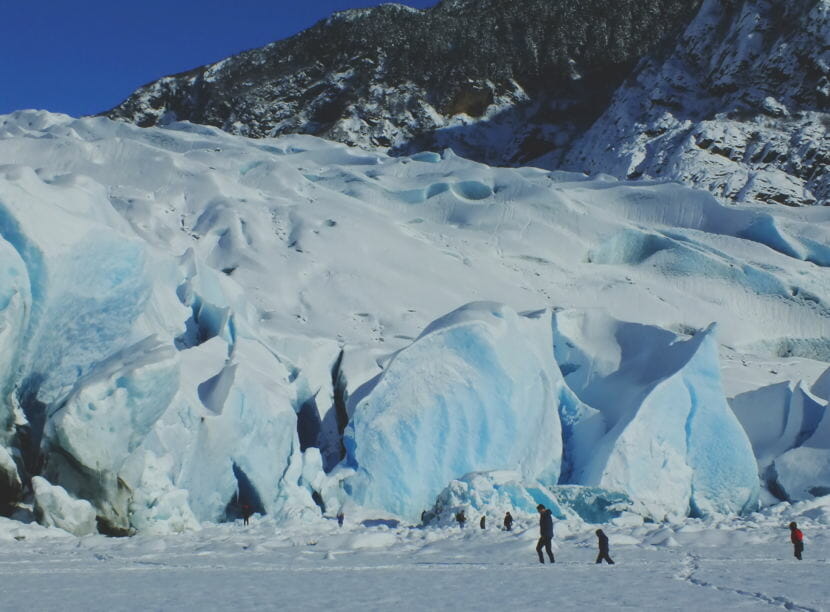
Attracted by the wonders of the Mendenhall Glacier, many Juneau residents have been crossing the Mendenhall Lake ice recently to view the glacier up close. But that ice may be not as safe as it looks.
“The glacier is active, and that’s something that people don’t realize,” said John Neary, director of the Mendenhall Glacier Visitor Center. “A lot of folks think: ‘Aw, it’s wintertime. It’s a chunk of ice. It’s frozen.’”
But Neary notes that the activity is more evident as you move toward the face of the glacier.
“It has been calving, both from above and from below,” he said.
According to Neary, they receive almost daily reports of people stepping or falling into unfrozen water, especially near the terminus or the face of the glacier.
“Some of them, people are just going ankle deep because it’s just a small slush puddle kind of crack,” Neary said. “But others are going to their waist or more.”
Chunks of ice at the terminus can also shift, or calve and fall on people who are too close. So far this season, no one has been reported hurt.
“Right now is not a safe time to be out there, at least by the face of the glacier and by Nugget Falls,” said Jayme Johns who is firefighter, engineer, and special teams water coordinator for Capital City Fire/Rescue.
Johns said they also get called out for ice rescues, but none so far this season.
Johns and Neary both referred to recent drone video footage of Mendenhall Glacier. It shows thin ice or no ice at the terminus of the glacier where calving breaks it up and shifts it around.
https://www.facebook.com/madisonbeau.sylte/videos/10103908224988198/
Video courtesy of M Beau Sylte
Neary recalls a recent ski excursion on Mendenhall Lake when he tried to keep at least a quarter-mile away from the glacier.
“The ski track that I was in came up to a crack. Then, the continuation of the ski track was eight inches to the left, which means that at a quarter mile out that whole section of the lake ice had shifted eight inches,” Neary said.
“That’s happening much more dynamically right close to the face where you’re getting chunks and cracks splitting and moving around as that lake is readjusting to all that,” he said. “So, naturally, you’re going to have a lot of weak spots.”
Johns also warns about assuming that any existing lake ice at the glacier’s face is thick or solid, especially if it’s covered by snow. It could be very thin ice that only froze the previous night.
“The 10 or 12 inches of ice that they may have been walking on that was deemed somewhat safe for travel is only a few inches thick at the face of the glacier,” Johns said.
The ice around Nugget Falls is also thin where the water runs continuously.
If they do get a 911 call, Johns said it may take firefighters at least 30 minutes to leave the Glacier Valley Fire Station and cross the lake ice by ATV.
Johns said they would coach the victim out if they’re still mobile, throw them a rope, or extend a ladder or other object. If that’s not possible, then a firefighter in a dry suit and harness will swim out to the victim. Another firefighter would then pull the rescuer and victim out of the water with a floating rope.
Johns said his last ice rescue a few years ago involved a dog in open water about 150 feet from shore. He swam out 50 feet with a floating rescue board.
“By the time I got there, the dog was pretty tired. And, he was excited, but he didn’t want me there. He gave me a couple growls,” Johns laughs. “I told him I’m here to save you. He actually got on the board, laid on the board all the way back. He was like ‘OK. I guess you’re here to help me.’”
What to do if you’re alone and you fall through the ice
If you do fall through the ice, Johns has some important tips for a self-rescue.
First, the water will be shockingly cold.
“You really have to think about it and get yourself under control, get your breathing under control because the water is so cold that it takes your breath away,” Johns said. “You really need to be conscious of that and go ‘I’m going to make it out and I control myself. I need to not panic right now.’”
Johns said you may have use of your limbs for only 10 to 15 minutes in the very cold water.
He suggests going back the way you came.
“You just put hands up on the ice and you try to push yourself up,” Johns said. “At the same time, you want to kick as hard as you can with your feet because your clothes are going to be wet. They’re going to be pulling you down a little bit. You just want to kick as hard as you can like a seal and try to push yourself out of the water.”
Once back on the ice, do not stand up. You could break the ice again by concentrating your weight in a single spot. Keep your weight distributed over a wide area and belly crawl or roll away from the ice edge until you are on thick ice or solid ground.
Call 911, if you can.
Johns recommends taking off your coat and getting out of your wet clothes as soon as possible, especially if they are cotton.
If you expect a long hike to warmth and safety, then you may want to completely undress and wring as much water out as you can before putting your clothes back on. You’ll lose your body heat faster if your clothes are soaking wet.