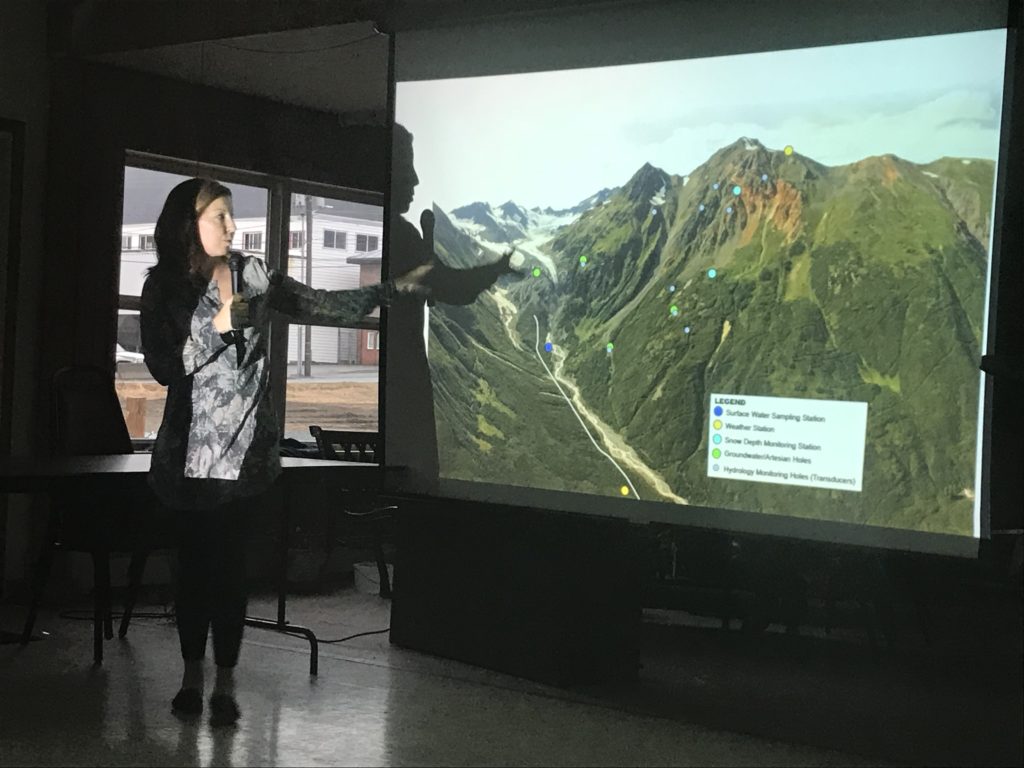
The Palmer Project, a potential hard-rock underground mine was the focus of a water-and-mining forum Wednesday attended by dozens of residents at the Alaska Native Brotherhood Hall, Haines.
Residents hoped to learn more about a how the project, still in the exploration phase, could affect water and salmon in the Chilkat and Klehini rivers, if the mine is developed.
Not all stakeholders believe the forum has the community’s best interest in mind.
People packed the ANB Hall, eager to learn more about how the nearby mineral exploration could impact water and salmon.
“Why do we as a company do water quality sampling?” said Liz Cornejo, vice president of community and external affairs for Canadian company Constantine Metal Resources Limited. “One, we have to do it for assisting the permitting process and compliance to ensure that we are maintaining water quality for everyone.”
Cornejo also is co-chair of the recently formed Chilkat Valley Mining Forum Committee, which organized the event.
“The Palmer project is still in the exploration stage,” Cornejo said. “We are getting more advanced and we are doing more in-depth studies. We are hopefully in the next few years, working towards feasibility. And that information will help answer that question of: is it going to be a mine?”
The prospect was discovered in 1969 by local prospector Merrill Palmer, its namesake.
Constantine leases the claim and partners with a Japanese company called, Dowa, which supplies 49 percent of the exploration funds. The partnership has been going on for several years.
The sites are located on steep mountainsides above a glacially fed river. Exploration shows they’re rich in copper, zinc, barite, gold and silver.
The economy of the region largely is reliant on fishing and tourism and many are concerned that a large mine could interfere with the existing economies.
Takshanuk Watershed Council executive director Meredith Pochardt organized the event and was a forum guest. She talked about the effect on fish when too much copper gets into the water from mining.
“Fish are much more sensitive than humans are to copper,” Pochardt said. “It impacts a lot of their homing migration, their predator avoidance and their ability to navigate and find food.”
Department of Environmental Conservation architect Allan Nakanishi with talked about the value of public comment in the permitting process.
“When we go out to public notice on a permit, the local community may have fairly in-depth knowledge that wasn’t apparent or available on the application,” Nakanishi said.
The forum also included a representative from the Central Council of the Tlingit and Haida Indian Tribes of Alaska, who talked about their water-testing programs.
Two local stakeholder groups decided not to participate in the forum.
One was the Chilkat Indian Village of Klukwan.
“We are a community that literally relies on the return of the salmon,” tribal president Kimberly Strong said. “All five species run through the Chilkat River. That’s why our people, the Tlingits, survived and thrived over the past thousand or more years in this valley.”
Strong’s community had participated in a forum held last fall, but decided against it this time around.
“There was concern that if it is being chaired by the mining industry, we wanted our name off to make it clear that we were not part of the group at this point,” Strong said.
Lynn Canal Conservation executive director Elsa Sebastian said her group also decided not to participate.
She said the group was undermined by the fact that “two of the voting members on the forum hold a direct interest in the mine and one of these members represents a Canadian company that is in Haines solely for their financial interest in the mine.”
Those two members are the co-chair, Liz Cornejo, who works for Constantine — and a member of the Palmer family.
Donald “J.R.” Churchill, a commercial fisherman who recently organized the Haines Fishermen’s Alliance to advocate for salmon and its habitat also stopped working with the forum.
“The original intent was a good one. As things moved on, it was decidedly weighted to the mining side of that,” Churchill said. “I get why they pulled out. They didn’t want to be attached to a group that was decidedly pro-mine.”
Cornejo said co-chairing the 10-member group that organized the forum is a lot of work.
But she would be happy to step aside if someone thinks her interest in the mining company is problematic, and also if someone else is elected to the position by other members of the group.
“The chair does not really have a larger say in anything, it is still one voice in the 10-group committee,” Cornejo said. “We just do a lot of the administrative work in the background to help facilitate the committee work.”
For now, Cornejo said they would like feedback about the most recent forum so they can plan future events.