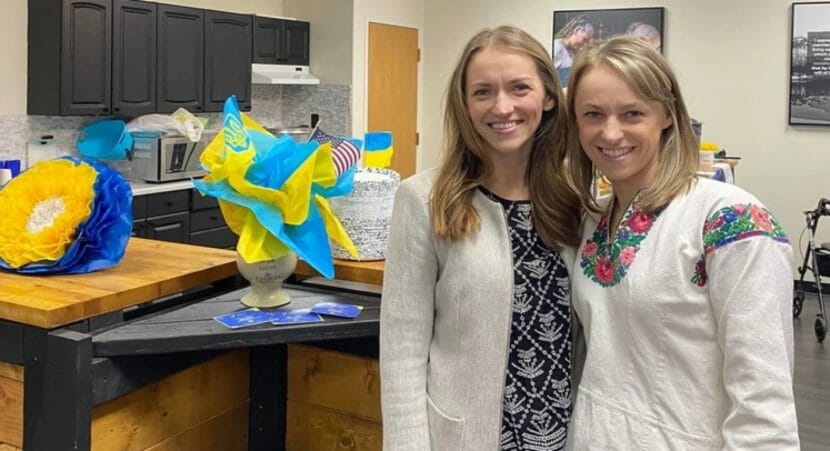
More than 300 refugees from the war in Ukraine have come to Alaska to settle, mainly near family in places with Slavic communities.
“We saw this immediate rush of people who applied right at the beginning of the program were approved, and then got their families here as quickly as possible,” said Issa Spatrisano, who oversees Refugee Resettlement and Food Resources for Anchorage-based Catholic Community Services. She also serves as Alaska’s state refugee coordinator.
Soon after Russia invaded Ukraine back in February, President Biden enacted the Uniting for Ukraine program to help those fleeing the conflict find temporary homes more quickly than through conventional refugee efforts. Since then, more than 54,000 have come to America under the program, including the more than 300 who came to Alaska.
Ukrainians also have come to the United States through other programs and as private citizens traveling on a visa.
Refugee-relief workers have been busy
Spatrisano said she and her staff have been busy over the past few months.
“Statewide, we’re seeing some serious growth in the refugee-resettlement program,” she said. “It’s the largest year in the state’s history — by far.”
Spatrisano said most of those who’ve arrived in Alaska under the Uniting for Ukraine program have family who applied to sponsor them to live in places where previous waves of Slavic-speaking immigrants have settled.
“The largest Ukrainian communities statewide, per Census data, are Anchorage, the Mat-Su Valley and Delta Junction,” she said in an interview last week.
The earlier immigrants began coming to Alaska in the 1990s from nations that previously were part of the old Soviet Bloc.
“Many former Soviet Union arrivals independently decided to move to Alaska and decided to make their home (in communities) across the state,” Spatrisano said, “but especially in the area of Delta Junction.”
Spatrisano said in an interview last week that the pace of new arrivals had begun to slow.
“Alaska definitely should expect more cases,” she said, “but I don’t think we’re going to expect as many people as quickly as we saw them in the first opening of the program.”