If a tree falls in the forest and nobody’s around to hear it, does it make a sound?
Maybe that’s best left to the philosophers. But if hundreds of trees tumble off a mountainside and into the ocean — who would find out about it first?
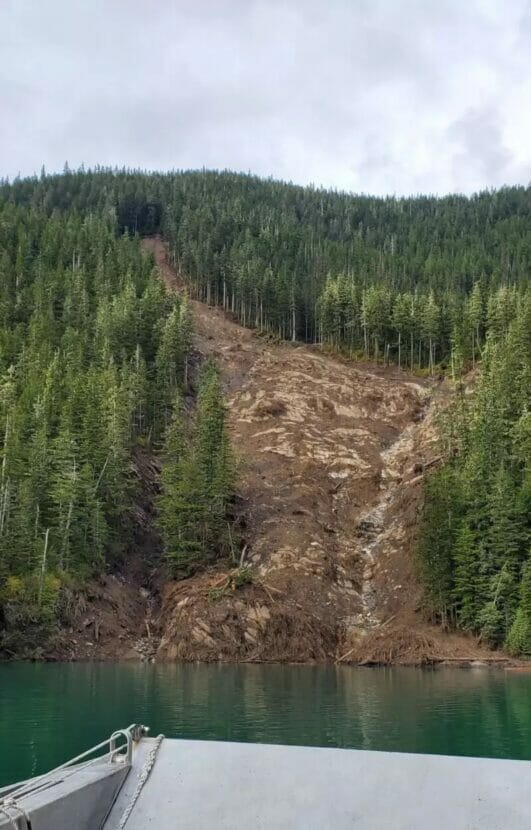
In remote Southeast Alaska, that would be mariners and pilots. They were the first to notice the aftermath of a huge landslide near LeConte Bay in the last week of September. Personnel at the nearest ranger district, in Petersburg, were unaware that it had happened at all.
The Tongass National Forest spans 16.7 million acres — the largest National Forest in the United States. It’s a lot to keep track of.
Doug Riemer is the owner of Nordic Air, a Petersburg-based charter flight business. He was piloting a tour around LeConte Bay when he noticed the telltale signs of a slide.
“Mostly just timber, everywhere,” said Riemer. “This slide was pretty dramatic because it didn’t just land in one spot. It just brought a whole bunch of trees down and it just ripped all the branches off of them and pulled the bark off of them and everything like that — littered trees all over.”
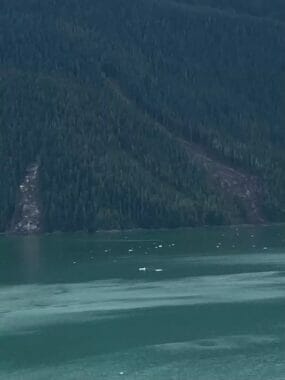
That debris can be a dangerous problem. Floating wood can damage or even sink small vessels and marine infrastructure. Glorianne Wollen is Petersburg’s harbormaster. She says she and her team have been getting reports about the slide from northbound vessels all week. And now, they’re trying to fish out as much flotsam as they can before it can clog up the Wrangell Narrows in front of town.
“It was mostly big, big root wads,” said Wollen. “We knew something that let loose because there was rocks and sand and dirt and stuff that was still attached. But we ended up seeing it and reacting as it occurs.”
Landslides are alarming when they happen, even in the most remote areas. Climate change and the resulting wetter weather are making them more common in Southeast Alaska.
Brian Bezenek is a meteorologist with the National Weather Service in Juneau. He says Southcentral-Southeast has seen record-breaking rains in the last few weeks, and it’s probably no coincidence that the slide happened when it did.
“There was an atmospheric river that was pushing through the central-southcentral Panhandle during that time frame,” said Bezenek. “It just turned out that it was a very rainy end of the week, across the area. Petersburg reported 4.47 inches on the 21st — which, looking at the records, would be the rainiest day on record for that day. Over those two days, we’ve received 7.02 inches.”
To put that number in perspective, the normal monthly precipitation in the Petersburg area is 14.35 inches of rain. It got half of that in a single weekend.
Bezenek says those heavy rains will probably bear down for weeks to come. But there’s no telling how long it’ll take for all the debris to get flushed away.