Alaska seafood processors hired fewer people in 2023 but paid them more and relied more on nonresidents to fill the jobs, a state analysis shows.
The employment trends are what would be expected in an industry struggling to find workers, said Dan Robinson, the state economist who wrote the analysis for the Alaska Department of Labor and Workforce Development’s monthly magazine.
“I do think the reason for that is just they’ve had to work harder to get workers and to pay workers more to come there,” said Robinson, the department’s research chief and author of the article in the November issue of Alaska Economic Trends.
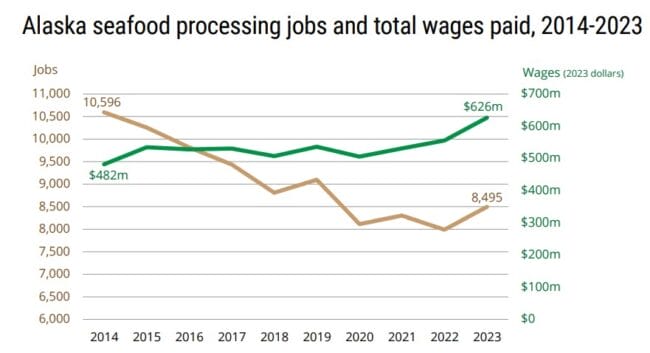
The number of Alaska seafood processor jobs totaled 8,495 in 2023, about 20% lower than the total in 2014, the analysis shows. At the same time, according to the analysis, total pay to processing workers of $626 million last year was about 30% higher than the aggregate pay in 2014, calculated in 2023 dollars, of $482 million.
The average monthly wage for seafood workers in 2023 was $6,100, exceeding the statewide average of $5,700 for all workers, the analysis found.
Processing workers made more money, despite myriad woes afflicting the Alaska seafood industry, including market erosion, low fish prices and rising costs.
It is not clear whether the inflation-adjusted increase in processor workers’ earnings was from higher base pay or from increased overtime pay, Robinson said. The department does not have the information needed to make that distinction.
Increased earnings of either type, along with the smaller jobs total, point to the same underlying cause, he said.
“Lower employment, higher wages, that smells strongly of difficulty finding enough people and having to pay them more,” he said.
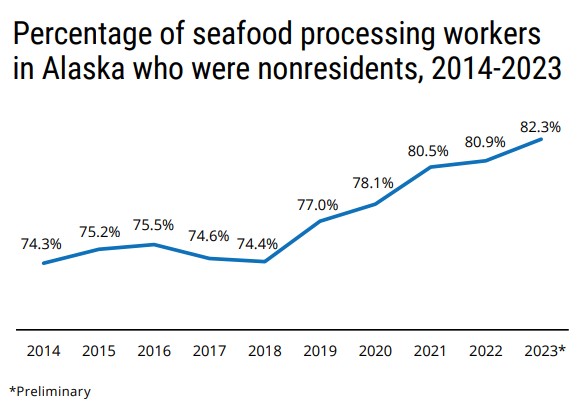
Nonresidents made up 82.3% of the seafood processing workforce in 2023, according to the department’s analysis. Nonresidents have long made up the majority of seafood processor workers, but the proportion has crept up in recent years, from about three quarters from 2014 to 2018 to over 80% since 2021, according to the analysis.
Workers from outside the United States have also been important to the industry, but the numbers who are employed through a special visa program vary by year. In 2023, the U.S. Department of Labor’s Employment and Training Administration certified Alaska employers to hire 825 workers under the federal H-2B visa program, which is commonly used for the seafood industry. Of the authorized positions, 554 were for seafood processing workers, according to the state analysis.
It is unclear whether all 554 spots were used by the seafood industry, Robinson said.
In some years, there are far fewer seafood processing workers hired through these visas. In 2014, for example, the federal Department of Labor granted only one company’s request to hire workers under the H-2B program, and only 20 workers were authorized, Robinson’s analysis said.
Yet to be determined by the state Department of Labor and Workforce Development is the full impact of seafood plant closures that have roiled some coastal communities.
A particularly devastating closure came this year at the seafood plant in King Cove. The plant has operated for more than a century and has long been critical to that Alaska Peninsula community’s economy and its main source of local tax revenue.
Robinson said the Department of Labor and Workforce Development does not yet have all the information needed to analyze this year’s seafood processing employment.