Listen to this story:
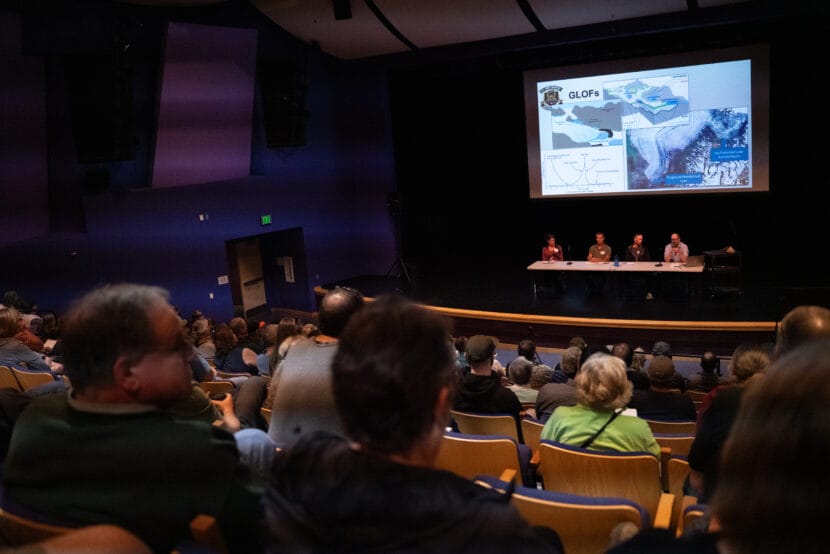
As the next glacial outburst flood looms over Juneau’s Mendenhall Valley, around 200 residents filed into the Thunder Mountain Middle School auditorium last night to talk about a permanent solution. Officials from the U.S. Army Corps of Engineers said it’s years away. But residents in the flood zone said they need a solution sooner to feel safe in their neighborhoods.
Dominic Walsh’s home on Northland Street flooded last year. The temporary levee the city put up this year is meant to protect his home until there’s a permanent fix, but he doesn’t feel confident in that.
“I don’t feel any safer with the HESCO barriers, maybe a little bit, but not really,” he said.
This is the first time the levee will be put to the test. Although city officials said they are confident the levee should work properly, they are urging residents in the flood zone to evacuate when the flood warning is issued.
Walsh said he’s spent all year recovering from the last flood and preparing for the next one, and it’s challenging to imagine that he’ll be living with that anxiety for several more years while the federal process unfolds.
Craig Loken lives on Emily Way, a street that got hit hard by the flood last August. He said the Army Corps’ slow approach is painful to watch.
“If it takes 10 years, there won’t be anybody left in the Valley to benefit from all these studies,” he said.
His family has lived in the Valley for three generations. Loken said they are thinking about moving away, depending on how this long-term solution pans out.
The Mendenhall Glacier and Lake are on federal land, so anything built there is under federal jurisdiction. The Army Corps is starting with a technical study to gather all of the physical data about the baseline conditions in the Valley. Congress allocated $4.75 million to the study and Army Corps officials said it will take a few years to finish.
That study will inform another report called a feasibility study. That’s where the Army Corps weighs each option and picks one. It could take another couple of years and millions of dollars more.
After that, engineers have to design the solution they pick, which can take another couple of years. Then the Army Corps has to build it.
Leif Hammes is chief project manager in the civil works branch of the Army Corps in Alaska. During Wednesday’s meeting at Thunder Mountain Middle School, he explained that the building timeline depends on how big the project is, but that this is a top priority in his office.
“We do look for ways to go faster, save time, get us there quicker, but from sort of where we are today to physical construction is multiple years — you know, six, seven, ten-ish years is not an unreasonable timeline,” Hammes said.
Added together, Mendenhall Valley residents can expect a decade or more before there’s a permanent fix.
Hammes said that Army Corps staff can’t change the agency’s process because it’s grounded in federal laws.
But Erin Stockdale, chief of the planning section at the Army Corps, told residents to speak up and tell their stories since Congress has the power to make things move quicker.
“The ‘just build it’ avenue is not common, but I will say the squeaky wheel gets the grease,” she said.
Lots of ideas were floated, including a tunnel through the ice, a lake tap at the bottom of Suicide Basin and a permanent levee. At this stage in the process, Hammes said the Army Corps isn’t ruling anything out yet.
But one idea got more attention at the meeting than any other: a dam on Mendenhall Lake.
Dave Hanna has lived in Juneau his whole life. Although his place on Auke Lake isn’t in the flood zone, he said glacial outburst floods are the most devastating issue Juneau is facing. And he thinks a dam is a simple fix. He went up to the microphone and told the Army Corps as much.
“If you put a dry dam across the outlet of the lake, it would serve as a pedestrian bridge,” he suggested. “Find out what you’ve got to build on, and then figure out how to build it, because we can’t wait seven years.”
The crowd erupted into applause. Many residents agree with him.
Scientists are beginning to research other lakes farther up Mendenhall Glacier that might release outburst floods in the future. No one knows how big the risk is yet, but it could narrow down the options for a permanent solution.
That’s a major reason Hanna is pushing for a dam.
“Anything we do at Suicide Basin is probably not the correct thing to do, because it doesn’t address future basins,” Hanna said.
Bob Deering lives along the Mendenhall River and is a retired engineer who once worked at the Army Corps. He thinks a dam is the only viable solution, and said that the process the agency laid out is too slow.
“Frankly, it’s unacceptable,” he said. “I mean, everybody’s going through all this stress right now, with the flood, you know, looming above us, and we’re going to go through that for another 10 years?”
Suicide Basin is expected to be full around mid-August, but National Weather Service forecasters don’t yet know exactly when it will unleash the next flood.
Find resources and the latest stories on glacial outburst flooding in Juneau here.