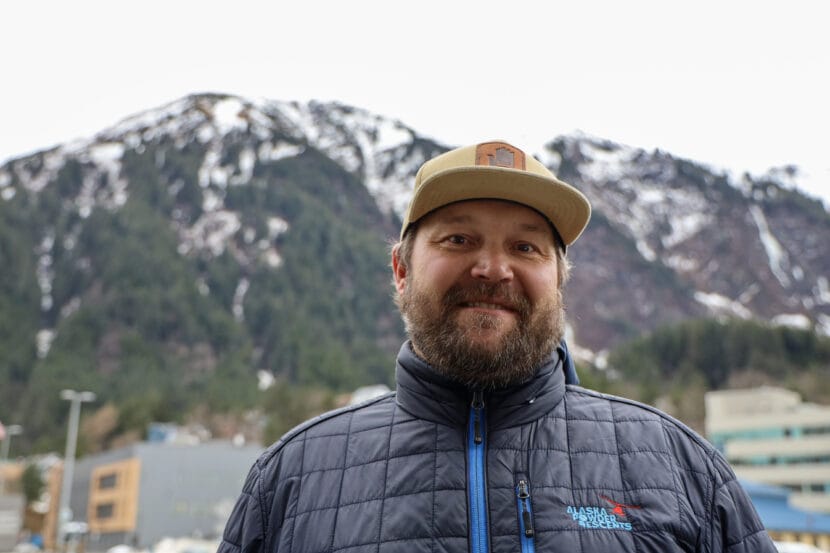
John Bressette is Juneau’s new avalanche advisor, tracking weather and avalanche risk in the capital’s urban paths. He joined the city just before record snowfall, followed by rain and flooding, pushed the community to declare a disaster and issue evacuation advisories downtown.
KTOO’s Mike Lake spoke with Bressette about navigating that moment and what first drew him to avalanche forecasting.
Listen:
The following transcript has been lightly edited for clarity.
Mike Lane: You’re not new to forecasting avalanches. How did you get your start in this field?
John Bressette: Well, I grew up here in Juneau, and I started going heli-skiing with my friends when I was about 18 years old, and decided I better start learning about avalanches to make sure I knew what I was doing. So I took my first avalanche class here through Bill Glude, who is a longtime avalanche specialist in Juneau and worked on some of this urban stuff a long time ago. Took some classes with him, helped him out with some research projects, and started working for him under Alaska Avalanche Specialists. And in the beginning, he had a contract with AEL&P to do forecasting for them. We also worked out at Kensington Mine and kind of helped develop the program they have going out there now and then I worked for AEL&P directly for a long time under Mike Janes as an avalanche tech assistant forecaster.
Mike Lane: Where did you work before CBJ?
John Bressette: Well, I was doing backcountry forecasting for the Coastal Alaska Avalanche Center. And still am trying to balance both of those for now. It depends on the time of year; I’m a commercial fisherman in the summer, heli-ski guide in the spring and avalanche forecaster in the winter.
Mike Lane: So this isn’t a full-time position with CBJ. This is more of a seasonal?
John Bressette: Yeah, seasonal for now, and we’ll see how it plays out moving forward.
Mike Lane: Immediately, when you started working at CBJ, you were immediately right in the midst of of a disaster, so what was it like to experience that kind of timing?
John Bressette: Yeah, it was intense right off the get go there. So there wasn’t a whole lot of learning on the job. It was right into it. But I feel like everybody at CBJ was really good to work with, and we kind of seamlessly moved into a pretty good workflow, and were able to kind of make decisions on the fly and keep the public informed of what was going on, and I hope that went well from their perspective.
Mike Lane: What are some misconceptions people have about avalanche danger?
John Bressette: Oh, some of the big myths in the avalanche world are that loud noises can set off an avalanche, which is untrue. I think maybe one of the others is that we can predict how big or how far an avalanche will run. And that’s one of the real tricky points to avalanche forecasting, is not knowing how big or how far an avalanche will run during a given avalanche cycle. So it’s — the science behind it is coming a long ways, but it will always be an unprecise science as far as predicting the size of avalanches.
Mike Lane: Do you have any advice that you could give to those folks who are heading into avalanche terrain in the backcountry?
John Bressette: Yeah, so that’s, I want to make it clear that you know forecasting for the urban danger is much different than forecasting for the backcountry, which I do both. So I’m happy to speak on both, but it’s a completely different thing when you’re talking about people traveling into avalanche terrain, you’re looking more at human-triggered avalanches, whereas in the urban, especially in a place like Behrends, where we can’t do control work, you’re looking at more natural avalanches. So yeah, the advice for people, if they’re heading into avalanche terrain is to take an avalanche class, get some education, find the right mentors and group of people that also practice safe habits and just get yourself educated and find the right people to travel with.
Mike Lane: And what about equipment?
John Bressette: Yeah, with equipment. I mean, the bare minimum you want to have is a beacon, probe, shovel, partner — and know how to use those things, too. You know, it doesn’t do you any good if you don’t know how to use the equipment. So getting comfortable with those specific tools are kind of the bare minimum that you need to travel safely in the backcountry.
Mike Lane: Okay. And as far as avalanches go, what do you think we could improve on, CBJ specifically? Are there any lessons to be had that we should know about?
John Bressette: Yeah, I think that having more monitoring tools and using technology that’s come a long way for avalanche and weather monitoring is something we’re pushing really hard to get done. Right now, we’re working with AEL&P and DOT to put together a weather station on Mount Juneau, or, I should say, rebuild. There was one there previously, but we’re kind of revamping it and getting it live again, as well as, thanks to the state and the governor’s office, through this disaster declaration, we were able to buy what’s basically an avalanche radar. So it points at Mount Juneau, and we can now detect when avalanches happen at night or during foul weather. So that’s a really useful tool for us to kind of know when activity starts if we can’t visually see it or hear it. So I think those two things are going to have huge, huge benefits down the road when we enter this kind of avalanche cycle again.
Mike Lane: Are there any hot spots right now that you look at today? You step outside and you look up and you go, Hmm, that’s something we want to keep an eye on, more so than these other areas?
John Bressette: Yeah. I mean, I would say that the Behrends and the White Subdivision pass, the Bartlett pass. Those are our three big ones. Debris came a lot closer to people’s homes and the roads than than we previously thought. So you know, there was debris within 10 feet of a couple homes and on Thane it came down under the power lines and was within 100 feet of Thane road and stuff like that. So, yeah, I would say, when we get a big snow cycle like that, there’s, you know, places that we don’t typically think of the hazard being high that actually came pretty close. So those are the reasons we got people out of their homes. And yeah … I hope that comes through, that people’s safety was of the utmost importance.