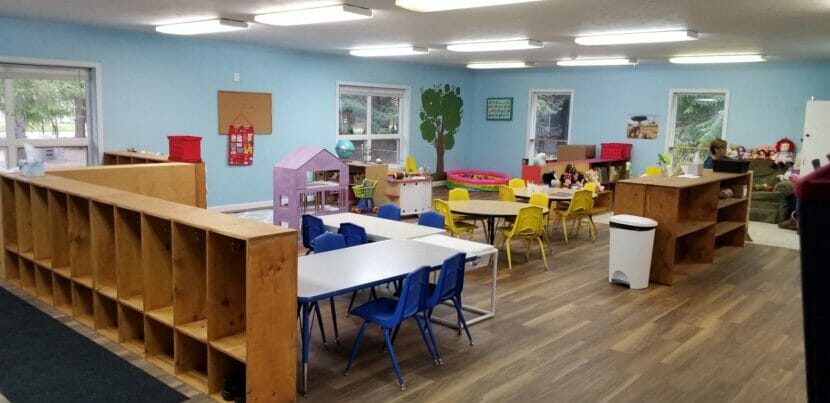
A regional conference for child care providers in Juneau offered a chance for attendees to meet with legislators and advocate for more child care assistance from the state. Attendees also learned about two bills currently in the Legislature that address the lack of child care in Southeast Alaska.
The Southeast Alaska Association for the Education of Young Children has served the region for 40 years. It helps parents find child care, assists providers with training and advocates for improved child care access.
Blue Shibler is the executive director of the organization. Earlier this month, the nonprofit held its annual conference in Juneau. The theme this year was “Be well, care well.”
“We had a lot of workshops about active play and mindfulness, both for adults and the children they work with,” she said. “We had a really good workshop that was all about caregiver stress management tools. So it’s really giving people tools for mindful self-regulation while they are working with children.”
There’s a reason for all this talk of self-care. Workers in the field are overworked and underpaid. The starting pay for child care workers is around $12 per hour. Days are long, and staff turnover is high. Not enough people get into the field. And the problem is especially bad in Southeast.
“Southeast Alaska as a region is considered a child care desert, that means we are meeting less than half of the need,” Shibler said. “There are communities that have no child care, and there are communities that have not enough child care.”
Shibler led an advocacy workshop that offered attendees a chance to speak with legislators. Haines child care provider Kim Larson was part of that group. She is limited to providing care for eight children total, and only three of them can be under 30 months old. She says care for that age range is in high demand.
“We are in need for more providers zero to thirty months,” Larson said. “I have a waiting list for five infants right now, and you know I can only take three at a time.”
Larson told legislators she thinks helping parents pay for child care is part of the solution.
“One of the things we talked about was how they support college-age kids, you know with the Pell Grants and stuff, and then of course they support the K through twelve kids, through the school, and then now they are starting to support pre K,” she said. “But they don’t support zero to three, which is when the kid’s minds grow the most, their brains grow the most, is in those early years. And there is no funding for that.”
Alaska legislators are working on two bills that address the issue. Rep. Andi Story, D-Juneau, was among the lawmakers who met with the group.
“We are trying to expand the number of families who can afford child care by making the subsidies more inclusive,” she said.
House Bill 89 would extend assistance to families who make up to 300% of the poverty level.
“You would make an application and then you apply to child care assistance, which is under the Department of Health, and then they make a payment towards the center to help with the cost of care. They would make a payment on your behalf,” she said.
The payment would be a flat rate, adjusted to the cost of each daycare center.
The other bill — House Bill 46 — would incentivize investments in child care centers through tax deductions.
“If a business makes investment into a child care center, they can deduct up to three million dollars for an investment they might have made into a child care center in their area.
The House bill also includes a provision that would allow child care providers to organize for collective bargaining with the department of health. Story says the bills and increased revenue will help daycare centers function better.
“They can afford to keep the adequate staff on, keep their doors open, keep the experienced staff with your kids, not have so much transition,” she said. “Little ones like to see their same caregivers, they bond with them. You want the people taking care of your kids making a living wage.”
Shibler, the conference organizer, says child care fits into the bigger economic picture.
“Child care is an essential part of an economy, and without it, we are going to continue to see labor shortages in all industries,” she said. “I think everybody needs to come together and realize that as a public good, child care needs to be heavily subsidized, not only at the government level but from private businesses as well.”
The bills are currently moving through the House. Rep. Story says if child care is seen as a priority, they will pass.