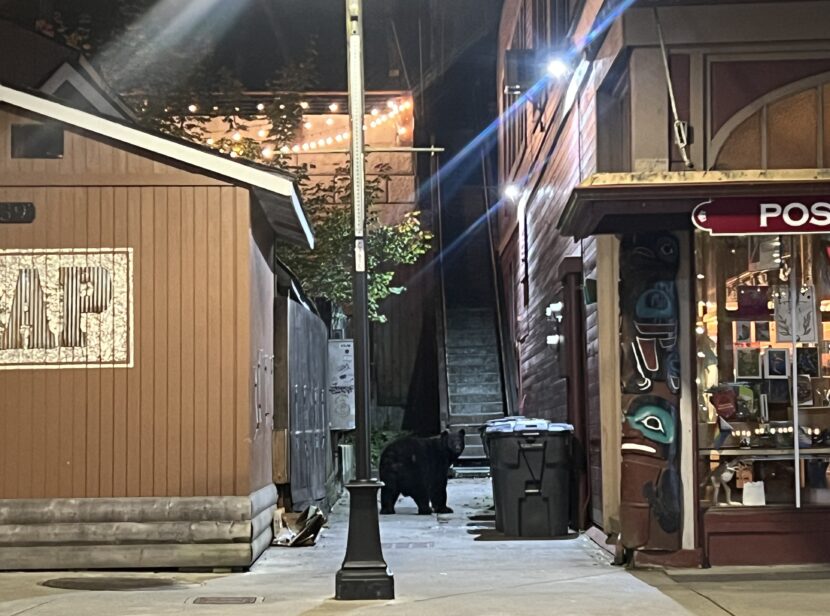
Human-bear interactions are not necessarily uncommon in Southeast Alaska. But they can be dangerous to the bear as well as the human.
KTOO’s Mike Lane recently sat down with Area Management Biologist Carl Koch with Fish and Game Wildlife Conservation to talk about securing trash and other attractants. In part two of that interview, they review how best to keep safe in bear country.
Listen:
The following transcript has been lightly edited for clarity.
Mike Lane: Should hikers, dog walkers, make any adjustments to their habits this time of the year? And if so, what adjustments?
Carl Koch: Yeah. Well, first of all, they should be alert. If you have a dog, hopefully it has good recall. Or if not, you know, consider a leash, because you don’t want your dog chasing them, chasing the bear. For runners or people that walk with earbuds, it may be time to stop doing that, so they can be more aware of their surroundings, or take one earbud out at least, so you can hear stuff that’s going on around you.
Mike Lane: Okay, is there anything I should do if I encounter a bear or something I shouldn’t do?
Carl Koch: Yeah, that’s great question. You definitely should never run that can trigger a chase response. And so if you encounter a bear and the bear doesn’t know you’re there, you should consider keeping your eyes on the bear, and especially if it’s close to the trail that you’re on, slowly back away. But make sure you’re paying attention to what the bear is doing, and you can exit the area. If it’s aware of you, then you want to wave your arms and talk to it so it knows you’re there, knows you’re human. If you’re in a group, which is safer, you want to group up. Ways to prevent that from happening in the first place is to make noise while you’re hiking, and that depends on people’s comfort level with bears. If I’m alone around bear country, I’m always making noise. You know, around here, I’m pretty comfortable with bears. Maybe I’ll just stay alert. But if you’re trying to avoid them all together, make them, give them lots of noise, so you’re not surprising them is a good idea.
Mike Lane: So what about bear bells?
Carl Koch: Bear bells, there’s kind of mixed, mixed reviews on that. When I was young, that was the big thing. They make noise. So there may be less likely to surprise a bear. But some studies have shown that the bears can be curious because it’s like a metallic sound, and they can’t necessarily always associated with a human. They may come to investigate. It’s probably still better than surprising a bear, but yeah.
Mike Lane: And what about carrying bear spray?
Carl Koch: Yeah, I’m glad you asked. It’s good to always have a deterrent with you, and bear spray is pretty safe one to use. You know, most people can learn how to use it. Carrying is good if you see the bear, like we talked about earlier, you would take the deterrent out and have it ready and, you know, be ready to spray the bear if it came, you know, too close.
Mike Lane: Do we find more human bear interactions at the beginning of the season versus, say, in the middle of the summer?
Carl Koch: If there’s good fish and good berries, we kind of get a break from the phone ringing off the hook, although we still are getting calls. And I guess when I talk about calls, one thing for folks to know is, you know, we all live in bear habitat, so if you have a concern, feel free to call us. But we don’t need to know every bear sighting. But, if you have an aggressive situation, property damage or issues with a bear, that is, you know, continuing to cause concern, we’re happy to provide advice, and sometimes we deal with the bear directly. One thing that we we don’t do is enforce the city ordinance. So if the call is about your neighbor not, you know, leaving their trash out all week, you want to call the non-emergency line for JPD, and the community service officers can help with that.
Mike Lane: Okay. And if somebody does need to reach out for a bear that’s showing up constantly. Who do they call?
Carl Koch: Yeah, they can call Fish and Game during business hours at 907-465-4265, or after hours they can call the Juneau Police Department, and they have a list of my team’s cell phone numbers, and they can get ahold of us after hours on or on weekends, if it’s something that needs to be escalated to the point where we need to respond.