Alaska Beacon

Alaska Beacon is part of States Newsroom, a network of news bureaus supported by grants and a coalition of donors as a 501c(3) public charity. Alaska Beacon maintains editorial independence. Contact Editor Claire Stremple for questions: info@alaskabeacon.com. Follow Alaska Beacon on Facebook, Bluesky and Twitter.

Alaska Legislature OKs increase to rural power subsidy

Unalakleet, one of the communities in Alaska eligible for power cost equalization. (Photo by Rashah McChesney/Alaska’s Energy Desk)

Residents of 194 rural Alaska towns and villages will get more of their monthly power bill subsidized by the state if Gov. Mike Dunleavy signs legislation approved Monday by the Alaska House of Representatives. 

On Monday, the state House voted 38-2 to increase the maximum subsidy allowed under the state’s Power Cost Equalization program. The bill passed the Senate on May 3. 

With the governor’s approval, the maximum amount of subsidized residential power will increase from 500 kilowatt-hours to 750 kilowatt-hours per month.

In 2020, the average American house consumed 893 kwh per month, according to the U.S. Energy Information Administration. 

In PCE-eligible communities, electric companies reduce the cost of power for homes, then apply to the Alaska Energy Authority for credits that bring the overall cost of power closer to the average of electricity in Juneau, Anchorage and Fairbanks.

The size of the subsidy has forced rural residents to drastically conserve power or risk a major hike in their electric bill if they go over the subsidized amount.

“You go to the communities at Christmas and you wonder why there’s not that many lights on. It’s not because they don’t believe in Christmas or don’t have holiday spirit,” said Sen. Bert Stedman, R-Sitka.

Return to original compromise

When created in 1984, PCE was intended to serve as part of a grand compromise: Southeast Alaska would get state-funded dams, Southcentral Alaska would get subsidized natural gas, and rural Alaska would get PCE.

The program originally subsidized up to 750 kwh per month, but the Alaska Legislature reduced that figure in 2000 because of cost concerns. 

“We just want to get back to where we were on the program that was negotiated back in 1984,” said Sen. Lyman Hoffman, D-Bethel.

After the 2000 decrease, the legislature created an endowment to fund the program in perpetuity, and that endowment has grown to $1.1 billion. 

The PCE extension would increase spending from the endowment by as much as $15.6 million per year, but the endowment’s investment earnings are large enough to cover the cost, according to estimates provided by the Legislature.

Squeeze on community assistance

The drawback is that other programs could suffer. State law says that money not used for PCE — up to 5% of the endowment’s value annually — may be used on the state’s community assistance program, which provides general-purpose grants for local governments. 

Expanding PCE means less money available for that program and others, including a renewable energy grant program that also relies on extra PCE earnings.

“I feel a little bit like I’m between a rock and a hard place on this one,” Nils Andreassen, director of the Alaska Municipal League, told the House Finance Committee earlier this month.

Andreassen represents towns that rely on PCE, local governments that rely on community assistance and municipalities that need both.

Members of the Senate Finance Committee were told in April that an additional $320 million deposit into the PCE endowment would be needed to eliminate the risk to community assistance programs if PCE subsidies were raised.

“If we don’t make those endowments, then this would also take away the earnings for those additional programs,” said Sen. David Wilson, R-Wasilla.

Neither the House nor the Senate proposed an additional deposit into the PCE fund to address the problem.

More aggressive investing

The bill does contain a provision that allows PCE fund managers to invest the fund more aggressively, which could increase investment earnings and over time increase the amount of money available to spend. It would also increase the risk of losses in any given year. 

Previously, managers were told to target 4% returns; they will now be able to pursue all “prudent” investments, similar to the approach employed by the Alaska Permanent Fund.

Many legislators, including Sen. Donny Olson, D-Golovin, said the program’s expansion will help rural residents as they anticipate significantly higher home heating and fuel costs. 

“People can no longer live in rural Alaska where they were born and raised,” he said.

“Those people that can’t afford to live in rural Alaska … are going to be forced to move, and where are they going to move? They’re going to move to the cities. So if you think the homeless population in the metropolitan areas is bad now, you ought to wait,” he said.

Alaska Senate approves bill formally recognizing Native tribes

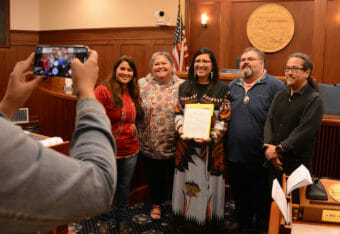
Supporters of House Bill 123, the tribal-recognition bill, pose for a group photo after the Alaska Senate approved the bill on Friday, May 13, 2022. (Photo by James Brooks/Alaska Beacon)

Alaska’s state government would formally recognize all of Alaska’s 229 federally recognized tribes under legislation passed Friday by the state Senate in a 15-0 vote.

If signed into law by Gov. Mike Dunleavy, the measure will be mostly ceremonial. Lawmakers said it nonetheless represents an opportunity to respect Alaska Natives and tribal organizations that have historically been discriminated against by the state.

“I think the fundamental issue is a little bit of respect and recognition,” said Sen. Bert Stedman, R-Sitka.

Some lawmakers said the measure, formally known as House Bill 123, could lead to further agreements between state and tribal organizations on a variety of topics.

“Now the work begins on defining what real government-to-government relationships should look like,” said La quen náay Liz Medicine Crow, who supported the bill and watched it pass the Senate.

“And that’s the next part, that we’re looking forward to seeing how that actually happens,” she said.

The bill must return to the House for a procedural vote before it goes to Dunleavy. A spokesman for the governor said Dunleavy will review the bill when it reaches him.

Effect on ballot measure

The bill is almost identical to a tribal-recognition ballot measure headed to voters this fall. 

If Dunleavy signs the bill or allows the bill to become law without his signature, the ballot measure will be canceled under a provision of the Alaska Constitution that nullifies ballot measures if the Legislature passes a substantially similar law.

Legal analysis conducted by legislative attorneys concluded that the bill is similar enough. Lt. Gov. Kevin Meyer would make the final determination.

Richard Chalyee Éesh Peterson was one of the prime sponsors of the ballot measure and watched as the Senate voted.

He said organizers would be meeting later Friday and that the initiative “is now unnecessary.”

“The ballot initiative never should have happened. It was (because of) a lack of Legislature actions for the last few years,” he said.

Former Rep. Chuck Kopp, R-Anchorage, introduced a similar measure in 2020, but it failed to become law. Rep. Tiffany Zulkosky, D-Bethel, reintroduced it in 2021. 

Members of the Legislature, particularly Republicans, had previously worried that recognizing tribes could create a patchwork of land laws. Sen. Mike Shower, R-Wasilla, said the fear was that the bill would create “230 individual nation-states” scattered across Alaska.

Shower, chair of the Senate State Affairs Committee, heard testimony on the bill and amended it slightly to meet non-Natives’ concerns about the issue.

Ultimately, he joined 14 other senators in support.

Though symbolic, said Sen. Tom Begich, D-Anchorage, recognition “does a whole lot because it provides dignity and respect.”

Sen. Gary Stevens, R-Kodiak, said recognition, “will lead to further conversations” between the state and tribes. 

One example: Legislation near final passage in the House that would have the state partner with tribes through compacts in order to operate schools.

Alaska House rejects $5,500 payout, sends budget to negotiating committee

House Minority Leader Cathy Tilton, R-Wasilla, is disappointed as she leaves the Alaska House of Representatives on Saturday, May 14, 2022. Tilton was among 18 lawmakers on the losing side of a vote to agree with the Senate version of the state’s annual budget. (Photo by James Brooks/Alaska Beacon)

After three days of delay and doubt about the outcome, the Alaska House of Representatives turned down a Senate-written budget containing $5,500 payments for eligible Alaskans. Those opposed to the budget cited concerns about spending exceeding revenue.

The House’s 18-22 vote against the Senate proposal means two different plans will now go to a six-member committee assigned to craft a compromise that can pass both House and Senate.

Speaker of the House Louise Stutes, R-Kodiak, told reporters after the vote that it means Alaskans should not expect a $5,500 payment this year.

Other legislators said the final budget details are uncertain.

“This budget, regardless of the outcome today, is still a work in progress,” said Rep. Sara Rasmussen, R-Anchorage, who voted in favor.

The Senate proposed hundreds of millions of dollars in spending on Anchorage’s and Nome’s ports, plus millions more on projects across the state, but it was a proposed $4,200 Permanent Fund dividend and an additional $1,300 energy payment that dominated discussion.

“I think the main sticking point here between the two budgets is the size of the dividend,” said Rep. Ben Carpenter, R-Nikiski.

Largest budget item

The payments’ combined cost of $3.6 billion was the largest single item in the Senate proposal. That cost, combined with other spending, would have resulted in the largest budget in state history.

Despite an expected multibillion-dollar windfall in oil revenue because of high prices caused by the Russian invasion of Ukraine, the budget would have resulted in a deficit of about $1 billion, requiring the state to spend from savings to close the gap.

Even as individual Alaskans wrote their lawmakers in support of the $5,500, other Alaska residents, plus business and labor groups, lobbied against the Senate budget. 

The AFL-CIO and the Alaska Chamber opposed it, as did the Anchorage Economic Development Corp., Alaska Miners Association, Associated General Contractors, Council of Alaska Producers and the Alaska Support Industry Alliance.

“A concurrence vote for the Senate budget is not conducive to a long-term, sustainable fiscal plan,” the latter groups wrote in a combined letter.

The leaders of the Senate and House majority and minority caucuses met with Gov. Mike Dunleavy earlier in the week. Several attendees said the governor told them he would veto about $1 billion from the budget — including the $1,300 energy payment — if House lawmakers agreed with the Senate plan. Doing so would have eliminated the deficit within the budget. Now, House and Senate negotiators could eliminate the deficit themselves. 

Payment supporters cite high fuel costs

Rep. Tom McKay, R-Anchorage, voted in favor of the Senate plan. He acknowledged the lobbying, some coming from within his own district, but said he wanted to take a statewide view.

He and others said the price of home-heating fuel and transportation gasoline requires that the Legislature make an extraordinary effort to distribute money to Alaska residents.

Rep. Ron Gillham, R-Kenai, said that when he comes into work at the Capitol, he frequently passes someone sleeping on the sidewalk.

The difference between $5,500 and $2,600 — an amount previously approved by the House but rejected by the Senate — could be the difference between getting that person off the street or allowing them to keep sleeping there, he said.

“If I can help that one person, it’s well worth it,” he said.

Lawmakers who spoke in opposition cited the risks of the proposal. If oil prices in the next fiscal year are lower than the $101 per-barrel average predicted by the state, the state’s savings accounts could evaporate, forcing lawmakers to spend more from the Alaska Permanent Fund.

Because the Permanent Fund’s investments provide between half and two-thirds of the state’s general-purpose revenue, overspending could create deficits in the future, encouraging significant budget cuts or tax increases.

Rep. Bart LeBon, R-Fairbanks, was a banker for decades before joining the Legislature. He said that if a business came to him with a business proposal akin to the budget, he wouldn’t approve their loan. 

“This budget, from the other body, does not balance,” he said.

Members cross caucus lines

The final vote crossed party and caucus lines: Four members of the House’s majority coalition voted in favor of the Senate budget, and three members of the House minority voted against it, as did Republican David Eastman, R-Wasilla, who isn’t a member of either caucus.

Stutes appointed Rep. Kelly Merrick, R-Eagle River; Rep. Dan Ortiz, I-Ketchikan; and LeBon to the budget conference committee assigned to negotiate a compromise. All three voted against the Senate version of the budget.

She skipped Rep. Neal Foster, D-Nome, who is co-chair of the House Finance Committee. Foster voted in favor of the Senate’s proposal.

Meeting later Saturday, Senate President Peter Micciche, R-Soldotna, appointed Sens. Bert Stedman, R-Sitka; Click Bishop, R-Fairbanks; and Bill Wielechowski, D-Anchorage, to the conference committee. Wielechowski voted in favor of the $5,500; Stedman and Bishop were opposed.

Stedman said the conference committee will have its first meeting at 3 p.m. Sunday.

Bill aimed at reducing hair discrimination in schools is headed to governor

Sen. David Wilson, R-Wasilla, speaks on the floor of the Alaska Senate on Monday, May 2, 2022 at the Alaska State Capitol in Juneau. (Photo by James Brooks/Alaska Beacon)

The Senate on Wednesday agreed to accept the changes the House made to a bill that aimed to reduce hair discrimination — including the amendment to strip the protection for employees in the workplace. The bill still retains protection in public schools.

“I’ll be voting yes today. Not because I support some of the changes that happened in the other body. But we are running out of time this session and I support where the bill is as it stands, no matter how incremental. This bill as drafted still protects our children of color,” bill sponsor Sen. David Wilson, R-Wasilla, said on the floor Wednesday.

He added: “Just because you have not personally experienced discrimination does not mean discrimination does not exist. I appreciate the body’s support for this piece of legislation. Racism in the workplace is not going away and I expect future work on this issue. The good news, Mr. President, is that people that oppose this piece of legislation are not long for this earth, and so I support the body to vote yes.”

In the bill’s original intent, school boards and employers wouldn’t be allowed to adopt a dress code that: prohibits an individual from wearing a hairstyle that is associated with race; prohibits an individual from wearing a natural hairstyle, regardless of the student’s hair texture or type; or requires a student to permanently or semipermanently alter the student’s natural hair. Natural hairstyle includes, but is not restricted to, braids, locs, twists, tight coils, afros, cornrows, and bantu knots.

The House on Tuesday amended the bill, deleting the portion relating to the workplace, which Democratic Anchorage Sen. Tom Begich referred to as “weakening the bill.” The bill would still reduce hair discrimination in public schools.

The version of the bill that the Senate concurred with also says school boards cannot adopt a dress code that prohibits a student from wearing traditional tribal regalia or objects of cultural significance at a graduation ceremony. The House made that amendment on Tuesday.

The bill is headed to the Governor. Once it’s transmitted, he’ll have to sign, veto, or allow it to become law without his signature.

Site notifications
Update notification options
Subscribe to notifications