Western

Bethel settles out of court with man ‘attacked’ by police officer

Wassillie Gregory and the City of Bethel have settled out of court related to an incident in which the man was roughly arrested by a former Bethel police officer in a grocery store parking lot.

Gregory’s Attorney Sean Brown filed a lawsuit earlier this month against the city and former officer Andrew Reid, seeking damages. He argued that Reid violated Gregory’s civil rights and committed assault and battery in what he described as an “attack” last July.

The complaint says Gregory presented no threat to the officer and that the city is liable for Reid’s conduct. It claims the city knew of other complaints against Reid and did not properly investigate.

Brown says the terms of the settlement are confidential but that the case is dismissed as part of the settlement.

A judge earlier this month dismissed Gregory’s conviction for harassment after the video surfaced in early April.

Gregory pleaded guilty last year to the harassment charge without the assistance of an attorney. He originally faced charges for harassment, disorderly conduct, and resisting arrest. The latter charges were dismissed with original guilty plea.

From a distance the video shows the arrest in which the intoxicated Gregory is slammed to the ground several times. Brown’s complaint on behalf of Gregory says the officer pepper sprayed Gregory in the face and that he suffered a fractured shoulder and rib, requiring medical treatment in Anchorage.

Reid was hired by the city in 2012 and fired in March of this year.

Noorvik man faces kidnapping, attempted sexual assault charges in April attack

An aerial view of Noorvik in August 2011. (Creative Commons photo by Thester11/Wikimedia Creative Commons)

A Noorvik man faces charges of burglary, kidnapping, and attempted sexual assault after being charged with breaking into a neighbor’s home, attacking a woman walking by, and dragging her inside the house.

It all happened on the morning of April 4 in Noorvik, a community of fewer than 700 people about 43 miles east of Kotzebue.

That’s when court documents allege 28-year-old Johnny Nazuruk broke into a home in the Kobuk River community, waited for the woman to walk by, and attacked her — before dragging her inside the house against her will.

A sworn statement from the woman Nazuruk allegedly attacked, as well as investigation from Noorvik village public safety officer John McCrary, say once Nazuruk pulled the woman inside, he threw her down and attacked her, punching and kicking her torso and head. Court documents say Nazuruk then tried to rip off the woman’s clothing. She continued to struggle as he turned to take off her boots. That’s when the woman says Nazuruk “raised up slightly” and she was able to “knee [him] in the groin” and run out of the house.

She fell on the steps leaving the home, just as court documents show Nazuruk caught her leg and tried to pull her back inside. She screamed for help, alerting a local man walking by on his way to work. As the man approached the struggle, investigators say Nazuruk ran back into the house and locked the door. The man then walked the woman home.

Days later, the woman told her story to VPSO McCrary, who interviewed witnesses and sought to arrest Nuzurak—but by then he was already in Nome’s Anvil Mountain Correctional Center, arrested in April on separate charges of resisting arrest.

In all Nazuruk faces five felony charges for the alleged April attack, including burglary, assault, and attempted sexual assault. He also faces one felony charge for kidnapping and one for attempted kidnapping. Nazuruk’s criminal record includes multiple assault convictions, as well as a felony burglary conviction in 2012.

He formally heard the charges in the Nome court Sunday, April 17, and had a first appearance for the Kotzebue court the following day. He remains in custody at AMCC.


Mining plan too close to home for some Nome residents

Lower Dry Creek, pictured above, could become the site of a placer mining operation as early as 2016 according to Nome Gold Alaska. (Photo by Francesca Fenzi/KNOM)

Mining company Nome Gold Alaska has formally opened its doors, and agenda, to Nome residents for the first time. The company called a public meeting to share plans for a placer mining operation near Dry Creek earlier this month.

The plan is a controversial one. Dry Creek is close to central Nome, and part of the proposed mining area would border Greg Kruschek Avenue — near the Nome Recreation Center and public safety building.

The claim’s proximity has raised concerns from residents about the impact of dust, noise and industrial activity in an area that’s near homes, businesses and recreation sites. Nome resident Sue Steinacher attended the open-house meeting, and said her concerns are two-fold.

“There’s the potential impacts on the people who live here – from dust, from noise,” Steinacher said. “That and the fact that the company is under constant scrutiny. To bring this right into the center of town disrupts everyone’s quality of life, and it puts them under a microscope.”

She alluded to the rocky history between Nome residents and the mining company’s recent predecessor. In 2011, Nome Gold — a Canadian-owned company with Russian investors — purchased 11,500 acres in mining claims from Alaska Gold Company.

However, another Canadian company of similar name — Nova Gold, which purchased Alaska Gold — is responsible for the failed Rock Creek Mine that Steinacher describes as a “black eye” on Nome’s recent history. The project left a freshly constructed road and shuttered facilities in its wake, and seems to have made a lasting impression on both residents and city officials.

At a meeting of the Nome City Council on Monday, council members discussed tools available to the city when it comes to holding Nome Gold accountable for the proposed Dry Creek venture. Councilman Stan Anderson asked if the city had existing drilling or noise ordinances at its disposal — or if one could be developed in the future.

“I have nothing against mining, but when it’s going to be in my front and back yard then I do have a problem with it,” Anderson said.

Upper Dry Creek, an area many residents utilize for recreation, could also be developed in Nome Gold’s placer mining plans. (Photo by Francesca Fenzi/KNOM)

Steinacher also voiced the need for a guarantee — that Nome Gold will be minimally intrusive in its operations, and won’t leave another incomplete project behind.

“I am concerned,” said Steinacher. “I think that it is very easy to say at this stage: ‘We’re going to reclaim it and it’s going to look great.’ Those are all wonderful ideas, but you’re not going to get that in writing. There’s absolutely no guarantee of what you’ll get when they’re done.”

“Well, we have to do it or we don’t mine. We’re put out of business,” said Cecil Conner, Nome Gold’s general manager. “But that’s not going to happen because we’re going to make sure we take care of our land.”

Conner said that when it comes to project accountability, the company is held to strict standards dictated by the Army Corps of Engineers (and other state and federal agencies). But he acknowledges that local trust is another matter — and says this month’s open-house signals a shift in the company’s approach to community outreach.

“We want to be a part of the community,” said Conner. “We want to be a friend to the community, not a foe.”

Indeed, the mining company is not without local supporters. Nome Gold employee Kody Cannaday said in a written statement that he’s grateful for the paycheck the company provides, adding: “Nome Gold has a big positive impact on the local businesses.”

Others may remain skeptical, but Steinacher says — when it comes to Dry Creek — she hopes community members will continue to speak up…whether they’re for or against.

“Maybe this isn’t really a sound project and shouldn’t be done. But maybe it’s going to be done. But the more scrutiny it gets the more concerns that are expressed, the better it will make that project in the long run.”

Nome Gold is still in the permit-seeking stage of development for Dry Creek, but could begin mining as early as 2016.


Bills in U.S. House, Senate would transfer land to Native corporation for Arctic infrastructure

A map of the Point Spencer allotment shows the BSNC portion in green, the Coast Guard portion in purple, and the State of Alaska portion in checkerboard. (Image courtesy of the Office of Rep. Don Young, Google)

Opportunities to build up up Arctic infrastructure are advancing with a bill introduced this week in both the U.S. House and Senate. The bill aims to transfer land near a natural deep water port on the Seward Peninsula to state and regional shareholders.

Point Spencer is a spit of land on the western edge of the Seward Peninsula, near the natural harbor of Port Clarence, about 120 nautical miles northwest of Nome. A Coast Guard-operated navigation facility at the point shuttered in 2010, and since then, efforts have been underway to transfer that land to the Bering Straits Native Corporation (as a concession under the Alaska Native Claims Settlement Act), with the Coast Guard and the State of Alaska maintaining small footholds for future expansion.

The bill is sponsored by Rep. Don Young, who sponsored a similar bill last year in the house. This year Sen. Lisa Murkowski is advocating a companion bill. Young said the goal of the legislation is to open the area up for development, but he insists it won’t conflict with similar deep-water port efforts in Nome announced in February.

“This does not affect the Nome potential, that is being studied by the [U.S. Army] Corps of Engineers,” Young said from his Washington, D.C. office Tuesday. “This just gives it to the Native corporation to, in fact, have a potential port with a private-public involvement.”

New in this year’s version of the bill is a conveyance map assigning fewer than 300 acres to the Coast Guard and the state, with the vast majority—more than 2,000 acres, including an airstrip—allotted to BSNC.

Those potential partnerships are what Bering Straits Native Corporation spokesperson Matt Ganley said would be at the heart of any development that might occur at the site. Last summer BSNC completed an economic feasibility study for a port facility at Point Spencer, finding that any seaport would need to rely on an economic backbone other than international shipping; long-range freighters simply won’t need to stop in western Alaska.

At a projected cost of about $5 million annually, Ganley said any Point Spencer development could support oil and gas exploration in Arctic waters, act as the staging ground for oil spill response efforts in the region, and become an outlet for mining and other resource extraction in the Arctic.

Young said the first step is to transfer the lands to allow those partnerships to flourish. Though he’s agnostic as to how the point would ultimately be used, he said the opportunities for a port work well with Alaska’s other natural resources.

“I’m looking down 100 years from now, I see the whole Arctic opening up to mineral resource development and an ability to shop product to around the world is going to be very needed,” Young said. “I want to develop a job corps based resource industry in the Arctic.”

Ganley said locals in the neighboring communities of Brevig Mission and Teller, to the east of Point Spencer, have expressed support for potential jobs and industry should Point Spencer be developed, while also voicing concerns over potential impacts to subsistence resources. Like previous versions of the bill, however, the legislation has provisions for archeological and cultural artifacts in the area, but it does not mention subsistence.


Community scientists travel to Dillingham for water quality training

Sue Mauger, Science Director at Cook Inlet Keepers, trains IGAP Coordinators on how to check water temperature on Nielsen Creek near Dillingham. (Photo by Matt Martin/KDLG)
Sue Mauger, Science Director at Cook Inlet Keepers, trains IGAP Coordinators on how to check water temperature on Nielsen Creek near Dillingham.
(Photo by Matt Martin/KDLG)

Villagers from Togiak, Illiamna, Port Heiden, among others, traveled to Dillingham last week for scientific training. It’s part of the Indian Environmental General Assistance Program or IGAP. The researchers are looking to set a baseline data set of water quality and temperature in the region.

The Environmental Protection Agency requires all IGAP coordinators to attend an annual training. The coordinators record water quality, and this is the first year they’ll also measure the water temperature. Sue Mauger, a Science Director with Cook Inlet Keepers, headed up the training.

“So of the work we are doing, the water temperature, we are targeting salmon streams because we are trying to see whether we have temperatures that (cause) stress to salmon,” added Mauger.

Mauger is one of two full-time researchers who work with the community scientists. Dan Bogan is the other. He’s been a part of this annual training for a decade.

“I guess what motiates a lot of the people that are here are the threats on the horizon in some of the villages; mining threats, development coming in and potentially changing water quality,” Bogan said.

Bogan says the work of the environmental coordinators set up a baseline that researchers like himself can use to see what, if any, changes happen to the water systems in the future. And that data would be hard to come by without the researchers.

“We have 40% of the nation’s surface water in this state and know about less than1% of it,” said Bogan. “In just about every one of these villages they are the only people out there collecting this information.”

Aisha Upton flew in from Togiak for the training. She says she’s ready to put her new skills to work when she gets home.

“Get everybody informed about how important it is to save our environment and especially preserve it for many years to come, for the next generation,” Upton said.


First Kuskokwim restrictions expected May 21

Salmon strips drying on a rack in Bethel, 2015. (Photo by Daysha Eaton)

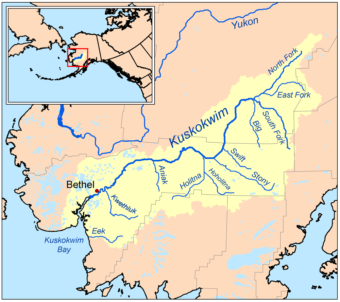
The first fishing restrictions on the Kuskokwim River are expected to go into effect on May 21st as managers are expecting another poor king salmon run. With the lessons learned from 2014, managers hope to bring enough king salmon to spawning grounds and allow for limited fishing along the way.

For the second year in a row, federal staff will manage day-to-day fishing on the Kuskokwim River from the mouth to Aniak.

Neil LaLonde is the refuge manager and in-season manager during the chinook run. He says many people have bought their nets over the winter, and will be ready to fish.

“We feel that if we didn’t go to some type of schedule that harvest should be much greater with the sheer amount of additional 4-inch nets that are available on the river,” said LaLonde.

Managers will close fishing to all but federal qualified subsistence users – that is people who live in communities on or near the Kuskokwim, a provision that’s unique to federal management. Sport fishing will be closed.

A new set of gill net closures is anticipated for several tributaries. As of June 7th, there will be no gill net fishing on the Kwethluk, Kisaralik, Kasigluk, and Tuluksak rivers.

“Those tributaries have not done well specifically in this drainage over the last several years,” LaLonde said.

LaLonde says subsistence fishing is open now with no restrictions on gear until the first closures begin on the lower river on May 21st. He’s planned extensive engagement with the tribes and the recently established Kuskokwim River Inter-Tribal Fisheries Commission and continued work with the state, which runs many of the rivers’ monitoring projects.

The run is forecast to be slightly better than 2014, which saw the lowest subsistence take of king salmon on record, but conservation and making escapement will remain the top priority.


Site notifications
Update notification options
Subscribe to notifications