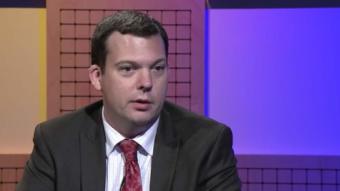
Alaska Statehood Pioneers: In Their Own Words

Episode 3: Tom Stewart

Episode transcript

Tom Stewart: But the net result was that the convention was the most representative body that had ever been assembled in a governmental function in Alaska. We had people from Ketchikan, Wrangell, Petersburg, Juneau, Haines, Valdez, Cordova, Kodiak, Seward, Dillingham, Palmer, Unalakleet, Nome, Kotzebue, far and away – the most representative group that had ever assembled for a governmental purposeOpening Titles

Narrator: Tom Stewart was the fourth of five children born in Idaho, who found his was to Alaska through his father, a mining engineer who worked the gold mines in Juneau. As a young man he was a ski bum, but because of his role later on in turning the territory of Alaska into the 49th state, friend and fellow judge Walter Carpeneti once likened him to “Alaska’s Ben Franklin.”

Intertitle: Growing up in Juneau

Tom Stewart: My father was a mining engineer and a graduate of the first class at the University of Montana Missoula. And worked initially for the US Geological Survey. …

And he came here in 1910 engaged by Fred Bradley. Mountain across the channel is named Mt. Bradley.

Tom Stewart: Fred Bradley had been the Superintendent of the – he was at the time the Superintendent of the Treadwell Mines which was the big operating mine, but they were about to develop the Alaska Juneau Gold Mine.

And he contracted with my father to come up here and spend a year or two and re-survey their mining claims to prove the claims that they owned against competing claimants at the Perseverance Valley.

In 1919, governor at the time I think it was Riggs I’m not sure appointed him to be the Territorial Mine Inspector and for the next 30 years until 1949 that was the position that he held.

Intertitle: “Chief Engineer on a No. 2 Shovel”

Tom Stewart: Well I had a scholarship to the Colorado School of Mines, but I decided I didn’t want to be a mining engineer. So the State of Washington offered Alaskans from the Territory of Alaska the same terms going to their state school as residents of Washington. So it was a much more developed facility than the school at Fairbanks and so I went to the University of Washington and I took a degree there. I started out in ’36, but I didn’t have enough money so I came home and I worked in the mine here, not underground but in the mill. I had – my father distinguished my job as saying I was chief engineer on a number two shovel – I moved muck. I lost my hearing working along side the grinding machines. And I was graduated finally in April of ’41 I took the little extra credit hours and finished a quarter early.

I took my degree at the University of Washington in April, late March early April and in the meantime the last two years my grade average rather dropped. I had a pretty decent grade average. Because I took up skiing and I would go skiing right after five o’clock on Friday and come back at eleven o’clock Sunday night and skied at Mt. Baker and I had a wonderful life skiing, but my academic record suffered.

Intertitle: Ski Bum to Ski Trooper

Tom Stewart: When I got my degree at the University I went to Sun Valley. I got a ride with a friend. And I stayed until I had ten cents left to my name.

It’s 3500 feet up there and I used to ski it 10 times a day, that’s 35,000 downhill feet, but vertical feet. I got back to Seattle and walked down the street to the draft office and said I’m ready to go. This was in April of ’41 about eight months before Pearl Harbor. So I joined the Army and sent me over to Fort Lewis and got basic training.

So I was chosen for this detail. There were three of us. A sergeant, a corporal, and buck private Stewart. And we were guards on a secret shipment on a little freighter that sailed out of Tacoma for Sitka where the new Naval base was being built. I later learned that that secret shipment was the first radar machine coming to Alaska. And we stood 24-hour guard, four on and eight off on the bow of that ship. It took 14 days to go from Tacoma to Sitka cause we went on the outside and run into a big storm, rolled 40 degrees, made four knots an hour, but we got to Sitka and that was a casual and I was assigned to the West by God Virginia National Guard, which was guarding – the assignment was to guard the base shore units to protect against the Japanese invasion.

I decided I really didn’t belong there for the war. We were in the war after Pearl Harbor and a cadre of officers came through examining soldiers for officer candidate school. And I was selected to go with a master sergeant and a buck sergeant and we went to Fort Benning, Georgia and I became a 90-day wonder. Second lieutenant in 90 days. And fortunately I had a shirttail relative, a colonel who was second in command at Fort Benning, was a nephew of a woman who was married to my uncle and she wrote him and he and his wife invited me to their home when I came and he said this is a tough program but if you make it you tell me where you want to go and I’ll see that you get there. And I did make it and I said I want to go to the ski troops. There was one battalion called the First Battalion 87th Mountain Infantry Reinforcement at Fort Benning, I mean at Fort Lewis and that is where I was assigned and I spent the rest of my career in what became the 10th Mountain Division. …

I was seldom on the front line. I was usually about 300 yards back cause I was a company commander of First Battalion Headquarters Company. …

My job was to protect, to provide parameter defense for the battalion headquarters which was the communications central and the battalion headquarters was usually about 300 yards back of the actual fighting front. I got into some pretty hot action, especially crossing the Po River, a lot of shrapnel splattering around. My communications sergeant was lying in a ditch next to me and the shrapnel was – the shells were exploding in the trees above us and he gave a yelp and a piece of shrapnel just about severed his wrist. And his wrist – his hand was about a foot from my head. If it had been another foot, it would have gone – that would have been the end of me.

And a lot of them when they came back from the war became instructors at Sun Valley and many other resorts. The 10th Mountain people set up a lot of ski areas like Aspen, Vail, a lot of the Colorado resorts had their background in the 10th Mountain Division.

Intertitle: And in Alaska?

Over on Douglas Island. The bridge had been built in 1935 and right behind the knoll that we’re seeing across the channel from where we’re sitting there is something called the Douglas ski bowl.

And we – I bought a rope tow. When I got out of the Army in the fall of ’45 I had never been in the interior of Alaska. I wanted to do that. I was still in uniform on terminal leave. I was a Captain at the time and I met my brother who was the head of the Valdez District of the Road Commission. We drove up to Glennallen, down the new Glenn Highway into Anchorage, took the train to Seward and on the dock in Seward I found sort of a homemade ski tow that some soldiers had developed. They had a Dodge truck engine and several hundred feet of one-inch rope and wooden wheels for the pulleys. I bought the whole outfit for $50 and shipped it to Juneau. And we manhandled it up the hill and set up the rope tow there and it operated for 25 years.

Intertitle: Red Flag

After I got a Masters Degree of the School of Advanced International Studies, I was aiming for Russian studies. I went to Yale Law School and I was graduated from the Yale Law School in 1950 and I went to the State Department to present my credentials. I had the summer of ’49 in Middlebury College in the Russian School and I could speak Russian, not fluently but acceptably. And they said we loved to have somebody like you but we don’t have any money for Russian Studies. This was at the very beginning of McCarthyism. Anybody involved in Russian Studies was suspect. And the man that interviewed me for a position in the State Department on the Russian Desk, which I was aiming for, said if I were you I’d go back to Alaska.

So I did. I came home, lived in this house with my father and my stepmother.

Tom Stewart: And he [DAD] was a very close friend of Ernest Gruening who was the Governor and just lived down the street and his son – he had three sons; Ernest, Jr. who was killed in the war, Peter who was the youngest son who committed suicide out in Australia, and the middle son was named Huntington – Hunt Gruening. And he and is wife were living in the mansion and we were contemporaries and got to be very dear friends. So I used to spend a lot of time with the Gruenings and my parents spent a lot of time with the Gruenings and of course Bob Bartlett the delegate to Congress, lived right in the house next door and was a very dear friend of mine and of my parents.

Intertitle: Adlai Stevenson and Alaska

Tom Stewart: In the meantime I became very active in the Democratic Party and I became the chairman in southeast Alaska. Adlai Stevenson had been the candidate for president. And after he lost to Eisenhower the first time he made a highly publicized trip to the Soviet Union, spent about six weeks over there getting acquainted with the Soviet leadership and making up his own mind about what that was all about.

And when he returned there was a meeting, a national meeting of the Democratic National Committeemen, Committeewomen, and the state chairpersons of the party at each state. It was held in Chicago in the fall of ’43, no ’53. And I learned that nobody from Alaska was going.

So I got proxies from all of those people and I went to Chicago on my own. And Gruening was a good friend of Stevenson’s, so I had an audience with Stevenson after the meeting was completed. I was supposed to have 15 minutes with him and he was quite interested because I was talking to him about statehood trying to enlist his support to support our move. And I had a whole half an hour with him and invited him to come to Alaska and see for himself. I couldn’t officially authorize the trip cause I was an Assistant Attorney General and didn’t have any position in the government to do that, but I had some good friends in Gruening and Bartlett and told them that I had made this invitation and they needed to make it official from their positions as Governor and of course Bartlett was the delegate to Congress.

So they did and Stevenson came here the summer of ’54, stopped in Juneau and I met him in Prince Rupert and came on the ship with him.

There were more people supporting statehood by far than were opposed. The opposition came mainly from the canned salmon industry because they feared local control of the fisheries. They had had a favorite position with the federal agencies in the fisheries field and they were opposed and the gold mining industry was opposed because they feared that statehood was going they forgot it was going to bring more taxes and make their operations more difficult economically. And so the newspapers here in Southeast, which was the center of the fishing industry, except for Bristol Bay, the local paper in Juneau opposed and one of the two papers in Ketchikan was opposed.

…In territorial days the major resources were indeed controlled by nonresidents. Salmon industry, canned salmon because the salmon was marketed by being canned. It was before the days of the freezer ships and sending fresh frozen materials out.

And the same with the mining industry. The mining industry if it is going to be large it requires a lot of capital and the capital basically was not very much available to Alaskans, still isn’t today. You have to go outside the state to get big money by and large, unless your name is Elmer Rasmuson or something like that.

There was a man named Allen Shattuck who was a Democrat but he was an anti-Gruening Democrat and he was an insurance man, retired, living in a beach home across the airport. And so when I got to Juneau I got – and he had written a pamphlet called the Case Against Statehood. I arranged for Stevenson and a couple of the men that were with him to sit down with Allen Shattuck and his son Curtis Shattuck, who was a Democrat also but anti-Gruening. And they had a visit with him and then Stevenson went to Anchorage and gave a speech to 5000 people present. They had it at the ballpark, Mulcahey Stadium, largest crowd ever assembled for a political event and gave a rousing speech in favor of statehood.

Intertitle: McCarthyism and Whiskey

Tom Stewart: But in any event that’s how I got in the business and in 1954 the 53 session of the legislature was a debacle. It reflected what was happening in the nation, McCarthyism. They formed a legislative investigating committee to search out Communists in the government. They found one Communist. He was a longshoreman in Skagway and he had an idealistic view of Communism as something that was good for the common people.

And those years there was no such thing as the Legislative Affairs Agency. So the Assistant Attorney General served the legislature by writing bills for them. The legislators would come to our offices and say we want a bill on such and such a subject and here’s what we – the idea of it and so I and my compatriot who was John Dimond, the son of Tony Dimond, a very dear friend, wrote legislation. And I spent a lot of time in the legislature.

The last night I was down just outside the chamber, went into the men’s room and there was a wastebasket about three feet high and a foot and a half in diameter, filled to the brim with whiskey bottles. The Speaker of the House, it was a man from Fairbanks named George Miscovich, had his coffee cup in his desk and full of whiskey. And the house never did adjourn, they just walked off. It was a debacle. It was – there were I think about 20 Republicans and 4 Democrats in the House. The Senate was evenly split. There were 16 members on the Senate – 8 Republicans and 8 Democrats. It took them three weeks to organize and choose a President of Senate when they finally compromised.

That session was a debacle. And the people of Alaska sensed that and so in the next election, which took place in 1954, there was a complete shift. There were I think 21 members of the house were Democrats and three were Republicans. In the senate there were about 12 or 13 members who were Democrats and three Republicans.

And right after the election when the new complex of the legislature was known there was an assemblage of Democratic leaders in Fairbanks in the home of a man named Alex Miller who had grown up in Juneau. I had known him since he was a child. And we kind of parceled out functions for the upcoming session. We were going to reorganize the legislature. Cut down the number of committees, have parallel committees in the house and the senate so they could communicate better, and we assigned jobs to various people. Some of the people from Fairbanks were assigned particularly to the reorganization of the body and I drew the job of preparing for the holding of the Constitutional Convention.

So when the legislature convened in January of ’55 I was the chairman of the house committee on statehood and federal relations. And a fellow named Bill Egan was the chairman of the senate committee on statehood and federal relations.

Intertitle: Memorializing the Territory

Tom Stewart: As a territory if we wanted some official expression to the President or the Congress we had to write a memorial asking them to do something and it isn’t very long – maybe I should read it. It is House Joint Memorial Number 1 passed by the House January 25, 1955 and by the Senate February 8th. It is addressed to the Honorable Dwight D. Eisenhower, President of the United States who was not especially in favor of statement and to the Congress of the United States.

In memorial of the legislature of the Territory of Alaska in 22nd Session assembled respectfully submits that:

We representatives of the citizens of Alaska again appeal to you the duly constituted representatives of all the people of the United States that you may recognize us and our constituency as equal citizens under the democratic flag of America. We remind you again that the people of Alaska have demonstrated with all their history their territorial status, their inherence to the principles upon which the government of the United States was founded and remind you by referendum and by acclamation through our land an overwhelming majority of our people have declared unequivocally their desire for statement and the right of a free people to govern themselves. We recall to you that your own electors through the platforms of the major political parties and by their popular accord have given you a mandate for statement for Alaska and therefore we ask that you collectively and as individuals dismiss all partisan concerns, look only to the merits of our cause, recognizing correctly injustice we suffer in not being allowed to govern ourselves or participate in the election of the President or having voting representation in the Congress, all of which may be cured by enabling immediate statehood for Alaska your memorialists ever pray.

I wrote that – that’s the way I felt at the time.

Intertitle: “How do you set up a convention?”

Tom Stewart: But in the meantime after that meeting I resigned my job as Assistant Attorney General and on my own, spent my own money. I was not married. I decided that there wasn’t really anybody in Alaska who knew much about how to set up structure and operate a Constitutional Convention. So I made a six week long trip across the country. I went to the University of Washington. I went to the University of Chicago. I went to Public Administration Service in Chicago. I went to the University of Illinois, Evanston I think it was. I went to Harvard. I went to Yale, which was my school. I went to Columbia. I went to Princeton and then New Jersey I went to Trenton and met with Mrs. Katzenbach who was a Vice President of the New Jersey Convention of ’46, which was a very successful convention. And I met with her and some other people that had been delegates. I met with a professor named John Sligh at Princeton, who was a distinguished figure in the academic world in state government, state constitutions. And I went to Washington, DC and I met with people at the legislative reference service of the Library of Congress. I met with the officers of the American Political Science Association.

And everywhere I went I said how do you set up a convention? How do you get qualified advisors to help you work on the substance of a constitution? And I got some excellent advice from Mrs. Katzenbach, whose son Nick Katzenbach had been in the law school a year or so ahead of me and later became the Attorney General of the United States under Johnson. She said hold your convention at the State University. I said we don’t have a State University. We have something called the Alaska Agricultural College and School of Mines. Well hold it there instead of in the capitol. Because the capitol has entrenched lobbying interests and they will be lobbying for their pet projects. If you go to the University you will have a library facility. It is a much better scene. …

It was an unpopular decision in Juneau because there were a lot of people in Juneau who were concerned even in those days about the possibility of moving the capitol. And I remember going to a Chamber of Commerce luncheon and Curtis Shattuck, whom I already described to you, was an anti-Gruening Democrat, sitting across the table from me. Underneath the table he kicked me severely in the shins because I had promoted the idea of having the convention at the University.

When we organized it because of the background that I had acquired on this trip across the nation Bill Egan and I met. We had been good friends politically and otherwise and decided that I should be the chairman of the joint house and senate committee. He was the chairman of the senate committee and that we would meet together rather than separately to build a bill to call the convention. And that’s what we did. We wrote this bill. This is just Chapter 46 of the session laws of 1955. And it was critical to the success of the convention.

For one thing in that 53 session of the legislature in the First Judicial District, Southeast Alaska, I think there were six members. Five of them were from Juneau. One was from Petersburg. Nobody from Ketchikan, Wrangell, Sitka, Haines, Skagway. Second District they were all from Nome. Nobody from Kotzebue. Nobody from Unalakleet. Third District there were 10 members of the house. All ten of them were from Anchorage. Nobody from Kodiak. Nobody from Cordova. Nobody from Valdez. Nobody from Palmer. So we determined that there should be representation from every community in Alaska that had about a thousand people or more.

And so we created special election districts, 22 of them.

Intertitle: “The most representative body that had ever been assembled”

Tom Stewart: And we decided on a convention of 55 members because that would give us an opportunity to have better spread. Forty-eight of those members were elected from those 22 – from those districts, but there was one district at large. So seven of the members ran at large over the whole territory. They were people like Ralph Rivers and his brother Vic Rivers, who were well known. Ralph had been the Attorney General elected territorial wide and Vic had been the President of the Senate. And there were four or five others that ran at large, but the net result was that the convention was the most representative body that had ever been assembled in a governmental function in Alaska. We had people from Ketchikan, Wrangell, Petersburg, Juneau, Haines, Valdez, Cordova, Kodiak, Seward, Dillingham, Palmer, Unalakleet, Nome, Kotzebue, far and away – the most representative group that had ever assembled for a governmental purpose. Today you couldn’t do that because the Supreme Court decision in Baker vs. Carr determined that for an election to state legislatures one man – one vote. The districts have to have drawing of equal populations within a small percentage and it would not be possible to have that kind of a body assembled, but at that time it was and that was a critical function – a critical aspect of the success of the convention because the people at large knew that they had representatives participating in the decisions that were made there.

In light of this bill and I basically wrote it, I was dealing with a man named Ken Johnson. Ken Johnson was the chairman of the house committee on finance. We had to get money and I worked closely with him. And he said we can get you $350,000 and there was $80,000 left in the coffers of the statehood committee.

So he went to Bob Atwood and said look I’ll give you $350,000; you can use the $80,000 that you have, if you make Stewart the Executive Director of the committee and let him set up the pre-convention studies. So I became the Executive Director of the Statehood Committee and my office – I say my office, I had one secretary, oversaw the preparation of the pre-convention studies. I wanted to go out and hire people that we selected from this University or that University, people that we – I could feel were going to work with Alaskans. Atwood had a different idea.

And I had a telegram from him, representative from Public Administration Service in Chicago will be in Juneau next week and they are going to do the pre-convention studies. Well in retrospect Bob Atwood was right and I was wrong cause we would have had the time and the expertise together with that group of people. PAS was in the business of doing this kind of thing. They had done it for states. They had done it for cities. They had done it for other nations.

And the man they sent was a man named John Cochran, who was very experienced. And John and I immediately hit it off and he assembled a staff, some people from Brookings, from various Universities. For example he had a man named – I don’t remember the name at the moment. I’ll think of it in a minute. And set them to work July, August, September, October drafting this three-volume set of studies of state constitutions. In the meantime they wrote articles to newspapers detailing what the convention was going to face so that the populace in March would have a better idea of what a Constitutional Convention was about and how they would function.

Intertitle: Alaska Constitutional Convention, November 1955 – February 1956

Tom Stewart: When it came to the organization of the convention in November I had not anticipated – I of course was executive officer of the statehood committee and I hadn’t anticipated being an officer of the convention. I was not a delegate. My father was a delegate, but I was not. And Cochran came to me and he said you should be the secretary of this convention, in charge of its administration.

And I was elected to be the secretary of the convention so I resigned as executive officer of the statehood committee and served as the secretary of the convention in charge of all the administrative aspects – getting these consultants to come, arranging their travel, arranging all the physical space, all the details and structure of that convention.

Looking back on it and I don’t think it had been seriously talked about having the convention in Fairbanks. When I came back from New Jersey and after that discussion with Mrs. Katzenbach I was quite convinced and I took to the committee let’s have the convention in Fairbanks at the University.

It was the remoteness, the middle of the winter. It was a cold winter – 50 below zero.

There were no lobbyists in Fairbanks, except one and what do you suppose that was? I’ll show you – the only organized group that came and lobbied the convention Article 7 – Health, Education, and Welfare. It is one, two, three, four short paragraphs. The education lobby. The school superintendents came to represent their representatives to Fairbanks and they had a three-page detailed article on education.

The constitution says about education there are three sentences. The legislature shall by general law establish and maintain a system of public schools open to all children of the state and may provide for other public educational institutions. Schools and institutions so established shall be free from sectarian control. No money shall be paid from public funds for the direct benefit of any religious or other private educational institution.

That’s the whole constitution on education. Fundamental basic concept. The details are left to the legislature.

Tom Stewart: And when the convention assembled we had published this three volume set of studies and it was done on an old A. B. Dick mimeograph machine, bound in a paper cover.

There was a question about consultants. On the way back from Hawaii I went to the University of Colorado at Boulder. There was a national meeting of the American Political Science Association. And I had the names of several of the leaders of that organization. And I said I would like to find the names of people that can be consultants for natural resources, for elections, for the executive branch, for the legislative branch, for the judicial branch and so forth. So I canvassed about 30 or 40 people at that meeting. And said now I don’t have any authority to hire you, but would you be willing to consider coming to Alaska in the middle of winter and spending a week or two or three or more as a consultant to the committee in your specialty. And I got a list of about 30 or 35 names. And I brought back and was able to give that to the committees and let them take their choice from people that had promised yes they would come if the convention decided to hire them.

Virtually all the committees got expert academic people to come and consult with them for a week or two or three as the case may be.

Intertitle: Article 8, Enshrining Sustainability

Tom Stewart: Common Use. Wherever occurring in their natural state, fish, wildlife, and waters are reserved to the people for common use. General authority. The legislature shall provide for the utilization, development, and conservation of all natural resources belonging to the state, including land and waters for the maximum benefits of its people.

You won’t find that in any other constitution.

You know the consultant to that committee was a professor from – I have forgotten what school he was from then. He is now had a career in Indiana State University named Vincent Ostrum. And because my father was a member of that committee and dealing with him on especially the mining aspects of it – mineral rights. They were having a tough time putting together an article, so they had a Sunday session. It was in the basement of a church in Fairbanks and I went to it just as an observer. I think I was the only person other than the committee members who were there. And Ostrum was up at a blackboard and getting suggestions from various delegates, people that represented Alder Lee in the fisheries and I can’t remember his name now, the fellow who ran the F. E. Company, the Fairbanks Exploration, ran the big gold dredges. My father of course who was the – who would have been the mine inspector, Commissioner of Mines for years.

They all had a lot of background in the management of the resources that their professional lives had been concerned with and kind of pooled together their thoughts and helped that in an outline of this article, which he did on the blackboard that day. …

Ostrum told me that working with that committee to him was almost a spiritual experience. The depth of understanding that they expressed about the use of the resources remained through his life impressed by that as one of the unique experiences professionally that he has ever had.

Intertitle: The Alaska Tenessee Plan

Tom Stewart: There was an unlikely individual by the name of George H. Lee Lehleitner. George Lee Lehleitner had been a Naval commander in World War II assigned in Hawaii and he had gotten to know Joe Farrington, who was the delegate to Congress from Hawaii as Bartlett was from Alaska and become friends with him.

He knew that Hawaii was aspiring for statehood. He didn’t know anything about Alaska.

He got the legislative reference service of the Library of Congress to research the history of the admission of states and he found that the last seven territories on the way to becoming a state each of them had elected a provisional delegation to the Congress – two senators and a representative to go to Washington sponsored by the territorial government to lobby for statehood.

He recognized that the process by which legislation gets enacted is – especially in the senate but also in the house is one in which somebody has something they want to do and they contact other members who are their friends and say now if you’ll vote for this proposal for me, you can be sure that I’ll support what you want. And that’s he envisioned these people would do. And he tried to persuade the Hawaiians when they wrote their constitution their convention of 1950 to elect a provisional delegation, then send them to Washington. They could call in every senator and every house member and say I am the duly elected provisional senator or house member from my territory and if you vote for statehood for us, you can be sure that I’ll be back here as a full-fledged member and I’ll support your cause. Vote trading. He tried to persuade the Hawaiians and they determined not to do it.

He never had anything to do with Alaska, but he heard that Alaska was going to have a constitutional convention.

He got acquainted with Bob Bartlett and he said to Bartlett I’d like to go to Alaska and try to persuade the Alaskans to do that. And so Bartlett gave him an introduction. He gave him an introduction to me in Juneau and I had – I collected all the people that were running to be delegates to the convention in this room.

And I was at the, I think you might call it a smoke-filled room but it was the session that really decided on specific things to do and there were about 20 of us in that room. Most of them were delegates but I was there. I was an elected officer of the convention. And we discussed it back and forth and we decided yes, let’s do it.

So when the convention sent questions to the people to be voted on there were three questions. The first one was shall the constitution as drafted by the convention be adopted? The second one was called the Alaska Tennessee Plan because Tennessee was the first territory to use this device and shall we elect provisional senators and a house member and send them to Washington as official lobbyists of the Territory of Alaska? Number three shall fish traps be abolished? Because the fish – involved in the invention is a fellow from Petersburg particularly by the name of Elder Lee, who was desperate that – to get rid of fish traps because the fish traps had been mismanaged and were seriously damaging the fishery.

Those three propositions went to the voters in April of ’56 and I don’t remember it was something like 65 to 35 the vote in favor of each of them.

And then there was an election. An Ernest Gruening was elected as provisional senator and Bill Egan was elected a provisional senator. He in the meantime had been the president of the convention and Ralph Rivers, former Attorney General and former member of the legislature was elected to the house.

It was not a foregone conclusion. And there had to be a lot of persuasion. The southern senators of course were like Stevens.

The south was Democrat and once they got in office they stayed there. And their power in the senate derives from tenure. The longer they are there, the more powerful they become. And they were jealous of that power and they were suspicious of it being invaded by people rom a new entity. Well it had an obvious effect of making each vote a little bit less effective cause there were more votes in the senate. No, I don’t think it was a foregone conclusion. I don’t think it would have happened if it hadn’t been for the energy of the likes of Ernest Gruening and Bob Bartlett and people that worked on it.

Intertitle: Unconventional Heartache: Marrying Jane

Tom Stewart: I met her [Jane] probably in about 19 – late ’53 or early ’54. I was interested in renewing the ability to play the piano a little bit and she was the most prominent piano teacher in Juneau. So I talked with her about taking some piano lessons and I got some other lessons. I had not been married before. She had been married previously and she had four children. So for the next year or so we dated and did things with the children and I enjoyed the children and they seemed to enjoy being with me.

A doctor in Fairbanks told me that he thought that I might have a heart problem because I was working long hours, a lot of stress, and I began to get pains in my chest. I had a very dear friend, a first cousin, at the Virginia Mason Hospital in Seattle.

And so I went to the Virginia Mason Hospital and they did a lot of tests and my cousin said to me your heart problem is that lady. So I came back and I asked her to marry me and she decided that she should consult with the four children. And she had been dating another fellow as well, as a matter of a fact a couple of them. One of them is the fellow who did the Stewart bowl. So she asked the children if she were to remarry, she’d already accepted me basically. If she were to remarry, should it be I or the other fellow. And the oldest girl said Tom, the second girl said the other fellow, and the third girl said Tom. Those three girls were 9, 7, and 5. And the three-year-old boy, when she asked him, said Gene Autry.

So I came down, I was in Fairbanks of course for the convention and Ernest Patty, the President of the University, who had been an old friend, I had worked with him closely in getting the physical arrangements for the convention in that building, which is now called Constitution Hall. It was built to be as kind of a student union building. And so we planned to be married at the convention while it was still in recess and he gave us the use of his home, beautiful home of the President, because he was very well to do and he had a similar home in Seattle and he and his wife were going to go to Seattle where they had a son for the Christmas holidays.

So I came down here and spent Christmas with my – with those children and Jane and then she and I traveled to Anchorage. And we were to be married by a man named Fred McGinnis. Fred McGinnis had been the Pastor of the Methodist Church in Juneau, very, very competent, bright fellow.

So we got on the train, went to Fairbanks and our friend Fred McGinnis was stuck in Kodiak. And I don’t remember the name of the man that did the wedding in the President’s home. My parents were there and my sister, a very dear friend from here that I had been skiing with and had been living with me before Jane and I courted. That was the wedding party and we stayed in the home for a week. And she came back to take care of the four children and shortly after the convention ended I arranged with the ex-husband to adopt them and he didn’t object. So I adopted them in the spring of ’56. And reared from that point.

Intertitle: Closing the Book on Statehood

Tom Stewart: Well this is the book called The State of Alaska and on the dust jacket it says a definitive history of America’s northern most frontier by Ernest Gruening, Governor of Alaska 1939 to 1953. …

I believe that he gave me this copy. And I was moved by his inscription, which says For Tom Stewart. Who has done more than any other of Alaska’s young men to bring the state of Alaska into being. With high esteem and affection and regard the author Ernest Gruening. So I rather value that book.

Credits:

Recorded September 23, 2003, at Tom Stewart’s home in Juneau, Alaska.

Died December 12, 2007.


Full interview transcript

Judge Tom Stewart
Interviewed by Dr. Terrence ColeTerence: Okay today’s September 23, 2003 and we’re had Judge Tom Stewart’s house in Juneau, Alaska on a nice sunny –Judge: Pleasant day.

Terence: – day in Juneau. But anyway Judge maybe if we just start sort of talking about your mom and dad and growing up in Juneau and tell us a little bit about that.

Judge: My father was a mining engineer and a graduate of the first class at the University of Montana in Missoula. And worked initially for the US Geological Survey. One of his major projects he was the Assistant Chief of a party that spent two summers in Death Valley and determined the depth of Death Valley (inaudible) was a desert and he went to work as a mining engineer for the Sunshine Mine. It was a famous coalmine between Wallace and Kellogg, Idaho. And he lived in Wallace and my mother, who was from north central Missouri, a little place called Fayette. She had been a Professor of English at the college there, was spending the summer with one of her sisters who was married to the county physician in Wallace. My father had a room in their home and that’s how they met. And married I’m not sure some time around 1908. And he came here in 1910 engaged by Fred Bradley. Mountain across the channel is named Mt. Bradley. Fred Bradley had been the Superintendent of the – he was at the time the Superintendent of the Treadwell Mines which was the big operating mine, but they were about to develop the Alaska Juneau Gold Mine.

And he contracted with my father to come up here and spend a year or two and re-survey their mining claims to prove the claims that they owned against competing claimants at the Perseverance Valley. And he did a very successful job for them until they kept him on to engineer the main tram tunnel to which the ore was going to moved from the mining site to the mill which was on the side of the mountain above the beach. It was a major project that the tunnel had to have double track that were 40-car trains 10-ton cars so there were 400 tons an hour moved through that process. And they surveyed that. It is about a three-mile tunnel and they surveyed it from both ends, drove it from both ends simultaneously. He told me that he – in order to establish that survey he had to chain level, that is the measuring tape, steel tape, called a chain always had to be level. And the land was so steep they were going up that he would get three feet of chain and eight feet of plump bob to the last marker. And he went over the mountain, back, and over again three times. And in that distance they had to take account of the curvature of the earth among other things. And he told me more than once I guess that the drilling superintendent called him about two o’clock one morning and said we’re going to break through. And they did and the floor was only an inch apart, three-mile tunnel.

So he did a very successful job for them and until 1919 he was – after he had left working for the AJ on contract, he was a private mining engineer who went around the country and did geological and mining surveys as a – for hire for people that wanted that work done.

In 1919, governor at the time I think it was Riggs I’m not sure appointed him to be the Territorial Mine Inspector and for the next 30 years until 1949 that was the position that he held.

And they – my family had five children, actually there was a stillborn child at the beginning of the marriage and then I had an older brother Ben, Ben Jr. My father was Ben who went to Reed College for a year and then to the Alaska Agricultural College and School of Mines, now the University of Fairbanks. And made a career, a lifetime career as an engineer for the Alaska Road Commission during territorial days and then we became a state he worked for the federal government and was the US Aide Mission Chief in Laos to teach the Laotians how to build roads and to build a road that would serve the American military needs in the Vietnam War and he retired from that.

My second brother also went one year to the school in Fairbanks. I don’t know whether it was because his older brother who was a little big bigger or bully tossed him out in the snow at 70 below zero.

Judge: – where the bursar when he came to borrow some money asked him for his passport cause he was from the Territory of Alaska and he was graduated from Harvard Medical School and about a three or four year medical career technically in the Navy but serving the Marines. And when he came back he went back to Boston and became an orthopedic surgeon training at Massachusetts General Hospital in Harvard and at Peter VanBrigham.

And I have an older sister who is still alive. My oldest brother died. My second older brother who is now 90 lives in the Seattle area, but he is no longer practicing of course at age 90. As a matter of fact he’s crippled. He has to move on crutches. My sister is 89 and she is an interesting lady. She had a terrible illness when she was 14 years old. She hasn’t heard a sound since then. Destroyed the auditory nerves, both of them. And she got a degree in botany, but couldn’t make a living because she couldn’t teach and eventually got a degree in librarianship and was a catalog librarian for the Library of Congress and then moved out and became a catalog librarian for the Oregon Historical Society and had a full career there and wound up her professional work as a librarian for the Portland School District as catalog librarian.

Terence: All without being able to hear. I mean she couldn’t.

Judge: And she doesn’t sign. She lip reads. She is an expert lip reader. She can read a shadow. And she can read across a big room. So if people have private conversations she knows what they’re talking about.

Terence: Better now talk about her.

Judge: And then I was the fourth child born to that family. And I had a younger sister who had a very interesting career. She –

Terence: And what’s her name, Judge?

Judge: Mary.

Terence: Mary.

Judge: Mary Elizabeth. She was about three and a half years younger than I. And she eventually – she married a man named Robert Fellows, who was the head of the Alaska Branch of the US Geological Survey. And in the summer of ’48 and ’49 they were living in what was still called Mt. McKinley Park and he was doing the geology of the park. And one day in the summer of ’49 they had a suspenseful female child. He didn’t come home. And they went looking for him and they found his body lying alongside the railroad track at the age of 35 he had a heart attack and collapsed and died. So she came back here and lived with me for a year with a child and traveled in Europe for a year with her parents.

And then eventually she was hired by a (inaudible) Stephenson, the Arctic explorer to – he sold his collection of 20,000 of Arctic literature to Dartmouth College and his wife was to be the librarian. And they hired my sister, who was working at the library in Swarthmore College outside of Philadelphia to be the assistant librarian. And so she moved to Hanover and with her baby who was about four years old by that time and worked there and lived with the Stephenson’s for two or three years.

And she met a very prominent British Antarctic explorer by the name of Charles Swidenbank and Swidenbank whose career stemmed from the Antarctic studies at Cambridge University came to Dartmouth to research in the Stephenson Collection and met and married my sister and took her back to England and she lived the next 40 years of her life in Cambridge and died about three and a half years ago of breast cancer. Had two more children and so that’s where my family history.

My mother –

Terence: Before we go there – so she worked with Stephenson for a couple of years or at least-

Judge: At least, yeah. I got to know him well in addition and –

Terence: And what your impressions of him?

Judge: Well he was a very intelligent perceptive man and of course he had vast experience in the Arctic not the Antarctic. He wrote the book called the Friendly Arctic in 1911, in I think, which documented the year that he spent living as an Eskimo in an Eskimo family in the Arctic. And the first time I met him I was a young lieutenant in what was known as the Ski Troops, the 10th Mountain Division and we were – this was after we had – my regiment had made the landing on Kiska to drive off the Japanese. And we came back to Camp Hale in Colorado to retrain to go into the war in Europe. And he came and showed us how to build an igloo. It was the first time I ever saw an igloo, first time I saw one built, and the last time also.

And then I got acquainted with him a little bit further after World War II I went to something called the School of Advanced International Studies, SAIS, which is now the Graduate School of International Studies for the John Hopkins University, but its campus has always been in Washington, DC. And Stephenson wrote a book in collaboration with the professor I had in political geography named Hans Likert. They wrote a book called Compass of the World that outlined their theory that in generations to come the polar route, air route, was going to the main commerce potential between the countries of Europe, including the then Soviet Union and America. And it has fairly much developed that way. I’ve read recently that FedEx is establishing their main base in Anchorage because they can fly their planes there and service them and take them onto Asia or Europe.

Terence: Yeah, actually I love that book Compass of the World.

Judge: Hans Likert wrote it and Stephenson collaborated with him on it. It is a – as you know, it’s a symposium of articles by a variety of people who have had experience in the Arctic.

Terence: And it has that good map. I show it to my class he has several maps in there but one of the short line distance between Seattle and Tokyo is going through –

Judge: Dutch Harbor.

Terence: – Dutch Harbor. So I always ask the students well what harbor – and they always of course Pearl Harbor you know. I say no it was bombed by the Japanese during World War II and it’s the shortest –

Judge: My mother died of an infectious ailment in 1933 when she was about 55 years old. I was a freshman in high school and my younger sister was grade school year. Five of us were at one time the largest family to go through all the grades of the general school system. And my father remarried in 1935 about two years after my mother had died. A very interesting woman named Doris Scott and her father was a man named Temple Scott, who was a dealer in rare books and she had been reared with her sisters in London and never went (inaudible) to school but was a very well read individual. And when my father married her in ’35 she was acquainted with his sister and her daughters in New York City and he was visited there and she had never been west of Philadelphia. She came and spent the rest of her life in Alaska in Juneau.

Man: Sorry to cut you guys off, but we got a reel change here.

Terence: Okay. She really did it when she decided to go west.

Terence: Judge, you were talking a little about your sister who went to work for the Stephens, the collection.

Judge: She married as I told you Charles Swidenbank who still today although he’s retired is one of the best known Antarctica British Antarctica explorers at the British Antarctic survey at Cambridge University. He wrote four books. One is the first one was called an Alien in Antarctica. The second was called Forty Years on Ice. The third was called A Foothold on Antarctica. It was his first trip. He went with the first joint expedition, the Norwegians, the Swedes, and he represented the British. And they’re the people that proposed and promoted British – the Antarctic Treaty by which all the countries that have research stations down there said they would not make any territorial claims. So that no nation claims land as their own. They have their own research stations, but they don’t claim that land. And that was that trip that established that principle. And then his final book was called Vodka on Ice. He spent a year with the – as the only non-Russian with the Soviet Russian expedition to Antarctica.

So she had quite an experience. For example, he was honored and she went with him and they guests of the King of Sweden. And she described the party she went to at Buckingham Palace with Queen Elizabeth and Prince Phillip and where they were, some private guests. And a little anecdote of that experience she and other ladies went to the ladies rest facility which was a bench with 13 holes and a stream of water running beneath it, right out about the fifth century or something.

She had a little conversation with the Queen at the top of the stairs and she said to the Queen I saw you on the tele, which is a British label of the television, and you looked and it was your birthday, your official birthday party aboard the battleship and you looked a little bit upset. And the Queen said indeed I was. I wanted to take some pictures and my husband wouldn’t let me.

Terence: What’s the use of being Queen then.

Judge: She said to the Queen I understand that you keep a daily journal. How in heaven’s name in your busy life are you able to manage that? And the Queen said it’s true. I do keep a daily journal. When we retire in the evening my husband reads and I write in my journal. At least I can keep things straight instead of the way the newspaper puts them.

Anyhow she had a very interesting life and their youngest child was a Down syndrome victim and she spent the last years of her life promoting care facilities for Down syndrome people in Cambridge where she lived.

Terence: Judge, did she have anything that comes to mind about working with Stephenson, ever say what that was like at all or anything comes to mind?

Judge: Well they were very dear friends, but no. I visited there in Hanover with the Stephensons and my sister in their home, but I don’t have any per recollection.

Terence: Sure, okay. Well let’s get back now to your sort of experience. You went to school here in Juneau, the high school. What did you –

Judge: Well I had a scholarship to the Colorado School of Mines, but I decided I didn’t want to be a mining engineer. So the State of Washington offered Alaskans from the Territory of Alaska the same terms going to their state school as residents of Washington. So it was a much more developed facility than the school at Fairbanks and so I went to the University of Washington and I took a degree there. I started out in ’36, but I didn’t have enough money so I came home and I worked in the mine here, not underground but in the mill. I had – my father distinguished my job as saying I was chief engineer on a number two shovel – I moved muck. I lost my hearing working along side the grinding machines. And I was graduated finally in April of ’41 I took the little extra credit hours and finished a quarter early. They were on a quarter system there.

Terence: What was your degree in, what field did you study?

Judge: Well I suppose you could say pre-law, although I had no intention to go to law school at that moment. It was literature and history.

Terence: Had your dad wanted you to become a mining engineer or was that you know –

Judge: He never pushed in that direction so I didn’t do that. I had a good friend, for example, Earl Beistline, whose father was the chief carpenter for the Alaska Juneau Gold Mine and he grew up here. We have been dear friends over the years. And he of course became a mining engineer and taught at the University for many years and is still active in it – in the field.

Terence: We are going to talk to him and I know him pretty well so.

Judge: But in any event I took my degree at the University of Washington in April, late March early April and in the meantime the last two years my grade average rather dropped. I had a pretty decent grade average. Because I took up skiing and I would go skiing right after five o’clock on Friday and come back at eleven o’clock Sunday night and skied at Mt. Baker and I had a wonderful lift skiing, but my academic record suffered.

Terence: How did you get up to Baker, was it a – could you get a train up there – how did you?

Judge: No, we drove. I had friends and we belonged to the Mt. Baker Ski Club, which was a Bellingham organization. Took us five hours in the road systems in those days to drive up there.

Terence: Was there any lift or how did you get up the mountain?

Judge: There was a rope tow, but we did a lot of climbing and skiing back down.

Terence: Had you ever gone skiing – did anyone ever ski in Juneau when you were a kid?

Judge: As a matter of fact the way I got into skiing I had come home to work for a year to save money to go back to school and there was an Austrian ski instructor and a German ski instructor and they had been part-time instructors at Sun Valley and there was some Juneau people oh when it first opened in about ’36, ’37 and there was a couple of Juneau people with the means took a ski vacation at Sun Valley and met these two fellows and urged them to come to Juneau. And they did and they spent that winter and a friend, who is still a dear friend here of mine, had become a skier and we skied with those two fellows. And they taught us the Arborg technique. We were the only people in Juneau that knew the Arborg technique.

Terence: Could you describe that, what was that?

Judge: It was developed by a man named Hanna Schneider, who taught in the Arborg Country in Austria. And it is what enabled modern skiing. You bend your ankles and your knees, thrust them forward so that your balance is towards the tip of the skis and you can turn. You can make beautiful flowing turns. There are many refinements of it but nowadays but basically it is what is known as the Arborg technique because it was in the Arborg Region that Hanna Schneider developed this anyhow.

Terence: What part of – where did you go down, what hill or what was the spot here in Juneau?

Judge: Over on Douglas Island. The bridge had been built in 1935 and right behind the knoll that we’re seeing across the channel from where we’re sitting there is something called the Douglas ski bowl. And we – I bought a rope tow. When I got out of the Army in the fall of ’45 I had never been in the interior of Alaska. I wanted to do that. I was still in uniform on terminal leave. I was a Captain at the time and I met my brother who was the head of the Valdez District of the Road Commission. We drove up to Glennallen, down the new Glenn Highway into Anchorage, took the train to Seward and on the dock in Seward I found sort of a homemade ski tow that some soldiers had developed. They had a Dodge truck engine and several hundred feet of one-inch rope and wooden wheels for the pulleys. I bought the whole outfit for $50 and shipped it to Juneau. And we manhandled it up the hill and set up the rope tow there and it operated for 25 years. But then that’s getting ahead of the story.

Terence: But that’s over on Douglas where you used to ski – I mean before it was there.

Judge: Not where it is now. There’s a developed facility called Eagle Crest and there’s a road up to it and there are three chair lifts over there or two chair lifts and a pomolift (?), but that’s all much more recent.

Terence:In the early days you just bushwhacked up there and then skied down basically, right?

Judge: We had this rope tow and it went up the mountain about 900 feet and it was a very good facility.

Anyhow when I got my degree at the University I went to Sun Valley. I got a ride with a friend. And I stayed until I had ten cents left to my name, but I had bought a ticket to come back on the train. I came back on the train after about two weeks at Sun Valley.

Terence: You mean you skied your life savings away?

Judge: A lot of skiing.

Terence: On the big mountain –

Judge: Mt. Baldy.

Terence: Baldy okay.

Judge: It’s 3500 feet up there and I used to ski it 10 times a day, that’s 35,000 downhill feet, but vertical feet. I got back to Seattle and walked down the street to the draft office and said I’m ready to go. This was in April of ’41 about eight months before Pearl Harbor. So I joined the Army and sent me over to Fort Lewis and got basic training.

Terence: Did you expect that – cause you were drafted – cause the draft was just instituted like the year before I guess so.

Judge: October of ’41.

Terence: Yeah.

Judge: The original draftees were told they would be in for a year. Had a saying Ohio – Over the hill in October. I wasn’t quite in that group but I expected to be in for a year. Then it lasted closer to five. Anyhow.

Terence:So from Fort Lewis you had basic training and where did you –

Judge: Well I had read that General Simon Bolliver Buckner, who was the head of the military services in Alaska was going to develop a ski area at McKinley Park. So I wrote him – I was a buck private, so I wrote him a letter, General Buckner. I understand you’re going to develop a ski area and I’m a certified ski instructor of the Pacific Northwest Ski Association and I’d like to help you develop that and teach. I got a nice letter back, Dear Private Stewart. I had in writing to him I mentioned my father’s name because I knew that they were acquainted. My father persuaded him and the powers at be in the military to develop electric power for the military bases being built – Elmendorf, Richardson, Ladd Field in Fairbanks with coal fired steam plants because of the coal resources available on the railroad and the lack of oil resources and the lack of sufficient shipping to move oil up here. And so they did. They developed the coal plants at all those places and they’re still operating. They are still developing power for those bases from the Healy River coal primarily.

Anyhow I mentioned to him and he said well the letter that he wrote back to me he said I would like to have you up here for that but you’re not in my command. General DeWitt’s command on the Pacific Coast and you get yourself transferred up here to Alaska and then let me know. So I saw a notice on the bulletin board at Fort Lewis volunteers wanted to go to Alaska and I turned up for the interview. It was a Major what became to me to be known as the West by God Virginia, National Guard. And this Major was a West Virginia coal miner and he was interested in what I could tell him about coal mining in Alaska. And so I was chosen for this detail. There were three of us. A sergeant, a corporal, and buck private Stewart. And we were guards on a secret shipment on a little freighter that sailed out of Tacoma for Sitka where the new Naval base was being built. I later learned that that secret shipment was the first radar machine coming to Alaska. And we stood 24-hour guard, four on and eight off on the bow of that ship. It took 14 days to go from Tacoma to Sitka cause we went on the outside and run into a big storm, rolled 40 degrees, made four knots an hour, but we got to Sitka and that was a casual and I was assigned to the West by God Virginia National Guard, which was guarding – the assignment was to guard the base shore units to protect against the Japanese invasion.

Terence: Is that the Naval Air Station at Sitka, right?

Judge: Right. It was being built at the time. Well Pearl Harbor came.

Terence: Where were you at the time of Pearl Harbor? What were you doing that morning? Do you remember that what happened that day?

Judge: I don’t particularly. I remember there was a very dramatic incident a few days before that right around Thanksgiving. There was a dynamic storage shed and it was a Sunday and I with some others had volunteered to go out and do some work on a machine gun in placement. And the first sergeant of the company was up in the front of the truck and there were eight or ten of us in the back and pulled up alongside of this dynamite shed and it was on fire on the inside. And we stopped the first sergeant thought maybe we could fight the fire but we didn’t have any tools so fortunately we drove on and around the point of a little ridge got out of the truck and the fire department from the Army Base at Alice Island on the south end of Japonsky where the base was being built before the bridge to out there, came and started to fight the fire. And the captain who was in charge of the unit maybe he was a major, I’m not sure, realized that they couldn’t stop it and ordered them to move out of there but before they could move it blew. So he and the other men were killed, except one who got down under the truck and was protected, shielded by the fire truck, but it was a pretty traumatic time. Every window in Sitka facing the shore was broken by the force of that blast.

And anyhow I decided I really didn’t belong there for the war. We were in the war after Pearl Harbor and a cadre of officers came through examining soldiers for officer candidate school. And I was selected to go with a master sergeant and a buck sergeant and we went to Fort Benning, Georgia and I became a 90-day wonder. Second lieutenant in 90 days. And fortunately I had a shirttail relative, a colonel who was second in command at Fort Benning, was a nephew of a woman who was married to my uncle and she wrote him and he and his wife invited me to their home when I came and he said this is a tough program but if you make it you tell me where you want to go and I’ll see that you get there. And I did make it and I said I want to go to the ski troops. There was one battalion called the First Battalion 87th Mountain Infantry Reinforcement at Fort Benning, I mean at Fort Lewis and that is where I was assigned and I spent the rest of my career in what became the 10th Mountain Division.

Terence: How did you first hear the ski trip – because of the ski did you, was that well known to you?

Judge: Well at that time most of the people in it were volunteers. They had to get letters of recommendation about their experience as skiers or mountain climbers and the battalion was about a thousand men roughly. It was heavily peopled with people with that kind of background and eventually as the organization enlarged ours was the first battalion of the 87th. It grew to the 87th Mountain Infantry Regiment. Then they cadred the 86th Mountain Infantry Regiment and then the 85th in that order chronologically and they took specialists from our unit and made them the core of the next unit and so forth. So eventually the people that had the mountain background were spread out through the whole division which is about 10,000 men.

Terence: Were a lot of those early folks, the ones from Sun Valley. Did a lot of those you must have known?

Judge: There was a very prominent ski instructor ran the Sun Valley Ski School named Freda Fifer and he was in our organization. The last push that we had in northern Italy I went to the aid station and he came in with a piece of shrapnel in his lung. I had known him but not well but quite a few ex-patriot Austrians, anti-Hitler people, anti-Nazi that were in the outfit. And a lot of them when they came back from the war became instructors at Sun Valley and many other resorts. The 10th Mountain people set up a lot of ski areas like Aspen, Vail, a lot of the Colorado resorts had their background in the 10th Mountain Division.

Anyhow in June of 1942 the Japanese Navy wanted to destroy the American Navy and the tactic that they had determined was to send a task force to the Aleutians. What they didn’t know was that the Americans had broken the Japanese code and knew what the Japanese were up to and so the Navits and Hawsley, the admirals in command of the American Navy engaged the Japanese fleet at Midway and that was the turning point of the war in the Pacific. They were not fooled by this diversionary fleet which had one or two carriers, couple of cruisers, and some destroyers. And they went to Dutch Harbor and bombed Dutch Harbor in June of ’42. And then they had a troop ship or more than one with them and they went out and established bases at Attu and Kiska. Well the American military was not very happy about their taking American soil. They didn’t make much publicity about it. A year later almost a year, late April or May of ’42 I mean of ’43 they sent a unit out to take Attu. And some of our advisors on equipment and clothing and footwear advised them to equip those men with the proper foot gear for the conditions they would meet out there on the snow, wet snow, rain and wind, not severe cold but severe conditions. And there were more casualties at Attu from trench foot then there were from Japanese action. When I say casualties I mean people that were injured, not necessarily killed. And men lost their toes, lost their feet because they would spend three weeks in wet shoes and socks, never changed them.

Well of course they wiped out the Japanese garrison, about 3000 men, but Kiska was their major base. Kiska they had three missions. They had men who trained in submarine warfare. They had two man submarines. They were going to intercept American ship traffic along the Alaskan coast. They had engineers. They were building an airstrip so they fly planes off Kiska and they had radiomen and they were jamming American radio signals. I had a good friend who was in the Alaska Communications System, the old ACS, which was the only communication – long distance communications that we had in Alaska. And he said they had a lot of trouble. He was based in Nome and the Japanese on Kiska were quite successful in jamming their signals.

Well the Americans blockaded the island. They had two cruisers, five destroyers that circled around the island for that whole year from ’42 to ’43 to keep any resupply from occurring. One Japanese ship attempted to resupply and it was detected by an American PPY, sent a message to American submarine and sank it off of Amchitka with a thousand men on board.

Anyhow because of the tragedy at Attu for lack of proper training and equipment to be in snow and cold and rough country away from roads, they determined to send our regiment, the 87th to spearhead the attack on Kiska, which we did. We landed on Kiska on the 15th of August 1943. It was kind of spooky because the landing fleet had two battleships, six heavy cruisers, and about 50 destroyers and DE boats and all those ships were firing big guns on the island and as we went ashore and moved up the mountain. Ridge is about 3000 feet high. These big explosions were taking place right in front of us, but we were not getting any small arms fire. No ground resistance. And it was about 36 hours before we finally determined that there were no Japanese on the island. They had gone. And the Americans had not seen them go. Writings about it have indicated that the high command were suspicious that this might have happened, but made the deliberate decision to land our Regiment anyhow. They thought maybe they had retreated into the tunnels that they had built on Kiska. They had their headquarters in a tunnel, hospital in a tunnel, as many as possible men underground because of the American (inaudible) there.

And anyhow it is kind of an interesting story how they escaped. There was a sergeant in my company by the name of Sherman Smith and he was an (inaudible) souvenir hunter. And when we landed he went into the Japanese tunnel after we knew they were gone looking for souvenirs. He didn’t even have a flashlight. He had a plumber’s candle. And he detected trip wires on the floor of the tunnel so he knew it was booby trapped, but he saw a Japanese sun flag three or four feet long, two or three feet high with some writing on it. So he took it off the wall and folded it up and put it in his gear, brought it back to Seattle and left it there when we sailed for Europe.

Terence: Okay, have to change tape. Attu either committed suicide or whatever that had some relative or something in San Diego. I never did see this program. I don’t know if you had seen it.

Judge: No.

Terence: They had called me up. It was NBC

Judge: We got this sun flag and in the meantime we went back and retrained at Camp Hale and then I went to Italy and fought the war against the Germans (inaudible). That was a bloody war. We had a thousand men killed and 4000 wounded out of our regiment or our division of 10,000 men.

But anyhow when he got back from Germany, I mean from Italy, 1983, 40 years after we got left Kiska, he took the sun flag out of his gear back home and it had writing on it and it said it belonged to a man named Carl Kassucarba, who was a mountaineer. So he wrote to a mountaineering organization in Tokyo and asked if they knew the man and they got an answer yes, that he was the secretary of the organization and he spoke good English. So Smith and his wife went to Tokyo, went to Japan and gave him back his flag. And he was so enamored of this process that they had six presentations. They went to his original village. They went to another village, gave him back the flag and gave it to him again.

And then there was a reunion of our 10th Mountain Division in Seattle in 1986 and I spotted Smith. He had been transferred to another unit after Kiska so I hadn’t seen him during the war in Italy. I saw him in the crowd and I walked up to him and I said, hi, you’re Sergeant Smith. I’m Tom Stewart and stuck out my hand. And he gave me a steely look and he said I hated all officers. Turned on his heel and marched away. Didn’t want to talk to me.

But we had a banquet at the non commissioned officers club at Fort Lewis in the course of that reunion and I told a little funny story about our commanding officer who was in the crowd and Smith walked up to me afterwards and he says Stewart you’re all right. We became very good friends after that.

But anyhow he invited Kassucarba to this reunion so I got acquainted with him and in 1992 my wife and I were in Seattle and we went to a banquet of the American Alpine Club. Kassucarba spoke good English and Smith after this banquet – at that banquet sat – which was in the fall of 1992 said what do you think about our return to Kiska. And I said oh that sounds like it might be interesting. Well he said it has to be organized in Alaska and you live in Alaska and so we need your help. Well it turned out that we got 10 veterans from the 87th Mountain Infantry and I led the operation. And we got two Japanese veterans, Kassucarba and another man named Toroterra Sudano. Then we had a Japanese photographer to take pictures of the operation and an American newsman and a medic from Adak because people at Elmendorf that were supporting our effort it wasn’t a good idea for 12 men over the age of 75 to be out on the island without a medic. So they assigned a young hospital corpsman from Adak to go out with us on the Coast Guard cutter. And I had asked them for handheld radios so when the Coast Guard cutter came back to get us it was going to be a different ship than the one that took us out there. I could talk with them and tell them where we were and they called me and said we don’t think that’s a sufficient communication. We’re going to send a tech sergeant with portable satellite equipment you can talk anywhere in the world.

So there were 16 of us went out to Kiska in August of 1993. And Kassucarba told me what happened, how they got away. He was manning the radio and radar equipment up on top of the ridge above Kiska harbor. And they were desperate to leave. This was late July and that time of year they have lots of fog and rain, bad weather. And the skippers of all of the seven American blockade fleet, two cruisers and five destroyers spotted moving targets on their radar between their position down at sea and the island and they fired hundreds of rounds of ammunition, rushed over there because it was over the horizon, not in their line of sight but within radar range and found nothing. They communicated in English between among themselves and Kassucarba was sitting up on top of the island listening to the communications and we’re going to withdraw for 12 hours to rearm and resupply, we’ll be off the blockage for 12 hours. So they went back to an American base back down the Aleutian chain to do that and they had a Japanese rescue fleet, two cruisers and four destroyers standing about 300 miles off shore. They sent them a coded signal. They rushed in at full speed into the harbor at Kiska and in 55 minutes they moved 5500 men from the beach onto those ships. They had landing craft and they dropped them over the side, went ashore and got the soldiers who had their rifles, went back out and they boarded ship by clambering up a cargo net, tossed their rifles in the bay, sank –

Terence: We have a couple of – I mean it’s all essential but they referring to is that for a short-term in November by sort of launching of this project there are a couple of questions that we’re asking sort of everybody about the sort of overall thing of the convention and stuff.

Terence: Are we ready, okay. Well let’s just finish this first Judge.

Judge: Kassucarba heard this communication, sent a coded signal just two letters A B something like that to the Japanese fleet. They came rushing in at full speed, 55 minutes they took 5500 men off the beach, loaded the ships, and left. And this was actually about 10 days or two weeks before we got there, but the high command Admiral Kincaid I think was the ranking officer. He and Buckner determined that they would land us anyhow, not tell us if the Japanese might be gone. They thought they might have gone into their tunnels and be laying in ambush. So that’s what happened.

Terence: What was it like then going ashore? Did you guys go down in cargo nets or how did you go ashore?

Judge: We went down cargo nets into the landing craft. Nowadays they have marine assault landing vessels that can open up the stern and the water comes in and they have the landing craft inside the ship and you can board them inside the ship and drive them out to the ocean. But they didn’t have that we went down in cargo nets and came as close to the beach as we could and jumped out of the ship and waded ashore up to our chest level in the surf with full gear. Took us a week – took us a full day to get dried off after we got on Kiska.

Terence: Was a lot of guys sick in the landing craft or how did that –

Judge: I don’t remember that. It was you know a heightened anticipation of this battle because they had estimated we would be 75% casualties, the first wave, which we were. And I was a platoon leader and the platoon leader is the ones that get it first, but fortunately the Japanese were gone.

Terence: Did any of the guys in your platoon get hit by friendly fire – I know there was some casualties?

Judge: Well that was in another battalion. There were three battalions in our regiment. I was in the First Battalion and the Second and Third Battalions had landed a few hours earlier, a little bit down the shoreline and they were told don’t move at night. They were told not to move at night. If it moves, it’s a Jap, shoot it. Well some poor kid got up to take a leak and somebody else in the other unit saw him and shot him and the major who was in command of that battalion at the time decided there must be Japanese out there so he sent out a patrol. I had a captain friend who tried to dissuade him from doing that because of this order from higher headquarters. Sent out the patrol and they got into a big firefight between the two battalions. They killed 15 or 16 men fighting amongst themselves in the middle of the night and the fog and the rain. That didn’t happen in my battalion, but I am very well aware of it.

Then we had casualties from booby traps. The Japanese had some crude booby traps. They had a 75-mm Howitzer in a tunnel, a cave up near the top of the mountain. You could bore sight that gun on the beach that we had landed on. That would have been tough because the tunnel wasn’t much of a target unless a shell landed right in the opening and wouldn’t take them out.

And that first night it was wet and rainy and cold and windy and miserable and the communications squad of my battalion went in there and the colonel said don’t touch that gun. Well there wasn’t enough room to be their sleeping bags down in the cave to stay dry so someone grabbed a hold of the spooks of the wheel and had a pressure release type booby trap underneath the wheel and it blew and killed two of the men and shell shocked the others. So we had – it was kind of a bloody mess, but that’s the story of the Kiska operation.

Terence: How long did you stay on the island?

Judge: We were there from August to December because they didn’t you know those landing ships that they took us in there with didn’t stick around. They needed to use them elsewhere in the Pacific. So they left and I think the first ship that sailed was probably a month after we got there, a ship that came in, one of the old Alaska steamship vessels. They had some liberty ships; two or three of them came and took out some specialists that they wanted for other assignments. But we came back in December and went back to Camp Hale, spent about three weeks at Camp Carson in Colorado Springs and then went back to Hale and retrained up there. And then in the fall of ’44 we were assigned over to Italy.

Terence: Okay, well we’ll talk about that later about the Italy cause I do want to ask you about the over there. But now let’s skip ahead. One thing maybe you could tell us a little bit about the – is this sort of statehood movement the desire in general and the people who were pro and con about it, just sort of set the scene.

Judge: Well my own role devolved initially from the fact that I – after I went – after I got a Masters Degree of the School of Advanced Interactol (?) Studies. I was aiming for Russian studies. I went to Yale Law School and I was graduated from the Yale Law School in 1950 and I went to the State Department to present my credentials. I had the summer of ’49 in Middlebury College in the Russian School and I could speak Russian, not fluently but acceptably. And they said we loved to have somebody like you but we don’t have any money for Russian Studies. This was at the very beginning of McCarthyism. Anybody involved in Russian Studies was suspect. And the man that interviewed me for a position in the State Department on the Russian Desk, which I was aiming for, said if I were you I’d go back to Alaska.

So I did. I came home, lived in this house with my father and my stepmother and before long I got involved in Democratic politics. Went to the local meeting and got involved in the statehood issue.

Terence: Now had your father been a Democrat, had he been involved at all?

Judge: Yes.

Terence: Okay.

Judge: And he was a very close friend of Ernest Gruening, who was the Governor and just lived down the street and his son – he had three sons; Ernest, Jr. who was killed in the war, Peter who was the youngest son who committed suicide out in Australia, and the middle son was named Huntington – Hunt Gruening. And he and is wife were living in the mansion and we were contemporaries and got to be very dear friends. So I used to spend a lot of time with the Gruenings and my parents spent a lot of time with the Gruenings and of course Bob Bartlett, the delegate to Congress, lived right in the house next door and was a very dear friend of mine and of my parents.

Terence: Bartlett lived right next door to you, right down here, that one there?

Judge: White house about 20 feet from mine.

Terence: Did he own it or did the –

Judge: No. He was the Secretary of Alaska, secretary which is what is now called the Lieutenant Governor. And he was a newspaperman, as well as a gold miner. And he came there to live while he was the secretary. It was an elected position and he was very much involved in the statehood movement, as was Ernest Gruening. And I became involved and I –

Judge: There were more people supporting statehood by far than were opposed. The opposition came mainly from the canned salmon industry because they feared local control of the fisheries. They had had a favorite position with the federal agencies in the fisheries field and they were opposed and the gold mining industry was opposed because they feared that statehood was going they forgot it was going to bring more taxes and make their operations more difficult economically. And so the newspapers here in Southeast, which was the center of the fishing industry, except for Bristol Bay, the local paper in Juneau opposed and one of the two papers in Ketchikan was opposed.

The governor before Gruening was John Troy and he owned the Empire. And Gruening came here when they fired Troy because he was a lush and had trouble with drinking. And Gruening – this was an interesting story I got from Stephenson. I drove him from his farm in Bethel, Vermont to Peterboro where I was in school, studying with the migrant (?) and coming back on that drive he said did you know how Gruening got to be the governor of Alaska? And I said oh he was director of the Division of Territories and Island Possessions in the Interior Department and they had to fire Troy so they sent him here. And that’s not quite the story.

The story that Stephenson said was that of course Harold Ictcos (?) was the Secretary of the Interior and Gruening was the head of the Division of Territories and Island Possessions, which he had persuaded Roosevelt to establish. He wrote a very well known book called Mexico and Its Heritage and he was very familiar with the Caribbean area and so of course Puerto Rico was a principle territory. And so Ictcos came to Roosevelt and said he is insubordinate. Three times Ictcos discovered that Gruening had been in Roosevelt’s office. What Ictcos didn’t know that he was going there. He said I can’t tolerate this SOB. Got to get rid of him. And Roosevelt was friendly towards Gruening so they compromised. They sent him to Alaska to be the governor.

Anyhow he was a very active proponent of statehood and he got the first legislature, see he started in ’39 as governor and the legislature, either the House or the Senate, had been Republican and he couldn’t get the legislation passed that he thought was needed. For example an income tax. The ‘49 session of the legislature was the first time that he got a favorable legislature and they passed this bill, Chapter 108 of the Session Laws of ’49 establishing an Alaska Statehood Committee. And it had some 14 members I think. They had 11 residents and ex-officio of the governor and a delegate to Congress. And the committee was directed to get a necessary qualified person to do research, act as executive to represent the committee, have ready in preparation for a constitutional convention, other detailed studies and so forth.

Well the chairman of the committee was Robert Atwood, who was the editor and publisher of the Anchorage Times. And Bob Atwood was a publicist and his view of what the committee should focus on was to advertise statehood. They chartered a D-6 sent about 65 people to Washington to lobby the Congress for a week. They had a very active organization in Anchorage called Operation Statehood and they promoted this trip. They did hire a professor I think at the University whose name I have forgotten in Anchorage, I mean in Fairbanks, to do the job as the executive of the committee, but they didn’t follow through on that. So they did none of the studies in preparation for a convention.

In the meantime I became very active in the Democratic Party and I became the chairman in southeast Alaska. Adali Stevenson had been the candidate for president. And after he lost to Eisenhower the first time he made a highly publicized trip to the Soviet Union, spent about six weeks over there getting acquainted with the Soviet leadership and making up his own mind about what that was all about.

And when he returned there was a meeting, a national meeting of the Democratic National Committeemen, Committeewomen, and the state chairpersons of the party at each state. It was held in Chicago in the fall of ’43, no ’53. And I learned that nobody from Alaska was going. The National Committee man was not going, the committee woman was not going, the state chairman, a fellow named Frank Marr in Fairbanks was not going and I thought it was a shame that we wouldn’t have some representation at that meeting.

So I got proxies from all of those people and I went to Chicago on my own. And Gruening was a good friend of Stevenson’s, so I had an audience with Stevenson after the meeting was completed. I was supposed to have 15 minutes with him and he was quite interested because I was talking to him about statehood trying to enlist his support to support our move. And I had a whole half an hour with him and invited him to come to Alaska and see for himself. I couldn’t officially authorize the trip cause I was an Assistant Attorney General and didn’t have any position in the government to do that, but I had some good friends in Gruening and Bartlett and told them that I had made this invitation and they needed to make it official from their positions as Governor and of course Bartlett was the delegate to Congress.

So they did and Stevenson came here the summer of ’54, stopped in Juneau and I met him in Prince Rupert and came on the ship with him. And interestingly enough it was in July as I recall, nice weather, and he and I were out playing shuffleboard with some of the people he had with him. And he said let’s sit down and talk. So we went over and propped our feet up on the rail and we talked for two hours. And among other things he said you know I have only heard proponents of statehood. I’ve talked with you and with Bartlett and Gruening. There must be somebody opposed. I said yes, indeed there are. Would you like to talk to somebody that is opposed? Yes I would.

There was a man named Allen Shaddock, who was a Democrat but he was an anti-Gruening Democrat and he was an insurance man, retired, living in a beach home across the airport. And so when I got to Juneau I got – and he had written a pamphlet called the Case Against Statehood. I arranged for Stevenson and a couple of the men that were with him to sit down with Allen Shaddock and his son Curtis Shaddock, who was a Democrat also but anti-Gruening. And they had a visit with him and then Stevenson went to Anchorage and gave a speech to 5000 people present. They had it at the ballpark, Malkey Stadium, largest crowd ever assembled for a political event and gave a rousing speech in favor of statehood.

So that’s sort of when I got started in the statehood effort. And there was a committee from the Senate interior I believe. The Senate was Republican and the chairman was a man named Butler, a senator from Nebraska and several other senators. And I testified before that committee. Butler had been up here previously and determined that we weren’t ready for statehood for reasons A, B, and C. So when I testified I said here’s how we have satisfied A, B, and C, we’re ready. You’re the chairman of the Senate Committee. You have tremendous influence in what the committee says. Unless you change your mind we’re not going to get it. So I’m here to tell you, you’ve got to change your mind. And I had sort of a confrontation with him.

Terence: Did he – what were like the basic you know the pros and cons, I mean it was largely on taxes is that the main issue you’d say, I mean?

Judge: I think so. I don’t really remember that detail. That’s a good many years ago, 50 years ago, but I don’t retain that detail.

Terence: Okay.

Judge: But in any event that’s all I got in and in 1954 the 53 session of the legislature was a debacle. It reflected what was happening in the nation, McCarthyism. They formed a legislative investigating committee to search out Communists in the government. They found one Communist. He was a longshoreman in Skagway and he had an idealistic view of Communism as something that was good for the common people.

And those years there was no such thing as the Legislative Affairs Agency. So the Assistant Attorney General served the legislature by writing bills for them. The legislators would come to our offices and say we want a bill on such and such a subject and here’s what we – the idea of it and so I and my compatriot who was John Dimond, the son of Tony Dimond, a very dear friend, wrote legislation. And I spent a lot of time in the legislature.

The last night I was down just outside the chamber, went into the men’s room and there was a wastebasket about three feet high and a foot and a half in diameter, filled to the brim with whiskey bottles. The Speaker of the House, it was a man from Fairbanks named George Miscovich, had his coffee cup in his desk and full of whiskey. And the house never did adjourn, they just walked off. It was a debacle. It was – there were I think about 20 Republicans and 4 Democrats in the House. The Senate was evenly split. There were 16 members on the Senate – 8 Republicans and 8 Democrats. It took them three weeks to organize and choose a President of Senate when they finally compromised.

Terence: Three weeks –

Terence: So I think we were talking about the –

Judge: The political scene in the legislation. That session was a debacle. And the people of Alaska sensed that and so in the next election, which took place in 1954, there was a complete shift. There were I think 21 members of the house were Democrats and three were Republicans. In the senate there were about 12 or 13 members who were Democrats and three Republicans.

And right after the election when the new complex of the legislature was known there was an assemblage of Democratic leaders in Fairbanks in the home of a man named Alex Miller, who had grown up in Juneau. I had known him since he was a child. And we kind of parceled out functions for the upcoming session. We were going to reorganize the legislature. Cut down the number of committees, have parallel committees in the house and the senate so they could communicate better, and we assigned jobs to various people. Some of the people from Fairbanks were assigned particularly to the reorganization of the body and I drew the job of preparing for the holding of the Constitutional Convention.

So when the legislature convened in January of ’55 I was the chairman of the house committee on statehood and federal relations. And a fellow named Bill Egan was the chairman of the senate committee on statehood and federal relations.

But in the meantime after that meeting I resigned my job as Assistant Attorney General and on my own, spent my own money. I was not married. I decided that there wasn’t really anybody in Alaska who knew much about how to set up structure and operate a Constitutional Convention. So I made a six week long trip across the country. I went to the University of Washington. I went to the University of Chicago. I went to Public Administration Service in Chicago. I went to the University of Illinois, Evanston I think it was. I went to Harvard. I went to Yale, which was my school. I went to Columbia. I went to Princeton and then New Jersey I went to Trenton and met with Mrs. Katzenbach, who was a Vice President of the New Jersey Convention of ’46, which was a very successful convention. And I met with her and some other people that had been delegates. I met with a professor named John Sligh at Princeton, who was a distinguished figure in the academic world in state government, state constitutions. And I went to Washington, DC and I met with people at the legislative reference service of the Library of Congress. I met with the officers of the American Political Science Association.

And everywhere I went I said how do you set up a convention? How do you get qualified advisors to help you work on the substance of a constitution? And I got some excellent advice from Mrs. Katzenbach, whose son Nick Katzenbach had been in the law school a year or so ahead of me and later became the Attorney General of the United States under Johnson. She said hold your convention at the State University. I said we don’t have a State University. We have something called the Alaska Agricultural College and School of Mines. Well hold it there instead of in the capitol. Because the capitol has entrenched lobbying interests and they will be lobbying for their pet projects. If you go to the University you will have a library facility. It is a much better scene. So –

Terence: And did that help? Could you say that using the University sort of as the forum? I mean did that really help do you think in a way in the tone and tenor with the way it actually –

Judge: No question. I’d say no question. It was an unpopular decision in Juneau because there were a lot of people in Juneau who were concerned even in those days about the possibility of moving the capitol. And I remember going to a Chamber of Commerce luncheon and Curtis Shaddock, whom I already described to you, was an anti-Gruening Democrat, sitting across the table from me. Underneath the table he kicked me severely in the chins because I had promoted the idea of having the convention at the University.

When we organized it because of the background that I had acquired on this trip across the nation Bill Egan and I met. We had been good friends politically and otherwise and decided that I should be the chairman of the joint house and senate committee. He was the chairman of the senate committee and that we would meet together rather than separately to build a bill to call the convention. And that’s what we did. We wrote this bill. This is just Chapter 46 of the session laws of 1955. And it was critical to the success of the convention.

For one thing in that 53 session of the legislature in the First Judicial District, Southeast Alaska, I think there were six members. Five of them were from Juneau. One was from Petersburg. Nobody from Ketchikan, Wrangell, Sitka, Haines, Skagway. Second District they were all from Nome. Nobody from Kotzebue. Nobody from Unalakleet. Third District there were 10 members of the house. All ten of them were from Anchorage. Nobody from Kodiak. Nobody from Cordova. Nobody from Valdez. Nobody from Palmer. So we determined that there should be representation from every community in Alaska that had about a thousand people or more.

Terence: What happened to the Fourth Division? Was that similar as well?

Judge: All Fairbanks.

Terence: Fairbanks.

Judge: And so we created special election districts, 22 of them.

Terence: How did you decide those Judge? How did you draw those boundaries and how did you?

Judge: We had to use in order to mechanically operate an election we had to have governmental representatives. So we chose them according to districts. We had number one was the Ketchikan and Hyder. Number two was Wrangell and Petersburg. Number three was Sitka. Number four was Juneau. Number five was Haines and Skagway and so forth, 22 of them, blanketing the state.

And we decided on a convention of 55 members because that would give us an opportunity to have better spread. Forty-eight of those members were elected from those 22 – from those districts, but there was one district at large. So seven of the members ran at large over the whole territory. They were people like Ralph Rivers and his brother Vic Rivers, who were well known. Ralph had been the Attorney General elected territorial wide and Vic had been the President of the Senate. And there were four or five others that ran at large, but the net result was that the convention was the most representative body that had ever been assembled in a governmental function in Alaska. We had people from Ketchikan, Wrangell, Petersburg, Juneau, Haines, Valdez, Cordova, Kodiak, Seward, Dillingham, Palmer, Unalakleet, Nome, Kotzebue, far and away – the most representative group that had ever assembled for a governmental purpose. Today you couldn’t do that because the Supreme Court decision in Baker vs. Carr determined that for an election to state legislatures one man – one vote. The districts have to have drawing of equal populations within a small percentage and it would not be possible to have that kind of a body assembled, but at that time it was and that was a critical function – a critical aspect of the success of the convention because the people at large knew that they had representatives participating in the decisions that were made there.

And then other critical aspects of this bill and if you want to understand the convention you really need to be familiar with Chapter 46 of the session on (inaudible). And compare its terms with terms of the bill for statehood that had been pending in the congress and had been written by staff people in Washington that didn’t really understand political situation in Alaska.

This – well for example that bill that had been pending in the congress would have had the convention only 60 days. No opportunity for a recess to go back and talk with the constituents. And it would have convened in about three months. There wouldn’t have been time for pre-convention studies. There wouldn’t have been time to assemble a staff of consultants to sit with the delegates and help to educate them on possibilities. Not on what they should do but what they could do, what had been done in other jurisdiction. And we scheduled the convention to convene in November after this bill became law in March. So there was about eight months to do the preparation.

In light of this bill and I basically wrote it, I was dealing with a man named Ken Johnson. Ken Johnson was the chairman of the house committee on finance. We had to get money and I worked closely with him. And he said we can get you $350,000 and there was $80,000 left in the coffers of the statehood committee.

So he went to Bob Atwood and said look I’ll give you $350,000; you can use the $80,000 that you have, if you make Stewart the Executive Director of the committee and let him set up the pre-convention studies. So I became the Executive Director of the Statehood Committee and my office – I say my office, I had one secretary, oversaw the preparation of the pre-convention studies. I wanted to go out and hire people that we selected from this University or that University, people that we – I could feel were going to work with Alaskans. Atwood had a different idea.

And I had a telegram from him, representative from Public Administration Service in Chicago will be in Juneau next week and they are going to do the pre-convention studies. Well in retrospect Bob Atwood was right and I was wrong cause we would have had the time and the expertise together with that group of people. PAS was in the business of doing this kind of thing. They had done it for states. They had done it for cities. They had done it for other nations.

And the man they sent was a man named John Cochran, who was very experienced. And John and I immediately hit it off and he assembled a staff, some people from Brookings, from various Universities. For example he had a man named – I don’t remember the name at the moment. I’ll think of it in a minute. And set them to work July, August, September, October drafting this three-volume set of studies of state constitutions. In the meantime they wrote articles to newspapers detailing what the convention was going to face so that the populace in March would have a better idea of what a Constitutional Convention was about and how they would function.

Cochran went to Atwood and said I think you better send Stewart to Hawaii because the Hawaiians had written a constitution in 1950 when they thought they were going to be admitted that year. They did get their bill did pass the house, but it got stymied in the senate. But they had a convention. So I went out there. They had an old fashion wire recording. Some of their leading delegates critiquing their convention. I met with those people in Hawaii.

When I got off the plane the whole committee, Hawaiian Statehood Commission it was called, was out on the tarmac to greet me. And their first question was you’re not trying to get ahead of us are you? They expected to be the 49th state.

Terence: And Judge just to let you know it is about twenty-five to one so we will 15, 20 minutes and then we will. Okay.

Judge: Well, as I say, they sent me to Hawaii and I was out there for about 10 days meeting with the leaders of their convention. And I learned some useful things. I learned for example don’t establish a committee except for a major element of the constitution. If you have committees that don’t focus on the basic structure of the constitution you get material in the document that doesn’t belong there or be left to legislation. I was able to come back and tell the delegates don’t create too many committees. Anyhow –

Terence: And that probably helped keeping it trim, I mean, right?

Judge: It did.

Terence: That’s the basic goal.

Judge: And when the convention assembled we had published this three volume set of studies and it was done on an old A. B. Dick mimeograph machine, bound in a paper cover. And the committees – I’ll say one other thing

Cochran was a very perceptive, knowledgeable man. He is no longer alive. And he and I went to Fairbanks about a week before the convention because one of my responsibilities was to see that the facilities were there and I had been dealing with Ernest Paddock, who was a mining engineer and worked for my father and I had known him for many years. And they were building what was a student union building that seemed to be well adapted to the convention and open space on the ground floor and second floor it had the food serving facilities and it had small offices upstairs so that those were committee rooms and office of the president and my office as the secretary.

So Cochran and I had a room together downtown in Fairbanks in the Polaris Building. And he said you know we should – the convention should have a whole set of rules. I said well John I don’t have any time and the ability to sit down and draft the rules. So he sat down and drafted a proposed set of rules. And he drafted 11 motions elected a temporary president, temporary vice-president, forming a committee on committees and various additional motions. And we passed them out to people that we knew among the delegates so they quickly organized. They organized very rapidly. And then when the committees were determined each committee took the volume – those three volumes and focused on the material in them that dealt with the subject matter of that particular committee. So the delegates got a good overall view of what they had to do instead of coming in there wringing their hands and saying I want to talk about this in a very disorganized fashion. It was well organized and within a week the whole convention was organized, structured, and ready to go.

There was a question about consultants. On the way back from Hawaii I went to the University of Colorado at Boulder. There was a national meeting of the American Political Science Association. And I had the names of several of the leaders of that organization. And I said I would like to find the names of people that can be consultants for natural resources, for elections, for the executive branch, for the legislative branch, for the judicial branch and so forth. So I canvassed about 30 or 40 people at that meeting. And said now I don’t have any authority to hire you, but would you be willing to consider coming to Alaska in the middle of winter and spending a week or two or three or more as a consultant to the committee in your specialty. And I got a list of about 30 or 35 names. And I brought back and was able to give that to the committees and let them take their choice from people that had promised yes they would come if the convention decided to hire them.

I ran into opposition from a man named George McLaughlin. George McLaughlin was a lawyer that I had known for years in Anchorage, prominent lawyer. The McLaughlin Juvenile Center is named for him. And he was the chairman of the committee on the judiciary and one of the members of the committee on the judiciary was a man named Irvin Metcalf, who was a man he and his wife had a small mom and pop grocery on the outskirts of Seward.

But Irv had been the United States deputy marshal and as an Assistant Attorney General I had some business out in that part of the world, Kenai Lake. And Irv and I got well acquainted. He had gone two years to the University of Washington Law School, but he didn’t complete the program. He had to come back. And he came to me and he said our committee on the judiciary is discussing whether we should have a consultant, what do you think? I said well Irv would you read a book about judicial administration and the organization of courts? And he said of course I would. Well I said the man who is listed here whose name is Shelton Elliott co-authored with the Chief Justice Arthur T. Vanderbilt of New Jersey a book called Modern Judicial Administration. How would you like to have the author of the book here to tell you why he wrote this instead of that? And he said well you put it that way yes. And McLaughlin had come with a draft judicial article and he thought he knew it all and was objecting and he knew that I was promoting bringing in a consultant. The committee voted four to three to hire the consultant. So I got in touch with Joe Donnelly and told him to come ahead at such and such date.

And when he was coming I went to George McLaughlin and I said George you don’t know Shelton, but I do and he is a lovely man and he is a fine gentleman and why don’t we both go to the airport and I’ll introduce you. We got there and I said – I introduced them and I said I’m sorry gentleman but I’ve got something else I’ve got to do and so you two can talk and I’ll leave. So I left George with Shelton Elliott and within the hour they were like that.

And Shelton had a great deal to do with the ultimate structure of the judiciary, which is modeled basically after the New Jersey system that Arthur T. Vanderbilt had engineered when they had their convention in 1946. And that sort of broke the ice and virtually all the committees got expert academic people to come and consult with them for a week or two or three as the case may be.

Terence: And all in addition to the PAS reports, right. I mean this additional to that?

Judge: Yes.

Terence: I mean you had your PAS report on this?

Judge: Oh, yes.

Terence: That’s right, yeah.

Judge: But these were not the people that had written that document. These were other people that came to deal with it. And one of the leaders was a man named John Bebout. John was a specialist in local government. And I took him and there was another specialist in local government named Welton Cooper from the University of West Virginia. And I traveled around the territory with him in the summer of ’55. We went to Kotzebue. He wanted to go to a village to see how they operated local government there. at Nome; of course Anchorage and Fairbanks, and talked with the majors and members of the city councils, got an idea of what was in their minds about local government. And Bebout stayed for the whole convention and he had with the national organization for local government. I’ve forgotten the title of it now and was very influential. Talked to Vic Fisher and I think Vic was the chairman of the committee on local governments and Bebout was his right-hand man.

So all of these factors which we put into this bill could happen in my judgment were critical to the ultimate success of that convention, which was a smashing success. We had given them 75 days instead of 60 days, so they could have a 15 day recess over the Christmas/New Year’s holiday, go back to their home communities and talk with their local constituents about what they were doing and it met an acceptance of the ultimate work product that might not otherwise have happened as successfully.

When it came to the organization of the convention in November I had not anticipated – I of course was executive officer of the statehood committee and I hadn’t anticipated being an officer of the convention. I was not a delegate. My father was a delegate, but I was not. And Cochran came to me and he said you should be the secretary of this convention, in charge of its administration.

Well another person also ran, a woman named Kathryn Payly Hurley. She wasn’t Katie Hurley. She was Katie Alexander at that time. She had been the secretary of the senate and so she ran too. And I was elected to be the secretary of the convention so I resigned as executive officer of the statehood committee and served as the secretary of the convention in charge of all the administrative aspects – getting these consultants to come, arranging their travel, arranging all the physical space, all the details and structure of that convention.

Maybe this is a good time to take a break.

Terence: Okay.

Judge: You might be interested in this Terrence, this over here.

Terence: Yeah I think Judge we were talking about the organization of the convention and you mentioned that Katie Hurley – what exactly then was her position?

Judge: I had hired her to be the chief clerk and basically what the chief clerk did was sit at the plenary sessions where everybody was there and kept a record of their actions. What propositions were submitted. What the votes were on them. About like what the secretary of the senate would do which she had experience at that. She wasn’t Katie Hurley. She was married to a man named Joe Alexander and then Hurley was one of the delegates to the convention. He was from Palmer and they romanced and she might have been divorced from Alexander and married Jim Hurley.

Terence: Now you know just to sort of backtrack just briefly. Maybe you could just tell us a little bit too when you met your wife cause you got married about that time, right? What the time of the convention?

Judge: Well, during the convention. I met her probably in about 19 – late ’53 or early ’54. I was interested in renewing the ability to play the piano a little bit and she was the most prominent piano teacher in Juneau. So I talked with her about taking some piano lessons and I got some other lessons. I had not been married before. She had been married previously and she had four children. So for the next year or so we dated and did things with the children and I enjoyed the children and they seemed to enjoy being with me.

When I asked her to marry me, which was probably in well maybe George Rogers told you, that a doctor in Fairbanks told me that he thought that I might have a heart problem because I was working long hours, a lot of stress, and I began to get pains in my chest. I had a very dear friend, a first cousin, at the Virginia Mason Hospital in Seattle. His name was Caleb Stone and when I was at the University I had spent a lot of time with him and his wife. And he had a doctor friend who was a heart specialist. As a matter of fact he had come up here and taken the electrocardiogram of a whale as part of his research on hearts and stayed with me.

And so I went to the Virginia Mason Hospital and they did a lot of tests and my cousin said to me your heart problem is that lady. So I came back and I asked her to marry me and she decided that she should consult with the four children. And she had been dating another fellow as well, as a matter of a fact a couple of them. One of them is the fellow who did the Stewart bowl. So she asked the children if she were to remarry, she’d already accepted me basically. If she were to remarry, should it be I or the other fellow. And the oldest girl said Tom, the second girl said the other fellow, and the third girl said Tom. Those three girls were 9, 7, and 5. And the three-year-old boy, when she asked him, said Gene Autry. Anyhow –

Terence: So I guess she didn’t married to Gene Autry?

Judge: No, not to my – she might have been better off, certainly would have been far better off financially.

Terence: You won the election, that was good.

Judge: So I came down, I was in Fairbanks of course for the convention and Ernest Patty, the President of the University, who had been an old friend, I had worked with him closely in getting the physical arrangements for the convention in that building, which is now called Constitution Hall. It was built to be as kind of a student union building. And so we planned to be married at the convention while it was still in recess and he gave us the use of his home, beautiful home of the President, because he was very well to do and he had a similar home in Seattle and he and his wife were going to go to Seattle where they had a son for the Christmas holidays.

So I came down here and spent Christmas with my – with those children and Jane and then she and I traveled to Anchorage. And we were to be married by a man named Fred McGinnis. Fred McGinnis had been the Pastor of the Methodist Church in Juneau, very, very competent, bright fellow. And he and his wife were good friends of Jane’s and he was a good friend of mine too. And made the arrangements for him to do the wedding. Flew to Anchorage, there was a big snowstorm, and he was isolated in Kodiak. So we called the Methodist minister in Fairbanks and said there is this couple that I would like you to perform the wedding for them. And the man said well I haven’t had any opportunity to counsel with them and the woman has been divorced. I’m the Superintendent of the Church, you perform the wedding. So we got on the train, went to Fairbanks and our friend Fred McGinnis was stuck in Kodiak. And I don’t remember the name of the man that did the wedding in the President’s home. My parents were there and my sister, a very dear friend from here that I had been skiing with and had been living with me before Jane and I courted. That was the wedding party and we stayed in the home for a week. And she came back to take care of the four children and shortly after the convention ended I arranged with the ex-husband to adopt them and he didn’t object. So I adopted them in the spring of ’56. And reared from that point.

Terence: And what are the names of the kids?

Judge: Rebecca was the eldest and Donna and Elizabeth and Stephen – S-T-E-P-H-E-N. And he lives in Anchorage. He was chief pilot for Rust Air Service and then he wanted to get with the FAA as a flight inspector, but he had to have the qualifications that flying Beavers and Otters didn’t give him. Instrument rating, multi-engine rating. So about four years ago he went to work for Northern Air Cargo. He was co-pilot on a DC-6 and got an instrument rating and a multi-engine rating and about a week after September 11, 2001 the FAA offered him a job and he has been a flight inspector since then.

Terence: What about Donna? I went to school with her just briefly. She was in school at Fairbanks, right, wasn’t?

Judge: Yes, she used to play a flute in the orchestra up there and she was kind of a perennial student. She was there for about six years. She and I are quite close. She lives in Mill Valley, California and I – every summer she comes up and I take her on little trip. Let’s see three years ago we went to Glacier Bay. Two years ago we went to – down to Petersburg and to the Laconte Glacier. Went out on a boat with a former principal of a high school down there who was well known for his productions of Shakespeare plays and he had a trawler and he trawled for shrimp and he – the boat was also rigged for gill netting. We went out on the boat and hauled his traps and trawled for a load of shrimp and then cooked them on the boat and ate them right out of the sea. Donna and I had a good time there.

And then this last year, this last June, I gave her an alternative. We could – I have begun a good friend of Jay Hammond, former governor. We were different political parties so we weren’t that friendly when we were both in the legislature, but the man next door here – his name is Kent Dawson. He’s a former chief of staff for Hammond when Hammond was governor and Jay would come down and stay with him. Well the general symphony was doing a production of Copeland’s Portrait of Lincoln. You know what that music is?

Terence: No.

Judge: Well, it’s music and – but there has to be a speaker who recites writings of Lincoln’s and they wanted Jay –

Terence: Is that Carl Sandberg, is that?

Judge: Pardon.

Terence: Is it Carl Sandberg? Does he use some of Carl Sandberg’s biography? I think I’ve heard that recited though. I think I’ve heard it on the radio or something similar.

Judge: Anyhow the symphony here wanted Jay Hammond to do it because he has a resonant booming voice and makes a good recitation. They wanted to rehearse with him and my neighbors who were good friends ordinarily house him but they were doing some renovation and so she called me – Mrs. Dawson – Jennie Dawson and said can you house the Hammonds for a week? And I said sure I’d be delighted. So they came and we became great friends.

And so I’ve been out there and stayed with him at their house at Lake Clark. He has a magnificent layout there, 11 structures, including a beautiful home, all log structures that he built with his own hands. And so whenever he comes to Juneau now he stays here. And I gave Donna the opportunity of going to Lake Clark and spending a few days with the Hammonds or going to Dillingham cause I had not been to Bristol Bay and she had not been. And she opted for the Dillingham. So we went to Dillingham for – and the trip from here was five days up and back.

And we – I have a good friend – you might know him – Mike Davis. He represents the University in Dillingham. But he also has a set net and fishes for sockeye when the run comes in and he brings adult classes here and he asked me and other people to talk about government and I talk with him about the constitution and about the court system and so – and to his class. And so he invited me to come out to Dillingham and stay in a home next to one he has, which we did. And I chartered a plane and we flew all around the Dillingham area, which is pretty scenic to the northwest from it. And the flight around Bristol Bay with where all the seine boats were out. And then she went out fishing with him one day in his boat and helped him haul in sock – fresh sockeye. So we had a good visit in July.

Terence: Well that’s wonderful – that’s great. You’re so lucky with the kids too, that’s really.

Judge: Yeah.

Terence: That’s pretty much of a great blessing in your life I guess.

Judge: I have the oldest daughter here right now because my youngest daughter, who was born to our marriage, Jane and I had three children. The oldest of them is my youngest daughter. Her name is Mary and she is clerk in the governor’s – personnel clerk in the governor’s office for many years. And she has – she lived in Manfriend. She is divorced from her husband by whom she had two children. And he is moose hunting out of Anchorage right now and my oldest daughter came to stay with her while he was away. And our second child is the boy who built this stairway. He is a fine, fine carpenter. He went to law school for one term and he didn’t like it. He liked carpentry. So I encouraged him to stick with carpentry.

Terence: Did you tell him to get an honest trade – that’s not what you told him was it?

Judge: He and I are going to rendezvous in Paris this coming Monday and travel through – we’re going to spend two or three days in Normandy and then go down to northern Italy and tour through the Northern Apennines, across the Po Valley and up into the Alps on the route where I fought in World War II. And –

Terence: Will this be Judge – will this be the first time you’ve been back there since the war, the part –

Judge: No, actually I wanted to take my wife there. It’s beautiful country and I was very interested when I was there for six months in the war and so I rented a car from the Budget people here to pick up in Florence. This was 1989 and we arrived in Florence and I called the Budget office and the woman said, yes, sir, we have your car. So I went down there and she said may I see your license, driver’s license and I said of course. And handed it to her and she got a funny look on her face, walked over to her compatriot, came back and said I’m sorry we can’t rent you a car. I said what’s the problem? She says you’re 70 years old and our insurance only goes to 69. She said but there is a place down the street where you can rent a car for $15.00 a day more for insurance. Well $15.00 a day wasn’t bad for what we’re going to be four or five days, so I went down there and I told them I wanted to rent the car and drive it up to Bologna over to Venice, up to Lake Garda and through the hill country in the Apennines and end up at Milan. I wanted to take my wife to LaGasla and turn in the car in Milan. The man said you can’t do that. You have to bring the car back to Florence. Well, I didn’t have time for that. So we had Eurorail passes that I had purchased so we went by train, which was not very satisfactory because in the Northern Apennines the trains go through tunnels. You can’t see the countryside and you can’t stop where you want to stop.

Then about six years ago the Justice of a Supreme Court, who is a resident in Juneau, his name is Carpanetti, Walter Carpanetti and he practiced in my court before he went on the

Judge: I had opportunities to do that but I didn’t like that kind of work. I much preferred working with live people, live cases, rather than sitting up in an office writing opinions. Too much like going to law school. So – but he and his wife are dedicated – they’re devotees – they’re of Tuscany of Northern Italy. He did – about 10 years ago he did a sabbatical there. Took his family and spent a whole year and the children went to their school and learned Italian and he perfected his Italian. He is very fluent in Italian and he wanted to go over the battleground.

Well I had a journal that was written by a very bright corporal in my company named Oliver Andrews. Ollie Andrews taught Latin and French in a girl’s school back East. He didn’t want to be an officer. He wanted to be an enlisted man, but we got to be good friends and he kept a daily journal. And when we – when the hostilities ended on the 2nd of May of ’45, we spent a week or two there and then we moved over to what is called Venezia Giulia. That’s the region between Venice and Trieste. And it used to be Yugoslavia. But in World War II the Yugoslavs were our enemies and the Italians were our allies and the settlement after the war the Italians acquired Venezia Giulia. But Tito’s troops were on the boundary, which was called the Azonzo River. And we were sent over there to keep Tito from coming across the river and taking back that land.

But in the treaty after World War II where the Italians were are enemies, along with the Germans, and the Yugoslavs were our allies, the new treaty gave that land back to Yugoslavia. Anyhow we settled in a little village there called Pudzo to hold off, which is right on the edge of the river, to hold off the Yugoslavs from coming across it. And this corporal sat down and got a hold of a typewriter and typed up this journal, complete journal, very well written, very detailed. So Bud Carpanetti, Justice Carpanetti and I went back there about six years ago. I had the journal in my lap and he was driving the little car that we rented and we followed day by day the route that we fought through northern Italy. And he wants very much to show that to his wife and his daughters.

At the same time there’s a lieutenant from my company named Rocko Sacilliano and you can make some evaluation of Rocko’s status. He lives on North Rodeo Drive in Beverly Hills, been very successful in his career. He was a personal assistant to Eisenhower when Eisenhower was the President and he was the Assistant Secretary of Labor in the first Eisenhower administration and then he was the Undersecretary of Commerce in the first Nixon administration, but he got out before Watergate and became Chief Executive Officer and Chairman of the Board of a company called Tycor – T-Y-C-O-R, which was a nationwide title insurance company. He ran that company and did other successful things, but he has never gone back.

And so we made an agreement to go back in May when the Tet Mountain Veteran Association made its every third year return to Italy and just about the time we were ready to leave his wife became seriously ill and he had to cancel so I canceled. And now he is going to join us on this trip. He and his son, my son and I, are going to meet him in Paris and spend three days in Normandy, driving around the scenes of the landing there, then rendezvous with the Carpenetti party in Milan – fly from Paris to Milan and spend six days driving again the routes that are battalion fought through the North Apennines, across the Po Valley. My battalion was the first unit to cross the Po River, just shortly before the surrender. We got across the river and there were 250,000 Germans behind us and we were going up the highway to the Brennar Pass to seal off their escape route. And we got up to the head of them, along with the Guard, Lake Garda, which is a beautiful alpine lake and that is where the surrender came.

Terence: When did you arrive Judge – when did your unit arrive in Italy in December of ’44, is that right at the time of the –

Judge: Yeah, it was either the last two or three days of December or the first two or three days of January.

Terence: And where did you ashore I mean lower Italy had been sort of pretty well controlled by then, right, I mean, where did you go?

Judge: Oh, yeah, yeah. The Germans had after they gave up the line in Rome they pulled back to the Apennines and fortified the Apennines all the way across from the Adriatic to the other sea and very strong fortifications. And the Americans tried two or three times unsuccessfully to break that line and then we came in there and we did break the line. We had an excellent general, won the Congressional Medal of Honor in World War I and –

Terence: What was his name?

Judge: Hays. George Hays – H-A-Y-S. And one of the key points that the Germans had fortified and twice the Americans took it and the Germans counterattacked and took it back from them. There is a feature called Mount Balvadere and it sets athwart two of the main routes from south of the Apennines through the Apennines to the Po and of course the Germans were using the Po because it was great farmland and they were getting a lot of their food supplies from there. And Mussolini had gone up and had a new capitol as it were in a place called Salo, on the west bank of Lake Garda. And so that – it was controlled by the axis powers and Mount Balvadere sits here and over here there’s a ridge called Riva Ridge. It is very steep and rocky on the face of it. And the Germans occupied that ridge and it had perfect observation of the face of Balvadere. So when the American troops went up Balvadere, the Germans could call down there artillery, seeing exactly where the Americans were. And Hays recognized that situation and we had some pretty good rock climbers. So in the middle of the night they climbed the rocky cliffs of Riva Ridge and totally surprised the Germans that were on top and wiped them out; 75 to 100 men up there – Germans. And this battalion from the 86th Infantry Mountain Men Regimen of our division climbed that rocky face, which the Germans thought was impossible. Climbed it at nighttime quietly, fixed ropes so that the troops that weren’t climbers could make their way up and secured it and the next day we went up Balvadere without that observation. And the Germans counterattacked again, but we were successful in driving them off.

Judge: You asked me if I had been back. I went back with my wife, with Carpanetti and now he wants to show his wife and his daughter and my son wants to see it and my lieutenant friend and his son, who is a bank president in San Diego, want to see it, so.

Terence: Well I can understand why. It sounds like it is going to be really great. You guys –

Terence: So Judge so what does it feel like though going back I mean you must view with really usually emotions isn’t it, in a way, seeing that and stuff is that?

Judge: Well, it is of course I was seldom on the front line. I was usually about 300 yards back cause I was a company commander of First Battalion Headquarters Company and I had a communications platoon that maintained our communications out to the rifle companies in the battalion and I had a weapons platoon that had had 75-mm Pack Howitzers that you could break down and load in pieces on new packs that could go where they couldn’t take cars and that was the platoon that my friend who was the lieutenant commanded and then I had a supply – we distributed the supplies to the units- food, ammunition, and so forth.

My job was to protect, to provide parameter defense for the battalion headquarters which was the communications central and the battalion headquarters was usually about 300 yards back of the actual fighting front. I got into some pretty hot action, especially crossing the Po River, a lot of shrapnel splattering around. My communications sergeant was lying in a ditch next to me and the shrapnel was – the shells were exploding in the trees above us and he gave a yelp and a piece of shrapnel just about severed his wrist. And his wrist – his hand was about a foot from my head. If it had been another foot, it would have gone – that would have been the end of me.

But I didn’t – I was not like a platoon leader who was out in front of his platoon on the front line. I saw a lot of blood and gore in the course of our progress, but I wasn’t in as bloody a situation as the rifle companies.

Terence: Did – is it easy or difficult to talk about it with like your son and stuff? I mean do they – I mean how is it –

Judge: It’s not difficult for me but I haven’t talked with them a great deal about it. They haven’t asked about it.

Terence: I bet they will after this trip.

Judge: My son might yeah a little more.

Terence: So did – I don’t know much about your – the mountain divisions operations in Italy so did you – wasn’t there some part that did involve some skiing in high up?

Judge: Only one action on skis. It is a place called Gratigliano and there is a fairly steep wall narrow valley kind of like the Gold Creek up here, but not quite as steep as Mt. Juneau. And at the head of it there is an area called I’m not certain whether the correct pronunciation in Italian is Abitone or Abitone’ and it’s rocky mountainous countries. As a matter of fact it is where the Duke of Abruzzi (?) – The Duke of the Abruzzi was a famous Italian mountaineer in the early part of the 20th Century, who made the first climb of Mt. Saint Elias. That book there is about him. And he did a lot of his climbing in the region of Abitone. And the Germans occupied the high ground and our operation was what you call a combat patrol. That’s to be distinguished from a reconnaissance patrol.

Reconnaissance patrol is usually about a squad of men, 8 to 10 or 12 men, who go out at night and crawl around or sneak around and try to locate enemy positions close at hand and spot them so that efforts can be made to eliminate them with artillery or whatever, mortars. Combat patrol is a patrol in strength, a whole battalion is – goes out prepared to fight in the daytime and approaches the area that the enemy is known to occupy and probes that strength with strength on our side too.

Well this was in February, early February of ’55 and the mountain side was pretty well covered with snow, about three feet of snow and the troops moved out, battalion close to a thousand men in white uniforms, on skis, and moved up this valley on this slope. I was on the opposite slope. There was a villa over there, four story villa, privately owned structure, and the regimental commander was there, full colonel and my battalion commander or lieutenant colonel and numbers of the staff officers from the battalion and from the regiment. There must have been a dozen of us up on the top floor of that building with field glasses watching this operation.

The Germans had observers dug in the snow. Our people skied right over them and they called down artillery fire from behind. They could tell exactly where the – by radio they could tell exactly to the artillery people – their artillery people where their shells were landing, what they needed to do to adjust their range. And we got the pants beaten off of us. We found out where the strength was, but we didn’t take it.

Terence: And then in operation was that the only one really on skis that –

Judge: The only one I ever saw on skis.

Terence: I see.

Judge: The more spectacular one was that night climb of Rever Ridge, which was – went down in the annuls of mountain fighting.

Terence: Well let me ask you this Judge, switch gears a little bit. How did this – these experiences in the war shape your feelings about you know life and what you wanted out of life, you know when you came back I mean?

Judge: Life is fragile. It can end at any moment from an accident. If you’re in war from the metal flying around in the air. I don’t worry about death. I saw lots of death. Happens to everybody. Not long from now it’s going to happen to me and it doesn’t bother me. I don’t grieve. My youngest son was killed in a skiing accident in 1986 down in – he was going to Southern Oregon State College at Ashland skiing on Mt. Ashland. He was a good skier, powerful skier, 24 years old and he came down a north facing slope in the springtime in March and the sun was warm but it wasn’t hitting directly on that slope, so it was fast, dry snow. He got to the bottom and there was a road that led back to the lift. And it was in the sun and the wet heavy spring snow. He came to the mountain too fast – came down the mountain too fast, swung his turn and couldn’t quite make it and went off into the trees and it killed him. Not instantly, he was – he skied off the trees.

I was there the next day and I could see the marks where his skis had cut the tree bark. When he hit (smack) tremendous force that his brain was shaken inside the skull and bruised throughout. I had seven neurosurgeons look at him, independent neurosurgeons, all said no chance; he’ll never come out of the coma. I spent the next month trying to persuade the hospital to let – to take the life support away and let him go. And I had a hard time persuading. This was before the Karen Quinlan case before the Supreme Court ruled that it was legitimate to do that and the hospitals were afraid that we might sue them or something, which we didn’t have any intention of doing. Then after they finally agreed to – of a regimen that would let him go, he was so young and strong that it took three weeks before he died. So we sat there almost three months and watched him die.

You know and it is not easy but I saw so many people die and it wasn’t that bad. I watched my wife die. She was seven years, almost seven years in the Pioneer Home and I fed her every day lunch and at supper. She didn’t know how to use a fork or spoon. She had dementia and so I watched her go. And it doesn’t disturb me. It’s a natural part of life to die.

Terence: But it has certainly given you a different perspective on valuing life when you have it, so right, that’s the – how did your wife take your son’s death? That must have been really tough for her.

Judge: I think she took it harder. That’s about the time that the dementia began to develop.

Terence: Yeah, well I guess the experience like the war obviously changes people doesn’t it though? I mean you were a different person when you came back weren’t you, is that fair to say?

Judge: Why sure. I’m sure.

Robert: I’m wondering to kind of going back you know how it is has been said World War II Veterans are the greatest generation, but it seems to me that some of the spirit, can do spirit that informed the war effort must have gone into the statehood effort as well that the people involved there maybe had seen so much but had realized they had the can do attitude to make a state.

Judge: Could be you know. I guess it could be said I threw myself into that effort. And as a result you saw what Gruening wrote. I wrote something.

Terence: Tom, could we have you – let me.

Judge: You know we used to as a territory if we wanted some official expression to the President or the Congress we had to write a memorial asking them to do something and it isn’t very long – maybe I should read it. It is House Joint Memorial Number 1 passed by the House January 25, 1955 and by the Senate February 8th. It is addressed to the Honorable Dwight D. Eisenhower, President of the United States who was not especially in favor of statement and to the Congress of the United States.

In memorial of the legislature of the Territory of Alaska in 22nd Session assembled respectfully submits that:

We representatives of the citizens of Alaska again appeal to you the duly constituted representatives of all the people of the United States that you may recognize us and our constituency as equal citizens under the democratic flag of America. We remind you again that the people of Alaska have demonstrated with all their history their territorial status, their inherence to the principles upon which the government of the United States was founded and remind you by referendum and by acclamation through our land an overwhelming majority of our people have declared unequivocally their desire for statement and the right of a free people to govern themselves. We recall to you that your own electors through the platforms of the major political parties and by their popular accord have given you a mandate for statement for Alaska and therefore we ask that you collectively and as individuals dismiss all partisan concerns, look only to the merits of our cause, recognizing correctly injustice we suffer in not being allowed to govern ourselves or participate in the election of the President or having voting representation in the Congress, all of which may be cured by enabling immediate statehood for Alaska your memorialists ever pray.

I wrote that – that’s the way I felt at the time.

Terence: Now that’s very eloquent too cause that sort of – cause that’s an idealistic cause isn’t it, I mean it really was.

Judge: It was.

Terence:It was a great sense of mission.

Judge: Right.

Terence: That you obviously felt too.

Judge: But you know there are some aspects of what the convention did. There was an unlikely individual by the name of George H. Lee Lehleitner – L-E-H-L-E-I-T-N-E-R. George Lee Lehleitner had been a Naval commander in World War II assigned in Hawaii and he had gotten to know Joe Farrington, who was the delegate to Congress from Hawaii as Bartlett was from Alaska and become friends with him.

And after the end of the war, World War – I say the war, World War II, he decided that his country had been very good to him. He was a successful businessman in New Orleans. He was a board member of the Armstrong Cork Company and had a kind of a monopoly on the distributorship of Armstrong flooring products through the whole state of Louisiana. And he was a friend of the Long family. Huey Long and his brother who was a -I’ve forgotten his first name, member of the senate.

Terence: Is it Russell Long, is that?

Judge: No. No. You’re thinking of Senator Russell.

Terence: Yeah.

Judge: I’m sure he knew him too.

Terence: Yeah.

Judge: It slipped my mind for a moment what his first name was. But so when he got back to Louisiana he wanted – he knew that Hawaii was aspiring for statehood. He didn’t know anything about Alaska. And he through – it was Earl Long – through Senator Earl Long he got the legislative reference service of the Library of Congress to research the history of the admission of states and he found that the last seven territories on the way to becoming a state each of them had elected a provisional delegation to the Congress – two senators and a representative to go to Washington sponsored by the territorial government to lobby for statehood.

He recognized that the process by which legislation gets enacted is – especially in the senate but also in the house is one in which somebody has something they want to do and they contact other members who are their friends and say now if you’ll vote for this proposal for me, you can be sure that I’ll support what you want. And that’s he envisioned these people would do. And he tried to persuade the Hawaiians when they wrote their constitution their convention of 1950 to elect a provisional delegation, then send them to Washington. They could call in every senator and every house member and say I am the duly elected provisional senator or house member from my territory and if you vote for statehood for us, you can be sure that I’ll be back here as a full-fledged member and I’ll support your cause. Vote trading. He tried to persuade the Hawaiians and they determined not to do it.

He never had anything to do with Alaska, but he heard that Alaska was going to have a constitutional convention. So through Joe Farrington, the delegate or rather Farrington had died and through his widow who became the delegate for Hawaii after his death. They were the publishers of the major newspaper in Honolulu. Through her he got acquainted with Bob Bartlett and he said to Bartlett I’d like to go to Alaska and try to persuade the Alaskans to do that. And so Bartlett gave him an introduction. He gave him an introduction to me in Juneau and I had – I collected all the people that were running to be delegates to the convention in this room. There were about 12 or 14 people throughout the northern part of southeast Alaska that came here and he outlined this idea. Well, it was a very novel idea. And people were interested but not particularly persuaded but when the convention assembled he went to Fairbanks, rented quarters and stayed at the convention and promoted this plan. And I was at the I think you might call it a smoke-filled room but it was the session that really decided on specific things to do and there were about 20 of us in that room. Most of them were delegates but I was there. I was an elected officer of the convention. And we discussed it back and forth and we decided yes, let’s do it.

So when the convention sent questions to the people to be voted on there were three questions. The first one was shall the constitution as drafted by the convention be adopted? The second one was called the Alaska Tennessee Plan because Tennessee was the first territory to use this device and shall we elect provisional senators and a house member and send them to Washington as official lobbyists of the Territory of Alaska? Number three shall fish traps be abolished? Because the fish – involved in the invention is a fellow from Petersburg particularly by the name of Elder Lee, who was desperate that – to get rid of fish traps because the fish traps had been mismanaged and were seriously damaging the fishery.

Those three propositions went to the voters in April of ’56 and I don’t remember it was something like 65 to 35 the vote in favor of each of them.

And then there was an election. An Ernest Gruening was elected as provisional senator and Bill Egan was elected a provisional senator. He in the meantime had been the president of the convention and Ralph Rivers, former Attorney General and former member of the legislature was elected to the house.

Well they didn’t have any money to do that so they had to wait for the 57 – this was in April of ’56 the people approved the Alaska Tennessee Plan, but it was a mandate to the legislature of ’57 to appropriate the money to send them. So they did and about April those three went to Washington and set up shop and did exactly what Lehleitner contemplated. They called on all the senators, some of them more than once and all the house members and said you give us statehood and you can be sure that I’ll vote for what you want.

After we became a state I asked Bob Bartlett one day how effective was the Alaska Tennessee Plan? He had never been very enthusiastic about it because those fellows were kind of treading on his toes. That was his territory was to work with the congress and so here came a contingent of three men doing what his job was. He was never very enthusiastic about it. But I asked him the question how effective was it? And his reply was very interesting. He said the Alaska Tennessee Plan neither helped nor hurt the statehood cause. Alaska got statehood when Sam Rayburn changed his mind. Well Sam Rayburn was a very, very powerful Speaker of the House, a southerner, and the southern senators listened to him.

Truman was the first president to advocate statehood for the territories. When he was elected in his own right to be the President in 1948 his State of the State address to the congress included give statehood to these territories. He was a good friend of Sam Rayburn’s and they worked closely together. And I, you know I can’t evaluate it but it is an interesting little aspect of it.

Terence: Well so that’s really fascinating. He was just telling me to stop shaking, not making the camera shake. I didn’t shake it that much did I?

Man: No.

Judge: Let me tell you a couple of little –

Terence: Oh, great, go –

Judge: Let me tell you a couple little anecdotes about the convention that aren’t terribly significant to the substance of it, but they’re kind of interesting.

You know there is no single original copy of the Alaska Constitution. The way – there was a committee, which I sure the legislature had, on style and drafting and after each proposal was adopted by the substantive committee that proposed it, that proposal went to the committee on style and drafting. And they had a wonderful man who was a professor from the Louisiana State University. His name was Kimbrough – K-I-M-B-R-O-U-G-H Owen.

Terence: Maybe if you could just say that again because we might have lost that on with the car.

Judge: His name was Kimbrough Owen and he was the consultant to the committee on style and drafting and the chairman of the committee was a delegate named George Sunborg, who had been the editor of the Fairbanks News-Miner. And he had published a paper of his own here. He was a journalist and (inaudible) books. There is a couple of them up there. He wrote a book about Bonneville Dam and about the biggest dam –

Terence: Grand Coulee.

Judge: Grand Coulee. And he was an expert with the language. So they polished the language and made the language of each article consistent. Where you were talking about a similar kind of action you got the same language in each article. And I can hear him now in his southern accent, the language of the constitution must sing. And so what they did was they worked over these proposals and then they would hand them to me and I would take them to the News-Miner and the News-Miner would print them in galley proofs. And the next morning I would pick up the galley proofs and take them back. So the whole constitution was prepared in print by galley proofs. And when it came time to sign it, over a 100 copies made, identical copies. There were 55 delegates and each of the delegates wanted to take a copy home with them, but there were five copies that were intended for the President, the senate, the house, the Governor’s office, and archives.

And so I lined 60 signature pages on long tables in the planuria – in the hall where they held the planaria sessions. And the delegates lined up alphabetically and walked down the line and signed their names 60 times, actually 61 times because the paper that it was printed on was a very high quality paper, but they wanted a copy done in calligraphy on sheepskin parchment. So we had this signature sheet for that copy as well. And signed their names 60 times. And then I went through all the signature pages –

Terence: That’s – this is great. Copy Judge.

Judge: I’ll tell you about that.

Terence: And I thought one thing too if we get a chance I’d like you to read this too, just read the inscription to Gruening’s book and we might talk a little just more about him too as the –

Judge: Okay.

Judge: Signed copy plus the 61st that sheet genuine sheepskin. And there was a little bit of money left over from the budget and they approved spending $10,000 to have that sheepskin calligraphic copy made. And so I went to I think it is Concord, California right next to Walnut Creek and there was a man whose name it slips my mind at the moment but he was the retired chief calligrapher for the United States Government. And he used to do the Christmas cards for the Roosevelt family. And I took the copy of the constitution and he did the whole thing in calligraphy on sheepskin parchment and it’s in the State Museum here.

And then there were I guess this is good – there were a 100 copies run off. Is there another one down there? There were a 100 copies run off.

Terence: Go ahead and start.

Judge: And so.

Terence: Say how many of the copies are run off.

Judge: I went through all of the signature pages and picked the best one because as they wrote their signatures – there were smudges and blotches of ink and things like that. I picked the best one and the News-Miner ran photocopies of that and so there are 40 copies of the original constitution like that, identical to the ones that were signed except that the signature page is a photocopy page. My signature is on it down there. My father’s signature is on it.

There was some (inaudible) warfare going on in the Democratic Party and the chairman of the committee on administration was Jack Coghill. And we were good friends. We did a lot of work together during the convention, but they decided that only delegates should get the constitution.

One delegate Ralph Robertson, R. E. Robertson, senior partner of the law firm known as Robertson, Monagle and Easton was unhappy with two or three provisions. He was unhappy with the fact that they didn’t put the designation of Juneau as the capitol in the body of the constitution. It was in something called the Schedule of Transitional Measures and he is unhappy with the abolition of fish traps because he represented the companies that processed the fish and he was unhappy with the provisions for direct action, initiative and referendum. He thought initiatives made bad law. They don’t get the consideration that legislation does. In the legislature they don’t have committees that study it, that suggest changes, improvements. None of that happens. Some Joe Blow comes up with an initiative, goes out and gets the signatures and that’s the way it goes if it is adopted. He was unhappy with those things. So about three days before the convention adjourned he wrote a letter of resignation and left town. Came back home to Juneau where he lived.

And the committee on administration made the decision that only delegates should get original copies even though my signature is on it. They didn’t want to give Katie Hurley one, who had worked with the plenary session every day while I was up in my office and they decided not to give me one. The convention adjourned and I stayed on for three or four weeks to wind up the affairs and set up the mechanism for the election, the votes on the propositions, the three propositions. And I said to Bill Egan, Bob Robertson’s copy is here, do you suppose I could have it? He said sure. So I took it and brought it home. And about two years later one of the delegates from Juneau came to my door and rang the doorbell. She said do you have Bob Robertson’s copy of the constitution? And I said yes, the president said that I could have it. She said well he’s going to sign it, which he did. He signed several copies. Several delegates were in town. I think he signed the parchment copy and he signed the copy that I didn’t – the Robertsons were good friends. I didn’t want to anger them so I gave it to them. But my father gave me his. So this is the original signatures.

Terence: That’s beautiful. That’s great. It really is.

Judge: Well that’s the story of why there is no single original constitution there. There are 61 signed copies and there were 40 that were put together that photocopy page.

Terence: Judge, did Robertson sign your dad’s? Did he sign that one?

Judge: I don’t think so, no. I didn’t have it in my possession then and my father gave it to me after that incident occurred.

Terence: What was it like having your dad in the – on the – you must have been very proud of you for sure but –

(Click)

Judge: If I could find it, but he – Bill never presented it to the delegates and they never acted on it. The delegates never voted on whether his resignation should be accepted so I was pleased that the family had brought him around.

Terence: So what was it like with your dad was that –

Judge: Well it was very nice to have him there. He was elected from Sitka. He had – after he retired I think I told you my brothers and I gave him some money.

Terence: Tell that story though that’s really a great story. So that was after he – in 1949 he retired, right?

Judge: He retired in ’49 and as a matter of fact I wrote – I was an Assistant Attorney General in the summer of ’47 I think it was. I came home from law school and worked for the Attorney General’s office, I guess it was probably ’48. And I wrote a piece of legislation creating the first retirement system. And one of the commissioners, head of one of the departments, fellow by the name of Hank Harmon wasn’t very happy about the way it was financed and got another one. My father retired under the first one and when the second one came out, he and about a dozen others were listed in a bill passed by the legislature that they got X dollars for retirement. Wasn’t very much, like $150 a month or something.

Anyhow my father retired and I came home from law school and lived with him and my stepmother here. I sensed that he was vegetating. Didn’t have something constructive to do. And so I got together with my two brothers. My sisters were not in a situation to be involved and went down to the bank and got a thousand dollar bill and put it on the Christmas tree with a note from my brothers and me saying this is for you to make a trip to Europe. He had never been to Europe.

And so in March of ’51 he and my stepmother went to Halifax and got on a ship and went to Liverpool and they swore they would be back in six months. I saw them the week after they returned and it was two and a half years later. They had a wonderful time. They traveled all over Western Europe. They spent a winter in Spain in a villa that they got for $75 a month which included a couple that cleaned and cooked for them. It was cheaper to be in Spain than it was to be here in this house by far.

And then when he came back it was ’51, ’52, it was the fall of ’53 and the apartment house over in Sitka – one of those apartments that were – there was one built here called the Mendenhall. There were a couple in Anchorage. One is L Street Apartments and one is a building that has been kind of a derelict building down on Fourth Avenue.

Terence: McKay Building?

Judge: McKay Building, yeah Neil McKay bought it at one point. And there was a building like that in Sitka not quite as big. And the people – they got RFC money, that’s the Reconstruction Finance Corporation, federal money, and they defaulted. And they had a year’s opportunity to try and go out and raise the money to pay it off. And so a judge appointed my father to be the receiver on that apartment building in Sitka. So he and my stepmother moved over there in 1954 and he ran the apartment for a year and oversaw a sale of it to different owners. They liked in Sitka so they bought a house and they lived there for the next 12 years, until they (click) at the age of 80 something he was tired of shoveling snow and they moved to Sequim and he lived out his life in Sequim and died at the age of 97-½. But the mind was still functioning.

When he was 95 there was a feature story about him in the local paper in Sequim cause every morning he would walk five miles at the age of 95 and this story featured Ben the walker. Well he got a cancer of the prostate and it rendered him not only incontinent but it disturbed his ability to walk and my stepmother couldn’t handle the situation alone and so she put him in a little nursing home. And it was a neighborhood home not far from their little house in Sequin and my son was taking his flying lessons. The one who is with the FAA now in Anchorage, at Snohomish. And they had a cross-country trip. They flew from Snohomish to Port Angeles, which is about 15 miles north of Sequim. And he drove down to that nursing home and he told me my stepmother was wheeling my father down the corridor in a wheelchair and a rather hefty nurse came from the other direction. And when she got opposite him she made some teasing remark and my son said my father hauled off and whacked her on the bottom. And she said you got pretty good aim and his reply was how could I miss. If you’re doing that at 97-½ there’s still a bit of life there.

Terence: Boy is there ever. That’s great. That’s wonderful.

Judge: Anyhow.

Terence: So he what was – there was a couple other anecdotes you wanted to tell about the convention too besides no single copy, there was –

Judge: Well I wanted to tell you about that and I wanted to tell you about handwritten telegraphic copy.

Terence: I wanted to ask you too though Judge what date did you get married?

Judge: December 30, 1955.

Terence: And was the ceremony in the president’s house, is that where it was, did they have the ceremony?

Judge: The president’s home.

Terence: Okay.

Judge: In front of his fireplace and my wife and I had memorized our vows. The preacher didn’t have to read it off to us. And as I say it was quite private. It was just my father and my stepmother and my sister, my older sister. My younger sister was in school at Mount Holyoke College. It was too much of a trip for her. And my older sister was living in Portland and she came. And then I had a best man who was a dear friend here, still a dear friend here, and –

Terence: Who was the best man, who was that?

Judge: His name is Arthur Kimball. And my wife’s what do you call it – not the best lady, there’s another name for it.

Terence: Maid of Honor.

Judge: Yeah, that was Doris Ann Bartlett, Bob Bartlett’s daughter, who I had hired to be the librarian for the convention and she was maintaining the library collection for the use of the delegates.

Terence: Where was the library located – that was in Constitution Hall?

Judge: Yeah. Uh-huh. It was just a small library but it had materials that we had assembled about state constitutions.

Terence: Have you been back to the President’s house since then? Have you been –

Judge: I think so and I think there’s a new one now. I don’t think it’s the old –

Terence: He has been up there in Fairbanks.

Judge: He’s retiring now (inaudible).

Terence: Are you going to be in the state in November, are you going to be –

Judge: I’ll be back the 31st (inaudible) of October.

Terence: As (inaudible) mentioned you’ll get this letter from President Hamilton and if you’re able to come on up they’ll pay for the trip and stuff. It would be really – we should do something.

Judge: What will be the event?

Terence: Well essentially it is an advisory group for this project that we’re working on with commemorating the passage –

Judge: I probably would arrange to do that if they paid my way.

Terence: They will, no doubt absolutely.

Judge: I don’t want any money but I don’t want to spend it out of my pocket.

Terence: Absolutely. We’ll hit President Hamilton up for special events, but we’ll maybe we can arrange something at the Jamper’s house too.

Judge: Excuse me.

Terence: Judge, one thing I wanted to ask you was about D. A. Bartlett, George, or Sam, what kind of things, cause we were going to talk to her and she teaches of course she still teaches English up at the University. I don’t know if you’ve seen her in recent years, but she –

Judge: She was a very dear friend of my wife’s and of course she married Burke Riley, who was one of the delegates to the convention and the marriage didn’t sustain. As a matter of fact I think I processed the divorce as a judge. I haven’t seen her for many, many years, but she grew up in the house next door in some of her formative years. And she had a younger sister named Susie. I don’t know where – what has become of Susie, but as I say I haven’t seen her. But if I were to come to Fairbanks I would make it a point to have lunch with her or something.

Terence: We’ll set that up. We’ll make sure. One thing you know we’re going to try to talk to George Sunberg in Seattle in a couple weeks, so did he help. I guess he was the head of you said the which committee was he head of the –

Judge: Well on drafting.

Terence: So, and did that help a lot with his –

Judge: Oh, it helped greatly. It was a very important function and it improved the language I’m sure materially that I think some of the other committees were a little concerned about their making changes, but they attempted never to make substantive changes, only in the matter of expression so that stylistically the constitution came out much better.

Terence: And so everyone sort of appreciated him as a wordsmith I guess?

Judge: I think so.

Terence: Yeah. Let’s talk about Gruening just for a second. And I thought Judge if you might want to read that inscription and –

Judge: Well this is the book called The State of Alaska and on the dust jacket it says a definitive history of America’s northern most frontier by Ernest Gruening, Governor of Alaska 1939 to 1953. One of the last – no not the last – one of the last circumstances that I dealt with him while he was still governor. It was right at the end of the legislative session of ’55. In those days the session was only 60 days long. It was limited by the Organic Act. And they used to have a curious practice of stopping the clock so that the clock didn’t show that 60 days had passed, but usually it would only occupy a day or two.

Well Ernest Gruening wanted to address the senate, make a farewell statement to the senate because Eisenhower had been elected, excuse me. Hinzeman had been appointed and was about to take office and as I say I was an Assistant Attorney General and writing legislation and he got in touch with me and he said would you let me know when I might be invited to speak. Well as I say there was this schism in the Democratic Party. And one of the anti-Gruening Democrats was a man by the name of Howard Lyng – L-Y-N-G from Nome. And he was allied with Helen Monson, the daughter of John Troy who was publishing the Empire and a note was passed to the president of the senate who was a lawyer named Paul Robinson to the effect that Gruening wanted to give a farewell address to the senate and Howard Lyng got up and objected, didn’t think we should do that.

Robinson saved the day. It was about eight o’clock in the morning. They had been meeting all night long. So I called Ernest and said the senate had just voted to ask you to come and speak to them. And so he did. And that was his final message. Anyhow –

Terence: Well –

Judge: After he left office he and his wife had a home which is now a state park. It is about 23 miles out the highway from downtown, a place called right next to what is called Amalga Landing. There is a boat launching facility there. And they had built what was a summer home really. It didn’t have insulation, didn’t have running water, didn’t have central heat, but they lived there for about – they lived there until he became – until he went to Washington as a provisional senator under the Alaska Tennessee Plan. And that had to be in –

Terence: ’56 or ’57.

Judge: ’57 I guess it was yeah, ’57. And he wrote this book out there. He was a scholar. He was a real student and if you read the book you will see it is fully annotated with many references that he studied. But when – I believe that he gave me this copy. And I was moved by his inscription, which says For Tom Stewart. Who has done more than any other of Alaska’s young men to bring the state of Alaska into being. With high esteem and affection and regard the author Ernest Gruening. So I rather value that book.

Terence: Can you tell us Judge why do you think that people hated him so much – I mean the people who did you know?

Judge: Well he was a very outspoken individual you know. After he published this book he published a book which is titled Many Battles because he had many battles with people with a differing political persuasions not necessarily different parties because there was a strong core of anti-Gruening Democrats in Alaska. He was viewed as a – having been sent here by Harold Iccus. When the Stephenson story was true, he wasn’t Iccus wanted him the heck out of town. But he was – he fought the steamship companies, he fought the canneries, and people that were allied with those interests hated him. He was a fine, fine speaker, extemporaneously or when he prepared it, very literate, extremely well read, great command of the language. And if he became your opponent, watch out.

Terence: Well, do you think that you know cause he was obviously in a way a man of modest means wasn’t he you know. When he left the governorship –

Judge: I’ll tell you how he got some of his money. When he went to Washington he lived in a very interesting, not elaborate, but interesting and beautiful stone home in Rock Creek Park, which is a replica of the house in which Corwallis surrendered to Washington, built no nails, dowels, put the wood together with dowels. The way he got that home was when he wrote Mexico and its heritage, which portrayed the revolutionaries in Mexico in a very good light. He was an outspoken liberal and the revolutionaries you know might have had some relationship to communists in the Soviet Union, I don’t know, but his book treated them favorably and the Chicago Tribune, owned by Colonel McCormick, accused him of being a communist sympathizer and the Hearst papers where they were published across the nation also accused him of being a communist sympathizer. And he sued them for libel and he won $50,000 from the Tribune and he won $75,000 from the Hearst papers. But he told me one time that he couldn’t – a lot of that he didn’t collect because he had to have lawyers in every town where the Hearst paper was published and the legal bill was pretty horrific. But this was in the early 1930’s when that kind of money was – meant a lot more than it does today.

Judge: He –

Terence: Oh he kind of got his –

Terence: Judge, if – maybe we could talk a little bit about the natural resources article and the impact that becoming a state has made – you know the difference of our control, maybe the issue of resident versus nonresident control of the resources too if that’s relevant, I’m not sure.

Judge: Well that has been a very significant change, that thing that you mentioned, the resident versus nonresident control because in territorial days the major resources were indeed controlled by nonresidents. Salmon industry, canned salmon because the salmon was marketed by being canned. It was before the days of the freezer ships and sending fresh frozen materials out.

And the same with the mining industry. The mining industry if it is going to be large it requires a lot of capital and the capital basically was not very much available to Alaskans, still isn’t today. You have to go outside the state to get big money by and large, unless your name is Elmer Rasmussen or something like that.

So there have been many, many changes and of course one of the significant ones is senior status of our delegation in the Senate and in the House. Although I’m a Democrat and have been I believe in the two party system being at the root of our democracy, it is undeniable that the seniority that a fellow like Ted Stevens has gained has been tremendous economic boom to Alaska.

Terence: Do you recall the first time you met Ted Stevens when –

Judge: Oh, not specifically, but he was here as a member of the legislature and I didn’t know much about him. I’ve gotten to know him better because after the airplane accident in which his long-time wife and mother of his children was killed, not the mother of all of his children, he married Kathy Bittner and the Bittner family, Bill and Ellie Bittner, were very dear friends of ours. Jane and I and our family lived in Anchorage for about six years, from ’61 to ’67. My wife operated a bookstore there and I was the state court administrator before I was appointed to the bench here. And we made a lot of friends in Anchorage and the Bittner’s were among our very dear friends and still are and I’ve gotten to know Ted better because of his marriage to Kathy Bittner. You know, he was appointed by Hickel when Bob Bartlett suddenly died and been there a long time.

Terence: Do you – could you ever have imagined something like that during territorial days, having a guy like Ted Stevens with the influence that he has gained could that have been imaginable?

Judge: No, but that’s why I wrote that memorial. We need statehood. We need to have representation in the congress.

Terence: I heard one person, one of the other congressmen, once said of Bartlett they said well that’s got a voice, Bartlett’s, but no vote. So was that –

Judge: Well that’s kind of interesting. When I was at law school at Yale, I met a professor in the undergraduate school who – I’ve forgotten his name now, but he wrote a book about the House of Representatives. And he told me that Bob Bartlett was probably the single most popular member of the House of Representatives, 435 people. And it was a good measure due to Bob’s personality. He was a very likable individual and a very capable individual.

He and Gruening really didn’t get along very well. See he was the Secretary – elected Secretary of Alaska, which is tantamount to what is now called the Lieutenant Governor. But he didn’t have power like the Lieutenant Governor now doesn’t have power. Runs the Office of Elections, that’s about it. But I don’t think he and Gruening hit it off very well when he was Gruening’s second in command. And I don’t think he hit it off very well when he was the Tennessee Plan provisional senator invading Bartlett’s territory. And I don’t know after he became a senator you know he was pretty independent of Bartlett. He and Wayne Morris were the only two senators that voted against the Gulf of Tonkin resolution that authorized Johnson to go into Vietnam. And he elegantly opposed that, Gruening did. He was hugely able man, but feisty and ready to take on a battle if he didn’t agree and was effective at it too.

Terence: How did you sort of feel about when after Heintzleman replaced Gruening, I mean as a Democrat. I mean I always wondered was it – remember the people opposed the statehood. I mean is it fair to say that Heintzleman was opposed to statehood or lukewarm or how would you character –

Judge: He certainly was lukewarm, no more than lukewarm.

Terence: And what sort of rationale behind the people who sort of were opposed to it or were lukewarm, what was their sort of feeling you know?

Judge: Well, as I said, quite a bit of the opposition stemmed from the independence of the canned salmon industry from local control and the mining industry that was financed from outside. The Alaska Juneau Gold Mine, one of the principal financiers was – I can’t remember his name. He was a famous New York stockbroker. The money behind the mining was outside money. The profits left Alaska.

Terence: Would it be any possibility of anything like the Permanent Fund obviously under territorial days there really wouldn’t –

Judge: No. Gruening had a big battle with the Alaska Steamship Company. He felt that their rates were overcharging and it made the high cost of living in Alaska because of the cost of shipping food and finished goods that had to come from outside the state, outside the territory. He details that in his book. I’m sure you know that.

Terence: You know what about the – we’re going to talk a little bit about the natural resources article you said that was unique that talk a little bit about that one.

Judge: Article 8. Common Use. Wherever occurring in their natural state, fish, wildlife, and waters are reserved to the people for common use. General authority. The legislature shall provide for the utilization, development, and conservation of all natural resources belonging to the state, including land and waters for the maximum benefits of its people.

You won’t find that in any other constitution. Sustained yield, fish, forests, wildlife, grasslands and other replenishable resources belonging to the state shall be utilized, developed, and maintained on the sustained yield principle subject to preferences among beneficial uses.

Now that language was the subject of Supreme Court decision in State versus McDowell where the court outlawed –

Terence: Rural preference?

Judge: The rural preferences which guaranteed that rural peoples, who are largely Native peoples, subsistence. Look at that last clause. Subject to preferences among beneficial uses. And Jay Rabinowitz was no doubt the finest judicial presence Alaska has ever had dissented in that case. Saying that that clause subject to preferences among beneficial uses was justification, constitutional justification, for the legislature to establish a preference for rural peoples for the uses of fish, wildlife, so forth.

I don’t think when the court made that McDowell decision they sensed the division between the whites and the Natives that was generated by its impact. And if it were to be considered again today, I think they might take a look at Rabinowitz’ dissent and hang the decision on that clause.

Well I don’t know that I need to go through the titles of the sections – State Public Domain, Leases, Sales and Grants, Public Notice. No disposals or leases of state land or interest therein shall be made without prior public notice and other safeguards of the public interest that may be prescribed by law.

Mineral rights, mineral leases, water rights, access to navigable waters.

Terence: Do you think the experience of Alaskans in territorial days is what helped energize that language and make that –

Judge: No question. You know the consultant to that committee was a professor from – I have forgotten what school he was from then. He is now had a career in Indiana State University named Vincent Ostrum. And because my father was a member of that committee and dealing with him on especially the mining aspects of it – mineral rights. They were having a tough time putting together an article, so they had a Sunday session. It was in the basement of a church in Fairbanks and I went to it just as an observer. I think I was the only person other than the committee members who were there. And Ostrum was up at a blackboard and getting suggestions from various delegates, people that represented Alder Lee in the fisheries and I can’t remember his name now, the fellow who ran the F. E. Company, the Fairbanks Exploration, ran the big gold dredges. My father of course who was the – who would have been the mine inspector, Commissioner of Mines for years. I can’t remember whether Bert Riley was on that committee too. And he had been in Gruening’s office and worked with natural resources. I don’t remember whether George Sonborg was on that committee or not. I could find out, not in here.

They all had a lot of background in the management of the resources that their professional lives had been concerned with and kind of pooled together their thoughts and helped that in an outline of this article, which he did on the blackboard that day. And he has told me – I saw him when they came up. He was honored by Hickel’s big banquet for the Institute of the North about six weeks ago. He told me it was virtually a spiritual experience for him to see those men sit down and make his expressions that got codified in the article.

Terence: Judge, can you tell us that again, how Ostrum was describing the experience a little bit.

Judge: Ostrum told me that working with that committee to him was almost a spiritual experience. The depth of understanding that they expressed about the use of the resources remained through his life impressed by that as one of the unique experiences professionally that he has ever had.

Terence: And since natural resources were –

Judge: Hard core –

Terence: – hard core of the state right weren’t they? So in a way I mean I don’t know is that fair to say that in a way that article is at the core of the state?

Judge: I think that’s a fair proposition, yes.

Robert: With all the work you guys did and you were talking about that idea of sending you know proxy representatives to the senate, US, do you think Alaska statehood was a foregone conclusion? Do you think it just had to be or were the political –

Judge: It was not a foregone conclusion. And there had to be a lot of persuasion. The southern senators of course were like Stevens. The south was Democrat and once they got in office they stayed there. And their power in the senate derives from tenure. The longer they are there, the more powerful they become. And they were jealous of that power and they were suspicious of it being invaded by people from a new entity. Well it had an obvious effect of making each vote a little bit less effective cause there were more votes in the senate. No, I don’t think it was a foregone conclusion. I don’t think it would have happened if it hadn’t been for the energy of the likes of Ernest Gruening and Bob Bartlett and people that worked on it.

Terence: How about Judge what do you think would have happened if we hadn’t have gotten statehood? Can you imagine what Alaska would be like to today? I mean what would –

Judge: Puerto Rico is still a territory.

Terence: And how do you think for the average Alaskan, cause of course for now we take it for granted.

Judge: The people by and large I think the bulk of the Alaska population doesn’t have any sense of the limitations of territorial status. I was in a position as – in the Attorney General’s office to perceive it day by day. And vicariously by knowing people like Gruening and my father and Bartlett and I knew Tony Dimond well and his son John Dimond was my contemporary and a very dear friend. We were in law school at the same time. He was at Catholic University in Washington and I was at Yale, but I was – the year that I was taking my Masters in International Studies in Washington, John and I saw a lot of one another.

Terence: What would you say of all those men and yourself, what was the thing that probably was the most grading limitation of territorial life versus now? I don’t know was there any one thing or a couple of things that seem to be lacking, you know, what would it be?

Judge: Well, there is in my view there is considerable lack of depth of understanding of the political process. Failure to recognize the history of American government and how it has been dependent upon basically the two-party system. You have only to look at France before DeGalle, the South American countries, multi-party systems. They can’t summon a majority to govern the country. To get a clear-cut majority if you have a two-party system. It’s a failure to understand that people like the Ralph Nader’s of the world. They would be more effective if they operated within the framework of the party system then trying to establish an independent party that doesn’t command anywhere near a majority.

I once wrote a paper for the use of party members and Bartlett particularly on improving the party system, on making the drafting of platforms a more studied effort to be done by professional people and then to be considered by the party delegates at large for amendment, change, agreement, disagreement. But the drafting process ought to be in the hands of professionals. It doesn’t men you have to be persuaded by their end product but it does mean that the end product is a quality product. And I recommended to them that the party should be reorganized better to produce quality products so that the parties could establish a more independent identity. We stand for A, B, and C and the other party stands for D, E, and F. And distinguish it and the people rather than voting for the popularity or personalities can depend upon the party going to execute this policy, vote on policies rather than on personalities.

Terence: And in a way that is what you were able to achieve with the way the convention was set up?

Judge: That’s right.

Terence: Isn’t that basically that you were able to make the policies more than the personalities cause obviously Gruening with the personality offended so many people, just rubbed them the wrong way obviously you know. I think that is very well put. Judge, what about with Mr. Smeden, C. W. Smeden, did you run into him at all in –

Judge: Yes, I knew Bill Sneden because he owned and ran the Fairbanks News-Miner and they produced this document so I dealt with him and people in his office in getting this printed day by day the gallery proofs to take back to the committee on style and drafting that they could polish up and correct so that when they finished their job there was a finished product. And I worked with Bill and Bill became a very avid proponent of statehood. And he got to be a very good friend of George Lehleitner, the fellow that proposed the Alaska Tennessee Plan. To the end of their days they were good friends.

Terence: Did – that brings up another – Lehleitner did – were you convinced by him right away when you first had that meeting?

Judge: No, the meeting here I was interested but I wasn’t necessarily convinced and when we had that meeting in the smoked filled room in the Polaris Building in the apartment of Barry White, who was a very strong advocate of statehood, used to the President of a group in Anchorage called Operation Statehood that did a lot of work promoting the statehood cause. One of the people there was Hugh Wade and he Hugh Wade was the last Democrat – Secretary of Alaska and he was a very close intimate friend of Bob Bartlett’s. And he spoke against the proposal at that gathering. He was not a delegate. This was not an official body. It was just a group of gathered leaders. What the heck should we do? And he thought that it was kind of a cheap shot like the Hawaiians did and didn’t use it. I suspect myself that it had more effect than Bartlett gave it credit for.

Robert: Do you think your generation in some ways values citizenship more than you know for a lot of Alaskans we don’t even show up to the polls and for us probably the most driving interest is the Permanent Fund dividend check.

Judge: Yeah.

Robert: Talk – can you just talk a little bit about that tie of the responsibilities of citizenship and –

Judge: Well, I think in our education system there isn’t enough focus on the political process. People have become enemies of government instead of accepting their individual responsibility to make it work better. You know I think our public today doesn’t really understand government and the suspicions of actions of people that hold office.

Robert: Do you think we would have fought as hard for statehood today?

Judge: Peg you pardon?

Robert: If statement had been delayed let’s say. Let’s say the southern senators had had their way delayed Alaska’s entry, do you think our generation would have been up to the task – I mean we wouldn’t have a Prudhoe Bay would we and I mean what would we have fought as hard for statehood?

Judge: Cause we didn’t have a Prudhoe Bay. We were skating on pretty thin ice on how we were going to pay for – pay the bill. Well, I don’t whether I want to make a judgment about that. You know I can’t quote to you the individual, but many people say basic decisions come about because of leadership of an individual here or there who stands out and pursues a cause. Like Gruening did and Bartlett did too. And effective government is – effective governmental action is dependent upon leadership and we don’t have really very good examples of it I don’t believe in our political life today. There is a lack of strong leaders.

Terence: Well in that –

Judge: Well I told him I would give it serious consideration.

Terence: I hope you do.

Judge: Maybe do it next fall. I don’t have – I’m not in a situation to do it before then. I’ve made commitments for the winter and the spring and the summer.

Terence: But you know he’s absolutely right. I mean I honestly don’t think anyone has thought about this as much as you have. Anyone, no I’m serious about that and they just have not and so I think that would be really valuable.

Judge, if we could talk a little bit about the idea in the Convention of the every 10 years in the Constitution every 10 years – how about that?

Judge: Well, the origin of that concept came before Baker vs. Carr. You’re familiar with Baker vs. Carr? Well, I mentioned it before. That’s the Supreme Court decision that voting for representation in bodies has to be based on one –

Terence: Yeah one – yeah. Yeah, okay, right.

Judge: And the history of the states prior to that and the history of the states at the time that this provision for 10 years was one in which, especially in the senatorial bodies of the bicameral legislatures. The rural population with the geographic representation rather than one man one vote dominated the legislatures and prevented constitutional conventions that would change the apportionment or the rights of members of legislatures. And the large populations of the cities oftentimes were frustrated by the inability to get legislature to go along with what the interests of the majority of the people was and the inability to have a constitutional convention and rewrite their constitutions to enable better representation.

And so our delegates, thanks much to the work done by the consultants saw that they didn’t want our state to be bound up with an impossibility of rewriting a document if it became necessary because of the shifting populations and so they put that provision in there that that problem might not reoccur in Alaska. But one of the big differences is they didn’t have (inaudible) like this one.

California, a thousand pages in their constitution, impossible. California has almost been destroyed as an economy and as a political entity. By Proposition 13, they eliminated their tax base. Now they’re faced with this circus of recall because of the failure of the budget, they can’t tax adequately. This is the danger of direct legislation of initiatives that don’t – that if promoted by money interests, special interests and the people don’t have a chance to contribute.

Terence: Well what would the danger be today if – because it is every 10 years we face this question of having another convention, do you think if we had voted last time to have a convention, what would have been the outcome of that? What do you –

Judge: I’d be very concerned. You couldn’t get the rural representation because of Baker vs. Carr. You go back to just having people just from Anchorage and Fairbanks and Juneau and Ketchikan and Nome.

Terence: Which essential model that to the legislature, almost?

Judge: Yeah.

Terence: Right.

Judge: And the significance of the constitution to the operation of the government would be I think more widely recognized and acted upon by economic interests. Nominating economic interests. Ours didn’t have that domination. There were no lobbyists in Fairbanks, except one and what do you suppose that was? I’ll show you – the only organized group that came and lobbied the convention Article 7 – Health, Education, and Welfare. It is one, two, three, four short paragraphs. The education lobby. The school superintendents came to represent their representatives to Fairbanks and they had a three-page detailed article on education.

The constitution says about education there are three sentences. The legislature shall by general law establish and maintain a system of public schools open to all children of the state and may provide for other public educational institutions. Schools and institutions so established shall be free from sectarian control. No money shall be paid from public funds for the direct benefit of any religious or other private educational institution.

That’s the whole constitution on education. Fundamental basic concept. The details are left to the legislature. The educators who came there would have a three closed typed pages and you can imagine the problems that you would run into if that kept the legislature because it was in the constitution from being able to address the changing scene in the educational world.

There is a separate one and this is partly because of the fact that the convention was sitting in Fairbanks entitled State University. The University of Alaska is hereby established as the State University and constituted a body corporate, shall have title to all real and personal property now or hereafter set aside for or conveyed to it. Its property shall be administered and disposed of according to law and provides for a Board of Regents.

Terence: Why did you say that that sort of way because of it being held there, that gave more –

Judge: Yeah, there were Fairbanks people that were really concerned about the future of the university and wanted to get it written into the fundamental law.

Terence: Like the Juneau people with the capitol, right.

Judge: A little bit like that.

Terence: Judge –

Judge: At that point that was the only higher education institution in Alaska.

Terence: I’m surprised that the miners weren’t there though. Wasn’t the Alaska Miners Association – there was no – they didn’t come?

Judge: Not visibly, nothing like happened with the legislature. Didn’t have high paid lobbyists walking the halls and entertaining the figures.

Terence: But there was no rule against it?

Judge: No, no rules.

Terence: Just –

Judge: It was the remoteness, the middle of the winter. It was a cold winter – 50 below zero. My father walked out – he walked – he was living downtown and he walked to the campus every morning.

Terence: He walked all the way, is that right?

Judge: Yeah.

Terence: No, kidding. Well, that’s right, he’s walking –

Judge: He had a big parka and I don’t know that he was waring mukluks. In 1933, when – just about the time my mother died, maybe it was ’34. He was in Nome and the town burned and they didn’t have any other engineers so he had a woman that came and stayed with me and my sister, my younger sister, cause we were in high school. She was in grade school I guess. And he stayed up there and re-surveyed the whole town. And Nome was now laid out with straight streets, wide sidewalks, wide streets, and the people there got together and contributed their old property lines. They drew a whole new map and everybody got a squared off block and more room and the design of Nome stems from that engineering job that my father did after the fire. People contributed their properties and made the community a better place.

Terence: I know you can still see where the fire ended because the streets go down back to 10 feet wide.

Judge: Yeah.

Terence: What do you – we’re actually going to go talk to Jim Walsh, Mike Walsh’s son.

Judge: Yeah.

Terence: Do you have any memories of Mike at all at that?

Judge: Oh, I certainly do. Mike was a very dear friend of my father’s as a result of my father having been out there for several months and helping them. And you know Mike was elected by a write-in. There was a man out there that was running as a recall for the – to be a delegate to the convention and some how or other he dropped out and I think Mike was elected by about five votes. Something like that. I don’t – that’s not an accurate description but it is accurate as the general happening.

Terence: By a landslide. What did the role of Bill Egan have as far as the president? How would you talk about him?

Judge: Bill was a kind of – Bill was not an intellectual, although he did a lot of reading. He did not have a college education. He was a small town grocer, but he was kind of a consummate politician in a sense. He had an amazing memory for personalities. And he could meet somebody just once and he’d remember. The next time he saw, well hi Jack you know. He was in that sense a consummate politician and he was a very effective presiding officer. People got recognized and heard. He was fair. And occasionally where he had some strong feeling about a proposition I guess he would go down and turn the chair over to somebody else and speak to the proposition in a way that appealed to people. He was a very fair-minded understanding leader and he knew the parliamentary process because he had gone through several legislatures. He had that background in operating within parliamentary rules.

Terence: Was he president of the senate, was that – was he president?

Judge: He was never president of the senate that I know of. He served in the house, then he served in the senate and we were good friends. As I say, we sat down together and decided because of the background I had accomplished traveling to universities and finding out how you structure, how you should run a convention. He was quite amiable to my being the overall chairman of the joint committee, house and senate joint committee on statehood and federal relations. And we had a good working relationship during the convention, but I was seldom downstairs in the plenary sessions. My job was administrative, in the office, organizing as I say bringing in the consultants and getting committee space and getting printed up and so forth.

Terence: Did you ever consider when talking with Dean Patty holding it any other place on campus? Did you think about other buildings or was that the only –

Judge: No, this building was being built. It was brand new and there was a question of whether or not it was going to be ready in time for the convention. But the fact of it was Patty had it clearly in mind that this was where that thing should take place and it was quite admirably suited to a group operating in that way and of that size.

Terence: Whose – who had suggested that it be held there. Do you know? I mean in Fairbanks. Was it Patty? Was it your suggestion?

Judge: I was – I went to Trenton and talked with that delegate, that woman.

Terence: Tell us again cause when you said it before you called it Alaska Agriculture – it was that. It wasn’t that anymore, so you might tell us that again though just –

Judge: Well she said hold your convention at the state university. And I said we don’t have one. We have Alaska Agriculture College and School of Mines. Well she said we had our 46 convention, we had rewrote the New Jersey constitution specially completely reorganized the court system, made a far better –

Judge: Court system then they had had before. And it was a very successful convention and rewriting their constitution and she said it was because we were at the university we were at Rutgers, which is the State University in New Jersey. Instead of in Trenton where they’re entrenched lobbying interests. It should be operating in a more intellectual atmosphere away from those special interest groups.

Terence: Almost like a retreat in a way, wasn’t this?

Judge: Yes.

Terence: I mean in a way.

Judge: Yes. An extended retreat.

Terence: Was this one of the most interesting intellectual challenge in your career would you say I mean in a way or satisfying or is that –

Judge: Looking back on it and I don’t think it had been seriously talked about having the convention in Fairbanks. When I came back from New Jersey and after that discussion with Mrs. Katzenbach I was quite convinced and I took to the committee let’s have the convention in Fairbanks at the University. And they bought it.

Terence: They didn’t complain that it would be in the middle of winter and fifty below, huh?

Judge: Well the delegates weren’t the one that did it. It was the legislative session.

Terence: They were glad to send them up there. Let’s see we did talk with George Rogers yesterday. Would you tell us a little about him and your experience with him in this stuff? What –

Judge: Well George and Jean and I have been very dear friends – see they came here in 1945 when he came as an economist for the Office of Price Administration. It was administering the price controls during and immediately after World War II. And when I came back from the war the fall of ’45, I immediately became acquainted with them and we got to be good friends. They were also very good friends with my wife before I ever knew her. Cause her husband, her first husband, had come here also for the Office of Price Administration and they had social times together. But George has always been a very good friend.

At one point when I was in private law practice he shared my office with me because we were – we had a year long large project, the reorganization of the plywood mill that had been operating here and had gone broke. Henry Roedin, does that name mean anything to you? Well, Henry Roedin was the senior lawyer and he was technically the attorney for the trustee in bankruptcy, but I did the detailed work. And George and Henry shared my office and George and I have had a mutual I would say regard and respect for many, many years.

An interesting incident twice – two different summers, the summer of ’48-’49 and the summer of ‘49-’50. I hiked the Appalachian Trail along the Presidential Range from Canon Mountain over Mount Lincoln, Mount Jefferson, Mount Adams and to Mount Washington. It’s about a 75-mile hike. And one of those two trips my brother was with me and we met two young women on Mount Washington, you know that trail has a hut system and you don’t have to carry food and supplies. You can just take a change of underwear and a swimming suit and 15 pound pack and go off for a 75 mile hike cause every night you arrive at one of these huts that are manned and they have hot food and beds and they send you off with a hot breakfast in the morning and a trail lunch.

And anyhow we went there and my brother and I went off into the woods with these two young ladies. He went one direction and I went another. Well the woman that I was with was a reporter for the New York Herald Tribune and she was putting together the New York Herald Tribune Forum. It was held every fall by the Ogden Reed Family that owns the Tribune. They would get maybe 3,000 people at the Waldorf Astoria Hotel in New York to come to this forum. And this particular year the forum was on America and Its Resources and Ernest Gruening was going to be one of the speakers talking about Alaska as a great resource of America. And so she and I conversed about this out there in the brush and so she invited me to come down. And she said is there anybody else from Alaska. And I said yes there are two people. There is a lawyer, a woman lawyer named Mildred Herman, who was the Vice President of the convention and she used to go to New York every year for the America Cancer Society. She was there and George was a Litar Fellow at Harvard. And he and I had become good friends before and I told this woman about George.

So George and Mildred and I were invited to the forum to ask Gruening some challenging questions. They were written out in advance. They weren’t spontaneous. It was an interesting gathering. John Forestal, he was First Secretary of Defense was there. And John Weinen, the former Ambassador during the war from America to Britain was there. And Carl Sandburg, the poet, was there. We were all up on this platform, sort of little bleachers arrangement on it. And Gruening spoke and I asked him a question. And George asked him a question, a challenging question about statehood cause this was while I was in law school about 1947, 10 years before statehood.

I had a little interesting experience with Carl Sandburg. There was a party that the Ogden Reed Family gave at the Waldorf Astoria for the distinguished guests like Sandburg and Weinen and Gruening. And Rogers and I and Mildred Herman and a couple of other people that were with us went across Lexington Avenue to a waffle shop. I had to go back to the hotel to get a little check that they were going to give me to pay for my trip on the trip from New Haven to New York and back.

Well as I walked out of the hotel here was Carl Sandburg and we had met when we were on the platform and he was in his (inaudible), feeling no pain. And he was headed for Grand Central Station and so was I. So we walked down the street together and he said what do the people of Alaska think about Ernest Gruening? And I said well there is divided opinion. There are those like I who admire him greatly and they are great supporters, but there are other people that cordially dislike him. And there was silence. And he said here’s the great poet – I think the people of Alaska love him. I get vibrations. I get vibrations. The great poet getting his vibrations all the way from Alaska about Ernest Gruening.

Anyhow George and I have had a long association and I have a lot of respect for him. He is a fine economist and a fine mind. Unfortunately he has had health problems and he is failing as we all do when we get older.

Terence: I thought that it interesting you mentioned Mildred Herman because she is really important isn’t she, I mean as far her role. She was Vice President of the convention?

Judge: She was, yes. She was – I think she was the First Vice President, either she or Frank Barockovich, the Tlingit from Klawock. I practiced law with her. By appointment I was appointed by the court to assist her in the defense of a Native woman in Wrangell who had been accused of murder, murdering her boyfriend or husband or someone. And so I worked very closely with Mildred. She lived just a block down the street here, in that house up on the – above the top of the big wall down by the Governor’s, that was Mildred’s home. She was the first woman admitted to practice law in Alaska. She was a very persuasive person on her feet. She could sway a jury. I wouldn’t say that she was a great legal mind, but she was an effective courtroom lawyer.

Terence: And she was a member of the statehood committee, wasn’t she?

Judge: She was the secretary of the statehood committee and got to be a great friend of Bob Atwood, who was the chairman and they had a lot of cordial regard for one another.

Terence: Now did – what about the role sort of affording statehood? Did that ever –

Judge: Well, that’s –

Terence: Of affording, being able to pay for statehood you know. Was that something that what was sort of your view on that or how did that?

Judge: That didn’t worry me. Gruening had been responsible for getting an income tax passed in 1949 and it was a very modest rate. We could up that.

Telephone rings

Terence: Judge, we were talking about the first state senate you –

Judge: First state senate I was elected in the election of 1960, I’m sorry 1958 to the first state senate and I became the chairman of the committee on – the senate committee on state affairs. And what we did primarily was to organize the executive branch with the help of people from Public Administration Service who wrote the legislation that established the executive branch of the government. And I was I would say probably a fiscal conservative, although my general political stance was liberal, I was in that session a fiscal conservative.

In that first session we had commissioned a group and I can’t remember whether – I think George was one of the economists on the group to give us advice on basic policies. Should we bond ourselves? And if so, to what extent? What can we expect to be the source of income for the state to pay for capital expenditures? In the territory we couldn’t bond ourselves? It was prohibited by the Organic Act and capital construction was done through the Public Works Administration, which was a federal office that could approve public works and could issue federal bonds and then they could lease the facility to the territory to pay off costs, but as a territory we couldn’t do capital financing, debt financing.

So as I say, I was a fiscal conservative and the commission came back with a report. For example, not to build a ferry system. And I was a strong proponent of building a ferry system, but I voted against the proposal when it came before the legislature because we had the support of the specialists that said until you have a better handle on your sources of income, you should not bond yourselves for building $60M ferries. And as a result of that and another similar situation I had gone to Seattle on my own and gotten a draft of legislation in support of the labor effort for – what’s the program that pays off people when the job market is down –

Terence: The unemployment – the –

Judge: The unemployment security. And I had gotten new legislation and set up a new program for unemployment security, but the labor leaders – Lou Dystrom particularly, wanted to boost the payment and I and a couple of other leaders in the senate voted against it because we didn’t know where the money was going to come from. It wasn’t that we didn’t think it was a justified increase but how were we going to pay for it?

Terence: And in fact wasn’t it true Judge that the territory had gone broke on the unemployment security administration, right?

Judge: Close to it.

Terence: There was a federal loan I think to cover the –

Judge: Anyhow, I lost a re-election. I won by one vote. And there was a recount and I lost by two. And it stemmed from several things. Number one, I didn’t campaign for myself. I campaigned for John Kennedy. He was running against Nixon and I thought it was much more important that Kennedy should get Electoral College votes. So I campaigned for Kennedy, whom I knew slightly. He’d been up here and I had escorted him around and I lost, but it was because of fiscal conservatism.

Terence: Who did you lose to?

Judge: Alvin Engstrom, not the current Alvin Engstrom, his father, who was a drunk and a whoremonger. He was a friend. I got along with him. We weren’t enemies.

Terence: Was he a Democrat though? Did you lose in the general or the primary?

Judge: This was the general.

Terence: Okay. But I think George was on that committee and we were talking about –

Judge: Yes.

Terence: – yesterday and it said fiscal crisis impending was the headline in the Anchorage Times and Dick Fisher had told us about. He said Egan raised hell with him after this came out, this report. I mean that’s not what Egan wanted did he or he wanted to hear good news you know.

Judge: Yeah. And Egan, the whole ferry system proposal that required bonding to build those ships came out of the last two weeks or three weeks at most of that session, which was a lengthy session and didn’t have 60-day limit. And we met from January to May in order to structure the Executive Branch and the Legislative Branch and we framed the Judicial Branch, although we didn’t anticipate it was going to happen that soon, but there were big questions about how we were going to make it and it was long before the discovery of oil. Didn’t have any oil money.

Terence: Yesterday George was telling us he thought the absence of oil lobbyists at Fairbanks, because that was before Swanson River.

Judge: Yeah.

Terence: That that was crucial in getting a sound, does that –

Judge: Yeah. That was the fiscal picture.

Terence: Then just the truth is I forgot to ask you about Dick Fisher, but he was crucial with the local government article, wasn’t he, cause his –

Judge: Yes, he was.

Terence: Could you talk about him a little bit and how the little government articles that you know?

Judge: Well local government article has had a large misunderstanding, especially at the beginning, using this term boroughs and having overlapping city and borough governments, which was kind of a political necessity. But it wasn’t understood that that article is a very important one and what it says – Article 10. Vic and I always been close to it and – Section 1. Purpose and Construction. The purpose of this article is to provide for maximum local self-government with a minimum of local government units and to prevent duplication of tax levying jurisdictions. A liberal construction shall be given to the powers of local government.

Now minimum of local government units is one not two. And we had the example of terrible patterns of local government across the nation where there were multiple tax levying jurisdictions, water districts, sewer districts, school districts. In a metropolitan area you’d have 11 separate taxing authorities and no unification on it. And the example of that being corrected was Greater Miami and the people were advising at our convention about local government were warning us that we have to take steps to prevent that happening.

Well they didn’t want to abolish cities per se so they provided for boroughs and that term didn’t have a clear connotation of experience. They knew they didn’t want counties yet they wanted effective local government. So they rather than abolishing cities they created boroughs so that the boundaries of local government would reach beyond the narrow boundaries of the old cities and where a lot of people had moved outside that boundary and got the benefit of city services without paying for it.

Juneau, for example, is the largest municipality – about the largest municipality in America. It is 100 miles long forty miles wide. There is only one government in that area, which makes sense. It takes in power generation, takes in the end of the road, and you meet the objections of the tax people by having service districts. A different tax rate if you’re outside the downtown area and don’t have all the services. Maybe you don’t have sewers or something and they’re taxed at a lower rate. And that’s accommodated. But you look back to that purpose. Maximum local self-government with a minimum of local government units, governmental units.

Terence: Judge, was this an example of trying to chart a new course for the state?

Judge: Yes. And it did, but the people didn’t understand it. For example, in Juneau should they have a borough and a city? And I went to the City Council meeting and said no. Just have a borough because you have a city and a borough you have two government units with competing and they didn’t follow my advice and they created a city and a borough and each of them had an attorney. Those attorneys spent their time fighting the other unit.

And when I came to the court in 1966 a major case I had was between the city and the borough. And I could see that the people were sick and tired of the fighting between the two governmental units. And there was a proposition to consolidate and so I sat on the case, didn’t let it move until after the election and they voted to consolidate and Juneau was the first local area to make sense of local government and eventually Anchorage followed suit. Fairbanks still has it. Ketchikan still has it. They have a big fight about consolidating but it is the only thing that makes sense. It’s maximum local self-government with a minimum of units and the minimum is one not two.

Terence: How would you summarize overall the local article? Has it been a success or a failure, I mean among the articles does that stand out as –

Judge: Well it was misunderstood for a long time and as a result you’ve go this failure to consolidate local governments like San Francisco the city and borough of San Francisco – city and county of San Francisco is one government. And Dade County in Florida, Miami, one Greater Miami. And people in reading this thought that somehow they were getting something if they had both the borough and a city. And what they were getting was a great big headache. And I think there was a failure to understand that at the beginning.

Terence: How did – what was Vic’s role in that article? Was that important what he –

Judge: Oh, it was very important and Vic was the real leader in getting it established and he worked closely with John Bebout and with the consultants that came on local government and he was a major figure.

Terence: You know and then still we have the problem with the unorganized boroughs still I mean right?

Judge: Yeah, and that’s they have understood that and the legislature hasn’t exercised the leadership that it could. They can tax the unorganized and you didn’t have to extend the boundaries of the North Slope Borough clear out 200 miles to Prudhoe and left that one little local government become hugely wealthy. If they had taxed the unorganized borough and had some sort of local government to run it, which is the legislature. It has never been adequately understood nor applied in my judgment.

Terence: Well then one more thing, Judge, and this a little bit off but it is not Judge Wickersham. You said you had met him. I guess you met him when you were a kid, right?

Judge: Well, yeah, I never knew him as an adult really. When I was in high school I used to stop and visit with him on the street corner. And I didn’t have any grasp of his significance in the history of Alaska until I read of it after he died. He was something of a controversial, (sneeze) excuse me, figure. Probably because he was a strong Republican and Alaska had become a Democrat province as it were for the years of the Gruening and Bartlett and their associates.

Terence: In a way I found a letter Gruening once wrote and he said Wickersham was the leading and I think he saw himself in Wickersham a little bit too you know. They had some similarities I would think but there was a letter from Gruening to Bartlett or somebody – no that’s right he was saying Bartlett wasn’t worth a biography. It was an application – it was (inaudible) application for a grant and Gruening wrote this. This is after Bartlett died.

Judge: Oh, really.

Terence: It said yeah, I think Wickersham was the guy so they really had that thing sort of going.

Judge: Well as I say those two fellows were not the best of friends.

Terence: Right, yeah.

Judge: That it?

Terence: I think so. Okay. I want to thank you Judge very much for putting with us.

Judge: You welcome.

Terence: This has been very fascinating.

Judge: I hope it met your expectation to some degree.

Terence: More.

Alaska Statehood Pioneers: In Their Own Words

Episode 2: Vic Fischer

Episode transcript

Vic Fischer: When I came to Alaska in 1950 I was completely shocked to find that I was no longer a full-fledged citizen of the United States.

Opening titles.

Narrator: Vic Fischer was born in Berlin in 1924 with dual U.S. and Russian citizenship. He earned an undergraduate degree from the University of Wisconsin and masters in community planning from MIT, but was drawn to Alaska. After arriving in 1950, indignation over his newly limited citizenship overlapped with professional frustrations in municipal planning under Alaska’s territorial status and drove him to the statehood movement. As a delegate to the Constitutional Convention, his work shaped how city and borough governments developed across Alaska after statehood.

Intertitle: Coming to Alaska

Vic Fischer: Well, I had this dream of coming to Alaska, which came to me while I was on the troop ship during World War II and going from New York over to France and I was thinking about my future and what I would do professionally and where I would like to end up and I started thinking about going west because I was going to the University of Wisconsin and I thought well I like Wisconsin so the further west I go the better I might like it. So I started reading a – looking at a series of books that was in the ship’s library on the different – all the states and territories. And read about the bustling states and they kept talking about Seattle, Tacoma, and others being jumping off places for Alaska. So I got the Alaska volume in that series and I thought hey that’s the place where I want to end up. And at the same time I had been studying electrical engineering and I decided I wanted something more socially conscious, social – more with social purpose. So I ended up thinking and studying and city planning became sort of my professional goal.

After Wisconsin I went to MIT for my graduate degree in planning and it was a two-year program and when I was finishing there were lots of job opportunities from Nashua, New Hampshire to Cleveland Regional Planning Commission to Assistant Planning Director in Greensboro, North Carolina and various others. And none of them were really appealing and then all of a sudden notice came up on the jobs bulletin board at MIT of new planning position with the Bureau of Land Management in Alaska. So I went down to Washington, DC and knocked on doors and got right up to the Director of Bureau of Land Management and he thought that it would be great to have this young veteran from MIT go to Alaska, which was the frontier and to work as town planner for BLM. So I managed to get the job and came to Alaska.

And so I came to Alaska and that was in 1950 and I’ve been happily in Alaska ever since.

Vic Fischer: The job of town planner was something brand new and in a way was exploring, but BLM was developing townsites, some new locations, plotting, new townsites, and so that involved selling off lots. For instance, they had laid out the townsite at Tok Junction and one of the things I did was stand in the back of a pickup truck just as the olden day’s pictures. I stood in back of a pickup truck holding an auction for townsite lots, outcry and I had never done anything like that in my life, but it was fun. Others involved townsites that were Native townsites and federal and townsites in Kenai and Dillingham, Kotzebue and various places. So it was a marvelous job to start with to get know all of Alaska.

Intertitle: “Director of Annexation”

Vic Fischer: I worked for BLM for a year and a half and it was interesting that the day after I arrived I went to dinner at Ed Quitenan’s house. He was the only person I knew in Alaska at the time and he had been doing graduate work at MIT also and so he had Elmer Rasmuson and his wife over and I – when Elmer found out that there was a planner in town he said well I’m the chairman of the Anchorage City Planning Commission and why don’t you come to work for us. And I said I just came to work for BLM I can’t just turn my back on that. A year and a half later I did go to work for Anchorage’s – it’s first planning director.

When I became planning director, the City of Anchorage consisted of what today would be referred to as the central business district. The city limits were on 16th Avenue on the south and then on the east they went up to C Street and then sort of jogged around. But basically it was a very compact area and much of what is today called downtown was outside the city limits.

But mainly the work had to do with manage; helping manage the growth of Anchorage because in the 50’s, early mid-50’s there was a tremendous spurt of growth with the defense buildup in connection with the Cold War.

It was also interesting from the standpoint that when I became planning director, both the Anchorage Times and the Anchorage News at the time had editorials saying this is a great day. We now have a professional planner, an MIT graduate, which sounded like a real big thing. And we can now go ahead and build a city that is not going to make mistakes that cities in the old states have made and so on. And at the same time whenever any kind of zoning issue came before the public or a subdivision issue came before the public, you’d hear these angry shouts of no one can tell me what I’m going to do with my property. I have a God given right to do whatever I want to do. And so you had a clash on one hand and the community wanted to move ahead and build this city, build a community that was “good to live in” and good for business and so on. And on the other hand you have the individualistic Alaskan who really feels he/she has a God given right to live and act the way the individual wants.

Also we didn’t have the ability to solve many of the problems. We tried to get home rule authority. I talked to a delegate to congress, Bob Bartlett, about getting legislation through congress to authorize home rule for cities in Alaska so they could solve some of these urban problems and we just couldn’t get that.

Home rule government essentially means that the people in a community decide what the functions will be that will be carried out by the government and what the restrictions on the government would be given whatever state limitations there would be. There are different levels of home rule throughout the United States and different laws and this is something that we addressed within the Alaska Constitution.

The alternative to home rule is what is called general law. General law cities where the legislature, where the higher authority says what a municipality, what a local government can do rather than the people themselves through charter deciding what will be done and this is exactly the same situation as we had in Alaska when we had a territory which was a creature of the federal government and the federal government determined what could be done, what could not be done in the territory of Alaska.

Alaska, the territory of Alaska, did not have the right to have – to establish counties. So you had cities and then no general government outside the city. And the population in Anchorage and Fairbanks and other places grew way beyond city limits. And so the legislature, territorial legislature, authorized the establishment of school districts and that sort of took care of the provision of school services. But then people needed water and sewer and these basic services and utility districts, public utility districts were authorized.

And then there was Chugach Electric Company that was in conflict with the Municipality of Anchorage over provision of electric power. The utility districts were in conflict with the city over who was going to serve and get subdivisions and people started wanting to be annexed to the city. There were others who didn’t want city regulations. So there were constant fights and going into court over annexation issues and we had very, actually very important cases at the time in federal court. There were no state courts of course and I was acute called the director of annexation rather than director of planning by Ed Boyko, who was a very prominent feisty attorney, always fighting the city on every issue that came up.

There were vehement fights about annexation and about city reaching out and grabbing territory and some areas like Airport Heights that you might say were civilized areas were glad to become part of the city. In other cases there was strong resistance because people didn’t want to be regulated. They didn’t want to – there was some interests that didn’t want to have police. In what is now Fairview there was Eastchester, the area it became an island within a city because annexation other areas annexed but there was an area with nightclubs and various other types of not necessarily legal operations behind them that resisted to the end. They hired lawyers. They fought all the way, but the city always prevailed in the courts.

Insurance rates were horrendously high outside the city because the fire department wouldn’t serve and water supply wasn’t available and not adequate so that while people had to pay taxes when they became part of the city, they usually saved more on insurance than their taxes cost them.

If you’re outside the city, you had no government that you could address about local issues. The territorial government had no way of dealing with anything you might need. The federal government had jurisdiction. They couldn’t care less about what is happening at the local level. So essentially you were out in so-called no man’s land and that was it.

Vic Fischer: The territory had very limited authority. The governor of Alaska under the territorial government was appointed by the President. The highway department was run by the federal government. The court system was run by the federal government. The communications system, long distance telephone system, was run by the Army. Essentially everything all around. Management of resources, fish and game, lands, forest, everything was federal.

Intertitle: Operation Statehood

Vic Fischer: When I came to Alaska in 1950 I was completely shocked to find that I was no longer a full-fledged citizen of the United States. I had fought war to save democracy. I had already voted for President and US Senate in Wisconsin before and came and all of a sudden I’m in Alaska. I’m deprived of right to vote for President, right to have voting representation in the US Congress, the old cry of taxation without representation. And I was in this federal enclave of colony of the United States Government. And so I was outraged and there were quite a few other young people, veterans mostly, who were coming to Alaska at that time and we all felt very dissatisfied with the situation.

Shortly after I first came to Anchorage there was a meeting announced of bringing together Alaska cities and so I dropped in at the meeting that was held in the Fourth Avenue Theater. And that was the first coming together of communities in Alaska to discuss common issues and out of that came the League of Alaskan Cities, which later became the what is now the Alaska Municipal League. And I was asked to become the Executive Secretary of the League of Cities while I was Anchorage Planning Director and to move down to Juneau and be a lobbyist for the League of Alaska Cities, which gave me a chance to learn a little bit about territorial politics. And I spent part of the 1953 session in Juneau and then spent the entire 1955 session in Juneau as a lobbyist.

Statehood movement had of course been ongoing already. The territorial legislature had established an Alaska Statehood Commission – Committee and some very prominent people were on that. Delegate Bartlett had introduced statehood bills in the US House and there was consideration being given and those of us who were new to Alaska were very supportive but not organized until I believe it was in 1952 or so there was a hearing held on one of the bills in the US Senate.

And the Chairman of the Interior Committee holding the hearings at the end of the hearing said that well we’ve heard from the leaders of Alaska – Bob Atwood, the publisher of the Anchorage Times and from politicians, we are going to take the committee to Alaska to hear from the little people – what the little man thinks. So very spontaneously a bunch of us got together – Roger Cremo, Cliff Groh, Barry White, and others and formed a group, not an organization, just a group called little men for statehood.

And made up placards I’m a little man for statehood. And they were plastered all over Anchorage and they were in every store window up and down Fourth Avenue, which was then “the street” in Anchorage and when the delegation they arrived by ship from Seward they came to Anchorage by train and a map of Anchoragerites turned out at the railroad depot in the rain holding up signs “I’m a little man for statehood”. So real citizen enthusiasm was created…

A group called Operation Statehood was formed. In those days everything was called operation this, operation that, operation petticoat and whatever. And so we had Operation Statehood and we became activists for statement supporting the Alaska Statehood Committee by being totally independent, raising money, and holding rallies, having campaigns to send – to have citizens in Alaska send letters to their home newspapers from whence they came to their families to have their families write to their representatives in the US Congress for them to support statehood, placing ads, sending whenever hearings were being held in congress, in the senate, sending the messages with forget-me-not’s on them and we had a Gimmicks Committee …

…and then whenever there would be hearings we would participate and various others. I would give the pitch why Alaska could afford it economic development would be promoted through statehood and so on. Others would talk about political values and whatnot. We helped organize a flight, a chartered a DC4 and flew on Alaska Airlines to Seattle and on to Washington. Plane full of lobbyists, who worked with a similar delegation from Hawaii, to walk the halls of congress to lobby for statehood and just – I got very involved.

We had a number of congressional hearings on statehood committees would come up to Alaska aside from committee hearings in Washington and there was one in particular where I was testifying in behalf actually of the Anchorage Chamber of Commerce and making the argument of that statehood would further economic development and the main argument that I advanced then was that with statehood we could control over resources, control over transportation, control over other aspects of the infrastructure and that we would be able to manage our own affairs and move things forward rather than depending on decisions made in Washington by people who really didn’t care about what happens in Alaska.

Those hearings were fascinating. I remember Mildred Kirkpatrick testified at that particular hearing also, which was held in the Carpenter’s Hall at Fourth Avenue and Denali. And she was the Republican National Committeewoman and she told about the – working and being enthusiastic about the Republican President being elected Eisenhower becoming President and how she received a formal invitation to the inauguration and she was excited and she got on a plane and flew down to Seattle to go to Washington, DC. And in Seattle she had to go through immigration just as if she were coming from Japan or France, she had to go through immigration to prove that she was an American citizen. And she broke down with the ignonimity of the situation that my president was being inaugurated and I’m treated like a foreign and not an American citizen. This was one of the big issues that we had. It was the principle of having to go from a part of the United States into another part of the United States and go through immigration.

Statehood was inevitable. I mean we all felt that. Gallop polls showed time and again and again that more than two-thirds of the people in the United States supported statehood. Across the board editorial policies of major newspapers and local newspapers around the United States supported statehood. It was – it was just something that was accepted by the public generally and the inevitability was there and that is why the frustration became so horrendous when congress would come right up to the edge and not act to grant Alaska statehood, grant Hawaii statehood, because it was always these political arguments. There will be more Republicans versus Democrats and the division being close Alaska or Hawaii could make a difference. The same thing on the civil rights issue. It was a matter of the majority of the US senators supporting statehood but the filibuster power was with the southern anti-civil rights senators and on the house side they controlled the Rules Committee so that statehood bills just couldn’t successfully move through both houses.

Late 1954, it became very clear that congress again hadn’t acted on Alaska statehood bill and that something more needed to be done, some kind of a push was needed and Wendell Kaye and others suggested that well the time has come to go ahead and write a constitution for the future state of Alaska. Hawaii had already adopted a constitution in 1950.

The Constitutional Committee of Operation Statehood actually drafted a model constitution that – for Alaska – got it used as a tabloid as an insert to newspapers throughout Alaska and just to show people what a constitution might look like just as an educational tool. First of all for ourselves, but secondarily for the general public to see here is what it might look like, here are the pieces that make a constitution and this was derived in part from the model state constitution of the National Municipal League and other sources and it was nothing compared to the final constitution that was adopted, but at the time it was the only thing that most people in Alaska had seen in terms of what a constitution might be like.

Then, of course, came the election of delegates to the Constitution Convention and Operation Statehood was beating the drums for getting people out to the polls and quite a few members of Operation Statehood themselves came forth as candidates.

Intertitle: Becoming a Delegate

Vic Fischer: For me the decision to run was in a way easy and in other ways difficult. I was Planning Director of Anchorage in order to run I had to resign my position. So I decided statehood was more important – this opportunity to participate and the Constitutional Convention doesn’t come very often in one’s lifetime and so I quit City of Anchorage and hung out a shingle Planning Consultant. And picked up a little contract here and there, but devoted myself mainly to getting elected. I was one of the delegates who ran at large in the south-central division. At that point we had four divisions in Alaska…

Anchorage was electing one delegate and there were 12 to be elected in south-central at large. And I decided to run at large because I was well known in Anchorage being Planning Director and being in the news quite a bit, but also through my League of Alaska Cities and early BLM experience I had been out within the election

There were more than fifty candidates running for the 12 positions that Anchorage had in the Constitutional Convention and I was one of the 52 or so who were running. It was sort of new for most of us. There were some who had run at large, run politically. I had never run for office before and as I mentioned I was known in Anchorage but I figured I need to do something to get the word out to other areas. And I also felt I needed to go door to door. So and that was very difficult for me at the time. I was real hesitant and finally got in a car with Gloria and drove out to the butte near Palmer and passed by the first house, didn’t quite have nerve enough and then stopped at the second house and knocked on the door. And this lady came out and I introduced myself and I said I’m a candidate for the Constitutional Convention. And gave her a few words and turned out she didn’t really know anything about the forthcoming election of delegates. So I explained to her what the basis of the election was and what the Constitutional Convention was about and we had a very nice conversation.

Then I drove back home and wrote a letter to Dear Alaskan, I have been going door to door in the district and here are the questions. And then I had this short letter introducing myself and the Constitutional Convention delegate election. Then I added a resume, just a brief resume with education and work experience, listing all the communities from Kotzebue to Ketchikan that I had worked in, especially the ones within the district and I got a very good vote as a result and was elected to be a delegate.

Intertitle: Welcome to Fairbanks

Vic Fischer: I remember the first day I tried to move the car and the car didn’t want to go. And then I forced the car forward and it sort of went ga-plunk and I got out and looked and couldn’t see anything and didn’t have a flat. Then I went and pushed it again and it went ga-plunk and then looked out and then I learned that tires froze flat at least in those days. I’m not sure they still do. But it was quite an experience to be in this cold Fairbanks all of a sudden. And that of course was a continuing theme through the convention.

Arriving in Fairbanks we settled into an apartment and started talking with other delegates about president, who is going to be president and found that people from the rural areas, in particular, were suspicious of anyone from Anchorage and also from Fairbanks and would rather have Bill Egan.

To that point Bill Egan hadn’t even arrived in Fairbanks yet.

The most active one in pursuit of the presidency was Vic Rivers of Anchorage.

He had been a territorial senator, very strong politician and engineer by profession. A very, if you look around you’d identify him as a powerful politician. And he was lobbying actively to be selected for that post. Many of us novices, younger ones, who had not been involved in politics were suspicious of anyone of that sort who was actively lobbying for the position you might say wanted it.

Our concern basically was that some of those older establishment types were going to control the convention and try and push the constitution in some direction that we didn’t know but that there might be some hidden agendas.

On Sunday morning, the day before the opening of the convention, Egan arrived having hitchhiked on a truck from Valdez and he was confronted with the proposition and he was agreeable and Burke Riley was one of those who was very strong advocate for Bill Egan. And so then there was sort of an agreement among this group of younger rural types, the nonpolitical types that Bill Egan ought to be president, but no one was skilled enough to make a count really and know for sure.

And the sort of the fact of how inexperienced we were came out in the first opening day of the Constitutional Convention when arrangements had been made to have an opening by Governor Frank Heintzleman and certain other welcoming statements and then to elect a president pro-tem. And so Mildred Hermann was nominated as president pro-tem.

We just didn’t understand that until later that the role that Mildred Hermann was to play was to conduct the proceedings until such time as a new president was elected. And then of course once that was clarified we were at peace…

The beauty of Bill Egan was that he brought people together. Everybody felt that they were listened to, that they were part of the convention that they could be heard, that their view can be expressed and considered. It was as democratic with a small “d” as it could be. It was totally without partisanship and Bill Egan insisted on that. That was the agreement of the convention, but Egan insisted on it. A couple of times when a delegate would refer to something political, Egan would just cut the delegate off. And so Egan made sure that the convention worked as a group, that everyone marched together and votes were of course taken where divisions occurred on specific issues, but it was own man issues. It was never in personalities, it was never on partisan politics

Intertitle: Local Government Committee

Vic Fischer: Each delegate after we opened it was given an opportunity to give a choice of committee assignments. There was a list of committees. Each delegate chose one, two, three. And I chose local government as my number one. I think it was executive as number two and style and drafting as number three. And I didn’t at that point know much about style and drafting but one of the consultants had urged me to be on style and drafting that that is a crucial committee.

And it turned out in most cases people got one and three, first and third choices and I became the Secretary of the Local Government Committee keeping the minutes. This was something I had learned long, long ago that if you’re the secretary and you keep the record you keep the minutes. You establish what – how the future judges the actions of the particular group that you are reporting on. And in this case Supreme Court of Alaska has a number of times cited the minutes of the Local Government Committee.

It was an interesting group. John Rosswog of Cordova was the Chairman and Egan specifically wanted somebody from a small town rather than from Anchorage or Fairbanks to be chair of local committee. Again just to make sure that there was no perception of the big guys trying to force the constitution in any particular direction.

We first looked at what the Public Administration Service had prepared, which was sort of very general. We looked at local government structures around the United States, looked at Finland, looked at Swiss Cantons – Yule Kilcher was a delegate from Homer urged us to follow the Swiss example of independent Cantons. And we looked at local government systems everywhere, read on theory and so on and then started discussing principles and we had a consultant who was working with us and with whom we could have conversations but mostly it was amongst our group. And the thing of course that we started with was the existence of cities as authorized by the Organic Act and then the blankness of the rest of Alaska. We had these special districts and we saw from our own experience in Anchorage that we didn’t want the multiplicity, separate jurisdictions, but more than that we looked at Chicago with 2,000 taxing jurisdictions and the rest of the United States and other countries experience.

And then we started talking about principles. What is it that we want to achieve? And so gradually out of that concept evolved that there should be area wide unit, as well as cities and there should be no other taxing jurisdictions so that you don’t have conflicts.

In the states you have cities, you have counties, you have school districts, you have mosquito abatement districts, you have road improvement districts, you have fire districts, you have district for almost anything and they will overlap and each one will tax separately so that no one – none of them look at the overall tax burden on property owners or on in terms of fees for services. And the decision was made that there will be only two taxing jurisdictions and that would be the city and the area wide unit. And they would be the general governments. And there were some serious conflicts on the discussions on the floor of the convention about whether school districts should have independent taxing authority. And debates went on at great length, but in the long run those prevailed who argued that only a general government, that includes all other functions as well as schools, should be able to tax so that they could balance the needs for various purposes rather than have them independent taxing jurisdiction.

In structuring this area wide unit, one of the realities that we faced was that Alaska never had counties as other states had and the county was not allowed in Alaska because the mining interests and the fisheries interest did not want to have a jurisdiction that could tax their properties – their canneries, their mining properties outside of cities. So therefore congress specifically prohibited territorial legislature from establishing counties.

But at the time of the Constitutional Convention counties were in pretty bad repute in the United States because they were not created for the current era. They were poorly administered. They created conflicts with cities. There was the suburban versus urban type jurisdictions. …

The metropolitan jurisdictions were sort of sewn together but didn’t function well.

And so decided that what we needed in Alaska was a flexible form, which came to be – has come to be known as the borough and there were lots of arguments over the term borough itself. Some to the end argued that we should just call them counties and let it go at that and just define them for Alaska to be something different. The majority felt we out to have a different name and borough was agreed on.

The borough was conceived as a very flexible unit. In talking about this area wide notion. We looked at different parts of Alaska and we actually thought – looked at how it might do for the Anchorage region. We looked at southeastern Alaska. We looked at the Kotzebue area and the Lower Kuskokwim. And sort of tried to see how it might adapt itself. But we knew that we shouldn’t draw boundaries as had been done in other states for counties. We should leave this unit to be flexible and adaptable to future conditions to much deeper more thorough study than could be done in the context of Local Government Committee deliberations.

And so the principles were set forth in the constitution and implementation as in so much of the constitution was left to the legislature. Among the principles that boundaries would be flexible but also that it would be commission at the state level that would have jurisdiction over boundaries so that if conflicts existed in the future that a state level body would be able to deal with those and resolve those rather than have abutting areas or cities versus boroughs get into these struggle to the death kind of situations that we had between the City of Anchorage and utility districts.

Looking back from the present situation with respect to developing of local government in Alaska since statehood I would say that most of the local government article is very properly, very appropriately written. It has been thorough lack of proper implementation. The legislature took early steps that were completely wrong. As a result of that we didn’t start off as intended by the convention, by the committee and the convention that would be a deliberate look at Alaska in terms of regionalization of areas and then a logical movement forward as to which ones would be organized, which ones would be unorganized. And instead of that the legislature essentially did nothing and then when confronted with the need to have organized boroughs moved ahead in a way that didn’t deal with the rest of Alaska only certain urban areas where organized. The rest were left in the unorganized borough.

There has been over the years an adaptation more along the lines that had been initially conceived and establishment of the North Slope Borough, the Northwest Arctic Borough, some larger boroughs that incorporated on their own, follow the principles set forth in the constitution, both in terms of what a borough should be and the concept of home rule. So that the areas themselves had a greater say in being organized and how they’re organized.

The concept itself is workable. The state hasn’t seen it all the way through. We still have not you might say rationalized the whole state in terms of what would be the logical areas, but I think we’re moving, slowly moving in that direction and I hope we’ll get there without becoming a burden on rural people, on people who are not ready to be fully organized.

Intertitle: Looking Back

Vic Fischer: To me participating in the Constitutional Convention is a highlight of my life I mean. It was emotionally a tremendous high. It was intellectually a phenomenal achievement in terms of working with a group of people who came from all different parts of Alaska from all different directions and creatively worked together. It was such a marvelous experience because it was not just mutually reinforcing in terms of coming together but sort of reaching a higher and higher level. …

The respect that one gained for fellow delegates for Bill Egan as a presiding officer was something that was incomparable to serving in the legislature. After I served in the Constitutional Convention I was elected to return to the legislature. Later I served in the state senate. There is just no comparison to the – between legislative process and the constitution writing process. It was truly a highlight and nothing else could come close to it.

The constitution serves a higher purpose and it deals with the totality of what you’re creating of the state or a municipal charter you know deals with the totality of what a municipality is. You look at all aspects. You have a common goal.

In the legislature you are dealing with a lot of different pieces. You’re coming at it in partisan fashion. You have the Republicans. You have Democrats. You have your caucuses. You have lobbyists who are constantly after you to do this or do that. There are – you have a governor who is harassing your department heads and special interests. The budget is to be divvied up here and there and so on. …

In the Constitutional Convention you are not trying to get ahead of anybody. You’re not trying to – you’re not thinking for the next election. You’re just creating something in common.

Closing titles.

More recently, Fischer served as the director of the University of Alaska Anchorage’s Institute for Social and Economic Research. He lives in Anchorage and is a professor emeritus with UAA. He published an autobiography in October 2012.

Credits:

Recorded September 26, 2003, at Vic Fischer’s home in Anchorage, Alaska.


Full interview transcript

Vic Fischer
Interviewed by Terrence Cole

Terence: Okay, it’s September 26, 2003 and we’re at the home of Vic Fisher and Jane Anvik in Anchorage. So Vic, welcome and I mean thanks for welcoming us into your home. And actually maybe we should start with a story how you came to Alaska in the early 1950’s. What – how did you end up here?

Vic: Well, I had this dream of coming to Alaska, which came to me while I was on the troop ship during World War II and going from New York over to France and I was thinking about my future and what I would do professionally and where I would like to end up and I started thinking about going west because I was going to the University of Wisconsin and I thought well I like Wisconsin so the further west I go the better I might like it. So I started reading a – looking at a series of books that was in the ship’s library on the different – all the states and territories. And read about the bustling states and they kept talking about Seattle, Tacoma, and others being jumping off places for Alaska. So I got the Alaska volume in that series and I thought hey that’s the place where I want to end up. And at the same time I had been studying electrical engineering and I decided I wanted something more socially conscious, social – more with social purpose. So I ended up thinking and studying and city planning became sort of my professional goal. So after the war I went back to Wisconsin and then went on to graduate school and received a degree in city planning. And just as I received that degree the first full time professional planning job opened up in Alaska. And so I came to Alaska and that was in 1950 and I’ve been happily in Alaska ever since.

Terence: I was just thinking, could you hear that plane, Tim? I was just wondering if it was going to get louder that’s all. Just starting right now.

Tim: I was speculating on the thing. Yeah, it’s getting louder. Let’s stop for a minute.

Terence: Okay. Here’s this headline. That looks so different from what he does now, isn’t it? It’s very interesting, Byrdsog’s work. Where did you go to graduate school and how – what was the job – it was a BLM job right, wasn’t it – how’d you hear about it?

Vic: After Wisconsin I went to MIT for my graduate degree in planning and it was a two-year program and when I was finishing there were lots of job opportunities from Nashua, New Hampshire to Cleveland Regional Planning Commission to Assistant Planning Director in Greensboro, North Carolina and various others. And none of them were really appealing and then all of a sudden notice came up on the jobs bulletin board at MIT of new planning position with the Bureau of Land Management in Alaska. So I went down to Washington, DC and knocked on doors and got right up to the Director of Bureau of Land Management and he thought that it would be great to have this young veteran from MIT go to Alaska, which was the frontier and to work as town planner for BLM. So I managed to get the job and came to Alaska.

Terence: So was the job as town planner for BLM is that right, Vic? What kind of stuff did you have to do for them? What was the –

Vic: The job of town planner was something plan new and in a way was exploring, but BLM was developing townsites, some new locations, plotting, new townsites, and so that involved selling off lots. For instance, they had laid out the townsite at Tok Junction and one of the things I did was stand in the back of a pickup truck just as the olden day’s pictures. I stood in back of a pickup truck holding an auction for townsite lots, outcry and I had never done anything like that in my life, but it was fun. Others involved townsites that were Native townsites and federal and townsites in Kenai and Dillingham, Kotzebue and various places. So it was a marvelous job to start with to get know all of Alaska.

And then the first pulp mill was announced in Ketchikan so Frank Heintzleman asked that I come down to Ketchikan and look at the possibility of a new town being established in connection with the pulp mill at Ward Cove and so I spent a week in Ketchikan and so it was a great opportunity to see Alaska.

Other aspects were some townsite addition and plotting in the Anchorage area. Lot subdivisions at Indian as the road was being opened up. Worked in Soldotna and various other places. One of the things I did was lay out a plan for Cantwell, for a townsite at Cantwell, which was subsequently surveyed. Also developed a plan for a new townsite at Kasilof, which never did materialize. Then sold lots for a townsite at Portage, which was then already pretty swampy and after the earthquake that sank completely, so there is hardly a trace left of what was there once. So it was very interesting job that took me all over Alaska.

Terence: Let me think now. I just lost my train of thought. It’s all so interesting. If during that time so you did that about a year Vic or a year and a half or how long did you work for BLM before you went over to the City?

Vic: I worked for BLM for a year and a half and it was interesting that the day after I arrived I went to dinner at Ed Quitenan’s house. He was the only person I knew in Alaska at the time and he had been doing graduate work at MIT also and so he had Elmer Rasmuson and his wife over and I – when Elmer found out that there was a planner in town he said well I’m the chairman of the Anchorage City Planning Commission and why don’t you come to work for us. And I said I just came to work for BLM I can’t just turn my back on that. A year and a half later I did go to work for Anchorage’s – it’s first planning director.

Terence: Yeah, what were the challenges? Was Elmer still the city planning I guess it was a small volunteer commission or something? Was he still chairman and then what were the challenges that Anchorage in particular faced sort of from the planning?

Vic: When I to work as planning director for Anchorage, Elmer Rasmuson was the chairman of the city planning commission and there were all sorts of things to do. One of the things the planning commission wanted was a new zoning ordnance because the one that was ineffective and copied from some town in Oregon and actually had references to county and other things that were irrelevant to Anchorage and they wanted something more adaptive to a growing city. But mainly the work had to do with manage; helping manage the growth of Anchorage because in the 50’s, early mid-50’s there was a tremendous spurt of growth with the defense buildup in connection with the Cold War.

And so there was a need to extend roads, new subdivisions being developed over sewer and water lines being extended and so on the one hand we’re trying to do some long-term planning and at the same time I had the opportunity as a planner to participate in day-to-day decisions. And so it was a very exciting time and there were annexations to expand the service area of the city and it was a time when there was interest in planning.

It was also interesting from the standpoint that when I became planning director, both the Anchorage Times and the Anchorage News at the time had editorials saying this is a great day. We now have a professional planner, an MIT graduate, which sounded like a real big thing. And we can now go ahead and build a city that is not going to make mistakes that cities in the old states have made and so on. And at the same time whenever any kind of zoning issue came before the public or a subdivision issue came before the public, you’d hear these angry shouts of no one can tell me what I’m going to do with my property. I have a God given right to do whatever I want to do. And so you had a clash on one hand and the community wanted to move ahead and build this city, build a community that was “good to live in” and good for business and so on. And on the other hand you have the individualistic Alaskan who really feels he/she has a God given right to live and act the way the individual wants.

Terence: This is the old we want a town where I can do anything I want just that you know I don’t want anybody else to do it. Well what were some of the challenges with annexation particular and the service district problem that you faced in those years, you know the competing service district areas how you phrase it?

Vic: It was a very interesting era. Alaska, the territory of Alaska, did not have the right to have – to establish counties. So you had cities and then no general government outside the city. And the population in Anchorage and Fairbanks and other places grew way beyond city limits. And so the legislature, territorial legislature, authorized the establishment of school districts and that sort of took care of the provision of school services. But then people needed water and sewer and these basic services and utility districts, public utility districts were authorized. So you had outside of Anchorage you had Mountain View Public Utility District, you had an East Chester Public Utility District and what is now Fairview Spenard Public Utility District. They had vested interest that I’m going to have to stop.

Terence: That’s okay. That’s fine. No that’s great.

Jane: Ask him what the outer bound is?

Terence: That is what I was asking.

Jane: It’s 15th Avenue.

Terence: That is just what I was going to ask.

Jane: And ask him about the park system. Because what he did then was set up the whole Chester Creek Green Belt to the site of the University, all the stuff that was out in the woods.

Terence: Yeah, can you keep us on track here about what the things, okay. Let’s see we’re right in the middle of service districts.

Vic: So we had these service districts outside the city.

Terence: Oh, before you say that cause it is also roads, sewer.

Vic: No, there were no roads.

Terence:Were the roads –

Vic: It was water and sewer.

Terence: Just water and sewer, okay. All right go ahead, sorry. We had the service districts.

Vic: Right, service districts. And then there was Chugach Electric Company that was in conflict with the Municipality of Anchorage over provision of electric power. The utility districts were in conflict with the city over who was going to serve and get subdivisions and people started wanting to be annexed to the city. There were others who didn’t want city regulations. So there were constant fights and going into court over annexation issues and we had very, actually very important cases at the time in federal court. There were no state courts of course and I was acute called the director of annexation rather than director of planning by Ed Boyko, who was a very prominent feisty attorney, always fighting the city on every issue that came up.

Man: The plane is going to cause a problem here.

Jane: We have a visual aid.

Terence: And so why wasn’t the territory allowed to have counties? What was the thinking behind that?

Vic: The territory couldn’t have counties because –

Terence: Boundaries and the parks.

Terence: Did we have idea you finished? I think you finished the service district. What about tell us a little bit about the at that time when you became planning director what were the extent of the city limits?

Vic: When I became planning director, the City of Anchorage consisted of what today would be referred to as the central business district. The city limits were on 16th Avenue on the south and then on the east they went up to C Street and then sort of jogged around. But basically it was a very compact area and much of what is today called downtown was outside the city limits. The areas of Mountain View and Fairview were all outside the city –

Vic: It was very small and you could sort of take the city and the city of Anchorage itself the Anchorage area had by then already grown to this kind of an extent. And so in a way Anchorage was moving toward the problems that cities in the states had by not having any kind of a unified jurisdiction and conflict developing, being in court all the time, services not being adequate and that was one of the issues that was constantly bedeviling municipal administration. Also we didn’t have the ability to solve many of the problems. We tried to get home rule authority. I talked to a delegate to congress, Bob Bartlett, about getting legislation through congress to authorize home rule for cities in Alaska so they could solve some of these urban problems and we just couldn’t get that.

Terence: What does it mean, what is a home rule government? What does that mean?

Vic: Home rule government essentially means that the people in a community decide what the functions will be that will be carried out by the government and what the restrictions on the government would be given whatever state limitations there would be. There are different levels of home rule throughout the United States and different laws and this is something that we addressed within the Alaska Constitution.

Terence: Okay, good.

Jane: People who live there decide (inaudible) imposed on them from far away.

Terence: Right. And in a way the home rule issue is symptomatic of the bigger territorial statehood issue isn’t it to an extent, a reflection of it. Is that fair to say it’s a local reflection of the bigger issue.

Vic: Very much so. The alternative to home rule is what is called general law. General law cities where the legislature, where the higher authority says what a municipality, what a local government can do rather than the people themselves through charter deciding what will be done and this is exactly the same situation as we had in Alaska when we had a territory which was a creature of the federal government and the federal government determined what could be done, what could not be done in the territory of Alaska.

Terence: And so it wasn’t the people in the territory of Alaska making that decision, it is imposed on it from the federal authorities on top, right?

Vic: Right. The territory had very limited authority. The governor of Alaska under the territorial government was appointed by the President. The highway department was run by the federal government. The court system was run by the federal government. The communications system, long distance telephone system, was run by the Army. Essentially everything all around. Management of resources, fish and game, lands, forest, everything was federal.

Terence: Okay, good.

Jane: Including you had to have a passport to get into Seattle.

Terence: Yeah, we should talk about that as far as the general issue, but before we finish this, how about the parks in Anchorage and then we will go on to the statehood issue, the park issue that Jane mentioned, your consensus about that?

Vic: One of the things that we tried to do as we were dealing with problems of growth of Anchorage was to look ahead and do some planning for the future regardless of what the jurisdiction was. And one good example is parks and recreation in 1954 we established a citizens committee on parks and recreation and developed a long-range plan for park development in Anchorage everything from play lots, playgrounds, up to regional parks. And as part of that we laid out the Chester Creek Park system and the Campbell Creek Parks and set aside areas like Goose Lake and Russian Jack Springs for future recreation. We took land that the city owned that might be regular lots here and there such as Elderberry Park at the end of 5th Avenue by the Inlet and designated that as parks and so laid the basis for the park system that exists today. And this is a good example of where planning pays off because by having laid out something that was logical and would serve the community in the future others came along and implemented that over the years and today we have a fabulous trail system around Anchorage and great parks.

Terence: How – what would it have been like – we should wait for the siren.

Man: I think we should wait for the emergency vehicles to go by.

Terence: Vic, what would it have been like if you hadn’t have done that? Was it possible –

Terence: What would the park system have been like if you hadn’t have been able to sort of plan ahead that way?

Vic: Well a lot of the land that is now in parks might have gone for other uses, might have been developed, might not have been acquired for public purposes or set aside. In the years shortly afterward there was some urban renewal projects to clear up some of the slum areas that were evolving for instance along Chester Creek and while that was being re-developed land was set aside in accordance with the plan to preserve that land and that became part of the Chester Creek green belt. So we might have had some of the development but it certainly, the plan certainly facilitated setting aside and acquiring – times when Alaska and Anchorage were at a very low economic level. We had to have bond issues of a few hundred thousand dollars here and a few hundred thousand there to acquire land in accordance with this plan along Chester Creek to complete the green belt.

Terence: It does seem to me it is like the green belt is no good if it is broken up.

Vic: Right.

Terence: It’s like a highway system you know it doesn’t matter if it leaves off the last mile or mile in between it doesn’t help you get from one spot to the other. That’s really fascinating. One final thing about that issue about the service districts and the city. What was the level of government service, if you lived let’s say south of 16th Street then? Let’s say you lived at what is now 18th Street where was your – who did you talk to – who was your government, if any? What was your government?

Vic: If you lived in Spenard at the time for instance, you had your public utility district board, which was an elected board and that was about it. Well you could also vote for school board member. The school board had limited authority. Their budget had to be approved by the city and public utility district had very limited authority. There was another health district established at some point, which wasn’t really very effective, but you had no policing authority. There was no police. There were volunteer fire departments and there were problems of jurisdiction for the city fire department go across the line and fight a fire outside the city limits and the answer was often no because the taxpayers had to pay for fire service and the people outside didn’t. So it was in a way a no man’s land out there in terms of government.

Terence: And really –

Terence: So did you live outside the city or live on the border of the city, where was your house?

Vic: I lived just outside the city limits when my wife Gloria and I came to Anchorage in 1950 there was no housing available. There was simply nothing. We looked at something in Mountain View for $25,000, which was big money, far more than we could afford. And it was a one room nothing. And so then we found a lot just on the south side of 16th Avenue that had a cabin on it. The cabin was a converted garage that somebody had skidded over there, closed off the garage and cut a door into it, the door-door. Put a picture window on the side, so-called picture window, put an oil cook stove in one corner and chemical toilet in the other corner and ran some electric wires over. There was no running water or anything like that. And so we bought that and lived in that for a year and then built a house ourselves. Took us four years. We got in while it was still – while we were still working on it. Some windows weren’t in and so fixed one room and lived in one room, but this house was outside of the city limits and it was wilderness beyond us. So 16th Avenue and C Street wasn’t through. There were no lights to be seen. Our kids later used to go down to Chester Creek and catch salmon down there. And anyway we were at the edge of the wilderness. There were trees all around, beautiful view of the mountains, but now that would be called part of downtown. But it was outside then.

Terence: And so for you if you had a problem I mean cause you’re in this sort of no man’s land, cause you’re outside the city limits and you take away the issues of the utility districts, the school districts I should say, essentially the next stop for you I mean your government, your representatives are either legislature, right? But they are very weak so in one sense it is congress, right? Isn’t that kind of what – there is really nothing between you and the capitol in Washington, DC, is there? I mean besides the utility district stuff. I wonder if you could talk about that and say something.

Vic: Well in terms of the individual if you’re outside the city, you had no government that you could address about local issues. The territorial government had no way of dealing with anything you might need. The federal government had jurisdiction. They couldn’t care less about what is happening at the local level. So essentially you were out in so-called no man’s land and that was it.

Terence: Did that answer – okay. That’s fascinating – people don’t really realize that, that’s right here on the ground in Anchorage you have this where your house was on 16th Street that because of the problems with the local government and the weakness of the territorial government that issue. And now police, if you needed the police to come to your – they might cross the street, right? On a good neighbor basis but if they were busy somewhere else I mean and you needed police. I don’t know if you really didn’t have the city police wouldn’t respond, would they? I don’t –

Vic: No.

Terence: So it’s like the federal marshal I guess, right?

Vic: I can’t remember. Somebody must have had some jurisdiction.

Terence: I think it’s federal marshal’s

Jane: But the federal marshal was in Valdez.

Vic: No, we had a marshal here too.

Terence: But it was very limited I think that’s the main thing that they’re – because when they came and made reports I remember I read a few of them in the Truman Library and stuff, very minimal. They just didn’t have the manpower to do anything so. I think this theoretical jurisdiction but practical jurisdiction.

Vic: One of the reasons that many of these areas wanted to be annexed was to get police protection, get fire protection and insurance rates were horrendously high outside the city because the fire department wouldn’t serve and water supply wasn’t available and not adequate so that while people had to pay taxes when they became part of the city, they usually saved more on insurance than their taxes cost them.

Terence: But is it fair to say Vic that a lot of people resisted annexation because there were bitterly contested fights, weren’t there, about when the city wanted to annex something that some people just were stubborn about that, isn’t –

Vic: There were vehement fights about annexation and about city reaching out and grabbing territory and some areas like Airport Heights that you might say were civilized areas were glad to become part of the city. In other cases there was strong resistance because people didn’t want to be regulated. They didn’t want to – there was some interests that didn’t want to have police. In what is now Fairview there was Eastchester, the area it became an island within a city because annexation other areas annexed but there was an area with nightclubs and various other types of not necessarily legal operations behind them that resisted to the end. They hired lawyers. They fought all the way, but the city always prevailed in the courts.

Terence: That wasn’t admitted, what was the – what’s that called when the annex – I mean they have the right to do it under territorial days, I mean is that something you addressed – I don’t know if that is different under the constitution but it is not eminent domain, what is it called? Is there something – a legal term for that, that the city has a right to annex stuff, I don’t – well that’s okay, it just occurred to me? Let’s see anything else? Jane, can you think of anything else we should ask about this time in Vic’s career? Or anything else Vic that you think we should say before we go on to talk about the convention?

Jane: It was also the beginning of the Municipal League and you were one of the founding fathers of the Municipal League getting city governments around the rest of the state together.

Terence: Okay, you want to say something about that.

Jane: The league.

Vic: Yeah, when shortly after I first came to Anchorage there was a meeting announced of bringing together Alaska cities and so I dropped in at the meeting that was held in the Fourth Avenue Theater. And that was the first coming together of communities in Alaska to discuss common issues and out of that came the League of Alaskan Cities, which later became the what is now the Alaska Municipal League. And I was asked to become the Executive Secretary of the League of Cities while I was Anchorage Planning Director and to move down to Juneau and be a lobbyist for the League of Alaska Cities, which gave me a chance to learn a little bit about territorialtics. And I spent part of the 1953 session in Juneau and then spent the entire 1955 session in Juneau as a lobbyist. It was interesting being a lobbyist for a small group of cities that had no money because generally I had legislators buy me meals rather than as a lobbyist and treating legislators. So it – in a way it wasn’t too hard a job because many of the territorial senators and representatives had been local city council members and a number of them had been mayors of their cities and so I happened to know them and worked with them. They had municipal experience so it was an interesting phase but sort of part of my politicization.

Terence: And that really gave you a perspective of what the other cities were suffering right, throughout the territory or the other problems that they had. Is that – what were some of the common problems that all the cities had?

Vic: Well the common problems that cities had were lack of authority to do what needed to be done and of course they all had inadequate tax revenues because the economy was pretty slow at that time, especially outside of Anchorage and Fairbanks and it was mostly matter of jurisdiction and much of the work of me as a lobbyist then was to keep legislators from imposing restrictions on the ability of cities to meet local needs. Then there were additional authorities such as trying to get the authority to establish parking – downtown parking districts, tax districts, and various other steps toward meeting local needs.

Terence: What was the tax base of the cities and stuff. What did they rely on in general?

Vic: Generally it was a combination of property taxes and sales tax. There were business license taxes of various sorts and, but those were the main ones as they exist today in most cities.

Jane: And how did the territory get its money?

Terence: Did you hear Vic what Jane said? She was raising the question of how the territory got its territorial tax base I guess?

Vic: The territory had an income tax at that point and which had been voted in back in the latter 1940’s as part of a fiscal reform package to meet territorial needs. Then the state had various business licenses, liquor licenses then other fees. The main source of territorial income was income tax. There was no territorial sales tax and there was no territorial property tax.

Terence: When you went to Juneau, was Heintzleman governor then in ’53 or was Gruening still in office, what –

Vic: In – Gruening was in office when I first came and I had been to Ketchikan and I stopped by to see Gruening visited him in the capitol. Things were very informal in those days. I just went up to the third floor and said I would like to see the Governor and I went in and saw the Governor. And we had a good time. He actually had known my father. My father had been a journalist and wrote for a journal – The Nation that Gruening was editing back in the mid-1920’s. So we had a real nice visit, but by the time I went down to Juneau to lobby was 1953 when President Eisenhower had been elected and he appointed Frank Heintzleman to be Governor.

Terence: Let’s talk a little bit about the first meeting too, go ahead and take a drink if you want.

Terence: You were talking about when you first met Gruening and you said he had known your dad. Maybe talk a little bit about that, about if he had anything to say about your dad, do you remember or just say something sort of briefly about that, your first meeting with him, impressions of him, things like that.

Vic: Yeah.

Terence: When you first met Gruening you went up to the third floor of the capitol and introduced yourself. What was your evaluation of Gruening both at that time and later as sort of a leader and as governor and you know?

Vic: I found Gruening very personable, very interested and wanted to know all about my father and all about what I was doing. He was interested in the planning I was doing, particularly since I had just come from Ketchikan and looking at the pulp mill site and wanted to know how the community felt about that and how different interests were involved and what my impressions were. So it was interesting and then from then on I got to know him personally and saw him quite a bit, especially throughout the whole statehood fight and then afterward when he was senator and always had a personal relationship and he was very admirable guy in terms of being totally committed to what he believed in, just totally, as we all know from his fight for statehood, his leading role in the fight for statehood and the Vietnam situation, the Tonkin Resolution, where he and Senator Morris were the only ones in the senate who voted against the Tonkin Resolution which caused the great escalation of the Vietnam War.

Terence: Just a little bit off of it, but how did Alaskans respond to that vote in 1964, what was that, do you know?

Vic: I would say that Alaskans were pretty war oriented. There was a strong minority of people who felt Vietnam was all wrong, but at that time I would say that overall there was support for the Johnson’s and the Nixon’s fighting in Vietnam.

Terence: Is it fair to say that a lot of people in fact were outraged at Gruening’s – for Alaska and stuff?

Vic: Yes. People were very upset with Gruening and that probably was a factor in his being defeated not too long afterward.

Terence: That’s right, in 1968, that’s right. Okay. Well, you know you traveled around the territory, first for the BLM and then later you worked in Anchorage and then in the League of Alaskan Cities and then actually being in Juneau, you sort of developed more of a territorial-wide perspective it sounds like. What were the big territorial issues at that time and let’s talk about how maybe that led into the convention and the issues? What were the crying needs of Alaska as far as you felt at that time in the mid-1950’s?

Vic: I’d rather –

Terence: Go ahead, do it however you want.

Vic: Sort of from how I got involved.

Terence: Yeah, do it that way, yeah, okay.

Vic: When I came to Alaska in 1950 I was completely shocked to find that I was no longer a full-fledged citizen of the United States. I had fought war to save democracy. I had already voted for President and US Senate in Wisconsin before and came and all of a sudden I’m in Alaska. I’m deprived of right to vote for President, right to have voting representation in the US Congress, the old cry of taxation without representation. And I was in this federal enclave of colony of the United States Government. And so I was outraged and there were quite a few other young people, veterans mostly, who were coming to Alaska at that time and we all felt very dissatisfied with the situation. Statehood movement had of course been ongoing already. The territorial legislature had established an Alaska Statehood Commission – Committee and some very prominent people were on that. Delegate Bartlett had introduced statehood bills in the US House and there was consideration being given and those of us who were new to Alaska were very supportive but not organized until I believe it was in 1952 or so there was a hearing held on one of the bills in the US Senate.

And the Chairman of the Interior Committee holding the hearings at the end of the hearing said that well we’ve heard from the leaders of Alaska – Bob Atwood, the publisher of the Anchorage Times and from politicians, we are going to take the committee to Alaska to hear from the little people – what the little man thinks. So very spontaneously a bunch of us got together – Roger Cremo, Cliff Groh, Barry White, and others and formed a group, not an organization, just a group called little men for statehood. And made up placards I’m a little man for statehood. And they were plastered all over Anchorage and they were in every store window up and down Fourth Avenue, which was then “the street” in Anchorage and when the delegation they arrived by ship from Seward they came to Anchorage by train and a map of Anchoragerites turned out at the railroad depot in the rain holding up signs “I’m a little man for statehood”. So real citizen enthusiasm was created and after the visit by this group and the chairman by the way was very anti-statehood so it was a way of showing that this wide support.

Then a group called Operation Statehood was formed. In those days everything was called operation this, operation that, operation petticoat and whatever. And so we had Operation Statehood and we became activists for statement supporting the Alaska Statehood Committee by being totally independent, raising money, and holding rallies, having campaigns to send – to have citizens in Alaska send letters to their home newspapers from whence they came to their families to have their families write to their representatives in the US Congress for them to support statement, placing ads, sending whenever hearings were being held in congress, in the senate, sending the messages with forget-me-not’s on them and we had a Gimmicks Committee that would think of –

Terence: Was that called the gimmicks?

Vic: Gimmicks Committee, think up gimmicks like sending forget-me-not’s and doing various things and then whenever there would be hearings we would participate and various others. I would give the pitch why Alaska could afford it economic development would be promoted through statehood and so on. Others would talk about political values and whatnot. We helped organize a flight, a chartered a DC4 and flew on Alaska Airlines to Seattle and on to Washington. Plane full of lobbyists, who worked with a similar delegation from Hawaii, to walk the halls of congress to lobby for statehood and just – I got very involved. And it was a very exciting time and at various points we considered asking the legislature to call a Constitution Convention because Hawaii had one and Operation Statehood had a Constitutional Study Committee. So we studied what the constitution ought to be when we get to it. And then at one point there was a feeling that things were stymied again in the US Congress because what they would do is the house would move it – statehood bill but the senate would sit on it or it would get stuck in a Rules Committee in the house. The Senate Committee, Interior Committee will take up a bill and they will even pass it and then it would get stuck in the house. Hawaii statehood bill would come along and President Eisenhower, who said statehood for Alaska would prove to the world that America practices what it preaches. He said that before he was president and President of Columbia University, but when he became a Republican president he favored Hawaii statehood but said Alaska wasn’t ready for statehood. So then the Hawaii bill would move ahead of Alaska and the Democrats in the congress would say whoa, you can’t do that and so they would nullify each other and we of course tried to get the Alaska and Hawaii connected, but congressional politics stymied that and of course then there was the whole civil rights issue that worked against both Alaska and Hawaii. And so –

Terence: Let’s talk about that for a second because there really is three –

Robert: You were saying that you talked about economics why we could afford to be a state. We have heard from some people that were lobbyists on the other saying hey that’s a cockamamie idea we can’t afford it. Could you talk a little bit about your arguments for – I mean the economic arguments for statehood and against it were?

Terence: Well we should talk about this too, but I think really Anchorage was the center of this wasn’t it? I mean it wasn’t Juneau or Fairbanks or any other place, it was here, so.

Terence: Economic question that’s right.

Vic: We had a number of congressional hearings on statehood committees would come up to Alaska aside from committee hearings in Washington and there was one in particular where I was testifying in behalf actually of the Anchorage Chamber of Commerce and making the argument of that statehood would further economic development and the main argument that I advanced then was that with statehood we could control over resources, control over transportation, control over other aspects of the infrastructure and that we would be able to manage our own affairs and move things forward rather than depending on decisions made in Washington by people who really didn’t care about what happens in Alaska.

Those hearings were fascinating. I remember Mildred Kirkpatrick testified at that particular hearing also, which was held in the Carpenter’s Hall at Fourth Avenue and Denali. And she was the Republican National Committeewoman and she told about the – working and being enthusiastic about the Republican President being elected Eisenhower becoming President and how she received a formal invitation to the inauguration and she was excited and she got on a plane and flew down to Seattle to go to Washington, DC. And in Seattle she had to go through immigration just as if she were coming from Japan or France, she had to go through immigration to prove that she was an American citizen. And she broke down with the ignominity of the situation that my president was being inaugurated and I’m treated like a foreign and not an American citizen. This was one of the big issues that we had. It was the principle of having to go from a part of the United States into another part of the United States and go through immigration.

An interesting aspect of that hearing also was as usual there were those who testified that Alaska cannot afford to become a state. That we can’t support statehood and Senator Clinton Anderson of New Mexico said well that sort of makes me think of marriage. Can people really afford to get married if people approach that on strictly the financial basis? Most people might never get married, but there are other issues involved and he was wonderful in sort of taking care of that argument that we cannot afford it after Mildred Kirkpatrick made this very emotional statement of what it means to be a United States citizen and that you want to have full citizenship rights aside from economic development and other issues.

Terence: Yeah, maybe we should say something more about that. It isn’t a completely irrational issue, I mean is it? It’s more than that isn’t it. The whole idea of the desire for statehood in a way.

Vic: Well the, excuse me, frame it –

Terence: Okay, the question. Drawn along the lines of that issue by Clinton Anderson that you know you can’t – if people decided to get married strictly as a financial situation they wouldn’t get married and so that in this case it really has to do with the bigger issues of freedom and democracy that the Second World War had been about, especially for veterans I’m guessing.

Vic: Yeah. The feeling was very strong that we are entitled to statehood as US citizens. That we earned the right. There was no reason for us not to be full-fledged citizens and it just – it was unfair and Alaska was in a state – status of a colony and ruled from above, ruled from outside and we just want to be a soverign state just like everybody else since the majority of Alaskans at that point had already come from other states. They had been US citizens and it just seemed totally unfair. And this is aside from all the practical issues of being dominated by federal bureaucrats both distant and local and the desire to actually get management of our own resources.

Robert: Since so much of it was governed by outside politics and there was a southern – strong southern contingency that didn’t want to see Alaska statehood can you imagine it not happening? If it had been delayed for some reason and other pressing events had dominated congress, do you think it was inevitable?

Vic: Statehood was inevitable. I mean we all felt that. Gallop polls showed time and again and again that more than two-thirds of the people in the United States supported statehood. Across the board editorial policies of major – with newspapers and local newspapers around the United States supported statehood. It was – it was just something that was accepted by the public generally and the inevitability was there and that is why the frustration became so horrendous when congress would come right up to the edge and not act to grant Alaska statehood, grant Hawaii statehood, because it was always these political arguments. There will be more Republicans versus Democrats and the division being close Alaska or Hawaii could make a difference. The same thing on the civil rights issue. It was a matter of the majority of the US senators supporting statehood but the filibuster power was with the southern anti-civil rights senators and on the house side they controlled the Rules Committee so that statehood bills just couldn’t successfully move through both houses. And it was just sort of a nominal victory when finally in 1958 the house approved and then finally the senate approved. And senate action now became thanks to Lyndon Johnson who, thanks to Bob Bartlett was convinced to move the senate in that action.

Terence: Well let’s pursue this for just a second. It’s a little bit off then we will get back to your own involvement, but if everybody in Alaska believed it was inevitable and the mean the justice of it and the fairness of it and yet it had been stymied pretty near after the war for – let’s see there was a referendum in 1946, so 13 years from ’46 to ’59. You know and I think I’ve mentioned this with you, well, let’s just suppose that in an alternate world that it had been delayed, and because the issue – the opposition that has occurred to me you know in thinking about this a little bit is that is the rise in environmental groups that had been nationwide environmental costs (a) and then also the Native sovereignty movement sort of as a modern time. Because if we imagined the current political climate, let’s say it was automatic – it was just 2003 and the state had never have it – state had never been occurred, can you imagine this enormous opposition to giving the people of Alaska control of 103 million acres. I’m an environmentalist let’s say, what would an environmentalist say we’re going to give away one-third of Alaska to these developed hungry guys based in Juneau. And this is a hypothetical question and in a way you really don’t have to answer it. It was a set up to the idea of we were thinking and doing this program of – let’s just suppose the state hadn’t happened for whatever reason, what would Alaska be like today if there wasn’t a state? Just imagine this was not 1953 but 2003 and we weren’t a state.

Vic: Would oil have been discovered? You’ve got to give me –

Terence: Let’s just say oil is discovered.

Robert: Hold on. That was a great thing. Would you repeat that and kind of go with that thought.

Terence: He was asking me the question, but go ahead.

Vic: With oil.

Robert: No, but was that a rhetorical question? I mean I liked that what you were saying? So would you mind repeating that?

Vic: Just the question?

Robert: Well the question and then speculate?

Vic: Well it’s really hard to speculate about what might have happened if Alaska had to date not received statehood.

Terence: Meant I think anyway that residents could retain a greater share of natural resource wealth than nonresidents, you know, that was the thing where he was going with that. So maybe if we – what did you Robert? If you just say it is hard to speculate that if oil had been discovered and then maybe venture into this – like the Permanent Fund we wouldn’t have had that, something like that.

Vic: It is really hard to speculate as to what would have happened if to date Alaska had not become a state. The main question is would oil have been discovered? Very possibly not because it was on state land that the leasing took place and the discoveries occurred. But even if oil had been discovered, it would have been all federal money and it certainly wouldn’t have come to the benefit of Alaskans. It would have all gone to the federal treasury. There would be no Permanent Fund. No state expenditures for roads, for schools, for health facilities, and for everything else that our oil money had gone. So that we simply wouldn’t be where we are today. So…

Terence: That’s perfect. That’s good, yeah. That’s the overall idea that we were at least thinking of by thinking about in that way just the way you so articulated stated. It puts the achievement of the statehood in perspective I guess is what we could get out of it. This is not some academic exercise. You know that was very well put. Can you think of something else on that very point, Robert, or –

Robert: Well, no, I think again I just backup what Terrence was saying that was great. That is exactly. Cause you know I mean as Terrence and I have been reading it really at the time of statehood it was people really pegged their hopes on pulp. Oil wasn’t even like a blip on the screen.

Vic: Right. Cook Inlet was already in the works, but it was a hope. It wasn’t significant as we found out after we became a state and were broke.

Terence: Vic, let’s go back then to that issue of you telling your story and I think you were at the spot where the you know you were going through the various sort of the issues. I think that’s where you were getting at. I forget now exactly where you ended, but. Do you remember, Robert, where?

Vic: I think was getting to –

Robert: You talked a little bit –

Vic: Operation Statehood.

Terence: Oh, right, right, a little bit.

Vic: Moving towards Constitution Convention.

Terence: Okay, good, yes.

Vic: I assume that’s where you –

Terence: Exactly, that’s where we wanted to be.

Vic: Excuse me, I’m going to cough, so.

Terence: They can take it. I don’t think they have any hearing left anyway. Constitution Convention.

Vic: Okay. In late 1954, it became very clear that congress again hadn’t acted on Alaska statehood bill and that something more needed to be done, some kind of a push was needed and Wendell Kay and others suggested that well the time has come to go ahead and write a constitution for the future state of Alaska. Hawaii had already adopted a constitution in 1950 and so that’s when the legislature decided to –

Man: That’s all right, no problem.

Vic: Sorry about that.

Terence: That’s all right, take your time. This is very efficient doing this with you cause actually get right to it so don’t worry.

Vic: The legislature –

Terence: Wait just a second, the noise is that all right?

Vic: I assume by the way that Tom Stewart gave you a lot of detail about what the legislature did, so I’m not going to get into that.

Terence: He did, lots of detail. Over five hours.

Vic: So I don’t need to go through all of that.

Terence: Okay. So we were talking about the –

Vic: The legislature decided to go ahead and issue a call for the Constitution Convention and on the local sort of home front Operation Statehood.

Vic: The community and got people as excited as possible. The Constitutional Committee of Operation Statehood actually drafted a model constitution that – for Alaska – got it used as a tabloid as an insert to newspapers throughout Alaska and just to show people what a constitution might look like just as an educational tool. First of all for ourselves, but secondarily for the general public to see here is what it might look like, here are the pieces that make a constitution and this was derived in part from the model state constitution of the National Municipal League and other sources and it was nothing compared to the final constitution that was adopted, but at the time it was the only thing that most people in Alaska had seen in terms of what a constitution might be like.

Then, of course, came the election of delegates to the Constitution Convention and Operation Statehood was beating the drums for getting people out to the polls and quite a few members of Operation Statehood themselves came forth as candidates. Barry White was President of Operation Statehood at the time and he ran and was elected to the Constitutional Convention. I was Vice President and I was elected to the Constitutional Convention. Helen Fisher, no relative of mine, was Secretary of Operation Statehood. She was elected and a number of other members of the group were elected. And it was –

Terence: Excuse me. Is it fair to say that most of the delegates were pro-statehood? Were there any that were adamantly opposed you know going in to this?

Vic: Most of the candidates running for the Constitutional Convention were for statehood. The drumbeat of the candidates was I’m for statehood. I have no ax to grind. So if they’re not lobbying, they didn’t have an agenda they just want statehood. They want to further –

Terence: That’s okay.

Vic: I’m sorry.

Terence: That’s all right.

Vic: Bad day.

Terence: No, it’s just dry, all that flying too.

Terence: Okay, we were talking about –

Vic: Yeah, I know what we were talking about. The drumbeat of all the candidates was I’m for statehood. I have no ax to grind. Statehood was the issue. The convention was being called to promote statehood. That was really the thing. Writing the constitution became the matter afterward but at the time the election and at the time of convening of the delegates it was statehood and the role of the Constitutional Convention to promote statehood. There were some candidates who were not for statehood. Orie Robertson of Juneau. There were a number of – probably one or two others, several were not enthusiastically for statehood. They weren’t beating the drum I’m for statehood, they just sort of elect me I’ll represent you, but I would say the overwhelming majority ran on the statehood platform and then secondarily I have no ax to grind.

Terence: Okay, good. Okay. So I forget where we were when I interrupted you with that question. I think you were at –

Vic: Well we can go on to –

Terence: Well no cause you were saying and I called you back because I wanted to ask about this thing about the delegates, but talking about the election or cause you mentioned all the people in Operation Statehood and stuff who were members. So why don’t you go ahead about the decision to run and stuff like that.

Vic: You mean my decision?

Terence: For you that’s right.

Vic: For me the decision to run was in a way easy and in other ways difficult. I was Planning Director of Anchorage in order to run I had to resign my position. So I decided statehood was more important – this opportunity to participate and the Constitutional Convention doesn’t come very often in one’s lifetime and so I quit City of Anchorage and hung out a shingle Planning Consultant. And picked up a little contract here and there, but devoted myself mainly to getting elected. I was one of the delegates who ran at large in the south-central division. At that point we had four divisions in Alaska and as Tom probably described the election basis, so I won’t go into that.

Anchorage was electing one delegate and there were 12 to be elected in south-central at large. And I decided to run at large because I was well known in Anchorage being Planning Director and being in the news quite a bit, but also through my League of Alaska Cities and early BLM experience I had been out within the election district in Kodiak and Dillingham and Cordorva and Palmer and Valdez and so I was known – had people who could speak for me in all those areas. And so I was able – I’ve got a little whistle going –

Terence: Any time because we can always fix this. You ran at large.

Vic: Right. And well I really finished that.

Terence: Okay.

Terence: So you didn’t actually run against anybody. It was just a slate. It wasn’t like A against B was it or no?

Vic: There were more than fifty candidates running for the 12 positions that Anchorage had in the Constitutional Convention and I was one of the 52 or so who were running. It was sort of new for most of us. There were some who had run at large, run politically. I had never run for office before and as I mentioned I was known in Anchorage but I figured I need to do something to get the word out to other areas. And I also felt I needed to go door to door. So and that was very difficult for me at the time. I was real hesitant and finally got in a car with Gloria and drove out to the butte near Palmer and passed by the first house, didn’t quite have nerve enough and then stopped at the second house and knocked on the door. And this lady came out and I introduced myself and I said I’m a candidate for the Constitutional Convention. And gave her a few words and turned out she didn’t really know anything about the forthcoming election of delegates. So I explained to her what the basis of the election was and what the Constitutional Convention was about and we had a very nice conversation.

Then I drove back home and wrote a letter to Dear Alaskan, I have been going door to door in the district and here are the questions. And then I had this short letter introducing myself and the Constitutional Convention delegate election. Then I added a resume, just a brief resume with education and work experience, listing all the communities from Kotzebue to Ketchikan that I had worked in, especially the ones within the district and I got a very good vote as a result and was elected to be a delegate.

Terence: Okay. So you actually went door to door.

-break-

Vic: Federal official who voted for a position created in his da, da, da cannot serve in office created or whatever and the court ruled that – I’m going to take time out.

Terence: Okay.

Vic: The court ruled that it was legal.

Man: Okay. Any time Terrence.

Terence: Okay. So you got elected and this was a huge commitment on your part obviously Vic cause not only leaving your job, doing this venturing out into this elective office. So then and you knew by this time of course it was going to be held in Fairbanks?

Vic: Right.

Terence: So what was your – what were you thinking as you approached this event? What was it like?

Vic: Well it was a very exciting time. It was a matter of preparing oneself, reading the materials prepared by Public Administration Service, talking with others, and of course at the same time there was discussion of who was going to be president of the Constitutional Convention and several individuals were lobbying for that and it was –

Man: Airplane is really going to cause us some problems.

Terence: You mentioned who were –

Man: Okay, Terrence we’re ready.

Terence: So Vic who were the folks who thought they should be president?

Vic: Well in Anchorage the key candidate for president was Vic Rivers. He had been a very active politician, territorial senator from a very political family and he was a candidate and his brother from Fairbanks Ralph Rivers was a candidate also. So he had kind of gotten the word out.

Terence: But go ahead you were mentioning –

Vic: Various names cropped up for president of the Constitutional Convention. The most active one in pursuit of the presidency was Vice Rivers of Anchorage. He had been a territorial senator, very strong politician and engineer by profession. A very, if you look around you’d identify him as a powerful politician. And he was lobbying actively to be selected for that post. Many of us novices, younger ones, who had not been involved in politics were suspicious of anyone of that sort who was actively lobbying for the position you might say wanted it. And there was quite a discussion going on about Bill Egan among a few delegates and then we arrived in Fairbanks it was horrendously cold. It was quite the reception for those of us from the south.

Terence: The scene in the Gold Rush Charlie Chapman of eating the spaghetti 70 times.

Terence: What was the weather like when you got to Fairbanks?

Vic: The weather was horrendously cold. For those of us who came from the south it was quite a shock to arrive in Fairbanks. I remember the first day I tried to move the car and the car didn’t want to go. And then I forced the car forward and it sort of went ga-plunk and I got out and looked and couldn’t see anything and didn’t have a flat. Then I went and pushed it again and it went ga-plunk and then looked out and then I learned that tires froze flat at least in those days. I’m not sure they still do. But it was quite an experience to be in this cold Fairbanks all of a sudden. And that of course was a continuing theme through the convention.

But anyway arriving in Fairbanks we settled into an apartment and started talking with other delegates about president, who is going to be president and found that people from the rural areas, in particular, were suspicious of anyone from Anchorage and also from Fairbanks and would rather have Bill Egan. To that point Bill Egan hadn’t even arrived in Fairbanks yet.

And on Sunday morning, the day before the opening of the convention, Egan arrived having hitchhiked on a truck from Valdez and he was confronted with the proposition and he was agreeable and Burke Riley was one of those who was very strong advocate for Bill Egan. And so then there was sort of an agreement among this group of younger rural types, the nonpolitical types that Bill Egan ought to be president, but no one was skilled enough to make a count really and know for sure.

And the sort of the fact of how inexperienced we were came out in the first opening day of the Constitutional Convention when arrangements had been made to have an opening by Governor Frank Heintzleman and certain other welcoming statements and then to elect a president pro-tem. And so Mildred Herman was nominated as president pro-tem. And we who didn’t know anything about the rules were being undercut. Mildred Herman is being pushed for president to the Constitutional Convention and so somebody nominates Bill Egan. And so then this hurried consultation takes place to explain to us that this is only for temporary session.

Vic: So somebody nominates Bill Egan and then it took a while for those of us to realize – oh, and then the votes went for Mildred Herman and we were very upset thinking that things had gone awry and some of the people we thought were for Egan had voted for Mildred Herman. We just didn’t understand that until later that the role that Mildred Herman was to play was to conduct the proceedings until such time as a new president was elected. And then of course once that was clarified we were at peace and –

Terence: That’s good. That was fine. She was such a strong –

Man: Okay.

Jane: Mildred, as you told the story before, was those special interests were hijacking the process and you didn’t know who they were, but they were all old guys.

Terence: So something like that the fear that these old, entrenched –

Vic: Our concern basically was that some of those older establishment types were going to control the convention and try and push the constitution in some direction that we didn’t know but that there might be some hidden agendas and we were just uncertain and Bill Egan was from a small town of (inaudible). He had the reputation of fairness. He had been speaker of the territorial house of representatives, served in the territorial senate, and just a very fair person and just very likable and not a forceful person. So that one could feel very comfortable with him and the convention of course proved out the wisdom of Egan’s election because all the way through fairness was the hallmark of his presiding over the convention and it is really thanks to him that the Constitutional Convention worked as effectively and produced the kind of document that it did.

Terence: Excellent. Can you just sort of we’ll add contrast to that, what would have happened if like Gruening had been the president, not that he was going to, of course he wasn’t even a delegate, but that you know how would that have played – what was the difference in their personality say Gruening versus Egan? I mean can you put – cause they both went on to become in the Tennessee Plan so I’m just wondering what –

Terence: Anyway, so you comment on it if you want. They are not rolling, but the only reason why I think things about Gruening are important is that both Tom and George both said this that in a way Gruening was such a divisive figure that you know even more than whether you were Republican or Democrat, that meant for you in the Gruening’s camp or not.

Vic: Right.

Terence: And that in a way I think one of the beauties of the constitution is that it surpassed this built-in fault line in the statehood movement. Cause it was built in from the beginning because this guy was the foremost advocate – articulating position, so that’s why I asked the question. So if you want to say something about it you can and if not it’s okay.

Vic: Yeah, the beauty of Bill Egan was that he brought people together. Everybody felt that they were listened to, that they were part of the convention that they could be heard, that their view can be expressed and considered. It was as democratic with a small “d” as it could be. It was totally without partisanship and Bill Egan insisted on that. That was the agreement of the convention, but Egan insisted on it. A couple of times when a delegate would refer to something political, Egan would just cut the delegate off. And so Egan made sure that the convention worked as a group, that everyone marched together and votes were of course taken where divisions occurred on specific issues, but it was own man issues. It was never in personalities, it was never on partisan politics.

Terence: Okay. So he’s elected. He is president. Your work was divided up. What was the committee that you – cause you were already the Chairman of the local government?

Vic: No.

Terence: How did you divide the work let’s put it that way?

Vic: The – each delegate after we opened it was given an opportunity to give a choice of committee assignments. There was a list of committees. Each delegate chose one, two, three. And I chose local government as my number one. I think it was executive as number two and style and drafting as number three. And I didn’t at that point know much about style and drafting but one of the consultants had urged me to be on style and drafting that that is a crucial committee.

And it turned out in most cases people got one and three, first and third choices and I became the Secretary of the Local Government Committee keeping the minutes. This was something I had learned long, long ago that if you’re the secretary and you keep the record you keep the minutes. You establish what – how the future judges the actions of the particular group that you are reporting on. And in this case Supreme Court of Alaska has a number of times cited the minutes of the Local Government Committee.

It was an interesting group. John Ruswog of Cordova was the Chairman and Egan specifically wanted somebody from a small town rather than from Anchorage or Fairbanks to be chair of local committee. Again just to make sure that there was no perception of the big guys trying to force the constitution in any particular direction. Vic Rivers was on that committee from Fairbanks. Jim Doogan was on the committee. John Cross of Kotzebue was on it from Unalakleet. You had Maynard Lundborg, Eldon Lee from Petersburg. It was all of Alaska pretty well covered, including big cities. We didn’t have anyone from Juneau, but it was very interesting, diverse group. And it was an interesting process. Do you want me to get into the process?

We first looked at what the Public Administration Service had prepared, which was sort of very general. We looked at local government structures around the United States, looked at Finland, looked at Swiss Cantons – Yul Kilcher was a delegate from Homer urged us to follow the Swiss example of independent Cantons. And we looked at local government systems everywhere, read on theory and so on and then started discussing principles and we had a consultant who was working with us and with whom we could have conversations but mostly it was amongst our group. And the thing of course that we started with was the existence of cities as authorized by the Organic Act and then the blankness of the rest of Alaska. We had these special districts and we saw from our own experience in Anchorage that we didn’t want the multiplicity, separate jurisdictions, but more than that we looked at Chicago with 2,000 taxing jurisdictions and the rest of the United States and other countries experience.

And then we started talking about principles. What is it that we want to achieve? And so gradually out of that concept evolved that there should be area wide unit, as well as cities and there should be no other taxing jurisdictions so that you don’t have conflicts. And gradually –

Terence: Maybe talk about that Vic, no taxing jurisdictions so you wouldn’t have the school district leveling taxes plus –

Vic: In the states you have cities, you have counties, you have school districts, you have mosquito abatement districts, you have road improvement districts, you have fire districts, you have district for almost anything and they will overlap and each one will tax separately so that no one – none of them look at the overall tax burden on property owners or on in terms of fees for services. And the decision was made that there will be only two taxing jurisdictions and that would be the city and the area wide unit. And they would be the general governments. And there were some serious conflicts on the discussions on the floor of the convention about whether school districts should have independent taxing authority. And debates went on at great length, but in the long run those prevailed who argued that only a general government, that includes all other functions as well as schools, should be able to tax so that they could balance the needs for various purposes rather than have them independent taxing jurisdiction. So – I don’t know how much detail.

Terence: That’s good. The issue – maybe you could say a little bit how this was in the forefront of the municipal nationwide really cause this was the general trend, wasn’t it, to try to simplify or try to create metropolitan governing bodies?

Vic: Yeah.

Terence: And then also maybe a little bit about the idea that how during territorial days that the counties, remember we were going to come back to that, couldn’t have counties because of the fear of the taxing authority, so.

Vic: In structuring this area wide unit, one of the realities that we faced was that Alaska never had counties as other states had and the county was not allowed in Alaska because the mining interests and the fisheries interest did not want to have a jurisdiction that could tax their properties – their canneries, their mining properties outside of cities. So therefore congress specifically prohibited territorial legislature from establishing counties.

But at the time of the Constitutional Convention counties were in pretty bad repute in the United States because they were not created for the current era. They were poorly administered. They created conflicts with cities. There was the suburban versus urban type jurisdictions and there were efforts in various parts of the United States that we looked at for city county consolidation for metropolitan governmental organizations for metropolitan unification and so on. And in most cases they did not effectively move ahead. They just created more conflict. The metropolitan jurisdictions were sort of sewn together but didn’t function well.

And so decided that what we needed in Alaska was a flexible form, which came to be – has come to be known as the borough and there were lots of arguments over the term borough itself. Some to the end argued that we should just call them counties and let it go at that and just define them for Alaska to be something different. The majority felt we out to have a different name and borough was agreed on.

The borough was conceived as a very flexible unit. In talking about this area wide notion. We looked at different parts of Alaska and we actually thought – looked at how it might do for the Anchorage region. We looked at southeastern Alaska. We looked at the Kotzebue area and the Lower Kuskokwim. And sort of tried to see how it might adapt itself. But we knew that we shouldn’t draw boundaries as had been done in other states for counties. We should leave this unit to be flexible and adaptable to future conditions to much deeper more thorough study than could be done in the context of Local Government Committee deliberations.

And so the principles were set forth in the constitution and implementation as in so much of the constitution was left to the legislature. Among the principles that boundaries would be flexible but also that it would be commission at the state level that would have jurisdiction over boundaries so that if conflicts existed in the future that a state level body would be able to deal with those and resolve those rather than have abutting areas or cities versus boroughs get into these struggle to the death kind of situations that we had between the City of Anchorage and utility districts. Let me stop there.

Terence: Vic, I wonder if looking back given that the borough concept proved to be so controversial. I mean the legislature in many ways really fell down probably in (inaudible) or something. You know would you think if you could go back down to 1955 what in that issue would you have done different or could you – was there anything that could have been done different you know that would make it better, what do you think?

Vic: Looking back from the present situation with respect to developing of local government in Alaska since statehood I would say that most of the local government article is very properly, very appropriately written. It has been thorough lack of proper implementation. The legislature took early steps that were completely wrong. As a result of that we didn’t start off as intended by the convention, by the committee and the convention that would be a deliberate look at Alaska in terms of regionalization of areas and then a logical movement forward as to which ones would be organized, which ones would be unorganized. And instead of that the legislature essentially did nothing and then when confronted with the need to have organized boroughs moved ahead in a way that didn’t deal with the rest of Alaska only certain urban areas where organized. The rest were left in the unorganized borough.

There has been over the years an adaptation more along the lines that had been initially conceived and establishment of the North Slope Borough, the Northwest Arctic Borough, some larger boroughs that incorporated on their own, follow the principles set forth in the constitution, both in terms of what a borough should be and the concept of home rule. So that the areas themselves had a greater say in being organized and how they’re organized.

Terence: And Municipality of Anchorage, isn’t that sort of a fulfillment in the way of what you thought – I know it was hard to get there, but.

Vic: Right. The concept of the local government article in principle concept underlying local government article was adaptability to different conditions in the state of Alaska and the fact that the borough concept is working in Anchorage as well as in the Kotzebue area shows that the concept itself is workable. The state hasn’t seen it all the way through. We still have not you might say rationalized the whole state in terms of what would be the logical areas, but I think we’re moving, slowly moving in that direction and I hope we’ll get there without becoming a burden on rural people, on people who are not ready to be fully organized.

Terence: But Vic you know the one thing that is really fascinating about it –

Terence: The current problems with the borough –

(Overtalking)

Terence: The problem you faced in Anchorage in the early days of how you incorporate –

Terence: Okay. Vic, maybe let’s sort of summing up, cause we’ll have a chance to do this again cause I know there is lots more we could talk about the convention, all kinds of details. But you know basically I think we need a full day with you some time to go over this – a lot of this

Vic: Sound proof.

Terence: Yeah, that’s okay or maybe even when you come up to Fairbanks. We’ll just see. We’ll leave it up to these guys, but sort of overall how do you look back on the convention as an episode in your life, of the whole thing, a big part of this?

Vic: Well to me participating in the Constitutional Convention is a highlight of my life I mean. It was emotionally a tremendous high. It was intellectually a phenomenal achievement in terms of working with a group of people who came from all different parts of Alaska from all different directions and creatively worked together. It was such a marvelous experience because it was not just mutually reinforcing in terms of coming together but sort of reaching a higher and higher level.

Working on Style and Drafting Committee was very creative part of the constitutional drafting process because there the group under George Sonborg pulled together each part of the constitution to make sure it fits with every other part, that every single word, that every comma is appropriately placed, that meanings are examined. So if it says the legislature shall or the legislature may – that it makes a difference. One is a mandate. The other is permissive and words like that were very carefully crafted. We couldn’t of course anticipate everything that would come along such as subsistence priority for rural residents or anything of that sort. But in terms of creating a document. It was a real achievement.

The respect that one gained for fellow delegates for Bill Egan as a presiding officer was something that was incomparable to serving in the legislature. After I served in the Constitutional Convention I was elected to return to the legislature. Later I served in the state senate. There is just no comparison to the – between legislative process and the constitution writing process. It was truly a highlight and nothing else could come close to it.

Terence: Let’s talk about that more. Why was it so different from the legislative process? What was it? Was it purpose? Was it the willingness to compromise? Was it the tone of the level of the debate?

Vic: The constitution serves a higher purpose and it deals with the totality of what you’re creating of the state or a municipal charter you know deals with the totality of what a municipality is. You look at all aspects. You have a common goal.

In the legislature you are dealing with a lot of different pieces. You’re coming at it in partisan fashion. You have the Republicans. You have Democrats. You have your caucuses. You have lobbyists who are constantly after you to do this or do that. There are – you have a governor who is harassing your department heads and special interests. The budget is to be divvied up here and there and so on. And it is totally a different purposes are served and in a way different people serve there. In the Constitutional Convention those who had been in the legislature took off their hats, their legislative hats, they became different people. They became part of a group rather than factions. When the republic was formed you know there was real concern about factions and fractions and parties and so on. Well that has become part of our existence that we have parties, we have factions and they’re at each other and they are trying to get ahead of the other side. In the Constitutional Convention you are not trying to get ahead of anybody. You’re not trying to – you’re not thinking for the next election. You’re just creating something in common.

Terence: Well that’s very great, very eloquent too. That’s wonderful. Do you think that the location in Fairbanks sort of really helped as far as being away from the political process and being located at the University?

Vic: Ah.

Vic: Tom Stewart and others who laid the basis for the convention in terms of timing, in terms of the election and location. It helped create the convention that wrote the constitution that we have. The location in Fairbanks at College, Alaska on the University Campus was – let me start again.

Terence: Sure, go ahead.

Vic: The decision to locate the convention at the University of Alaska in Fairbanks was one of the factors that contributed to the success of the convention. For one thing, it took the delegates away from the capitol where the bureaucrats sat, where the legislature ordinarily sat, where the lobbyists usually congregated, where things were done in the conventional way. Instead of that the atmosphere was one of University academia. It was divorced from politics from the every day aspects of government so that one could rise above the daily concerns. The physical setting being away from Juneau created the atmosphere for unity again rather than divisiveness. The fact that it was cold in the winter I think was in fact we all stayed close together. We stayed indoors. You didn’t go wandering off climbing mountains or even going skiing. It was too cold for that. And so it was very good. The fact that students could come and observe the workings of the convention. Those were factors that really made – helped make for the success of the convention. And in part the situation where the convention met, the basement room with high windows with just delegates sitting at long tables instead of legislative desks, just tables. It was all sort of make shift. It was temporary. It was for this purpose assembled. So the setting at the University was very appropriate and very good.

Terence: Okay. All right. If – let’s see there was one more thing I was just thinking of. So one more question Vic and then they’ve got to do this cover thing we’ve got to shoot which is sort of the narrative frame for this little mini-documentary in November. But what about this issue of the 10-year, every 10 years put it to the vote of the people to reconvene and could this be duplicated or what’s different now then back then?

Vic: The 10-year call?

Terence: Right, exactly, yeah, yeah. I mean how do you feel about that cause every 10 years we face this question whether or not we do it again I guess or call it so. So my third question is what do you think about that provision in the constitution now? Maybe you want to speculate on why that was added and then (b) could it be done if we did vote last time – you know this last election to do this, would that have been a good idea?

Vic: That’s a big subject.

Terence: Yeah, is that too much?

Vic: Yeah. If we want to get into that I defer that one.

Terence: All right.

Vic: I think.

Terence: Yeah, it’s complicated I know.

Vic: Well there are strong arguments on both sides of holding the convention and I just don’t think you have time.

Terence: Time to do it, okay. All right.

Vic: To get a decent response.

Terence: Okay, that’s fair enough. That’s good. So I don’t think we should worry about that the names and stuff. We got enough stuff though.

Man: Yeah.

Robert: He mentioned several during the course.

Terence: Yeah, exactly.

Terence: Okay, one thing might be about – do you have any memories of Ted that you first time you ran into Ted Stevens?

Vic: Stevens?

Terence: Yeah. Yeah, cause that’s something –

Vic: Not in the context of this though.

Terence: Fine, okay. All right. Okay. Thanks Vic

Alaska Statehood Pioneers: In Their Own Words

Episode 1: The Constitutional Convention and Statehood

Transcript

Vic Fischer: When I came to Alaska in 1950 I was completely shocked to find that I was no longer a full-fledged citizen of the United States. I had fought war to save democracy. I had already voted for President and US Senate in Wisconsin before and came and all of a sudden I’m in Alaska. I’m deprived of right to vote for President, right to have voting representation in the US Congress, the old cry of taxation without representation. And I was in this federal enclave of colony of the United States Government. And so I was outraged and there were quite a few other young people, veterans mostly, who were coming to Alaska at that time and we all felt very dissatisfied with the situation.

Opening Titles

Narrator: Alaska experienced major growth and change in the 1940s and 1950s, fueled largely by the territory’s militarization during World War II and the onset of the Cold War. Territorial status left many of the of new residents, like Vic Fischer, indignant. A diverse and growing number of Alaskans, from career politicians and bureaucrats to shopkeepers and missionaries in the bush, joined the statehood movement that culminated in 1959. Fifty-five delegates from across the territory met in Fairbanks during a frigid winter in 1955. They wrote a state constitution from scratch and charted a course to turn Alaska into the 49th state.

In this episode, eight key figures from state history will describe how it all came together. In later episodes, they’ll share personal stories and talk individually about how their lives intersected with history.

Intertitle: Before Statehood

Vic Fischer: We had a number of congressional hearings on statehood committees would come up to Alaska aside from committee hearings in Washington …

Those hearings were fascinating. I remember Mildred Kirkpatrick testified at that particular hearing also, which was held in the Carpenter’s Hall at Fourth Avenue and Denali. And she was the Republican National Committeewoman and she told about the – working and being enthusiastic about the Republican President being elected Eisenhower becoming President and how she received a formal invitation to the inauguration and she was excited and she got on a plane and flew down to Seattle to go to Washington, DC. And in Seattle she had to go through immigration just as if she were coming from Japan or France, she had to go through immigration to prove that she was an American citizen. And she broke down with the ignominity of the situation that my president was being inaugurated and I’m treated like a foreign and not an American citizen.
Vic Fischer: The territory had very limited authority. The governor of Alaska under the territorial government was appointed by the President. The highway department was run by the federal government. The court system was run by the federal government. The communications system, long distance telephone system, was run by the Army. Essentially everything all around. Management of resources, fish and game, lands, forest, everything was federal.

Vic Fischer: And the main argument that I advanced then was that with statehood we could control over resources, control over transportation, control over other aspects of the infrastructure and that we would be able to manage our own affairs and move things forward rather than depending on decisions made in Washington by people who really didn’t care about what happens in Alaska.

Vic Fischer: Late 1954, it became very clear that congress again hadn’t acted on Alaska statehood bill and that something more needed to be done, some kind of a push was needed and Wendell Kay and others suggested that well the time has come to go ahead and write a constitution for the future state of Alaska. Hawaii had already adopted a constitution in 1950.

Tom Stewart: As a territory if we wanted some official expression to the President or the Congress we had to write a memorial asking them to do something and it isn’t very long – maybe I should read it. It is House Joint Memorial Number 1 passed by the House January 25, 1955 and by the Senate February 8th. It is addressed to the Honorable Dwight D. Eisenhower, President of the United States who was not especially in favor of statement and to the Congress of the United States.

In memorial of the legislature of the Territory of Alaska in 22nd Session assembled respectfully submits that:

We representatives of the citizens of Alaska again appeal to you the duly constituted representatives of all the people of the United States that you may recognize us and our constituency as equal citizens under the democratic flag of America. We remind you again that the people of Alaska have demonstrated with all their history their territorial status, their inherence to the principles upon which the government of the United States was founded and remind you by referendum and by acclamation through our land an overwhelming majority of our people have declared unequivocally their desire for statement and the right of a free people to govern themselves. We recall to you that your own electors through the platforms of the major political parties and by their popular accord have given you a mandate for statement for Alaska and therefore we ask that you collectively and as individuals dismiss all partisan concerns, look only to the merits of our cause, recognizing correctly injustice we suffer in not being allowed to govern ourselves or participate in the election of the President or having voting representation in the Congress, all of which may be cured by enabling immediate statehood for Alaska your memorialists ever pray.

I wrote that – that’s the way I felt at the time.

George Rogers: Tom is the one who sort of went into local and territorial politics in order to promote statehood and he did it very systematically and very thorough and he worked very hard on this. He worked up the idea of the convention. He also worked up the idea on staffing it and bringing in a consulting firm that was top flight to tell us. He was determined to have what he considered to be a model constitution. We could learn from what mistakes had been made in the past. So he had devoted a lot of his time to that. When he was in the legislature he worked very hard to get the legislation for the convention, the appropriations, all those sort of things. And it was almost a single-handed job.

Tom Stewart: And we decided on a convention of 55 members because that would give us an opportunity to have better spread. Forty-eight of those members were elected from those 22 – from those districts, but there was one district at large. So seven of the members ran at large over the whole territory. They were people like Ralph Rivers and his brother Vic Rivers, who were well known. Ralph had been the Attorney General elected territorial wide and Vic had been the President of the Senate. And there were four or five others that ran at large, but the net result was that the convention was the most representative body that had ever been assembled in a governmental function in Alaska. We had people from Ketchikan, Wrangell, Petersburg, Juneau, Haines, Valdez, Cordova, Kodiak, Seward, Dillingham, Palmer, Unalakleet, Nome, Kotzebue, far and away – the most representative group that had ever assembled for a governmental purpose. Today you couldn’t do that because the Supreme Court decision in Baker vs. Carr determined that for an election to state legislatures one man – one vote. The districts have to have drawing of equal populations within a small percentage and it would not be possible to have that kind of a body assembled, but at that time it was and that was a critical function – a critical aspect of the success of the convention because the people at large knew that they had representatives participating in the decisions that were made there.

George Rogers: Not everybody at the convention was in favor of Alaska becoming a state but they went along with this idea because it was an opportunity to examine what was possible here and I got some very interesting feedback from some very conservative people on that. That was what that whole experience was just marvelous.

Intertitle: Choosing Where to Convene

Tom Stewart: And I was elected to be the secretary of the convention so I resigned as executive officer of the statehood committee and served as the secretary of the convention in charge of all the administrative aspects – getting these consultants to come, arranging their travel, arranging all the physical space, all the details and structure of that convention.

Tom Stewart: And everywhere I went I said how do you set up a convention? How do you get qualified advisors to help you work on the substance of a constitution? And I got some excellent advice from Mrs. Katzenbach, …

…who was a Vice President of the New Jersey Convention of ’46, which was a very successful convention.

…She said hold your convention at the State University. I said we don’t have a State University. We have something called the Alaska Agricultural College and School of Mines. Well hold it there instead of in the capitol. Because the capitol has entrenched lobbying interests and they will be lobbying for their pet projects. If you go to the University you will have a library facility. It is a much better scene. …

Katie Hurley: Commons, it was the Commons. It was a very new building. And the bookstore was there and they just gave the bottom part over to the delegates. And they had made a stage so that Bill Egan was one level above, but he was the only person up on that level and I was right below him. I have a picture. It is very primitive. It is not fancy. It is just this table and everybody smoked who smoked. Can you believe it? You can see everybody smoking during the session. Bill Egan was a chain smoker and I never smoked, but I certainly breathed enough smoke during that convention.

Tom Stewart: It was an unpopular decision in Juneau because there were a lot of people in Juneau who were concerned even in those days about the possibility of moving the capitol. And I remember going to a Chamber of Commerce luncheon and Curtis Shattuck, whom I already described to you, was an anti-Gruening Democrat, sitting across the table from me . Underneath the table he kicked me severely in the shins because I had promoted the idea of having the convention at the University.

Jack Coghill: The thing is that Juneau, and of course there was big push by a lot of the heavies in Anchorage to move the legislature to move the capitol and all of that was a part of it, so Juneau and southeast Alaska didn’t want anything to do with Anchorage. And so Fairbanks, we became the neutral ground. And so the Fairbanks delegation, the Nome delegation, and the Southeastern Delegation ganged up on them and said we’re going to have the Constitutional Convention in Fairbanks.

Jack Coghill: And so you didn’t have organized groups. You didn’t pressure groups coming out there to the University and sitting. And a lot of times a lot of school groups were out. I had school people from Nenana come up and we had one of the gals that was a senior that gave a talk to the Constitutional Convention. We had a lot of visiting firemen that spoke to us and one thing or another, but pretty much left us alone to do the things that we had to do.

Tom Stewart: The only organized group that came and lobbied the convention. …

The education lobby. The school superintendents came to represent their representatives to Fairbanks and they had a three-page detailed article on education.

The constitution says about education there are three sentences. The legislature shall by general law establish and maintain a system of public schools open to all children of the state and may provide for other public educational institutions. Schools and institutions so established shall be free from sectarian control. No money shall be paid from public funds for the direct benefit of any religious or other private educational institution.

That’s the whole constitution on education. Fundamental basic concept. The details are left to the legislature.

Jack Coghill:
In fact the ordinance that we put in abolishing fish traps. We didn’t get the fishing industry out of Seattle or the pressure groups from the fishing industry that were Nick (inaudible) and all of those that were the big fishmongers. They didn’t show up because nobody thought we were serious. Thought we were just a group of people going through an exercise.

Tom Stewart: It was the remoteness, the middle of the winter. It was a cold winter – 50 below zero.

George Rogers: When I first saw the University it looked like a Siberian penal institution. We had these wooden structures with a water tower which had a clarion was tape playing up on top there and just reminded me of pictures I’ve seen in Siberia of these buildings. And this was this territorial days so they couldn’t go into debt.

Vic Fischer: I remember the first day I tried to move the car and the car didn’t want to go. And then I forced the car forward and it sort of went ga-plunk and I got out and looked and couldn’t see anything and didn’t have a flat. Then I went and pushed it again and it went ga-plunk and then looked out. Anyway, then I learned that tires froze flat at least in those days. I’m not sure they still do. But it was quite an experience to be in this cold Fairbanks all of a sudden. And that of course was a continuing theme through the convention.

Intertitle: Electing a Convention President

Vic Fischer: The most active one in pursuit of the presidency was Vic Rivers of Anchorage. He had been a territorial senator, very strong politician and engineer by profession. A very, if you look around you’d identify him as a powerful politician. And he was lobbying actively to be selected for that post. Many of us novices, younger ones, who had not been involved in politics were suspicious of anyone of that sort who was actively lobbying for the position you might say wanted it.

Vic Fischer: Our concern basically was that some of those older establishment types were going to control the convention and try and push the constitution in some direction that we didn’t know but that there might be some hidden agendas

Vic Fischer: And on Sunday morning, the day before the opening of the convention, Egan arrived having hitchhiked on a truck from Valdez and he was confronted with the proposition and he was agreeable and Burke Riley was one of those who was very strong advocate for Bill Egan. And so then there was sort of an agreement among this group of younger rural types, the nonpolitical types that Bill Egan ought to be president, but no one was skilled enough to make a count really and know for sure.

George Sundborg: I didn’t vote for Bill Egan, which I should have done. Bill Egan proved to be a wonderful presiding officer. He was so thoughtful of everybody there and all of his decisions were right and I was so impressed with him. But even though I hadn’t supported him for president, he appointed me chairman of the committee on style and drafting. And I’m sure it was because I’ve had a journalistic background and could put words together.

Katie Hurley: He didn’t care about being a star himself I guess is the best – the reason why he – and he was so willing to look at people individually and not be judgmental. And yet you know there were people who he had worked with and I think were on opposite sides but he saw his role, just did it, and much more – much better than anyone could have imagined that he had a very you know just a gentle way.

Maynard Londborg: You hear from ex-delegates now they’ll all – that’s about the first thing they mention is how fair Egan was as a chairman, president of the – there was a lot of us that didn’t know the fancy Roberts Rules backwards and forwards and he could cut us off and just you are out of order you know and you’d stand there bewildered. But he would just like a good schoolteacher he would just draw it out.

Katie Hurley: My favorite is when he would stop – he’d see somebody who was inexperienced, hadn’t been in a legislative body or hadn’t served on a city council or had any kind of experience and he could tell that they wanted to make a motion or make an amendment and he’d stop and call a recess and motion to them to come up and he’d say yeah. Cause I could hear him cause he was – they were right beside me and he’d say did you want to have – say something or did you want to make a motion. And he’d help them write it and that’s a real gift in a presiding officer. And of course it was informal enough that you could do that too.

Vic Fischer:
It was as democratic with a small “d” as it could be. It was totally without partisanship and Bill Egan insisted on that. That was the agreement of the convention, but Egan insisted on it. A couple of times when a delegate would refer to something political, Egan would just cut the delegate off. And so Egan made sure that the convention worked as a group, that everyone marched together and votes were of course taken where divisions occurred on specific issues, but it was own man issues. It was never in personalities, it was never on partisan politics.

George Rogers: He had this phenomenal memory. He would meet you in a crowd and come back 10 years later and say he remembered oh you had kids and how is so and so doing. He could remember these details. He didn’t have somebody prompting him. He was just incredible. When he was governor he would dress up like Santa Claus and go down to the supermarket and greet everybody. Things like this. He was the common man. He had a lot of good common sense and on the whole he was very trustworthy. He was just right for the job. He had his shortcomings too. We all do, but they weren’t – he was not corrupt in any way, just a – that to me is the bottom line with this guy. Real, this guy is honest, and he is ethical and he met all those things.

Intertitle: Committees and Consultants

Jack Coghill:
I think we went from November until the 20th of December or something like that and then we took a three week break and we came back in January and we finished up in February.

Maynard Londborg: I went there and had some good advice from a fellow that was running the trading post. He said well, be sure you pick up a good copy of Roberts Rules of Order. And he said another thing I think you will find most of the work done in the committee, in the various committees. So it’s real important that you get on the right one and that is where the work is done. Otherwise it is brought into the session as a whole and first reading, second reading and final reading.

George Sundborg: The committees that were set up were a committee on the legislature, committee on executive, committee on the judiciary, committee on public lands and so on.

Tom Stewart: Virtually all the committees got expert academic people to come and consult with them for a week or two or three as the case may be.

George Sundborg: They all met as committees for several months and drew up an article for that part of the constitution. And they would bring it before the plenary session when it was finished.

Katie Hurley: I was the Chief Clerk. And that meant that I was the person who took the minutes of the plenary sessions. Plenary I guess everybody knows that that is when everyone was together and all 55 delegates were there. …

And I had – I was in charge was what they call the boiler room which was where the stenographers and typists took care of committee reports and so forth, but we had a very small staff I think of about six people.

George Sundborg: And we would discuss it upstairs and downstairs and all around and finally pass it. And we – after we had passed all of the articles. I think there are 12 of them of the constitution, they turned the whole thing over to the committee on style and drafting.

Jack Coghill:
The only reason why we got through the constitution and we made the constitution as brief as we possibly could, that was part of the – Bill Egan’s thrust with his committee chairmen was keep everything simple. Don’t get legislative intent into the middle of the constitutional structure. And of course that followed through and so we actually in my estimation and a lot of other people that this is out still the best state constitution in the 50 states.

George Sundborg: The fault of many state constitutions, and they have suffered from this, is that they have locked into place provisions that the people have never been able to change. They say in states – a state constitution is of the quality it is quite as much as from it is left out as for what is left in. And it should be just a basic document for the formation of a state so that the state can change its provisions without having to get a two-thirds vote of the people and so on, as is required in most constitutions to get through an amendment. And so we kept away from all of those traps and it is really just a really great basic document.

Jack Coghill:
Territorial law, state law, and the things that you got done or amended are molded or twisted to accommodate contemporary time. Constitutional law is something that should be short, sweet, and direct.

Intertitle: Closing the Convention

Katie Hurley: They were long days at the end.

And I had an apartment in Northward Building and they provided me a typewriter there because there was only one bus a day out and one bus a day back and I didn’t have a car and we all rode out most – a lot of people didn’t have cars. So I would bring my notes back that I wasn’t able to do while we were still at the University back to my room and type away. And sometimes until four o’clock in the morning towards the end, but I was always up and ready to go at eight o’clock.

George Sundborg: I remember one weekend when our committee met practically night and day to finish up some – on some of the articles of the constitution.

Jack Coghill: We had good debate, but see when the constitution when we had a lot of votes that were split but when we finished the document and the Style and Drafting Committee, which was headed by George Sundborg, when they got done putting it all together everybody, all 55 of us, signed the document.

Maynard Londborg: Oh I learned a lot of things while I was up there and that is that you can debate. You can passionately debate but it doesn’t have to ruin a friendship and it is kind of interesting we started talking about missionary work and that but how many churches do not know how to do that. I mean they’ll end up in a bitter fight or something like that, but I learned a lesson there. There were two delegates who were just passionately debating on each side of an issue. And this went on for a long time, long speeches and they were debating back and forth and I had something that I wanted to inject and I thought well if I can go to this one fellow and get on his side then you know he might be on my side because he is against that other fellow. And we had a little recess and I went out in the coffee shop and here the two guys were talking about their next hunting trip they were going to take together. And I thought boy oh, you don’t take anything for granted on the way they debated you know.

Jack Coghill: The thing that I remember the most about the Constitutional Convention was the camaraderie that happened after we decided that the document was the best we could do.

Jack Coghill: And when we got done arguing there was no minority reports, no majority reports, except what was done by the committees. …

George Sundborg: We finally succeeded and signed the constitution in February of 1956.

And it was quite unified. It was like something that had been written by Thomas Jefferson you know?

The leader of the consultant was a man named John Bebout – B-E-B-O-U-T and he was on the staff of the state governors. They have a governor’s council or something that works for all the states and he was great. He made a statement that the Alaska Constitution is by far the best of all state constitutions.

Jack Coghill: When we signed the constitution in Signers Hall it was not the elaborate structure it is now. We had to kick the basketballs out of the way in order to put the seats in for the general public to come and watch us sign the document. …

It was the University gym.

Tom Stewart: And when it came time to sign it, over a 100 copies made, identical copies. There were 55 delegates and each of the delegates wanted to take a copy home with them, but there were five copies that were intended for the President, the senate, the house, the Governor’s office, and archives.

And so I lined 60 signature pages on long tables in the planuria – in the hall where they held the plenary sessions. And the delegates lined up alphabetically and walked down the line and signed their names 60 times, actually 61 times because the paper that it was printed on was a very high quality paper, but they wanted a copy done in calligraphy on sheepskin parchment. So we had this signature sheet for that copy as well. And signed their names 60 times.

George Sundborg: It was very special. And I think everybody who had served as a delegate was emotionally moved by it. We were all crying you know as we went up to sign the constitution. It was a great victory.

Jack Coghill: Now one fellow got a little bit upset. He was from southeastern Alaska.

Robertson. And he went home, but he did sign the document afterwards when they got down to Juneau why they got – Tom Stewart and the guys got him to relent and to sign the document – the constitution. So different than the United States constitution, which had 55 delegates, only 30 what – 38 of them signed the United States constitution. So there was a lot of dissenters.

Katie Hurley: After that They went back over to close the thing, sine die, you know, and that when I called the roll the last time I got so choked up saying their names that when I looked up there are these guys that I never would think that they had tears in their eyes, the ones that were sitting like Steve McCutcheon and Herb Hilscher. I mean those are hard-nosed guys and I had – oh, it was – it’s on the tape, the official tape and somebody sent me that from I couldn’t believe how choked up I was.

Maynard Londborg: Nobody seemed to want to leave after it was all you know the final gavel went down they just – there had been built up such a close friendship among the delegates.

Katie Hurley: It was so emotional at the end.

Because it was like we had been through – I mean starting out with 55 different individuals who had such – so many of them such wide backgrounds and that they could – they did come together so well.

I felt that I had witnessed statesmanship that I’ve never seen since.

Intertitle: The Alaska Tennessee Plan

George Rogers: The statehood proponents were looking at the history of how other states came in. Tennessee, what they did – they didn’t wait for Congress to act. They wrote a constitution. They elected their delegation to congress, sent the delegation to Washington, DC and demanded that they be seated.

George Sundborg: This man named George Lehleitner from New Orleans he had the idea and he got it first when he was a Naval officer stationed in Hawaii.

Tom Stewart: And he had gotten to know Joe Farrington, who was the delegate to Congress from Hawaii as Bartlett was from Alaska and become friends with him.

Tom Stewart: He knew that Hawaii was aspiring for statehood. He didn’t know anything about Alaska.

Tom Stewart: He got the legislative reference service of the Library of Congress to research the history of the admission of states and he found that the last seven territories on the way to becoming a state each of them had elected a provisional delegation to the Congress – two senators and a representative to go to Washington sponsored by the territorial government to lobby for statehood.

He recognized that the process by which legislation gets enacted is – especially in the senate but also in the house is one in which somebody has something they want to do and they contact other members who are their friends and say now if you’ll vote for this proposal for me, you can be sure that I’ll support what you want. And that’s he envisioned these people would do. And he tried to persuade the Hawaiians when they wrote their constitution their convention of 1950 to elect a provisional delegation, then send them to Washington. They could call in every senator and every house member and say I am the duly elected provisional senator or house member from my territory and if you vote for statehood for us, you can be sure that I’ll be back here as a full-fledged member and I’ll support your cause. Vote trading. He tried to persuade the Hawaiians and they determined not to do it.

He never had anything to do with Alaska, but he heard that Alaska was going to have a constitutional convention.

He got acquainted with Bob Bartlett and he said to Bartlett I’d like to go to Alaska and try to persuade the Alaskans to do that. And so Bartlett gave him an introduction. He gave him an introduction to me in Juneau and I had – I collected all the people that were running to be delegates to the convention in this room.

Tom Stewart:
So when the convention sent questions to the people to be voted on there were three questions. The first one was shall the constitution as drafted by the convention be adopted? The second one was called the Alaska Tennessee Plan because Tennessee was the first territory to use this device and shall we elect provisional senators and a house member and send them to Washington as official lobbyists of the Territory of Alaska? Number three shall fish traps be abolished? Because the fishermen involved in the convention, a fellow from Petersburg particularly by the name of Elder Lee, who was desperate that – to get rid of fish traps because the fish traps had been mismanaged and were seriously damaging the fishery.

Those three propositions went to the voters in April of ’56 and I don’t remember it was something like 65 to 35 the vote in favor of each of them. And then there was an election.

Jack Coghill: We got Ernie Gruening and Bill Egan were our Tennessee senators and Ralph Rivers was our Tennessee representative. We sent them back to Washington with the explicit instructions to go demand a seat on the floor.

Tom Stewart: It was a mandate to the legislature of ’57 to appropriate the money to send them. So they did and about April those three went to Washington and set up shop and did exactly what Lehleitner contemplated.

Jack Coghill: And they went around and they lobbied and they took material to every legislator, every senator and every staff person, every house member. And they lobbied the statehood thing.

Tom Stewart: They called on all the senators, some of them more than once and all the house members and said you give us statehood and you can be sure that I’ll vote for what you want.

Intertitle: Statehood Opponents

Tom Stewart: In territorial days the major resources were indeed controlled by nonresidents. Salmon industry, canned salmon because the salmon was marketed by being canned. It was before the days of the freezer ships and sending fresh frozen materials out.

And the same with the mining industry. The mining industry if it is going to be large it requires a lot of capital and the capital basically was not very much available to Alaskans, still isn’t today. You have to go outside the state to get big money by and large.

There were more people supporting statehood by far than were opposed. The opposition came mainly from the canned salmon industry because they feared local control of the fisheries. They had had a favorite position with the federal agencies in the fisheries field and they were opposed and the gold mining industry was opposed because they feared that statehood was going they forgot it was going to bring more taxes and make their operations more difficult economically. And so the newspapers here in Southeast, which was the center of the fishing industry, except for Bristol Bay, the local paper in Juneau opposed and one of the two papers in Ketchikan was opposed.

Vic Fischer: As usual there were those who testified that Alaska cannot afford to become a state. That we can’t support statehood and Senator Clinton Anderson of New Mexico said well that sort of makes me think of marriage. Can people really afford to get married if people approach that on strictly the financial basis? Most people might never get married, but there are other issues involved and he was wonderful in sort of taking care of that argument that we cannot afford it

George Sundborg: Frank Heintzleman of course when he was governor he was in a very difficult position because there was a large group at Anchorage, which had most of the population of Alaska. It was all for statehood. And they were just beating the drums for it you know. And Frank was trying to soft pedal that. And Eisenhower, the President, came out with a proposal to partition Alaska and only let certain part of Alaska be admitted as a state. And people blamed Heintzleman for this and so on.

George Rogers: I worked for him briefly for about two or three years. That’s another story, but he said that he was afraid that we couldn’t afford to support statehood. I said I agree with you, but that we are not going to be able to afford statehood until we get it because we don’t have control over our own destiny. So the legislature absolutely everything they did had to be approved by the congress. We couldn’t incur any indebtedness. There were lots of things we couldn’t do and you were in a straight jacket. You had to get rid of that. We had no lands that we could draw upon to get revenues from. So statehood would bring those things in. So I tried to argue with him that statehood would make it possible to afford statehood. He didn’t quite buy that. …

But of course he was Republican and the Republicans as a whole were anti-statehood. Although during the Constitutional Convention they – very conservative Republicans worked very well on that.

JAY HAMMOND:
Actually I had voted against statehood.

My reasons were simply this that with our tiny population – I don’t know it was only about 70,000 people and we had no economic potential immediately on the horizon, fishery, timber, mining, trapping all gone down hill. And I felt with our tiny population and first our ability to finance and administer were very dicey. And I said that with our small population virtually any idiot that aspired to public office is liable to achieve it. And a lot of folks subsequently have said yes and you proved it on more than one occasion. I did not oppose it idealistically, but I also was affronted by the fact that you couldn’t even look at such things as commonwealth status, which seemed to have some interesting aspects worthy of examination, but the very suggestion of looking at alternatives branded you as a crackpot or communist or some sort of loathsome creature. And very few openly opposed statehood. It was kind of the kiss of death to do so.

But one time I had an interesting experience subsequent to my service in the legislature when a number of us were standing around some unanticipated expenditure had crawled out from the rocks and there were eight legislators there. And one guy said huh, we almost went bankrupt the first – more people left the State than arrived by any other means other than the birth canal and the economy was going downhill badly. We were on the edge of bankruptcy and something as I saw crawled out of the woodwork unanticipated and some guy said well I never really was too hot on this statehood business and the other guy says no neither was I and matter of fact I voted against it. Six out of the eight legislators voted against it. But I was the only one stupid enough to publicly announce it.

Now was it a mistake, no. I was wrong. We did have and do have the ability to finance and administer, but the jury is still out as to whether we’ve succeeded in doing so.

Intertitle: Statehood

Katie Hurley: During the convention I don’t think anyone had any conception that it would happen so quickly. Looking back it is amazing the it was just two years and they thought – that’s why hardly anybody of the lobbyists came to the convention. They thought it was an exercise in futility. Too bad those guys are so carried away that they are spending all that time writing it – the constitution.

Vic Fischer: Statehood was inevitable. I mean we all felt that. Gallop polls showed time and again and again that more than two-thirds of the people in the United States supported statehood. Across the board editorial policies of major – with newspapers and local newspapers around the United States supported statehood.

Vic Fischer: The frustration became so horrendous when Congress would come right up to the edge and not act to grant Alaska statehood, grant Hawaii statehood, because it was always these political arguments. There will be more Republicans versus Democrats and the division being close Alaska or Hawaii could make a difference. The same thing on the civil rights issue. It was a matter of the majority of the US senators supporting statehood but the filibuster power was with the southern anti-civil rights senators and on the house side they controlled the Rules Committee so that statehood bills just couldn’t successfully move through both houses.

Jack Coghill: Hawaii had had their Constitutional Convention and they were getting ready and they wanted to have statehood. Well the thing was that the reason why we’re the 49th state and they are the 50th state is that in those days Hawaii was very Republican. It was the Dole Company and the big farmers and stuff like that.

Maynard Londborg: At that time the territory was very strong Democrat, which was kind of interesting because that was one of the blocks that we thought we’d have a hurdle with the United States Senate was the Republicans didn’t want Alaska in because that would give another solid Democratic candidates that would be in there and senators and representative and it would just add that many more.

Vic Fischer: It was just sort of a phenomenal victory when finally in 1958 the house approved and then finally the senate approved. And senate action probably came thanks to Lyndon Johnson who, thanks to Bob Bartlett was convinced to move the senate in that action.

Katie Hurley: Bob Bartlett had called to let me know that this was going to be the day, some time that day he was sure it was going to be the vote cause they had been arguing it and he was quite sure. …

And we dashed in. I parked the car and ran up the steps, two at a time, I was so excited to get up there.

To me that was the day that we became a state because there had been no much work and we had been so long. I had been in Washington in 1950 when the house had passed the state – I was in the gallery. I was with Mary Lee Council. Bob had seen to it that we were there when they passed the statehood bill in 1950. So this is like eight years later. So that was very exciting to be there.

George Sundborg: The statehood act was signed by the President on January 3, 1959 and by that time I was in Washington, DC and we were in business.
And I think that statehood sort of lifted us from the colonial status because we had rights, we had things that we could enforce, we could control our own destiny.

George Sundborg: If we go broke it is going to be our own fault. And that’s very good for a democratic society.

But I believe just on its – the grounds of self-government, statehood was a tremendous worthwhile goal and had they not discovered petroleum up there, we would have made it by somehow.

George Sundborg: It was a great time to be in Alaska. Things were improving. Statehood was coming, it was in sight you know. We were winning.

Closing titles.

Jack Coghill – Recorded January 26, 2004, in Nenana.
Vic Fischer – Recorded September 26, 2003, at Vic Fischer’s home in Anchorage, Alaska.
Jay Hammond – Recorded January 4, 2004, in Anchorage. Died August 2, 2005.
Katie Hurley – Recorded February 4, 2004, at Katie Hurley’s home in Wasilla. .
Maynard Londborg – Recorded March 31, 2004, at Maynard Londborg’s home in Denver, Colorado. Died September 5, 2004.
George Rogers – Recorded September 22, 2003, at George and Jean Rogers’ home in Juneau. Died October 3, 2010.
Tom Stewart – Recorded September 23, 2003, at Tom Stewart’s home in Juneau, Alaska. Died December 12, 2007.
George Sundborg – Recorded October 7, 2003, at George Sundborg’s home in Seattle/Magnolia, Washington. Died February 7, 2009

Interviews conducted by Dr. Terrence Cole, UAF Office of Public History

Site notifications
Update notification options
Subscribe to notifications