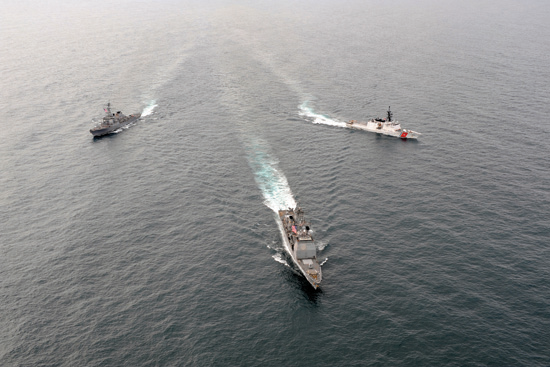
The Navy is currently conducting trainings in the Gulf of Alaska under the project name Northern Edge. It’s working on setting up the next phase of that project, to begin in 2016.
Alex Stone is the project manager for the Gulf of Alaska Environmental Impact Statement, or EIS. He has a background in environmental science.
“Associated with the EIS we get a permit from the National Marine Fisheries Service and that permit is good for five years,” says Stone. “So, the EIS that we do supports them issuing the permit.”
The Navy is currently training under a permit for 2011 to 2016.
“But, because the EIS process takes so long, we’re already working on the EIS to support the next permit which will start after the current one expires,” says Stone.
Liane Nakahara is a public affairs specialist for the Navy. She says at this point, the process is about half way done.
“We just completed the draft EIS and that’s kind of in the middle of the entire process,” says Nakahara. “So, we took all the comments that came in during the scoping phase, which was a couple years ago, and used those comments to develop the draft analysis, which is out for public review right now.”
Stone says this looks at the impact of training activities that are part of an annual project that includes several branches of the military.
“The Navy brings up an aircraft carrier strike group to participate in a joint exercise with the Army and Air Force and what this EIS looks at, of course, is the Navy part of it, which takes place in the Gulf of Alaska,” says Stone.
Stone says the Gulf of Alaska is prime training area for the Navy for three reasons. First, it’s an environment that’s unlike others around the States. The Navy does a lot of training near Southern California. Water temperatures, ocean depth, and environmental conditions are different in the Gulf. Second, he says it provides the opportunity to work with the Army and Air Force, since there are already bases nearby in Alaska. Finally, it gives Navy pilots a unique experience.
“It gives an access to the other ranges over the land in Alaska that are owned and managed by the Army and Air Force, which are really great training ranges for the pilots that are flying planes off an aircraft carrier,” says Stone.
With regard to the training that happens underwater, Stone says the Navy acknowledges the potentially harmful effects of sonar on marine mammals.
“Working with the National Marine Fisheries Service (NMFS), who is the federal regulator for marine mammals, we’ve developed a comprehensive set of mitigation measures which we have demonstrated are highly effective in minimizing our impacts to marine mammals,” says Stone.
The supplemental EIS has specific sections outlining acceptable and unacceptable effects to marine mammals, fish, birds, water quality, and more. In total, it’s hundreds of pages long but is available in its entirety at goaeis.com.
Nakahara says the public comment period is open through October 20th.
“All those comments will be considered in the development of the final EIS,” says Nakahara. “That will take another year or so to be able to incorporate everything, properly, into that final document before we then release it back to the public.”
Public meetings will take place from 5-8 p.m. in all locations with the Navy presentation at 6:30 p.m.
Kodiak, AK
Monday, Sept. 8, 2014
Elks Lodge
102 W. Marine Way
Anchorage, AK
Tuesday, Sept. 9, 2014
Z.J. Loussac Library
Public Conference Room
3600 Denali St.
Homer, AK
Wednesday, Sept. 10, 2014
Best Western Bidarka Inn
Sea Breeze Room
575 Sterling Highway
Juneau, AK
Thursday, Sept. 11, 2014
Juneau Arts & Humanities Council
Main Hall
350 Whittier St.
Cordova, AK
Friday, Sept. 12, 2014
Mt. Eccles Elementary School
Simpler Gymnasium
201 Adams St.