It may be rude, but it’s legal not to signal in a roundabout.
In an opinion handed down Sept. 4, the Alaska Court of Appeals determined that failing to signal in a roundabout was not a traffic violation, and it could not be used as justification for a traffic stop that led to the prosecution of a Fairbanks man for allegedly driving while intoxicated.
Curtis Noble was arrested in Fairbanks in November 2010 after University of Alaska officers observed him driving through a roundabout without signaling. Campus officers were tipped off about a possible reckless driver in the area. They tailed a vehicle for the better part of an hour and eventually observed Noble driving. Noble did not use a turn signal while entering or leaving a Fairbanks roundabout. Officers initiated a traffic stop and Noble was later arrested after officers discovered he had been drinking.
Appeals court judges determined that signaling only applies to vehicles in a linear fashion, not for vehicles entering or leaving a roundabout. Vehicles entering the roundabout must yield to traffic inside the circle.
The three judge panel also noted that it would be difficult, if not confusing and counterintuitive at times, for drivers to signal their intentions within the 100-foot statutory minimum inside a roundabout. The judges investigated the use of turn signals in roundabouts in other states and found inconsistencies, but noted that some states and the University of Alaska simply suggest drivers signal their intentions.
University officers erroneously believed that Noble was responsible for two infractions for not signaling while entering and exiting the roundabout. The Alaska Court of Appeals sent Noble’s DUI case back down to Superior Court.
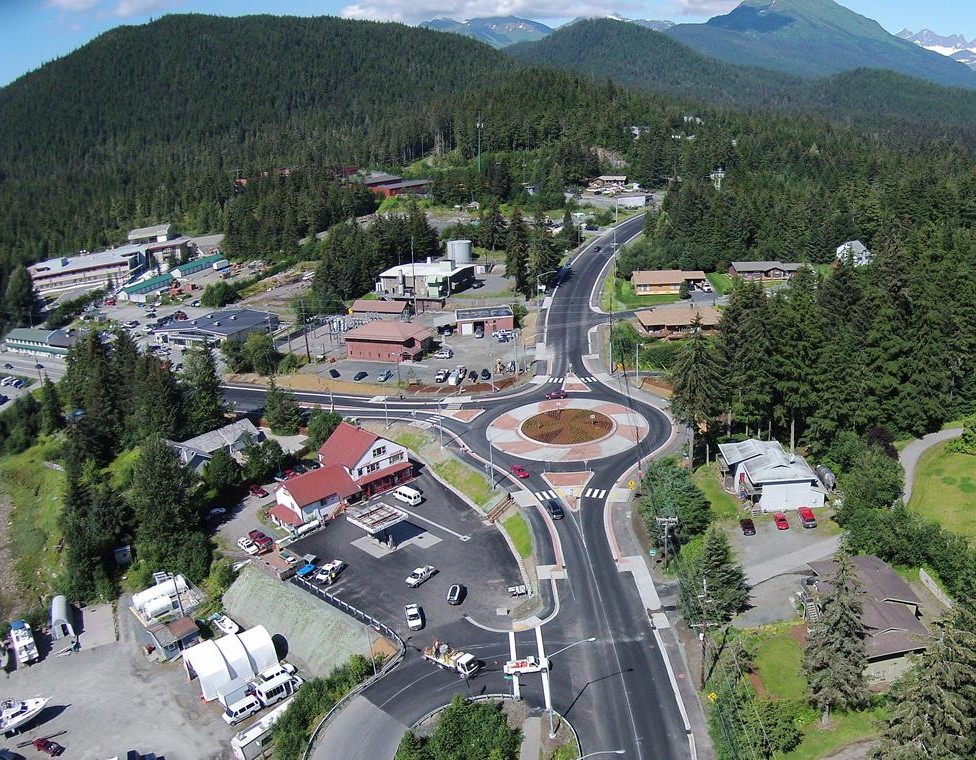
There are at least 16 roundabouts in Alaska. Juneau has three including one at the Douglas Island end of the Douglas Bridge, a modified roundabout at Manila Square in downtown Juneau, and a newer roundabout on Glacier Highway at Auke Bay.
Some drivers in the Douglas Island roundabout signal right to indicate they’re taking the next immediate turn. Others signal left to indicate a later turn.
The use of turn signals as defined in Alaska regulation mirrors the federal Uniform Vehicle Code that was developed in 1969 and predates the construction of modern roundabouts in the United States.
Department of Public Safety officials could not immediately comment on the court opinion or the possibility of legislative action to amend Alaska regulations or statutes on the use of turn signals in roundabouts.