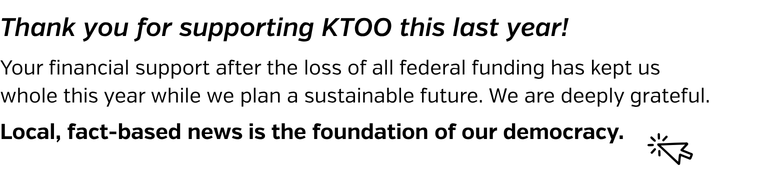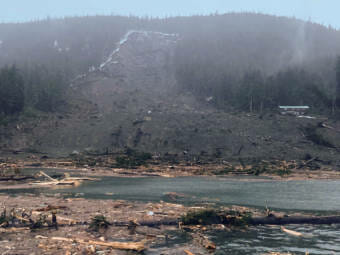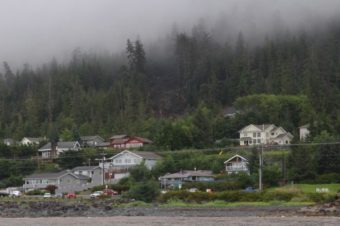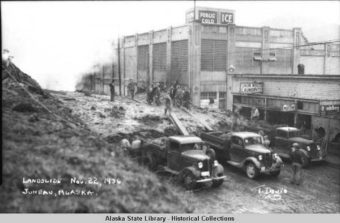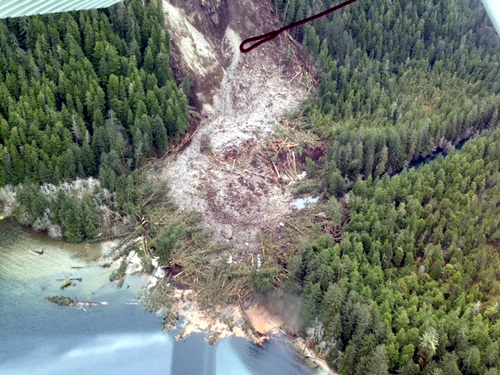
On a really basic level, a landslide is a bunch of earthen material that moves downhill, taking rocks, trees and — like the one in Haines on Wednesday — sometimes houses with it.
Landslides don’t always occur under the same conditions, but in Southeast Alaska they’re often associated with rainfall soaking soils over time, followed by a sudden, torrential downpour that shifts the balance between friction and gravity.
Peter Haeussler is a research geologist with the U.S. Geological Survey, and he told Alaska Public Media’s Casey Grove that it’s kind of like an air hockey table, if the air hockey table was tilted and the airflow turned on.
LISTEN HERE:
Full transcript:
Peter Haeussler: So in the case of Haines or Southeast Alaska in general, you know, you can have things wet for a long period of time. And if the water is able to drain out of that material fast enough, then you don’t have a landslide. But what can happen, for example, is that you end up with a lot of water within the soils. And then if you get like a pulse of really high rainfall, like what seems to have happened in Haines and Juneau, then that can increase those pore pressures and then allow the material to fail and flow downhill.
Casey Grove: Explain that pore pressure thing to me a little bit more. What do you mean when you say pore pressure?
PH: Yeah, so it’s maybe a little bit like air hockey in the way that the air in an air hockey table might blow up a little puck up off the bottom, so it can move around quickly. If that air wasn’t turned on in the air hockey table, then it wouldn’t move. Well, sort of similarly, you can have this water flowing down through the soil column, and if the water was able to flow away, then just the weight of that stuff is there. But basically, it starts to float at some level, maybe a little like a boat, and then it can start to move and go downhill.
CG: Is there a range of how fast a landslide can move? I just I wonder if you’re, you know, sitting in your house, and you could even hear something or see something coming? Would you even have time to get out of the way?
PH: I think really large ones can move, you know, extremely fast, you know, hundred kilometers an hour or 60 miles an hour, if they’re going down a steep mountainside, and then going sideways. I think snow avalanches are often a good analogy for different types of landslides that can occur in different places. So if you have steep slopes, and they’re going down a steep slope, then you can get higher velocities. If it’s lower angle slopes, they just won’t move as fast. But certainly, noise is a big precursor for many landslides that people have experienced and that they, they can hear them coming in some way. And so for local residents, if you hear something coming, and you think it might be in your neighborhood, that’s a good time to get out of there
CG: At this point, when we’re talking about Haines, it sounds like there’s two people still missing. And I wonder, do you know, how often do people get caught and landslides. I can think Sitka, but are there other examples in Alaska where folks have have been, you know, caught like that in a landslide?
PH: There was that essentially it was a submarine landslide. They were working on the dock there in Skagway. There was a low tide and a lot of construction materials on this piece of land surface and then it slumped in went into the water. I’m pretty sure somebody was killed in that landslide. In the 1964 earthquake, there were two people killed in that Earthquake Park landslide by the landslide itself. Most of the people in the ’64 earthquake were actually killed by tsunamis caused by underwater landslides. So that’s a another effect that can happen. If you have underwater slumping of materials, then that can displace water, which then makes a local tsunami and then that washing back of the water can be really destructive.
CG: This is potentially a tragic event. We may not find these other two people. But when you look at the landslides in Haines and the activity down in Southeast, is that an opportunity to study this phenomenon?
PH: Absolutely. It is an opportunity to understand why and when and how these things occur. The more data that we have, then hopefully the better job that we can do of predicting under what conditions that they’ll occur in the future. And, you know, hopefully, people can anticipate both the hazard and mitigate the risk associated with it down the road.