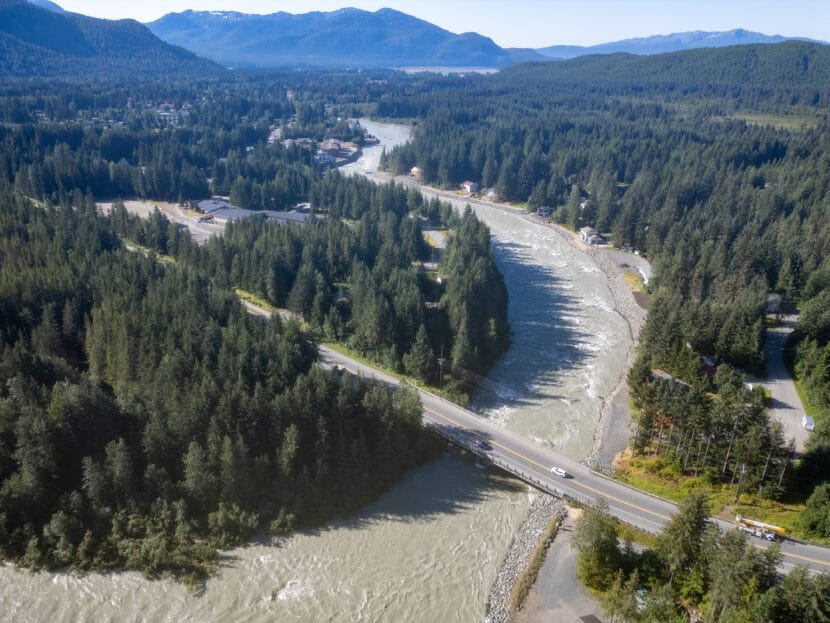
Some of the funding needed to study long-term solutions to glacial outburst flooding in Juneau has arrived.
Last Friday the U.S. Army Corps of Engineers received $4.75 million to start working on a technical report that will inform a later, fleshed-out feasibility study of potential solutions to annual flooding in Mendenhall Valley.
The funding came from the federal American Relief Act and will be disbursed over the next four years. It adds to the $1 million that the city and U.S. Forest Service secured in December to study flood solutions.
Denise Koch, Juneau’s director of Engineering & Public Works, wrote in an email to flood-affected residents that this is “a fantastic first step,” but that the city must still find millions more for the full feasibility study, which they estimate will total around $10 million.
Bruce Sexauer, chief of civil works project management at the Army Corps, said the money will be used to answer key questions about the Mendenhall Valley landscape, including hydrological and geological studies that will form a basis from which officials can weigh different solutions.
“If you build a house with no foundation, the house is gonna fall down — similar to a levee or a dam or a flood wall — you need to know what the foundation is to be able to build a secure structure,” he said.
One of the major questions, Sexauer said, is “exactly how much water would be released in combination with, say, a major rainstorm, and how likely that would be.”
It’s a complicated question and the answer could shift as the Mendenhall Glacier melts faster, if new basins other than Suicide Basin form further up in the mountains or if precipitation patterns change.
Residents in flood-affected neighborhoods would like action sooner rather than later. Bob Deering lives along the Mendenhall River. He’s a retired engineer with 32 years of federal agency experience and wants this process to be treated with urgency, given that Valley homes are expected to flood each year.
“They shouldn’t have to spend a lot of time figuring out what might work here,” he said. “They should be able to come up with a solution in one year.”
Nate Rumsey, the city’s Engineering & Public Works deputy director, said he hopes the technical studies will “jump-start into what a more traditional feasibility study or general investigation would be.”
He said the future feasibility study will look at various ideas to protect Valley residents, such as building a dam or permanent levee, expanding Mendenhall Lake’s capacity, siphoning water out of Suicide Basin, or even blowing up the glacier or surrounding mountains.
“We’re just too early in the process to be able to give any definitive ideas about what the likely solutions are, but I think those are all at least feasible,” Rumsey said.
As the city and Army Corps consider long-term plans, the short-term plan to install temporary flood barriers along Mendenhall River is underway. Contractors are set to prepare yards along Killewich Drive this week for HESCO barriers that will arrive imminently.