It took a Taser, a bean bag round and a chase before Juneau police managed to apprehend a suspect who resisted arrest Saturday night.
Police responded to a call that 27-year-old Zachary Pratt was causing a disturbance inside a business on Hospital Drive shortly before 9:30 p.m., according to a release from the Juneau Police Department.
Upon arrival, officers served Pratt with a warrant for his arrest on the grounds that he had violated his probation. At that point, according to the release, Pratt became violent and resisted arrest by fighting with the officers. Officers used a Taser to try to subdue the suspect, which proved unsuccessful. He then allegedly charged an officer and was shot in the upper leg with a bean bag round, but this did little to stop Pratt, who ran away into a nearby building where he proceeded to lock himself in a bathroom. Officers were eventually able to locate and successfully take Pratt into custody.
After the incident, Pratt was treated at Bartlett Hospital for non-life threatening injuries. An officer also sustained minor injuries during the encounter with Pratt. Further details were not immediately available Sunday evening.
Pratt was later booked at Lemon Creek Correctional Center, where he is being held on his warrant as well as three counts of assaulting a police officer and one charge of resisting arrest.
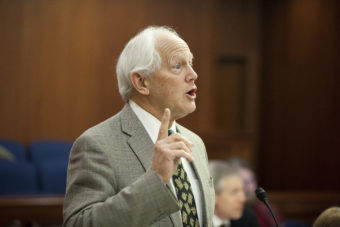
Rep. Chris Birch, R-Anchorage, argues over the debut of an oil tax credit bill, during a floor session of the state House in February. He wants the Legislature’s October special session to be held in Anchorage. (Photo by Rashah McChesney/Alaska’s Energy Desk)
An Anchorage lawmaker is requesting the Legislature’s October special session be held in Anchorage instead of Juneau.
In a letter to Gov. Bill Walker, Republican Rep. Chris Birch argued it would save money and increase public participation on crime legislation — Anchorage lawmakers and residents have expressed concern over a spike in crime there. Birch sent the the letter Wednesday after attending a town hall on crime in Anchorage the night before.
In it, Birch said maximizing public engagement with Senate Bill 54, which would modify last year’s Senate Bill 91, a criminal justice reform bill, is crucial to addressing constituent concerns.
“This isn’t an effort to move the capital or anything of that nature,” Birch said. “It’s an effort to bring some balance and recognize that we need to be accessible to the public and certainly at this time money savings are certainly a plus as well. I mean if three quarters of the Legislature can basically forgo transportation and associated costs with relocation for a month, that’s just a bonus.”
He added that many legislators are likely planning to attend this year’s Alaska Federation of Natives conference in Anchorage, which wraps up two days before the special session begins.
Birch said he spoke with the governor and his chief of staff about the letter, and expects the majority of the Legislature to support his request.
On Friday at a breakfast event at Commonwealth North in Anchorage, Walker was asked why the special session couldn’t happen in Anchorage.
“Well, the Capitol’s in Juneau. Gavel to Gavel is in Juneau. Alaskans all over the state are able to participate through the Gavel to Gavel process and be able to observe what goes on, ” Walker said. “So yes, it would be more convenient to have it in Anchorage. That’s not where the Capitol is. And if the Legislature would like to convene and move it to … Anchorage, I won’t oppose that.”
Juneau Democratic Rep. Sam Kito III said he thinks the request is short-sighted in several respects.
“One is we will have to fly regular staff to Anchorage in order to support any activities,” Kito said. “We currently don’t have a location suitable to have the entire House meet. That would have to be procured. And the other challenge is we don’t have Gavel Alaska in Anchorage, which means that the public would be less involved, even though he said they would be more involved.”
Kito said Alaskans are able to weigh-in electronically through the Legislature’s teleconference system. He also said that when the Legislature last met in Anchorage in 2015, they had about the same number of people attend the hearings as they regularly see in Juneau.
“I do think we will hear from as many people on the teleconference line or through letters to the committee on SB 54,” Kito said. “I think we have probably a better opportunity to connect with Alaskans if we’re in Juneau and we have the ability to broadcast all the information.”
Kito said he will speak with his fellow Juneau legislators and together they will encourage Walker to keep the session in Juneau.
Juneau Sen. Dennis Egan could not be reached for comment. Juneau Rep. Justin Parish had yet to review the proposal when reached.
KTOO’s Andrew Kitchenman contributed to this report. Gavel Alaska Gavel Alaska is produced by 360 North, which shares staff with KTOO.
UA President Jim Johnsen. (Photo by Adelyn Baxter/KTOO)
University of Alaska officials are considering a 5 percent tuition increase in each of the next two academic years.
UA has seen its tuition steadily increase over the last several years, including a 5 percent increase last year.
Colby Freel chairs the Coalition of Student Leaders. He said increases like this have become an expectation for UA students, but that they understand the strain the state and university are under.
“We want our education here in Alaska, we want to receive the quality learning that we get, so we’re willing to pay for it,” Freel said.
The university has seen state funding decline by $61 million since 2014 and enrollment drop by 14 percent since 2011. Among the austerity measures, the university has cut about 50 academic programs and reduced faculty and staff by more than 900 positions.
The University of Alaska Board of Regents discussed the tuition increase during its meeting that wrapped Friday in Juneau. The board’s final vote on tuition is expected at its November meeting.
The board also discussed Strategic Pathways, the massive plan to restructure and save money amid ongoing budget uncertainty in Alaska.
UA President Jim Johnsen has spent the better part of the last year meeting with staff, faculty, students and community members to figure out what needs to happen to cut costs while maintaining quality.
“How do we serve the state effectively as our budgets are being cut by the state?” Johnsen said at the meeting. “How do we step up in workforce development, how do we step up in research and economic development and diversification and building a culture of education in Alaska? How do we achieve those goals in this very challenging context?”
The final recommendations on Strategic Pathways will be presented to the board for a vote in November.
Regents also approved a $50,000 compensation bonus for Johnsen on top of his $325,000 base salary after evaluating his performance and approving his employment contract. Johnsen said the bonus will be donated back to the university through student development and cultural initiatives.
Jim Johnsen attends a meet and greet in Juneau on July 7, 2015. He was a candidate for University of Alaska president at the time. (Photo by Jeremy Hsieh/KTOO)
Earlier this week, University of Alaska President Jim Johnsen wrote Alaska’s congressional delegation urging it to quickly resolve the Trump administration’s directive to end the Deferred Action for Childhood Arrivals program, or DACA.
The Obama-era immigration policy protected certain undocumented immigrants brought to the United States as children. Alaska has 138 DACA recipients, according to the Center for American Progress.
Johnsen said in his letter that failing to resolve the issue through congressional action could prevent students from fulfilling their academic and professional goals and would ultimately hurt the state’s economy.
The letter comes as the University of Alaska Board of Regents is meeting this Thursday and Friday at the University of Alaska Southeast campus in Juneau. It’s unclear if it plans to address the DACA issue.
The regents will discuss a plan to create a College of Education at the Juneau campus, a proposal meant to respond to Alaska’s teacher shortage by filling those vacancies with UA graduates.
Regents will also hear updates on Strategic Pathways, a plan to cut costs throughout the university system by consolidating academic programs, and campus efforts to improve the handling of sexual discrimination and assault cases in light of a Title IX investigation by the Department of Education.
The regents livestream their meetings at alaska.edu.
Close
Update notification options
Subscribe to notifications
Subscribe
Get notifications about news related to the topics you care about. You can unsubscribe anytime.