Adelyn Baxter

Digital Content Director, KTOO

"I help inform KTOO listeners, viewers and readers by finding creative ways to bring our content to our audience wherever they are."

Waste Management closes recycling building, sets up temporary replacement

The city's temporary drop-off recycling area in Lemon Creek. (Courtesy City and Borough of Juneau)
The city’s temporary drop-off recycling area in Lemon Creek. (Photo courtesy City and Borough of Juneau)

The city’s drop-off recycling center building in Lemon Creek has been closed due to concerns over its structural integrity.

“So you’re going about your errands on a Saturday, and I think we’re all required under CBJ ordinance to go to Fred Meyer and then recycling and then Costco,” joked former Juneau Police Lt. Kris Sell at a January 2017 Mudrooms.

But the building’s closure won’t mess up your Saturday routine. The city has set up a temporary solution using shipping containers. People can park in the same place as always and signs will tell them where to leave their recycling.

The drop-off center at 5600 Tonsgard Court is operated by Waste Management, who contracts with the city. The city and Waste Management are searching for a new location for the recycling center.

The recycling center’s hours will remain the same, operating Thursday and Friday from 7 a.m. to 5 p.m. and Saturdays from 8 a.m. to 5 p.m.

The city’s recycling drop boxes at Statter Harbor and Thunder Mountain and Juneau-Douglas high schools remain unaffected.

JAHC apologizes for Wearable Art controversy

The Juneau Arts and Humanities Council apologized Thursday for the harm from its Wearable Art 2018 show.

In a statement, the council’s board acknowledges the situation surrounding the geisha-inspired piece that ran in Saturday’s show could have been avoided or better handled.
The board apologized to all parties involved, including the artist and model and the other artists whose work was overshadowed by the controversy.

“At an institutional level, many steps could have been taken much sooner to address this issue,” the statement reads. “There was a path available to the JAHC through patient, kind, thoughtful, and constructive communication for a more amiable resolution. That opportunity was missed, and for that we have the most regret.”

The board’s initial remedies include training for JAHC staff and board members, as outlined by a May report from its Diversity and Inclusion Task Force. It will also provide future Wearable Art entrants with educational materials.

The JAHC also plans to host a series of discussions and workshops on cultural appropriation led by community experts. Executive Director Nancy DeCherney said Wednesday the first event would take place on March 10.

The 13-member board’s statement follows a meeting Wednesday night in which 20 members of the community testified about the incident.

Read the full text of the statement below:

KTOO has an underwriting contract with the Juneau Arts and Humanities Council to broadcast the Wearable Art show Thursday at 8 p.m. on 360 North television. “Doragon” was removed from the broadcast. Additionally, KTOO’s assistant general manager for arts and culture is a member of the JAHC board.

As Wearable Art controversy tips toxic online, community comes together to find way forward

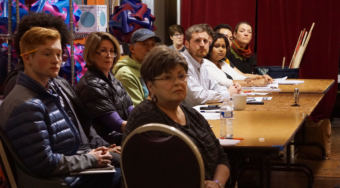
The Juneau Arts and Humanities Council board listens to public testimony at its monthly meeting on Feb. 21, 2018, at the Juneau Arts and Culture Center. About 100 people turned out to listen and weigh in on the council's handling of a geisha-themed entry at the weekend's Wearable Art show.
The Juneau Arts and Humanities Council board listens to public testimony at its monthly meeting on Wednesday at the Juneau Arts and Culture Center. About 100 people turned out to listen and weigh in on the council’s handling of a geisha-themed entry at the weekend’s Wearable Art show. (Photo by Jeremy Hsieh/KTOO)

The Juneau Arts and Humanities Council held its first board meeting on Wednesday since controversy broke at the one of Juneau’s biggest arts events of the year.

About 100 people showed up. The board had invited the public to comment in response to complaints that one piece at the show was racist or culturally insensitive.

On social media, the controversy took toxic turns. But in person the discourse went differently.

The Juneau Arts and Humanities Council board sat silently and listened as about 20 people spoke about what happened at Wearable Art 2018.

“Who gets to tell my story? Who would you like to tell your story if you’re a person of color? Someone who is Caucasian?” said David Abad, addressing the room.

Abad attended the show on Saturday night and saw the geisha-themed piece called “Doragon.” He’s Filipino-American and said he felt the need to share his perspective.

“Is the culture that is being presented, is it being respected?” he said.

The debate blew up on Sunday. The JAHC apologized and pulled the entry from Sunday’s lineup, but judges still awarded it third place.

The response on social media was immediate and wide-ranging.

Many people argued the piece should never have been allowed in the show. There was outrage that a white artist had been allowed to represent a minority culture without permission, also known as cultural appropriation.

Freda Westman wears her Alaska Native Sisterhood hat as she addresses the Juneau Arts and Humanities Council Board at its monthly meeting on Feb. 21, 2018, at the Juneau Arts and Culture Center. Westman was one of about 100 people who turned out to listen and weigh in on the council's handling of a geisha-themed entry at the weekend's Wearable Art show.
Freda Westman wears her Alaska Native Sisterhood hat as she addresses the Juneau Arts and Humanities Council Board at its monthly meeting on Wednesday at the Juneau Arts and Culture Center. Westman was one of about 100 people who turned out to listen and weigh in on the council’s handling of a geisha-themed entry at the weekend’s Wearable Art show. (Photo by Jeremy Hsieh/KTOO)

Some felt pulling the design was art censorship and reverse racism. They said the decision to remove the piece was unfair to the model and the artist, who had spent months on the design.

In many cases, things got ugly.

“I haven’t been on Facebook because I was told by my family and friends not to go there,” said JAHC Executive Director Nancy DeCherney.

“I’m not gonna make excuses. I may or may not have made the choices that I would like to make, but I made choices and I did that with other people,” she said.

Speakers at the meeting called her out for not properly addressing concerns about the design before and during Saturday’s show, including artist Freda Westman. She had a design in the show inspired by her Alaska Native heritage.

She felt the piece was racist when she first saw it at the tech rehearsal and told an event staffer.

“Dress rehearsal came and the piece was still in the show and the evening show came and the piece was still in the show,” Westman said. “That’s how it was met.”

Among all the speakers in the room, there appeared to be consensus an error was made. Westman said that surprised her. Based on social media, she expected to hear from people balking at political correctness and angry that “Doragon” was pulled from Sunday’s show.

“And so I was also very heartened to see that there were many people who were talking about the harmful piece and why it was harmful to them and that the response was also harmful,” Westman said.

About 100 people attending a Juneau Arts and Humanities Council Board meeting listen to Lance Twitchell speak during public testimony on Feb. 21, 2018, at the Juneau Arts and Culture Center. The crowd came out to address the council's handling of a geisha-themed entry at the weekend's Wearable Art show.
About 100 people attending a Juneau Arts and Humanities Council Board meeting listen to Lance Twitchell speak during public testimony on Wednesday at the Juneau Arts and Culture Center. The crowd came out to address the council’s handling of a geisha-themed entry at the weekend’s Wearable Art show. (Photo by Jeremy Hsieh/KTOO)

Another person who spoke at the meeting was artist Melissa Griffiths. Griffiths, who is white, said she had personal experience with cultural appropriation after being accused of it herself when she attended an Asian-themed party in 2013.

“And I got called out. At first I felt really resistant,” Griffiths said. “It hurt my feelings to be kind of lumped in as participating in racism.”

She hadn’t thought about who she was hurting by putting on a costume that represented someone else’s culture. But now, she says they were right.

“You know, the tough thing is, a lot of the time when we do something like this, it’s rooted in ignorance. We don’t know that we’re doing something wrong,” she said. “And you don’t know that you’re doing something wrong so you can’t fix that. But once you do know, then you can make different choices.”

The JAHC board thanked everyone for coming and moved on to other business.

But the conversation is far from over. DeCherney is working with cultural educators to set up a series of discussions and workshops around the topic of cultural representation and respect.

“You know I’m a white woman, and an older one at that,” she said. “So I have trouble and I need to be helped with that sort of stuff and I hope that we can all help each other.”

She said the first one will be held March 10.

UPDATE | Listen to the full public comment audio (57 minutes):

Scott Burton contributed to this report. 

KTOO has an underwriting contract with the Juneau Arts and Humanities Council to broadcast the Wearable Art show Thursday at 8 p.m. on 360 North television. “Doragon” was removed from the broadcast. Additionally, KTOO’s assistant general manager for arts and culture is a member of the JAHC board.

JAHC board to discuss fallout from Wearable Art

The Juneau Arts and Humanities Council has received more than 40 emails related to its handling of a controversial piece at this past weekend’s Wearable Art show.

The organization’s board will hold its regular meeting at 5 p.m. today at the Juneau Arts and Culture Center. Executive Director Nancy DeCherney said there will be facilitated public comment from 5 p.m. to 5:30 p.m. specifically for people to weigh in on the matter.

DeCherney said they will ask speakers to limit themselves to 1 to 2 minutes to accommodate more people. Attendees can also sign up to participate in the upcoming meetings and write down any topics they would like to see addressed.

There will be more conversations on cultural appropriation. DeCherney said the JAHC is organizing community discussions and training for the second weekend of March about the issues raised after Saturday’s show. Details are still being finalized.

One geisha-themed piece that appeared in Saturday’s Wearable Art show sparked a community-wide debate about political correctness, cultural appropriation and art.

KTOO’s Scott Burton contributed to this report. 

KTOO has an underwriting contract with the Juneau Arts and Humanities Council to broadcast the Wearable Art show. Additionally, KTOO’s assistant general manager for arts and culture is a member of the JAHC board.

End of an era: Juneau’s Dennis Egan reflects on why his successor must learn to ‘get along’

Sen. Dennis Egan hangs on to a display cabinet in the Capitol for support while chatting with a KTVA television crew after doing an interview on Feb. 8, 2018. Egan suffers from multiple sclerosis and severe vertigo, to which he attributed his decision not to run for re-election following the end of his term. Also pictured: KTVA reporter Steve Quinn, left, and camera operator Ken Kulovany. (Photo by Skip Gray/360 North)
Sen. Dennis Egan uses a display cabinet in the Capitol for support Feb. 8, 2018, while chatting with KTVA reporter Steve Quinn, left, and camera operator Ken Kulovany, after doing an interview. Egan suffers from multiple sclerosis and severe vertigo, to which he attributed his decision not to run for re-election following the end of his term. (Photo by Skip Gray/360 North)

For decades, Dennis Egan’s voice has been one of the most recognizable in Southeast Alaska.

“I can handle Juneau fairly well,” he said Sunday afternoon while sitting in his office in the Alaska State Capitol. “I just got a permanent handicap sticker, so that helps.”

But his career and legacy has been far more varied than just politics.

Long before he was appointed to the state Senate or elected Juneau’s mayor, Egan was a regular fixture on KINY’s airwaves.

He and his partner sold the station in 2008.

Now, the Egan era of Alaska politics is ending, too.

Alaska Sen. Dennis Egan announced his retirement earlier this month.

He represented Juneau, Haines and Skagway for nearly 10 years in the state Legislature.

“But it’s the little things. You don’t know how much you miss them,” he said. “And friends I’ve made, it’s really tough. Really tough … It’s the end of a couple of eras.”

Doctors diagnosed Egan with multiple sclerosis in 1982.

Now 70, he said complications have caught up.

He has severe vertigo, which makes it difficult to travel by boat or plane — something necessary to get around his Southeast district.

“My brain is still functioning fine. Well, a few of my staff doesn’t think so,” he said, joking. “That’s working, but it’s my health that’s just driving me crazy.”

Egan is not endorsing a successor right now.

He said there are plenty of people in the region who can represent his constituents as well or better.

“As long as they remember, no matter if you are an R or a D — doesn’t matter,” said Egan. “You’ve gotta be a people person. You have to get along. You have to listen to the other side. You may hate it. You may not like it, but you have to give folks the courtesy of listening.”

Advice that comes right out of the family playbook.

His father was Bill Egan, a longtime member of the Alaska Territorial Legislature and the first state governor.

Growing up in the Alaska Governor’s Mansion, Dennis Egan would get into all sorts of trouble, resulting in well-earned comparisons to Dennis the Menace.

But those early years were also formative. He learned at the feet of his father and other legends of Alaska history.

“In two sentences, you know where he stands on something,” said Christopher Clark, a longtime legislative aide and former reporter who first met Egan while working at KINY.

Clark later worked for Egan in the Capitol.

“That directness is what people find endearing, as well as the way he talks,” Clark said. “You know, that old, salty, gruff Alaska stuff.”

Egan’s directness and humor are what make him an effective leader, Clark said.

“If he’s polite to you, run like hell. If he’s yelling, cussing at you, then you’re in. It’s OK,” he said. “That’s kind of like ‘Old Alaska.’ It’s that old affability.”

Egan’s career in the Legislature began in 2009.

Juneau Sen. Kim Elton, a Democrat, had resigned to accept a position in the U.S. Department of the Interior.

Republican Gov. Sarah Palin and the Democratic legislators initially couldn’t agree on a replacement.

Egan was the compromise.

Former Alaska Public Radio Network reporter Dave Donaldson retired in 2012 after covering the Alaska Legislature for more than 20 years.

He said Egan’s appointment really came down to one thing.

“The fact is that people like Dennis Egan,” Donaldson said. “They always have liked him and still do.”

Donaldson chalks part of that up to Egan’s former life as a radio disc jockey. The man loves to talk and is good at it.

But Donaldson said Egan also grew up in a forgotten era of Alaska politics.

“Dennis Egan is probably as close as any to the old-school dealmaker. And that’s just because of his personality,” Donaldson said. “He knew how to talk to people. The problem is … there are so few people now who are willing to listen. And that’s really the sad part of Alaska politics right now.”

Egan will tell you that’s one thing he won’t miss, along with the long hours and marathon legislative meetings.

Sen. Dennis Egan, D-Juneau, listens to testimony in the Senate Resources Committee in the Capitol on Feb. 8, 2018.
Sen. Dennis Egan, D-Juneau, listens to testimony in the Senate Resources Committee in the Capitol on Feb. 8, 2018. (Photo by Skip Gray/360 North)

He worries that the days of political compromise are ending.

Egan said reaching across the aisle was a regular part of the process, not just a tactic.

That’s how he pulled off one of his proudest accomplishments, securing full funding for the Father Andrew P. Kashevaroff State Library, Archives and Museum that opened in 2016.

“I really respect the other side. And because of that, the other side respects me,” Egan said. “I’m a lifelong Democrat but I vote with the Republicans every now and then and Republicans help me. But it’s got to work that way or nothing gets done.”

He believes his colleagues have Alaska’s best interests at heart. They just need to find a way to work together.

“Everybody in this building is trying to do their constituents better. Senate averages about 35,000 constituents. House members average, what 17,500 or something like that,” he said. “But everybody is trying to do what they think is best for their constituents.”

Egan said he’ll stay involved post-retirement.

He serves on numerous volunteer boards and will remain active in the Juneau community.

Beyond that, his priorities are clear. He’s not going anywhere.

“I’m gonna croak here,” he said. “I’ve got a lot of Alaska Airlines mileage so my grandbabies can come see me!”

Site notifications
Update notification options
Subscribe to notifications