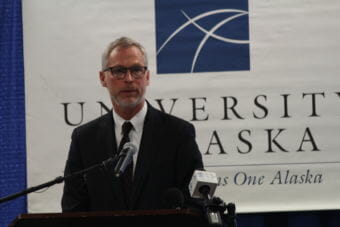
UA president Jim Johnsen delivers his State of the University address at Lucy Cuddy Hall at the University of Alaska Anchorage. (Photo by Wesley Early/Alaska Public Media)
In his State of the University address Tuesday, University of Alaska President Jim Johnsen stressed the need for an increase in state funding after four years of cuts.
“These cuts hurt badly. But the greater impact than to us here at the university is the impact to the state and our reduced capacity to serve our large, unmet needs for higher education,” Johnsen said.
The university’s annual budget has declined by more than $60 million since 2014. The UA Board of Regents requested an increase from the state for the next fiscal year, but Gov. Bill Walker’s proposed budget would flat fund the university at $317 million.
Johnsen said meetings with state legislators this session have left him hopeful that lawmakers want to invest in public education. He said the university has worked hard to find ways to save money by consolidating programs, cutting travel and administrative costs and freezing wages.
He also encouraged anyone concerned about university funding to do what they can to help.
“In whatever way you can by getting in touch with your legislators, we’re deep in the budget process right now, and letting them know how critical it is for you as a student, how critical it is for you as business leaders, how critical it is for you as leaders of foundations, as leaders of our state, as educators, that we support this great university,” he said.
After his speech, Johnsen said he feels the Legislature recognizes that the university is a sound investment.
“We didn’t just sit back or crawl under the table and wait for oil prices to come back. We went forward and came up with very strong, proactive plans,” Johnsen said. “And I think that legislators see, ‘Wow, OK, those guys are moving forward. They want to lead. They seem to be a good investment in our people and in our future.”
State budget negotiations are ongoing. Legislative subcommittees for both the House and the Senate are considering the university budget this week.
Alaska Public Media’s Wesley Early contributed to this report.
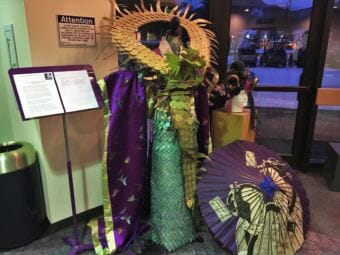
Beth Bolander’s “Doragon” on display in the lobby of Centennial Hall on Sunday. (Photo by Adelyn Baxter/KTOO)
A Japanese geisha-inspired costume was pulled from the second day of the annual Wearable Art show because of complaints from the public.
Even with the controversy surrounding Beth Bolander’s “Doragon,” the costume won third place in the event that took place Saturday night and Sunday afternoon at Centennial Hall.
First place went to “Siren” by KD Roope and second place went to “disMANTLE” by Lauralye Miko.
“The JAHC deeply regrets the pain that running this piece has caused and disavows all forms of cultural appropriation,” she said. “In deference to experts more educated on these difficult topics, the artist, production team and JAHC have made the decision to not run the piece in today’s show.”
The audience responded with a mixture of boos and clapping.
Bolander said Monday that she never intended to disrespect anyone’s culture with her piece.
She told KTOO she agreed to pull the piece because she was worried about threats to herself and her model and backlash against the JAHC.
Bolander said she needed time to process everything before speaking further.
Dani Gross modeled the piece Saturday.
The audience cheered and took pictures as she made her way down the runway in a wig and a dress adorned with 2,000 hand-painted dragon scales.
The piece was put on display Sunday in the lobby of Centennial Hall with the JAHC’s statement and an invitation to the public to participate in a future dialogue on the issues raised.
Gross stood in front of the display crying while other models comforted her.
Eriksen wrote that she was brushed off when she objected to the piece on Saturday night.
“The JAHC should be a leader in the arts and a leader in racial equity in our city,” her statement said. “They owe us an apology and they must commit to doing better.”
The post sparked debate on and off social media.
Eriksen declined requests for further comment, saying she does not want the issue to be framed around her.
Others on social media said the piece was an example of racism and cultural appropriation, because it represented a white artist benefiting from another culture.
Many commenters said they also were upset by the piece and planned to write the JAHC.
Others said they didn’t understand how the piece was offensive.
Definitions vary, but it generally describes the act of using something from a culture that is not your own, without proper credit or understanding of that concept’s importance or role within that culture.
Hunter Meachum models Freda Westman's "Plastic Protest" in the Wearable Art 2018 show on Saturday, Feb. 17, 2018, at Centennial Hall in Juneau. (Photo by Tripp J Crouse/KTOO)
Lacey Sanders models Jodie Buck's "Fluid" at Wearable Art 2018 on Saturday, Feb. 17, 2018, at Centennial Hall in Juneau. (Photo by Tripp J Crouse/KTOO)
Michael Kohan models designer Christine Woll's creation, "Hot Mess," at Wearable Art 2018 on Saturday, Feb. 17, 2018, at Centennial Hall in Juneau. (Photo by Tripp J Crouse/KTOO)
Elise Pypaert models Judy Bolander's "Burning" at Wearable Art 2018 on Saturday, Feb. 17, 2018, at Centennial Hall in Juneau. (Photo by Tripp J Crouse/KTOO)
Dani Gross models Beth Bolander's "Doragon" at Wearable Art 2018 on Saturday, Feb. 17, 2018, at Centennial Hall in Juneau. Organizers pulled this entry out of Sunday's lineup after receiving complaints about cultural appropriation. (Photo by Tripp J Crouse/KTOO)
Amy Dressel walks during Wearable Art 2018 on Saturday, Feb. 17, 2018, at Centennial Hall in Juneau. She designed her dress with Nic Hart. (Photo by Tripp J Crouse/KTOO)
Cathryn Nicole Carroll models "Cafe Disco," by Rachael Koplin, during Wearable Art 2018 on Saturday, Feb. 17, 2018, at Centennial Hall in Juneau. (Photo by Tripp J Crouse/KTOO)
KTOO has an underwriting contract with the Juneau Arts and Humanities Council to broadcast the Wearable Art show. Additionally, KTOO’s assistant general manager for arts and culture is a member of the JAHC board.
Juneau’s new elementary science curriculum will integrate aspects of Native culture in order to promote place-based learning in the classroom.
The Juneau School District Board of Education adopted the new curriculum Tuesday night. It brings Juneau’s K-5 classrooms up to date with current national and state science standards.
“We really brought a lot of connected resources to it as best we could, with lots of great conversation about Tlingit science and Western science,” curriculum coordinator Carin Smolin said. She and instructional coach Pam Garcia oversaw the creation of the new standards. Middle and high school standards are next.
Dozens of community members, teachers and parents took part in the process, which took more than a year.
Smolin and Garcia said they particularly are excited for teachers to use a new database connecting STEM professionals in the Juneau area with teachers and students for experiential learning.
The curriculum brings the district up to date with the nationally recognized Next Generation Science Standards. Since their release in 2013, 19 states have adopted them.
They encourage a deeper understanding of concepts related to science and technology by teaching students the “why” and “how,” instead of just the “what.”
Garcia said the standards are designed to help students relate to what they’re learning by connecting lessons to what’s happening in the world around them.
“Thinking and acting like scientists and engineers, that’s the whole idea,” Garcia said. “Because in the real world you observe phenomena and then you wonder and you ask questions and you make connections in order to learn about how the world works.”
Costs for implementing the new curriculum will include additional training for teachers, subscriptions to “Mystery Science,” an online database for hands-on lesson plans and new science kits for classroom use.
School board President Brian Holst and other members praised the committee for their hard work.
The district last updated science standards in 2011.
“What was refreshing is that, a really well done curriculum with a lot of support from our teachers won’t cost us a lot of extra resources,” Holst said.
The school district is working on its budget for the next fiscal year and needs to find a way to make up a projected shortfall.
“Essentially that’s $3 million of cuts that we have to identify,” he said. “And that’s because, by flat-funding schools, that’s actually a decrease because expenses, costs continue to rise.”
The final school district budget must be submitted to the city by March 30.
Arctic Youth Ambassador Tasha Elizarde pictured in downtown Juneau. (Photo by Adelyn Baxter/KTOO)
Since Tasha Elizarde graduated from high school last spring, she hasn’t been sitting around her parents’ house here in Juneau.
The 18-year-old was chosen last fall to represent her community and state on the international stage as an Arctic Youth Ambassador.
“That means going out and speaking with different leaders from different countries and different people in the U.S. and just being able to share our stories about living in Alaska and living in a different place, ” Elizarde said.
She’s one 13 young Alaskans serving the two-year term.
The communities they represent range from Anchorage to Shishmaref.
For the next 18 months, they will travel to other Arctic nations and to Washington, D.C., to raise awareness for Alaska’s changing landscape.
Elizarde and her fellow ambassadors met in Anchorage for the first time in January.
This is the second class of Arctic Youth Ambassadors.
The U.S. Fish and Wildlife Service and the U.S. State Department created the program in partnership with nonprofit Alaska Geographic.
Elizarde and her fellow ambassadors have a diverse range of priorities, such as rising sea levels and the ecological impacts of climate change on the tundra.
“Going in I knew I was interested in energy development,” Elizarde said. “I think that our state is very poised to take a new position on energy development, whether it’s through taking the lead on renewable energy or figuring out what to do about being an oil state.”
Elizarde decided to take a gap year between graduating from Juneau-Douglas High School and college.
She worked in the fall at a law firm outside of New Orleans. This spring she’s interning with an Alaska legislator.
“It’s really important to recognize that, yes, it’s important to look at data, but it’s also important to hear the personal side of things and the personal stories,” she said. “Because things like climate change are impacting real people and so those stories are super important.”
Elizarde plans to attend college out of state next fall.
She said she’s grateful for the opportunity to represent her fellow Alaskans and their interests.