
Clarise Larson

City Government Reporter, KTOO

"My mission is to hold Juneau’s elected officials accountable for their actions and how their decisions impact the lives of the people they represent. It’s rooted in the belief that an informed public has the power to make positive change."

When Clarise isn't working, you can find her skijoring with her dog, Bloon, or climbing up walls at the Rock Dump.

Local election shake-up continues as another school board incumbent drops out

Juneau School Board Vice President Emil Mackey discusses the district’s projected $9.5 million budget deficit during a meeting on Thursday, Jan. 18, 2024. (Photo by Clarise Larson/KTOO)

A local election shake-up continues as longtime Juneau school board member Emil Mackey says he has decided not to run for reelection after a nine-year tenure. 

Mackey said he changed his mind on running just this week.

“I’ve spent three terms on the board, including a consolidation process that was extremely taxing, emotionally and time-wise,” he said. “I think it’s time for somebody else to join the board, because I am just exhausted.”

His announcement comes just after board President Deedie Sorensen told KTOO on Thursday that she also is not running for reelection and will retire when her term ends this fall.

That means two full-term school board seats are open without incumbents for this fall’s municipal election. There’s also a chance to serve a partial term following former school board member Will Muldoon’s resignation this spring. 

The last chance to file for an open seat on the school board or Assembly is Monday, July 28, at 4:30 p.m.

Voters first elected Mackey to the board in 2015. He was then reelected in 2018 and again in 2022. He has a Ph.D. in public policy with an emphasis in higher education policy and a master’s in education from the University of Alaska Fairbanks. 

Like Sorensen, he played a critical role on the board during the COVID-19 pandemic and the decision to consolidate Juneau’s high schools and middle schools. Both Mackey and Sorensen faced some public backlash for their vote in favor of the consolidation and were the subjects of a failed recall attempt in last year’s election. 

Mackey said he is far from being done with public service in Juneau, but needs time away to focus on his family and business. 

“I’m coming out of the ninth round of a heavyweight fight, and I don’t feel like I need to start the first round of a new one,” he said. 

He said he’s “scared to death” that no one will run for his empty seat because of the difficulty of the role and the tough decisions board members are likely to face in the coming years. He blamed the lack of funding support from the state and federal government as the root of most of the Juneau School District’s problems.

Juneau’s hospital projected to lose millions under Medicaid changes

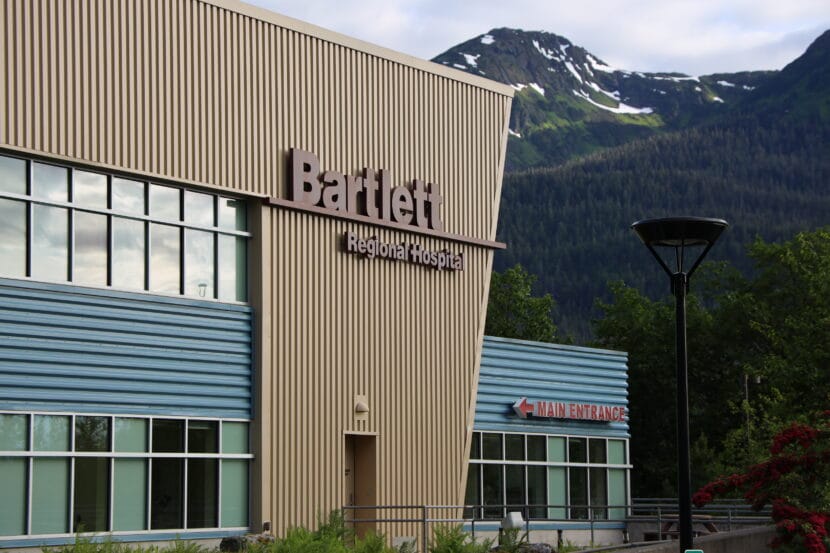
Bartlett Regional Hospital on Tuesday, June 25, 2024. (Clarise Larson/KTOO)

The Trump Administration’s new tax and spending bill cuts hundreds of millions of dollars in funding for Medicaid. That’s likely to affect the more than 250,000 Alaskans who rely on the program.

Medicaid is a joint state-federal funded health insurance program that covers people with low incomes or disabilities. More than 70 million Americans — including children — rely on the program to get critical care. Here in Alaska, 1 in 3 residents is enrolled in Medicaid. 

In Juneau, that’s going to affect the municipality-owned Bartlett Regional Hospital. CEO Joe Wanner said — in a worst-case scenario — it stands to lose between $3 to $4 million annually in Medicaid spending once the law goes into effect. 

“I don’t see this as the end of Bartlett,” he said. “It might be tough for a period of time. We will survive. We will continue to provide good patient care to the residents of Juneau.”

The new law will mean that most Medicaid recipients will need to meet certain work requirements to qualify for care. It will also compel the state to increase its eligibility checks and monitoring of recipients. Those requirements are expected to begin as early as January 2027, though the state plans to apply for waivers to push compliance back to 2029. 

The Alaska Department of Health retracted a recent estimate that Alaska could lose up to $500 million annually in Medicaid spending due to the cuts. Now, it’s saying the full impact of the changes is complicated to project because many Alaskans will be exempted from the new requirements. Officials say they are working on updated estimates. 

Alaska has consistently ranked among the top states in the country for the highest health care costs per person, according to a 2022 study published by Health Affairs. And, a report released by the state’s Department of Labor and Workforce Development earlier this month found that Juneau had the second-highest health care costs out of more than 250 cities surveyed in the U.S. 

Wanner said Juneau’s hospital will use the meantime to financially prepare for the changes and figure out what they will look like in practice.

“With everything health care, all you have to do is try to be in this position where you’re able to survive,” he said. 

Last spring, the hospital faced a multimillion-dollar deficit that threatened bankruptcy. Its board controversially chose to reduce staffing and shut down multiple programs to keep that from happening. 

“We’re in a much better place than we were a year ago,” he said. “As long as we keep on our trajectory, we’re able to sustain our financial viability that we’ve seen over the last 12 months, we should be able to build some reserves up to weather the storm before.”

The bill included $50 billion toward what’s called a Rural Health Transformation Program, which is aimed at offsetting the loss of Medicaid spending in rural areas. Wanner said that funding could help Bartlett. But for now, a lot is unknown.

Matt Carle, a spokesperson for the other major medical care provider in Juneau, Southeast Alaska Regional Health Consortium, or SEARHC, says it is still assessing the impacts of the bill on its services.

Newscast – Thursday, July 24, 2025

In this newscast:

  • Satellite internet provider Starlink experienced a major “network outage” on Thursday that lasted about two and a half hours.
  • Longtime Juneau School District board member and board president Deedie Sorensen says she is no longer planning to run for reelection. She’s been known as a longstanding advocate and voice for teachers during her six-year tenure.
  • Drag queens in Alaska typically find their stages in Anchorage or Fairbanks. But last week, three Alaska queens traveled to the bush to perform in Bethel’s first-ever drag show.
  • Alaska’s former U.S. Rep. Mary Peltola is suing the owners of the aircraft that her late husband Eugene “Buzzy” Peltola Jr. was piloting at the time of his death.

Retired teacher, longtime Juneau School Board member no longer running for reelection

Deedie Sorensen laughs with friends at City Hall was results of the Municipal Election roll in on Tuesday, October 1, 2019, in Juneau, Alaska. (Photo by Rashah McChesney/KTOO)

Longtime Juneau School District board member and board president Deedie Sorensen says she is no longer planning to run for reelection. She’s been known as a longstanding advocate and voice for teachers during her six-year tenure.

Sorensen says she will finish out her current term but plans to step down after this October’s municipal election for personal reasons. Earlier this year, Sorensen told KTOO she did plan to run for reelection.

“I’ve given a lot of years to public education in Juneau, and it’s been extremely stressful and I would actually like to retire,” she said. 

Sorensen is 74 years old and a retired elementary school teacher who taught in Juneau for more than 35 years. She holds a Master’s Degree in Early Childhood Education. During her career, she was an active member of the Juneau Education Association and served as a staff member on many district committees. 

Juneau voters first elected Sorensen to the board in 2019. She was then reelected for a second term in 2022. While on the board, she helped the district navigate the COVID-19 pandemic and the consolidation of Juneau’s high schools and middle schools

Sorensen and fellow board member Emil Mackey were the subjects of a recall attempt in last year’s election. The effort was led by a group of residents who wanted to remove them in part due to their votes in favor of the consolidation. But election results showed that most voters were against removing the pair and both held their seats. 

“I really appreciate the community support last year,” she said. “That was absolutely one of the highlights of the whole thing was the community support during the recall.”

Sorensen said she stands by the decisions the board made during the pandemic and the consolidation process. She said a lot of the difficult issues the school board faces could be solved if the state and federal government adequately funded districts. She described the current state of public education in Alaska as walking on the edge of a cliff that’s eroding under your feet.  

“I feel like the last seven years have been, at the state level, have been an assault on public education,” she said. 

She said state and federal moves to shrink government funding for education undermine the basis for a well-informed public.

Sorensen’s is one of two school board seats that will be open this election. There’s also an opportunity to serve a partial term following former school board member Will Muldoon’s abrupt resignation this spring. 

As of Thursday afternoon, the city clerk’s office has not certified any candidates for those seats. The deadline to file for a seat in this election is Monday, July 28, at 4:30 p.m.

Updated correction: Emil Mackey no longer plans to run for school board.  

Newscast – Wednesday, July 23, 2025

In this newscast:

  • A 35-year-old woman has died after the vessel she was on capsized near Sitka on Sunday.
  • Nearly all the staff of Juneau’s only print newspaper left the publication for a new, web-based local news outlet.
  • Haines is Alaska’s oldest borough – and a recent survey of residents under 40 years old provides a clearer picture of why. Respondents outlined a long list of factors that make it increasingly difficult for younger people to live in the small Southeast  community, ranging from scant housing and childcare options – to polarized local politics.
  • The Alaska Department of Health says it’s still assessing how President Trump’s so-called One Big Beautiful Bill Act will affect the state’s Medicaid program. State officials say they do not have reliable estimates of how many Alaskans could lose coverage or how much the new law will reduce federal health care spending.

Juneau opens up application for $2.5M in affordable housing funding

Downtown Juneau on Wednesday, March 26, 2025. (Photo by Clarise Larson/KTOO)

Juneau is inviting developers, nonprofits and tribal governments to apply for grants or loans from its affordable housing fund.

The city created the fund five years ago to address the city’s lack of housing — specifically, low and middle-income rentals. There is $2.5 million available in the fund this year. The application period opened last week and runs through Aug. 22. 

“Things are getting more challenging with the landscape for housing on the federal level,” said Joseph Meyers, the city’s housing and land use specialist. “I’m really hopeful that we get a lot of people applying for these funds, and get more units on the grounds.”

The city then uses criteria like proximity to public transportation and long-term affordability to decide which projects get funding and how much.  

The city has awarded nearly $13 million in grants or loans from the fund since its establishment. But not all projects funded in the past have been required to offer affordable units. In 2022, the Juneau Assembly approved a $1.2 million loan from the fund for a development called Ridgeview. 

The Assembly initially approved the loan for the project with an affordability requirement, but later stripped those requirements after input from city leadership. The developer listed the units as condos available for purchase at market price to the dismay of many Juneau residents. Some testified at public meetings and others posted hundreds of comments on social media. 

Meyers said since then, the Assembly has required affordability for projects approved to receive funding. 

“If the application doesn’t meet that requirement, they’d have to go back to the drawing board,” he said. “We really do want to focus on providing some affordability, at least with all these projects.”

The application period closes on Aug. 22. Then, a committee will review them and make recommendations to the Assembly for final approval. 

Site notifications
Update notification options
Subscribe to notifications