Heather Bryant

The most popular stories of 2014

In addition to the biggest local stories of 2014, we’ve also compiled the most popular ones. KTOO published nearly 4,000 stories on our website in 2014. Here’s what you clicked and commented on the most.


A large fuel tank on Attu

10. Why Attu Island is still fighting WWII

Kelsey Gobroski
Feb. 19, 2013

This story about surveying leftover World War II explosives, equipment, fuel and other detritus on a remote, uninhabited island in the Aleutians was published almost two years ago, but continues to draw a lot of fresh hits. It’s a fascinating story that connects the biggest armed conflict in history to modern day Alaska.

It was No. 2 on our 2013 version of this list.


Republican U.S. Senate candidate Dan Sullivan greets supporters on election night in Anchorage. The as-yet-undecided race between Sullivan and Democratic incumbent Sen. Mark Begich was the hottest in the state. Ted S. Warren/AP

9. Sullivan leads Begich by 8,000 votes

Liz Ruskin – APRN
Nov. 5, 2014

A Republican unseated Alaska’s lone Democratic lawmaker in Washington, D.C., in November after the most expensive political campaign in state history. Alaskans were inundated with unsolicited phone calls, web ads, television ads, campaign mailers and door knockers from backers of Republican Dan Sullivan and incumbent Democrat Mark Begich.

The hard fought race was on national observers’ radar, too, because of Begich’s vulnerability and the soon-to-be-realized potential for Republicans to take control of the Senate from Democrats.


The Juneau Empire on Channel Drive. (Photo by Heather Bryant/KTOO)

8. Empire reporter fired following disagreement with publisher

Lisa Phu
Feb. 10, 2014

Office politics at a Juneau news institution, Alaska Capitol politics and journalism ethics clashed in this story.

Managers at the Empire asked their Capitol reporter, Jennifer Canfield, to arrange a meeting for them on a bill that would’ve affected public noticing requirements and advertising revenue. The Empire maintains their interest and opposition wasn’t related to business, but about government transparency.

Canfield says she refused on ethical grounds, and then was fired. She ended up at the Alaska Budget Report and after the legislative session, did a temporary stint in our newsroom, too. The bill fizzled.

The firing story got hat tips from the Anchorage Press and national media observer Jim Romenesko.


Image shark_wide-c7d2a3015cc5e8a1eada3dfa7478ac0430b64459-s6.jpg7. New fossil takes a bite out of theory sharks are barely evolved

Geoffery Brumfiel – NPR
April 17, 2014

SHARKS!


6. Floating strip club flourishes in Kodiak

Associated Press
Nov. 20, 2014

The Associated Press picked up this titillating story of a crab boat turned strip club from KTVA. A couple of weeks after the story blew up, the club lost its liquor license.

Our publication rights for the AP version of the story have expired, but here’s a link to KTVA’s original story.


Delta Air Lines started a daily flight between Seattle and Juneau May 29. (Photo by Heather Bryant/KTOO)

5. 109 Delta passengers sleep in SeaTac after fog turns back plane

Lisa Phu
July 15, 2014

Delta’s announcement in 2013 that it would challenge Alaska Airlines’ monopoly on summer market share in the capital city was No. 5 on that year’s version of this list. The ensuing price war that sent airfares plummeting made our list of the biggest news of 2014. But it was coverage of this fog-related airline hiccup that drew more readers and even sparked a back and forth in the comment section.


Mitch Erickson’s dog pen was smashed by a muskox this weekend, and his dog Onslo was mauled. (Photo by Jenn Ruckel/KNOM)

4. One dog dead in another musk ox attack in Nome

Jenn Ruckel – KNOM
July 31, 2014

An unusually high number of musk ox wandered into populated areas in and around Nome this summer. Clashes with people, their property and dogs ticked up, as did residents’ anxiety. Some musk ox even attacked and killed dogs.

Surprisingly unsympathetic reader comments poured in. Some casual investigation reveals a few commonalities among many of the commenters: They don’t live in Alaska and they’re members of anti-animal cruelty movements that oppose the chaining or tethering of dogs.


3. AMHS dock in Skagway collapses

Rosemarie Alexander
April 24, 2014

The Alaska Marine Highway System’s floating dock in Skagway stopped floating. It was a fail that severed one of Skagway’s transportation lifelines for more than two weeks.

And why it failed was a mystery, at least until state transportation officials concluded a burst water pipe was the cause.


The internet outage has left many businesses unable to accept credit or debit cards. (Photo by Heather Bryant/KTOO)

2. Earthquake felt in Southeast Alaska, no tsunami expected

KTOO News Department
July 25, 2014

An 5.9 magnitude earthquake shook Southeast Alaska one early morning in late July, knocking out telecommunications across the panhandle.


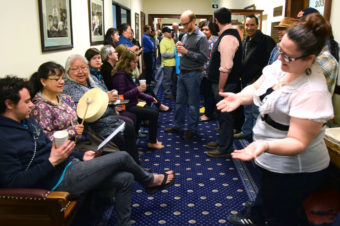
In the Senate gallery, an emotional Rep. Charisse Millett holds hands with Liz Medicine Crow while Senators debate the fate of the bill. The legislation, which passed moments later, makes 20 Alaska Native languages official state languages alongside English. (Photo by Skip Gray/Gavel Alaska)1. Alaska becomes the second state to officially recognize indigenous languages

Casey Kelly
April 21, 2014

Dedicated supporters for a bill recognizing Alaska’s indigenous languages staged an overnight sit-in at the Capitol on Easter Sunday. The Alaska Legislature passed it nearly unanimously and Gov. Sean Parnell signed it into law in October.

This is also the most read story in the history of KTOO’s website.


Did your favorite story make our lists? Let us know in the comments what you think the biggest story was of 2014.

Update: Mendenhall ice cave has partially collapsed

Update July 18, 2014 at 12:29 pm

The ice cave has partially collapsed near the entry. Laurie Craig of the Mendenhall Glacier Visitor Center said it happened sometime between late Thursday night and Friday morning.

Craig said in a printed statement that guiding company co-owner Becky Janes of Above and Beyond Alaska notified the Forest Service at noon Friday of the collapsed entrance. Above and Beyond Alaska is one of two commercial guiding companies holding permits to escort visitors along the west side of Mendenhall Glacier.

“The ice cave remains unstable and unsafe,” said Mendenhall Glacier Visitor Center Director John Neary. He said the collapse is a sign of structural weakness in the ice that may extend beyond the freshly broken ice.


Original story July 18, 2014 at 6:54 am

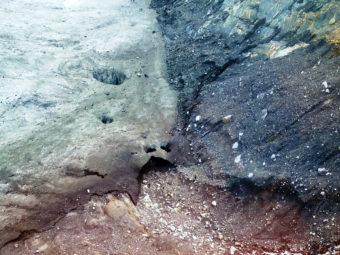
The much-visited ice cave at the western terminus of the Mendenhall Glacier is showing signs of imminent collapse. A flight over the cave this week showed thinning ice around the entrance of the cave and new holes in the ice surface.

Mendenhall Glacier Visitor Center Director John Neary flew over the cave on the way to check up on Suicide Basin. Neary says the cave seems “particularly ready to collapse,” in a press release sent out last night.

Commercial tour operators Above and Beyond Alaska suspended visits to the cave earlier this month after determining it was no longer safe to enter, according to the release.

Forest Service officials are asking that people stay away from the cave.


Neary provided more details about potential collapse on KTOO’s Morning Edition program on Friday. He warns that visitors inside the cave or on top of it could be seriously injured or even killed from falling ice and rock.

“When I was flying in the chopper,” said Neary, “I could see at least ten people climbing around on top of the ice not far from those holes. And, that’s just crazy.”

Alaska museums awarded grants for exhibits, training

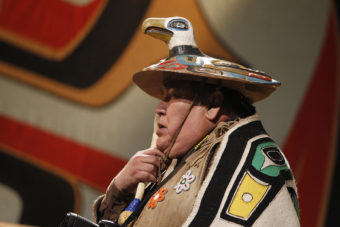
Shangukeidí (Thunderbird) Clan Leader David Katzeek wearing a clan hat at Celebration 2010. (Photo by Brian Wallace/Courtesy of Sealaska Heritage Institute)

Three Alaska groups have received more than $142,000 from the Institute of Museum and Library Services. The money will go toward a Tlingit clan hat exhibit in Juneau, the Whale House exhibit in Haines and a training workshop for small museums.
The grant supports Native American and Native Hawaiian museum projects.

Sealaska Heritage Institute President Rosita Worl says their grant will go toward the costs of an exhibit on the history and significance of Tlingit clan hats.

“A clan hat is not just something you put on for protection from the weather or something like that. In Tlingit culture, clan hats have very significant and complex meanings. And so that is our goal is to teach the public about the meaning and place of clan hats in our culture.”

The $49,000 grant will be used to design the exhibit.

Jan Yaeger is the museum curator for the Seldovia Heritage Institute. She says that finding instructional materials for museum workers is almost impossible.

“You know I always hear that everything in the world is on YouTube. But from my experience this is something that’s not on YouTube, in terms of how to actually create exhibits and mounts and so on. There’s very little information out there, freely available.”

Yaeger says as far as museums go, Seldovia’s is probably one of the smallest and like most small museums in Alaska, it’s hard to get training. The institute is using its $38,000 grant to develop a training workshop.

“Rather than take the expense to send one person outside, we could spend the same amount of money, put on our own workshop and educate staff from multiple museums. So we’re going to hire a consultant who has a great deal of experience and put together a workshop and invite up to 10 staff from a variety of Alaska museums to take part in that workshop and that way we’d be able to spread some of the knowledge and the skills.”

A third grant of nearly $48,000 was awarded to the Chilkat Indian Village in Haines for the installation of the Whale House exhibit and instruction from the Alaska State Museum in best practices for curating exhibits.

Lani Hotch is the executive director of the Jilkaat Kwaan Cultural Heritage Center and the project manager for the construction of the exhibit.

“We’ve even harvested trees from our land to create that exhibit. It’s going to really reflect who we are in this community, who we are as a people, our cultural traditions and the land we all stem from.”

Alaska State Museum employees also will teach staff at the heritage center to develop best practices for conservation, exhibit design and curation.

Flood warning cancelled, water continues to drop

The water levels continue to drop after setting a record height of 11.8 feet in Mendenhall Lake.

Bob Tschantz with the National Weather Service office in Juneau says that the flood warning was cancelled last night at midnight.

The high waters are a result of a glacial outburst, called a jökulhlaup, on Wednesday night.

“Waters are still running high–what we call bank full–but are not technically at flood level anymore,” Tschantz said.

The last measurement in Mendenhall Lake recorded levels at 8.25 feet and 10.5 feet in Mendenhall River.

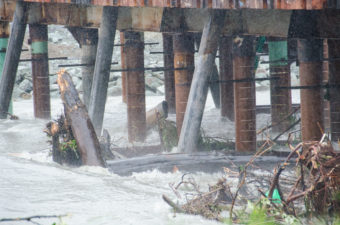
Reports of damage are still coming in. Tschantz says construction workers at Brotherhood Bridge yesterday had to use the crane to remove trees that were caught up in the bridge pilings.

CBJ officials do not yet have a count of how many homes were flooded.

We’ll continue to update this story as more information comes in. If your home was damaged or you have photos of the flooding you want to share, email heather@ktoo.org.

Fish dump found near trailhead, valley homes

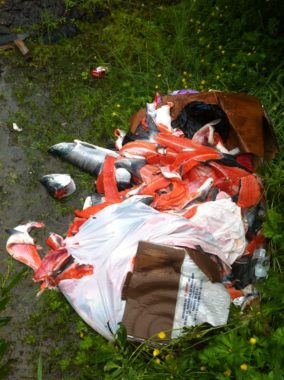
Alaska Department of Fish and Game biologists tracking bears near Mendenhall Glacier this morning came across a fish dump at the end of Valley Boulevard.
Two piles of cut up fish remains were found near the the popular Under Thunder trail.

“It’s a safety concern because it’s a bear attractant,” says biologist Stephanie Sell. “It’s in an area we know we have lots of bears because it’s butted up against Thunder Mountain.”

Discarding fish waste on public or private property is against state law.

Sell asks that people properly dispose of fish carcasses and says if you see someone dumping fish in town, you should call Fish and Game, Juneau Police or Alaska Wildlife Troopers.

“We just want to make sure that people don’t get hurt and at the same time we don’t want bears to get killed because of people’s irresponsible behavior.”

The best method of disposal is to clean fish at the docks and dump waste there. If you’re fishing in rivers, tossing small pieces in fast moving water keeps waste from building up on banks. If you have to bring the fish home, freeze the remains and put it out with the garbage in the morning.

Slideshow: The flying umiak

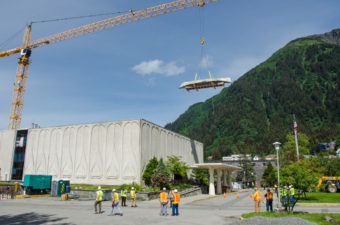
Earlier today, dozens of construction workers, museum employees and spectators gathered around the Alaska State Museum to watch crews carefully remove the 8-foot-wide, 45-foot-long walrus skin umiak from the old building.

The boat was originally constructed inside the building, making its removal a tricky affair. Situated on a protective wooden platform, the boat was removed through the front door before being hoisted up and over the building.

The new Alaska State Library, Archives and Museum will house the umiak along with the rest of the artifacts from the Alaska State Museum. The new facility is slated to be completed in 2016.

Site notifications
Update notification options
Subscribe to notifications