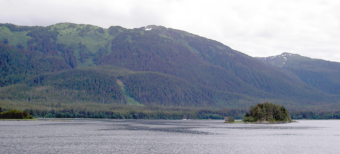
Funter Bay on the Mansfield Peninsula of Admiralty Island on Aug. 2, 2011. (Creative Commons photo by Stepheng3)
Update: The bill passed 31-8 and is headed to the Senate.
The Alaska House of Representatives is expected to vote today on a bill to protect the Unangax̂ cemetery at Funter Bay. The bill would add about 251 acres of state land, including the cemetery, to Funter Bay State Marine Park.
The cemetery holds more than 30 graves of people from St. Paul and St. George who died at Funter Bay during World War II after the U.S. military forced them from their homes and held them for much of the war at the remote spot on Admiralty Island.
Last year, the bill looked to be on its way to passing when the COVID-19 pandemic cut the session short. This year, a group of Republican representatives complained during floor debate that the bill transfers too much land to the park.
Republican Rep. Kevin McCabe, Big Lake, said he supports the intent of the bill, but he proposed an amendment that would transfer 90 acres to the park instead of 251.
Without the amendment, McCabe said, the state would be transferring additional acres, “including an island that’s offshore and not even part of this cemetery — that is unneeded transfer of Alaska’s wealth into a state park.”
Republican Rep. Dave Eastman (Wasilla) said the bill could stand in the way of future resource extraction.
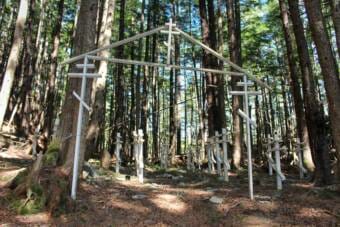
A recent photo of the Unangax̂ cemetery at Funter Bay. (Courtesy of the Juneau-Douglas City Museum)
“We are going in the wrong direction for a mere 30 interned individuals in the cemetery,” Eastman said. “We don’t know what technologies and future mineral discoveries might happen involving this area.”
Most of the people who died at Funter Bay were elders or very young children who were left to survive without clean water or basic medical care in the remains of an old cannery, more than a thousand miles from their homes.
The movement to protect the cemetery was motivated in part by what happened at another internment site, on Killisnoo Island, near Angoon. It’s on private land, and the owner has blocked access. The Funter Bay families want to make sure they can care for the graves — and that the site will serve as a memorial of the Internment.
Democratic Rep. Jonathan Kreiss-Tomkins, Sitka, is one of the bill’s sponsors. He said he had not heard any opposition to the bill from local residents or mining interests.
“I understand the concerns being highlighted by previous members,” he said. “But I think it may be more ideological and is not corroborated by any on the ground or local concern or hesitation about this proposal.”
Juneau Democratic Rep. Sarah Hannan, who is also sponsoring the bill, said the Department of Natural Resources had found the land has no commercial value. DNR recommended transferring the entire 251-acre tract because it would streamline management. Instead of two state divisions having separate management responsibilities in Funter Bay, the parks division could manage it alone.
McCabe’s amendment failed, 21-19, and the bill advanced without objection. If it passes the House, it goes next to the Senate.
A recent photo of the Unangax̂ cemetery at Funter Bay. (Courtesy of the Juneau-Douglas City Museum)
The first time Martin Stepetin went to the Unangax̂ cemetery at Funter Bay, he didn’t know how to find it.
“We looked all over inside of Funter Bay,” Stepetin said. “We went up to people’s cabins. And we’re asking folks, ‘Hey, do you know where this is — where the Aleuts were kept?’ And many people didn’t even know. And they lived there.”
The cemetery holds the graves of 30 to 40 Unangax̂ people who died at Funter Bay during World War II. In 1942, the U.S. government forcibly removed them from the treeless Pribilof Islands in the Bering Sea and took them to the Southeast rainforest about 1,300 miles away — with only one bag apiece and no hunting or fishing gear.
At Funter Bay they were left to fend for themselves, living in tents and the remains of an old mine and cannery, without clean water or medicine. About 10% of them died — mostly young children and the elderly — before they were allowed to return home in 1944.
Stepetin’s grandparents were held there. When he found the cemetery, he realized that anyone who stumbled on it would have no idea what they were seeing.
“Why is there a cemetery in the middle of the forest out in Funter Bay?” Stepetin imagined them asking. “Who are these people? What happened, and why are they here?”
Preserving that history is part of the impetus behind a bill that would add about 250 acres of state land, including the cemetery, to Funter Bay State Marine Park. That would mean the land couldn’t be sold or developed, and people would always be able to care for the cemetery so it wouldn’t gradually vanish in the forest.
But the bill serves a more immediate need.
Serafima Edelen is from St. Paul. She’s acted as a liaison between Pribilof elders and people in Southeast Alaska working to preserve the history of the internment. Edelen said the bill would also give people in the Pribilofs peace of mind that their loved ones won’t be disturbed.
“Our traditions — once somebody is laid to rest, they’re laid to rest,” Edelen said. “What we wanted was to know that they were going to be protected, they’re going to be safe. This land will be protected, and we don’t have to worry about them.”
‘We didn’t have a lot of persuading to do’
The bill to add the Funter Bay cemetery to the marine park almost became a law last year.
“We met with a lot of representatives and legislators and went down to try to help promote the bill and make sure it was going to get passed and make sure we had the support we needed,” she said. “And almost everyone that we met with — we didn’t have a lot of persuading to do.”
From left to right: Martin Stepetin Sr., Serafima Edelen, Mary Louise Lekanof, and Zinaida Melovidov on Juneau Afternoon, Feb. 10, 2020. (Photo by Rashah McChesney/KTOO)
Juneau Rep. Sara Hannan, the bill’s sponsor, said the elders’ work had an impact on lawmakers
“They came to understand the historical significance and importance of honoring those who were forcibly taken from their homes and died in custody of the U.S. government through neglect,” Hannan said.
She said the bill was well on its way to passing, with solid support from Senate leadership and committee chairs when the pandemic cut the session short.
For Hannan, who taught social studies and Alaska history before entering politics, passing the bill this year is a priority.
“I think it’s really important that we honor those families and protect their dead and that site,” she said. “And it allows us to point to educating Americans who don’t understand when we say ‘a relocation camp.’”
‘People do not know that this happened’
For the people working to get the Funter Bay bill passed, it’s only a starting point.
Niko Sanguinetti of the Juneau-Douglas City Museum describes the bill as part of a larger Funter Bay project that also includes a museum exhibit and a set of interpretive panels to be placed at the cemetery.
She helps coordinate among the groups involved in the Funter Bay project. They include the museum, Friends of Admiralty Island, private citizens, several Native governments and associations, and state and federal agencies. Together, they’re trying to preserve the history of the internment and the places where it happened.
“What we keep hearing from people here in Juneau, and really throughout the country, and throughout the world is that people do not know that this happened,” Sanguinetti.
A healing cross was constructed by individuals incarcerated at Lemon Creek Correctional Center and placed at the Funter Bay cemetery in 2017. (Photo by Scott Burton/KTOO)
Sanguinetti said the interpretive panels, which should go up in Funter Bay later this year, are “meant to follow the journey of the people” — from the forced removal, to captivity in Funter Bay, to rebuilding their wrecked houses when they returned home.
She said bringing the narrative through to the present was important to the elders who worked on the panels.
“Even though this is a terrible event, it didn’t destroy them,” Sanguinetti said, “And it doesn’t completely define them. So we wanted to make sure that we ended with the idea of hope.”
One of Serafima Edelen’s roles was working with Pribilof elders to make sure the panels and museum exhibit would get the story right — and tell it in the right way.
Edelen said in the past, many of the elders who went through the internment had been reluctant to talk about it. And they didn’t always agree on how much of the truth — which Edelen describes as “pretty dark” — they wanted shared.
For a long time, many of the people who were interned did not share their memories with their children and grandchildren at all.
“I hear a lot of stories of, you know, trying to listen through the vents when their parents or their older siblings would talk about being interned and the evacuations,” Edelen said. “And if they got caught, they were in trouble.”
She thinks part of the reticence was to protect younger generations from the trauma:
“I went through it and I’m just going to deal with it. You don’t need to know about this, you don’t need the hurt, I can handle it,” Edelen said.
There are important parts of the story that few outsiders understand: that the Unangax̂ were taken from a treeless island with endless views and dropped in an entirely alien, closed-in, forested landscape; that the men were forced to return to the Pribilofs in summer to hunt seals, leaving the women and children alone in Funter Bay; and that when it was over, they came home to find their houses ransacked and shot up by bored soldiers — and many of their religious icons gone.
Working with the elders ensured that those parts of the story would be told. But Edelen said everyone agreed it was important to tell the story in a way that would show the strength of the Unangax̂.
“We’re not trying to say ‘Woe is me,’” she said. “We wanted to portray that what we went through was uncalled for. There was a lot of mistreatment, a lot of trauma that happened, but the biggest thing we want to portray here is how resilient we are. We got through this. And we got through it together.”
‘It’s everybody’s history, not just ours’
Sanguinetti describes the Funter Bay project as a model that, if it succeeds, can be carried over to the other internment camps in Southeast Alaska. Funter Bay was a natural starting point because the cemetery is on state land, which means the site can be protected without asking anyone to give anything up. And Hannan said the bill, if passed, will not cost the state anything.
Some of the other sites could be more challenging.
Hannan said families have lost access to the cemetery at Killisnoo, near Angoon. The land changed hands a few years ago, and the new landowner has barred families from visiting the gravesites, citing liability concerns.
Martin Stepetin and wife Ann embrace at the Killisnoo cemetery in 2014. (Photo by Lisa Phu/KTOO)
Stepetin hopes the group will tackle that one next.
“We want to get the Killisnoo cemetery back into a respectful order,” he said. “And bring that site out of private hands, hopefully, or at least gain reasonable public access to that cemetery.”
He said bringing the Funter Bay model to all of Southeast is a huge undertaking, but he sees the work as necessary.
“This history is just not Aleut history,” he said. “It’s Alaskan history. It’s American history. You know, it’s everybody’s history, not just ours. This could happen to anybody.”
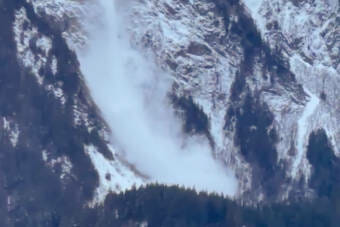
An avalanche from Mt. Juneau on Jan. 4. Juneau’s avalanche danger is considerable, and conditions are forecast to get worse. (video screenshot courtesy of Jess Parks)
Scott Cichoracki works for the Coast Guard search and rescue command center. He was on his way into Juneau’s Federal Building when he heard something that stopped him in his tracks.
“It kind of sounded like a plow truck when they’re scraping the road,” he said. “That’s what I thought it was. And I turned around to look, and I saw it up on the mountain and thought, ‘Oh my God, it’s an avalanche.’”
Cichoracki said he forgot to press record on his phone. But a video posted on social media by Jess Parks captured the Mt. Juneau avalanche from Douglas Island. In the video, it looks like the avalanche might have come down to the Flume Trail.
Juneau emergency programs manager Tom Mattice said it was a wind slab avalanche from Chop Gully that produced a large powder cloud but not a lot of debris. He said events like these are common, and they seldom reach the Flume Trail.
Alaska Electric Light and Power spokesperson Debbie Driscoll says that’s probably true for this slide, but no one has been able to walk the trail to check because of the avalanche danger.
In the urban avalanche advisory for Tuesday, Mattice wrote that recent storms have brought cycles of snow, rain and freezing mist, leading to a snowpack that was “definitely developing more questionable weak layers.” Add to that warming temperatures and wind-loaded slopes, and Mattice says there’s “lots to consider in the mountains at this time.”
The current avalanche danger is “considerable” — which is level three out of a scale that goes up to five.
“It wouldn’t take much to turn danger to HIGH today,” Mattice wrote. “If we see more warming than expected, more precipitation, or wind, any one of these could be enough to start to trigger more widespread natural avalanche events.”
Cichoracki says he’s glad Monday morning’s avalanche turned out to be harmless — because it was fun to watch.
“It was pretty cool to see,” he said. “Just nature being awesome.”
Today marks six months since Gov. Mike Dunleavy announced Alaska’s first known case of COVID-19, an international traveler to Anchorage. At a press conference, Chief Medical Officer Dr. Anne Zink said the man was an “isolated case.” Dunleavy urged Alaskans not to panic.
“What we’re basically doing is expanding spring break,” he said on March 15.
Sky Womack, of Juneau Urgent & Family Care, administers a drive-up test for coronavirus on Thursday, March 19, 2020 in Juneau, Alaska. (Photo courtesy Alicia McGuire)
For many, this past half-year has seemed far, far longer. The measures we’ve taken to stop the virus have left people stuck at home working remotely, caring for children or — for far too many — with no job left to go to.
There have been 6,113 resident cases in Alaska, and 43 Alaskans have lost their lives. Alaska has seen outbreaks in fish plants, homeless shelters and the Anchorage Pioneer Home. In Juneau, 17% of businesses say they’re in danger of closing.
The virus has yet to take off in Alaska like it has in the Lower 48, but Alaskans continue to live with the restrictions on daily living that keep it that way — and with the anxiety of not knowing what course the pandemic will take or how long it will last.
Six months in, we thought now was a good time to pause and take stock of where we are — and to look back on how we got here.
On March 13, Canada had closed its ports to large cruise ships until July 1. U.S. maritime laws prohibit international cruise ships from carrying U.S. citizens between American ports like Seattle and Skagway. With Canadian ports closed, most cruise ships could not come to Alaska.
Two weeks later, the Port of Seattle delayed its cruise season “until the resolution of the public health emergency.” A No Sail order from the CDC followed, and the major cruise lines all announced there would be no sailings in 2020.
This meant at least 90% of Southeast’s anticipated visitors would not be coming, and neither would the $800 million or so that cruise passengers were expected to spend in Alaska this year.
The Wilderness Adventurer, a small cruise ship operated by Seattle-based UnCruise. (Courtesy Uncruise)
An economic report published by Southeast Conference in June said that 17% of Juneau businesses said they were at risk of closing over the next 12 months — and that number was 23% across Southeast.
The towns that rely most on the cruise industry — like Haines and Skagway — were hit hardest.
Even the one glimmer of hope faded fast. On August 1, a small ship operated by Uncruise left Juneau with a wilderness itinerary and plenty of COVID-19 precautions in place. It was supposed to be a model for how cruise ships could still operate during the pandemic.
Bringing up fisheries workers without bringing up COVID
COVID-19 did not stop the fishing season.
Fishing communities worried about bringing in thousands of workers from out of state, but strict quarantine procedures and closed campuses appeared to keep COVID-19 from spreading from facilities to surrounding communities — at least in places where fishing operations could be self-contained.
The American Triumph — a 285-foot factory trawler, with an onboard processing plant — sits in the Port of Dutch Harbor on Friday. More than two-thirds of its tested positive for COVID-19. (Photo by Hope McKenney/KUCB)
Other places, where local residents worked alongside seasonal workers from out-of-state, saw some of the state’s largest outbreaks. At Copper River Seafoods in Anchorage, most of the plant workers tested positive — and health officials said the outbreak was likely adding to community transmission. At the Alaska Glacier Seafoods plant in Juneau, more than 60 employees tested positive.
While the industry’s precautions were largely successful in not driving outbreaks in Alaska, the salmon season itself was a failure. Prices were low, and there just weren’t enough fish.
No childcare, and no in-person school
On April 9, Gov. Dunleavy announced that schools would stay closed through the end of the school year. In May, the education commissioner presented a framework to guide their plans for the 2020 – 2021 school year.
This gave districts a few months to plan for fall. But without knowing how much the virus would spread over the summer, districts had to plan for contingencies ranging from in-person school to remote learning to some hybrid of the two.
And all of this came with questions about whether students would show up for online learning — and if all students would have the resources they needed to participate.
Siblings Timothy Ackerman, left, and James Ackerman, ages 5 and 4, follow classes at home via distance learning in the spring of 2020. (Photo by Sue Ackerman)
In late July, Juneau still planned to start school with a mix of remote and in-person learning. The district changed course on August 4, when Superintendent Bridget Weiss announced school would start with distance learning only. The earliest that large numbers of students could be back in school currently stands at October 16.
Add to that uncertainty about budgets. With fewer students enrolled — and more enrolled students choosing homeschool options that are compensated by the state at lower rates — school districts are expecting to see their budgets cut. Anchorage could lose millions.
Meanwhile, Juneau was still searching for solutions to its child care crisis. A fact-finding group had studied the problem and recommended that the borough dedicate staff to craft a solution.
This left parents largely on their own. As public officials cast about for solutions, parents are turning to social media to form child care pods with other families.
Where are we now?
All of this just scratches the surface. The last six months have seen a patchwork of mask orders, ever-changing travel restrictions and a struggle to find help for residents and businesses in crisis.
And that’s come with deep divisions about how to balance safety and controlling spread with keeping businesses open and leading more normal lives. Some even dispute the most basic, known facts about the virus.
A cot inside of the Rainforest Recovery Center on Monday, April 7, 2020 in Juneau, Alaska. City officials converted the drug and alcohol rehabilitation center into an emergency spillover shelter for COVID-19 patients at Bartlett Regional Hospital. The shelter is designed to house patients who don’t need critical medical care. (Photo by Rashah McChesney/KTOO)
Alaska – and Southeast – began the fight against COVID-19 by pulling up the drawbridge. Alaska’s isolation and its travel policies have controlled spread better in than most other states, but six months in, it’s clear that COVID-19 has swum the moat.
We’re running farmorestoriesnow from around the state about cases tied to community spread, not travel. The task for officials and residents alike is finding the right balance between living our lives and protecting everyone’s lives — for who knows how long.
Starting Sept. 12th, Juneau ordered bars closed for two weeks. That’s after employees of more than one bar caught COVID-19 at a social gathering.
KTOO’s Pablo Arauz Peña and Jennifer Pemberton contributed to this story.
Close
Update notification options
Subscribe to notifications
Subscribe
Get notifications about news related to the topics you care about. You can unsubscribe anytime.