KUAC - Fairbanks

KUAC is our partner station in Fairbanks. KTOO collaborates with partners across the state to cover important news and to share stories with our audiences.
Lightning sparks wildfires across Interior Alaska

A map generated by AirNow.gov shows recent wildfires around the state and the smoke that they generate. (From Airnow.gov)

Wildfire activity ramped over the weekend due to hot, dry conditions and numerous lightning strikes, including over 6,500 Sunday.

“Sunday is definitely our largest amount of lightning for one day this season,” said Sam Harrel, a spokesman for the Alaska Division of Forestry.

Harrel said even prior to Sunday’s lighting, earlier strikes resulted in numerous starts.

“Forty new fires, Friday, Saturday and Sunday,” he said.

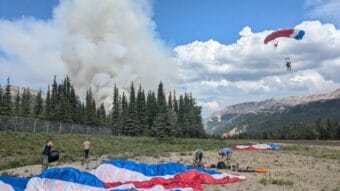
Smoke billows up from the 39,700-acre McDonald Fire, burning on military-training land about 30 miles southeast of Fairbanks. (From Alaska Wildland Fire Information)

The new fires were spread across a wide area of the state, from Southwest to the Kenai, Mat-Su and Interior. Among new fires responded to was a 1-acre blaze near the Willow Airport that was hit Sunday night with water and retardant.

“Retardant tanker and air attack responded from Fairbanks, and the tanker was able to make multiple drops with one load of retardant to encircle the fire with retardant, and that allows ground forces to get into place and start to encircle the fire’s edge,” Harrel said.

More forecast hot weather and lightning combined with increasingly dry duff layers has elevated wildfire potential. Harrel said additional firefighters are due from the Lower 48 starting Monday.

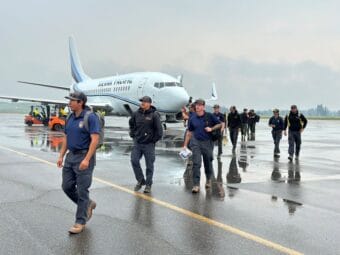
“There are three hotshot crews on that flight. On Wednesday, we are expecting another jet load with three hotshot crews on it,” Harrel said.

More firefighting aircraft are also coming from outside, according to Alaska Fire Service information officer Joan Kluwe.

“Water scooping planes and air tankers. There’s also a variety of helicopters,” Kluwe said.

Kluwe said the fire service was working seven fires as of Sunday night, including the McDonald Fire south of Fairbanks where efforts continue to protect cabins on the blaze’s south side.

“They did burnout operations on the west side of those cabins, and then they are also working on creating a contingency line on the east side,” she said.

Meanwhile, Kluwe said a new lightning-caused fire north of the McDonald Fire is also burning on military training grounds. She says the Clear Fire is in an area where there’s unexploded ordnance, which is restricting firefighters to point protection for threatened military assets.

There are over 100 active wildfires burning in the state.

Demolition of Fort Greely’s old nuclear plant to begin this year

Many of the nuclear-power components of the old SM-1A are encased in concrete in the building that still stands at Fort Greely. (U.S. Army photo)

The Army Corps of Engineers has decided to begin demolition of Fort Greely’s long-mothballed nuclear power plant this summer, a year earlier than planned. That means trucks will begin hauling construction debris off-site this fall.

The SM-1A nuclear power plant was taken off-line back in 1972, and the most radioactive reactor components were removed. More than 50 years later, the building that housed the reactor is scheduled for demolition.

On Tuesday, the head of a Corps of Engineers team in charge of the dismantling and decommissioning project gave a tour of the old power plant for a group of state and federal elected officials’ staff.

Program Manager Brenda Barber provided a project update, including Corps of Engineers decision to delay enclosing the building in a big tent to facilitate year-round work.

“We’ve had some challenges with respect to getting that up and running,” she told staff from U.S. Sen. Lisa Murkowski’s office and from state Rep. Ashley Carrick and state Sen. Robert Myers. Rep. Mike Cronk also participated in the tour.

Barber said the original plan was to erect a large weatherproof enclosure on top of shipping containers, but that raised concerns about potential earthquake, snow and wind damage, “and whether or not that weather enclosure would stay stable on top of those conexes during some of the severe weather that occurs here.”

That led the Corps’ team to reconsider how to cover the plant with the enclosure, and the vapor containment or VC structure that towers over facility.

“That means we have to eliminate some of the height concerns, particularly with the vapor containment structure,” she said, “so that the tent can completely encompass the site, the way we intended it to do.”

Barber says the Corps’ team now proposes to partially dismantle the VC structure and remove an old quonset hut next to the plant this summer and set up the enclosure over the site next year. Demolition work would then continue through the winter. Barber says the “re-sequencing” of the work includes moving up asbestos removal to this year.

“So this means that the community on base will see some demolition activity that we originally hadn’t planned to do this year,” she said in an interview after the tour.

The work requires the Corps to monitor the demolition waste for asbestos and low-level radiation sooner than initially planned.

“That will include all of our environmental monitoring and all of our radiological monitoring on very early, in August,” she said.

The materials being removed and taken off-site are classified as low-level radioactive waste. But initially, some of the waste will be inert, she added.

“All the debris that’ll be leaving now will be just metal from the demolition, some wood debris – basically construction debris.”

Barber says the Corps needs approval from the Army Reactor Office before work under the new schedule can begin. If they get the go-ahead, demolition will start this summer with trucks hauling away debris starting in the fall.

“So it’ll be a truck carrying what we call an intermodal container,” she said. “It’s very similar in size and look to a SeaLand container that you’d typically see on a barge.”

An average of two trucks per week will transport containers to Fairbanks, where they’ll be transferred to Alaska Railroad cars for delivery to Anchorage or Whittier. From there, they’ll be barged to Seattle, then railroaded to a hazardous waste facility in Texas.

Barber says the re-sequencing of work should enable the Corps to complete the dismantling and decommissioning of the power plant by the end of 2029, the previously set goal.

She says the agency will hold public meetings on the new schedule in July or August to let the public know about the new plan for dismantling the old SM-1A.

Eielson looking into cause of F-16’s in-flight emergency

A May 28 problem with an F-16 Fighting Falcon like this alerted the pilot of the jet fighter from Eielson Air Force Base’s 18th Fighter Interceptor Squadron to declare in in-flight emergency and return to base. (Eielson Air Force Base)

Eielson Air Force Base investigators are looking into the cause of an in-flight emergency that required an F-16 fighter pilot to jettison the plane’s fuel tanks shortly after taking off from the base last month. Meanwhile Eielson officials also are also preparing to remove contaminated soil from the off-base area where the tanks hit the ground.

Soon after the F-16 returned to base on May 28, Eielson officials began what’s likely to be a six-month process of determining what caused the pilot to declare an in-flight emergency. And to ensure the problem doesn’t happen again.

“The main point of conducting a safety investigation is to prevent future mishaps,” says Master Sgt. Daniel Douglas, the 354th Fighter Wing’s Flight Safety noncommissioned officer.

Douglas said in an interview last week that he can’t comment on the ongoing investigation into the mishap. But he says it’s an exhaustive process that includes interviewing those involved, examining the aircraft and double-checking initial findings with a second set of experts.

“Safety investigations are very thorough,” he said. “We don’t want to overlook anything and so we give every piece of information, every point of evidence its due diligence.”

An Eielson news release says the F-16 pilot declared an in-flight emergency just after takeoff and then jettisoned the plane’s two fuel tanks, before returning to base. Douglas says that’s done to reduce the weight of the aircraft and reduce risk of fuel further endangering the pilot and emergency personnel on the ground. No injuries were reported. The fuel tanks hit the ground in an uninhabited area about a mile and a half west of the base and east of the Tanana River.

Jettisoned fuel tanks fell on Mental Health Trust Authority land

The site is on land administered by the Alaska Mental Health Trust Authority, says Lt. Col. Christopher Higgins, who commands Eielson’s 354th Civil Engineer Squadron.

“It is densely wooded,” he said, “and so, we’ve kind of cordoned-off that entire area.”

Eielson officials asked that the exact location remain confidential, to ensure the safety at the site. Higgins says the 1.5-square-mile area includes the spots where the tanks were found and surrounding land that also may have been contaminated by JP-8 jet fuel that leaked from the two ruptured 370-gallon tanks after impact.

“We want to ensure that we’ve captured all of that fuel,” he said, “so we’ve given ourselves a little bit of a buffer to make sure that there’s enough space there.”

The base’s civil engineers will work with a contractor to clear the site and excavate all the contaminated soil, he said. It’ll then be loaded onto trucks that’ll take it to a facility that treats contaminated materials. That’ll probably be the one in Moose Creek, but that’s still not yet decided.

Higgins says the cleanup will comply with all state and federal regulations, which also mandate long-term monitoring of the site.

“I would expect that we will be required to continue to do follow-on testing for multiple years,” he said.

Eielson spokesperson Capt. Faith Hirschmann says base officials take their responsibility to protect the environment seriously.

“We’re really just committed to keeping our airmen and the community and everybody safe, while we do our mission and our training,” she said.

Douglas, the Flight Safety NCO, says it’ll probably take about six months to complete the investigation and issue a final report.

Fort Wainwright opens the Army’s biggest child care center

Fort Wainwright Child and Youth Services Coordinator Jessica Spittle explains the age-appropriate and child-safe design of one of the new CDC’s classrooms. (Tim Ellis/KUAC)

Fort Wainwright celebrated the opening of its new Child Development Center Tuesday with a ribbon-cutting ceremony. The $3.5 million facility is the Army’s newest and largest child-care center.

Active-duty military personnel and qualifying federal employees who work at Fort Wainwright now have access to a new spacious and colorful, on-post child-care option for infants through kindergarten-age kids.

“It’s a really great facility” says Post spokesperson Eve Baker. “And it’s the only facility of that type among the Army child development centers.”

Baker says the 42,930-square-foot child-care center is the Army’s largest. And it’s designed to be used for both child care and early childhood education. That’s why 22 of the rooms for kids are referred to as classrooms.

“The center will have room for 284 children, from infants through age 5 – for preschool children and kindergartners,” she said.

Baker says the Child Development Center, or CDC, will make child care available for kids whose parents have been waiting for a space to open up.

“It will clear the waiting list for the other two facilities that we have,” she said, “and there will still be plenty of room for additional children to come in.”

The brightly lit CDC’s classrooms are furnished with age-appropriate chairs and desks and fixtures to accommodate the different age groups. It also has all the necessary grown-up amenities for staff and parents, like administrative offices, break room and a laundry.

“As well as a nursing room for staff or for parents who may want to visit their infants during the day,” Baker added.

And there’s also a 3,000-square-foot multipurpose room.

“Small groups can come in and use it, they can do sports, they can run around,” she said, “It can be an evacuation space in the event of an emergency.”

And throughout the CDC, there’s beautiful artwork that celebrates Alaska history and culture.

“Our new facility is named the Denegee Child Development Center, and that is a Tanana word for moose,” she said. “We worked closely with our Alaska Native tribal partners to come up with an appropriate name for the center.”

Baker says kids will be surrounded by artwork, much of which was created by members of the local arts community.

She says child-care providers interested in working in the new CDC can contact Fort Wainwright’s Morale, Welfare and Recreation office.

Organization awards home in Fairbanks to combat-wounded Army veteran


Andy Armstrong prepares to get the keys to his news house from representatives of the organization and business that awarded the home to him. From left, Ken Eakes, Military Warriors Support Foundation executive director; Armstrong; Adam Little, regional Bank of America/Merrill Wealth Management marketing executive; Tyann Hollis, BofA/Merrill Wealth Management vice president. (Tim Ellis/KUAC)

An Army veteran has been given a home in Fairbanks, courtesy of a program that helps wounded combat vets rebuild their lives.

Memorial Day usually is a solemn occasion for Americans to remember and thank U.S. military personnel who lost their lives in combat.

But there was no sorrow during a ceremony held last week near Fairbanks to honor a veteran who survived a brush with death.

Spec. Andy Armstrong, a military police officer, deployed to Iraq in 2009-10 and Afghanistan in 2010-11. He and three fellow soldiers were seriously injured in August 2011 when the truck they were in detonated a roadside bomb. (Andy Armstrong)

And the only tears shed at Thursday’s gathering to honor Andy Armstrong’s service came from his wife, Elise, after one of the sponsors of the event gave her the keys to the cabin.

“So please join me and welcoming the Armstrong family to their new home!” said Adam Little, a regional Bank of America/Merrill Wealth Management marketing executive.

Elise also gushed when Little said his company and the Texas-based Military Warriors Support Foundation, which organized the event, also want to ensure the home is furnished.

“This is a gift card for you to choose your furnishings for this home,” he said. “We took care of all that for your home.”

“Thank you for doing this for all the veterans that are out there, and for their families,” she said, “because, like you said, there’s a lot of sacrifices that veterans go through and that much of the country doesn’t quite understand.”

Armstrong struggled to find the words to express his appreciation.

“I can’t thank you guys enough,” he said. “What you do is absolutely phenomenal.”

Armstrong and his wife, Elise, and infant daughter, Andi, talk with visitors about their new home just before organizers of Thursday’s event handed over the keys. (Tim Ellis/KUAC)

Armstrong was medically retired in 2012 after he and three other soldiers he was with sustained serious injuries when the truck he was driving hit an explosive device buried along a road in Afghanistan. He was awarded a Purple Heart, and after rehab returned home to upstate New York, where began working as logger.

Then late last year he got a job that brought him to Alaska, driving fuel trucks up the Dalton Highway from Fairbanks to Deadhorse.

“It’s challenging,” he said. “With truck driving, it’s very monotonous — in the Lower 48. Here, that road changes, by the hour. And it’s never the same. It keeps you kinda sorta on your toes.”

Armstrong says he and his wife have long dreamed of living in Alaska. And now that he’s got a job and a home in Fairbanks, Elise and their 1-and-a-half-year-old daughter, Andi, can both join him.

“When I was in the Army, me and my wife had actually wanted to get stationed up here,” he said. “And we tried and tried, because Alaska’s kind of always been our end goal. She had never been up here, I had never been up here. We just kind of knew that we wanted to come up here and see what it’s all about.”

Elise exclaims in appreciation about the toybox that Andi found as soon as the family walked into their new home. (Tim Ellis/KUAC)

Military Warriors Support Foundation Executive Director Ken Eakes says the organization is dedicated to helping veterans injured in combat to heal and achieve their dreams.

“We’ve awarded nearly a thousand houses that are mortgage-free to our combat wounded veterans and Gold Star families over all 50 states,” he said. The house given away Thursday is the third to be awarded in Alaska.

Eakes says Bank of America donates homes to his organization, often repairs and renovates them with locally hired workers, then awards them to deserving veterans. The program also teaches budgeting and other skills to help veterans build a new life in their new home and offers other services to help wounded vets recover.

Fairbanks neighborhood shaken by deadly cargo plane crash


A hillside riverbank about seven miles south of the Fairbanks International Airport smolders after a fuel plane crashed Tuesday, April 23, 2024. (Courtesy Mike Emers)


Tuesday’s crash of a large cargo plane in the Cripple Creek area southeast of Fairbanks shook the neighborhood with several explosions. Witnesses said their windows rattled and the ground trembled. For the family closest to the crash site, it was traumatizing.

A Federal Aviation Administration incident report for the crash posted Wednesday said both people on board the Douglas C-54, a version of the DC-4 airliner, were killed when it went down at about 10 a.m. Tuesday. The plane, with tail number N3054V, was listed as being operated by Alaska Air Fuel.

Tuesday was sunny and clear. Mike Emers was at his home office at Rosie Creek Farm when he heard the first boom.

“I was just getting some orders together. So, I sat here, and I heard an explosion, and I followed it across the sky. So, it went in that direction,” he said.

N3054V parked in Fairbanks in August, 2023. (File/KUAC)

Emers said he watched the plane pass through his window, then called first responders.

“Yeah, and then I, fumbling around trying to find my phone, called 911, and couldn’t get through. And I did get through to the trooper’s dispatch, but I couldn’t get through to 911. There’s no cell service here. But I’m on Wi-Fi calling. For some reason it wouldn’t call 911.”

His son ran down from the house and the two of them ran on their trail several hundred yards through the trees to the crash site above the river.

“We were running, yeah, and ran out to the river there to see, and then there was big black smoke and I, and I was really worried, so I’m going up there to see,” he said.

Emers said troopers and firefighters were there in about 15 minutes. The dirt road in the neighborhood became choked with a muster of vehicles from the Alaska State Troopers, Alaska Wildlife Troopers, University of Alaska Police, Fairbanks Airport Police and Fire, Fairbanks City Police Department, Ester Volunteer Fire Department, and Chena Goldstream Volunteer Fire Department.

They were able to get to the hillside on ATVs and got the fire under control, and it didn’t spread into the forest.

There was no one to rescue.

Mike Emers points to smoke starting to fill the screen on surveillance video of his farm, after a plane crashed there on Tuesday, April 23, 2024. (Robyne/KUAC)

When he returned to his farm, Emers checked his security video. He scrolled through, looking for the right timestamp. One camera that looks across the farm, caught the plane, flying toward the airport.

“It comes from here,” Emers said, pointing at a computer screen.

A moment later, the plane appears on the screen at 10 a.m.

“Oh, there it is. There it is. There, it burst into flames,” he said.

It was 10 seconds from the time of the explosion of one of the plane’s engines, to when it crashed, off the screen. In the video, a huge shadow blocked the sun shining on the greenhouses, as the smoke billowed up.

Emers choked up. He didn’t know who was on the plane, but everyone in Alaska knows someone who flies.

On the trail walking back to the crash site hours later, there was a faint smell of fuel. And farther down the slope, a heavy smell of smoke.

And then a tight acre, maybe acre and a half, of charred ground and spruce trunks on the steep hillside above the river. The hillside was scattered with debris and plane parts.

“It’s still burning a little bit here. There’s a hot spot here. It’s smoking,” he called to fire crews at the scene.

Emers is not on his own land. The plane crashed on uninhabited property owned by the Binkley family. But it’s all the same to him.

Fire hoses at the scene of a plane crash near Fairbanks on Tuesday, April 23, 2024. Authorities say a plane crashed and ignited a fire. (Robyne/KUAC)

Fire technicians Billy Morrow and Josh Chiles were among a crew from the state Division of Forestry & Fire Protection laying out long hoses on the charred ground Tuesday afternoon.

“There’s a lot of snow pack and everything behind it, but we’re gonna butt it up with some sprinkler kits connecting from that flank down on it, connecting to the river, all the way up here and then down to this side,” Chiles said.

They didn’t know how long the operation would take – the rest of the day, or overnight. They were placing the hoses around debris up and down the slope.

One of the plane’s engines was in the broken land-fast ice on the shore of the river. It was still on fire. Another big piece was out on the firmer river ice. A third big piece had already melted through and disappeared under the ice.

A drone flew along the river. Just off the burned zone, in the green trees, was the Emers’ family canoe.

“Well, we felt like this was our secret little place and now, you know…” Emers trailed off.

Site notifications
Update notification options
Subscribe to notifications